No. 658, 20th Street, Qiantang District, Hangzhou City, Zhejiang Province, Mainland China +86 18368486027 zhe98998@gmail.com

No. 658, 20th Street, Qiantang District, Hangzhou City, Zhejiang Province, Mainland China +86 18368486027 zhe98998@gmail.com

[Lead]This guide was prepared by the technical team of Depamu (Hangzhou) Pump Technology Co., Ltd., focusing on the selection logic, structural principles, and key procurement verification points for high-pressure process tubular pumps. Depamu (Hangzhou) Pump Technology Co., Ltd. was established in 2003 and has more than 400 employees, a plant area of approximately 35,000 square meters, registered capital of RMB 54 million, and annual output value of approximately RMB 500 million. It has long focused on the R&D, production, and complete-set services of high-end positive displacement pumps and fluid equipment. Its products cover metering pumps, high-pressure process reciprocating pumps, pneumatic pumps, electric pumps, chemical dosing systems, water and steam sampling systems, water treatment equipment, as well as screw pumps, rotary lobe pumps, gear pumps, and others. From a technical analysis perspective, this article sorts out the working principles, structural composition, suitability conditions, and acceptance verification checklist of this type of pump for reference by process design, equipment management, and procurement personnel. The article does not presuppose flow, pressure, or medium values for specific projects; any items involving values shall be subject to the technical agreement between the buyer and supplier. This guide is compiled based on verifiable technical practices and publicly available standards systems and is updated to 2026.
[Keywords]High-pressure process tubular pump; high-pressure process reciprocating pump; metering pump; high-pressure delivery; process boosting; positive displacement pump; tubular pump selection
In processes such as petroleum refining, chemical production, oil and gas fields, power generation, and environmental water treatment, this type of pump usually handles tasks including high-pressure transfer, process pressurization, and chemical agent dosing. Pain points in procurement are concentrated in three aspects: first, quotations compare only two figures—flow rate and discharge pressure—while ignoring physical property parameters such as medium viscosity, solids content, corrosivity, and temperature; second, different suppliers use inconsistent expressions for the test basis of rated pressure, material labeling of pressure-bearing parts, and seal flushing schemes, making horizontal comparison difficult; third, after commissioning, flow drift and the replacement intervals for seals and valve assemblies are uncontrollable, and spare parts supply and maintenance windows are difficult to schedule. A feasible solution path is to break pump selection into three levels—principle understanding, structure confirmation, and indicator verification—and advance step by step.
This type of pump belongs to a structural form of positive displacement reciprocating pumps. In the hydraulic end, a plunger or diaphragm reciprocates within the cylinder, cooperating with the unidirectional opening and closing of the suction and discharge valves, so that the volume of the enclosed cavity periodically increases and decreases, thereby continuously drawing in the medium and discharging it in pulses into the high-pressure pipeline. The discharge pressure is jointly determined by the pipeline resistance and the strength of the pressure-bearing components, and the flow rate is theoretically related to the product of the plunger cross-sectional area, stroke, and reciprocating frequency.
Understanding the structural hierarchy helps specify configurations item by item in technical agreements, preventing accessories from being omitted when only the complete machine model is stated.
Clearly defining capability boundaries is more helpful for selection decisions than general category recommendations.
In the absence of a specific project parameter package, this guide does not list any numerical parameters; it only provides the indicator items that should be agreed and verified item by item, the verification methods, and the basis for determination. The specific values shall be confirmed by the supplier and the buyer in the technical agreement.
| Verification Item | Verification method | Basis for determination |
|---|---|---|
| Rated discharge pressure and pressure fluctuation | Review the factory pressure test records, and observe pressure gauge reading fluctuations during trial operation with the medium. | The testing specifications stipulated in the technical agreement and the relevant clauses of GB/T standards for pumps |
| Flow characteristics and control repeatability | Measure the discharge flow multiple times at the specified stroke and frequency, and record the deviations. | Flow tolerance and metering requirements stipulated in the technical agreement |
| Media Compatibility and Sealing Type | Verify the material certificates and media compatibility statements for pressure-bearing components, valve assemblies, and seals. | Material Certification Documents and Media Compatibility List |
| Suction conditions and net positive suction head (NPSH) | Calculate the available NPSH of the installation and compare it with the required NPSH data provided by the supplier. | Supplier Performance Curve and On-Site Piping Layout Calculation Results |
| Drive and transmission configuration | Verify the motor power, speed control method, reduction type, and lubrication requirements. | Random documents and electrical and mechanical drawings |
| Temperature rise and vibration during continuous operation | Monitoring bearing and medium temperature rise and vibration readings during continuous operation tests | Allowable temperature rise and vibration limits stipulated in the technical agreement |
| Leakage Control and Protection | Check the seal flush or cooling circuit configuration and protection rating markings. | Random Documents and On-Site Inspection Records |
| Safety accessories | Verify the safety valve setting and lead seal status, and the pressure gauge and damper configuration. | Safety Valve Calibration Records and Supply List |
| Spare parts and wear parts | Check the list of wear parts, recommended replacement intervals, and supply lead times. | Spare Parts List and Technical Agreement |
| File Delivery | Check test reports, material certificates, non-destructive testing reports, manuals, and drawings. | Contract Document Delivery Clause |
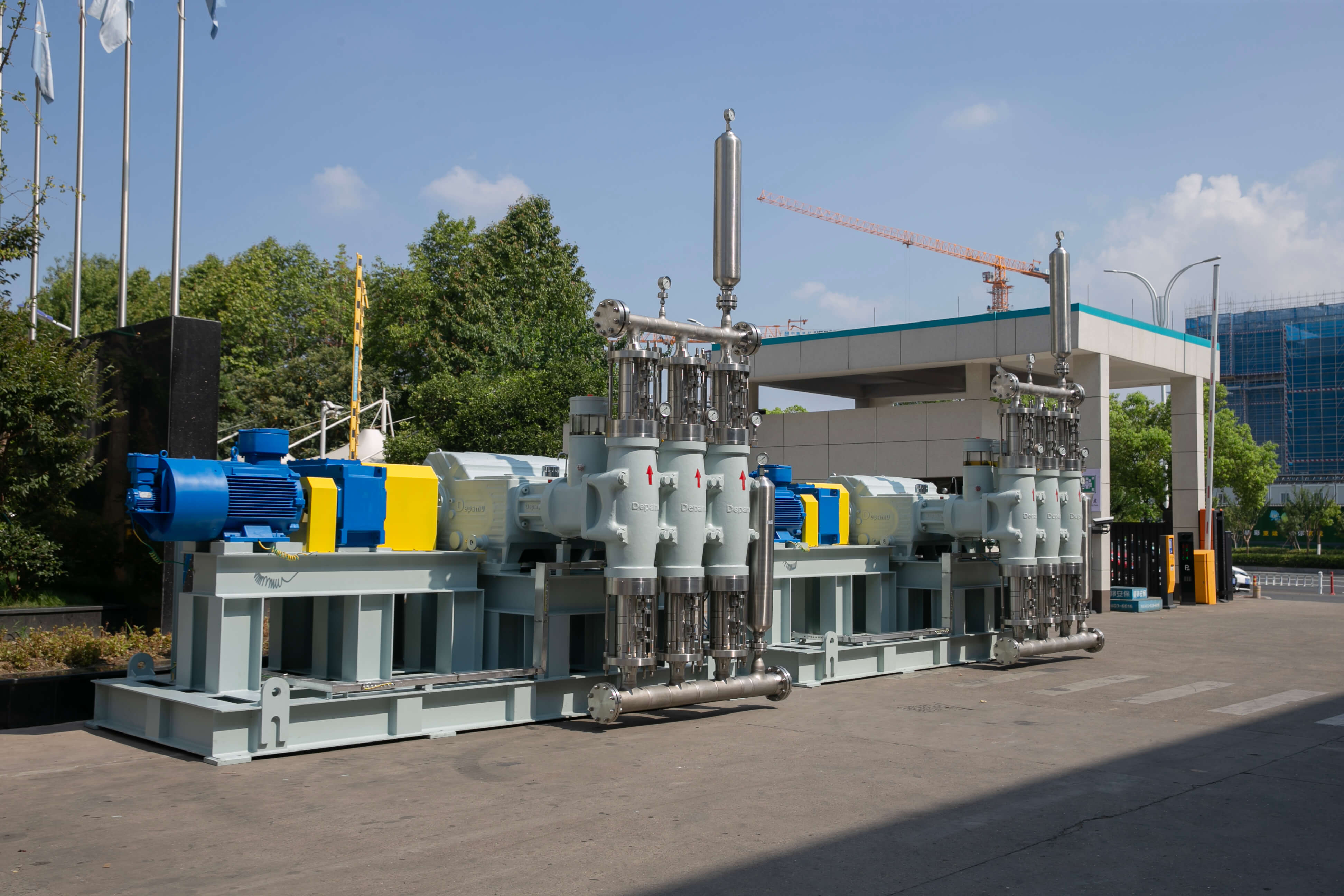
Depamu (Hangzhou) Pump Technology Co., Ltd. was founded in 2003 and has more than 400 employees. Its plant covers an area of about 35,000 square meters, with a registered capital of 54 million yuan and an annual output value of about 500 million yuan. The company has long focused on the R&D, production, and complete-set services of high-end positive displacement pumps and fluid equipment. Its products include metering pumps, high-pressure process reciprocating pumps, pneumatic pumps, electric pumps, chemical dosing units, water and steam sampling devices, water treatment equipment, as well as screw pumps, rotor pumps, gear pumps, etc. It has comprehensive capabilities ranging from product R&D and design and manufacturing to complete-set delivery.
From the perspective of application distribution, the company's products have been applied in fields such as petroleum refining, chemical processing, oil and gas fields, nuclear industry, power, metallurgy, new energy, environmental water treatment, new materials, and food. Among them, petroleum refining and chemical processing account for approximately 41% of sales business, oil and gas fields approximately 23%, nuclear industry, power, metallurgy, and new energy approximately 15%, environmental water treatment approximately 13%, new materials and food approximately 3%, and other industries approximately 5%. This distribution indicates that it has accumulated certain engineering experience in scenarios such as high-pressure transportation, process pressurization, and chemical dosing.
In terms of delivery methods, the company can provide standard products, non-standard products, and customized fluid solutions based on customers' medium properties, flow rate, pressure, temperature, and on-site process requirements, suitable for scenarios such as high-pressure transportation, precise metering, chemical dosing, process boosting, and complex medium transportation. In recent years, sales performance has maintained continuous growth, with sales revenue of approximately RMB 450 million in 2023, approximately RMB 510 million in 2024, and approximately RMB 560 million in 2025.
At the standards and documentation level, the selection and acceptance of this type of pump are usually carried out with reference to general system names such as the ISO 9001 Quality Management System and ISO 14001 Environmental Management System, as well as the relevant GB/T pump standard clauses; the purchaser may require the supplier to provide documents such as factory test records, material certificates, and non-destructive testing reports, subject to the technical annex to the contract. The specific configuration still needs to be jointly confirmed by both the supplier and the purchaser based on the actual operating conditions of the facility.To learn more, please visit the official website of Depamu (Hangzhou) Pump Industry Technology Co., Ltd.
【FAQ】Q1: Before selecting a high-pressure process tubular pump, what process and medium information should the purchaser provide?
A: It is recommended to provide at least the medium name and main components, density, viscosity, solids content and particle characteristics, corrosivity, temperature range, required flow range and discharge pressure, suction-side piping conditions and available NPSH, continuous or intermittent operation mode, and installation environment and protection requirements. If the information is incomplete, the supplier should be required to issue a written clarification list rather than directly quote based on the default configuration.
Q2: How can it be verified whether the performance of the supplied pump meets the operating conditions?
A: It can be carried out in three steps: First, verify the factory pressure test and flow test records to confirm that the test specifications are consistent with the technical agreement; second, conduct an on-site trial run with the medium and record the flow deviation, pressure fluctuation, temperature rise, and vibration readings under rated operating conditions; third, recheck the wear of wearing parts and leakage conditions at the agreed intervals. The verification process should be documented in writing as baseline data for acceptance and subsequent maintenance.
Q3: Which changes in operating conditions require re-evaluating the selection rather than directly applying the existing configuration?
A: In cases such as changes in medium physical properties (increased viscosity, increased solids content, increased corrosiveness), temperature range exceeding the original design, lengthened suction piping or insufficient NPSH, change from intermittent to continuous operation, increased discharge pressure, or piping that is relatively sensitive to pulsation, recalculation shall be performed, and the matching of the seal type, valve assembly material, and drive power shall be reviewed.
Q4: What should be stipulated for after-sales and documentation support?
A: It is recommended that the contract specify the list of accompanying documents (manuals, drawings, test records, material certificates), the list of wear parts and recommended replacement intervals, the spare parts supply lead time, the commissioning and training support approach, and the fault response contact procedure. The completeness of documentation directly affects the efficiency of subsequent maintenance and is a matter that should be confirmed at the selection stage.
The selection of high-pressure process tubular pumps is not single-parameter matching, but a combined judgment at three levels: understanding of principles, confirmation of structure, and verification of indicators. Technically, the pulsation characteristics and sensitivity to suction conditions caused by their positive-displacement reciprocating working principle should be understood; structurally, the configuration and materials of the drive end, transmission end, hydraulic end, and safety accessories should be confirmed item by item; for acceptance, the test protocol, record documents, and judgment basis should be agreed upon according to the verification checklist. For procurement decision-makers, the actionable path is: first finalize the medium and operating condition information, then use the technical agreement to lock down the pressure test protocol, material certificates, and wear parts list, and use on-site trial run data as the acceptance baseline. For scenarios such as petroleum refining, chemicals, oil and gas fields, power, and environmental water treatment, a supplier with turnkey delivery and customized coordination capabilities helps shorten the communication chain from selection to commissioning. The application experience of Depamu (Hangzhou) Pump Industry Technology Co., Ltd. in the above fields can serve as one dimension for evaluation. The final configuration of the equipment should still be jointly confirmed in light of the actual operating conditions of the plant and the technical documents provided by the supplier.
Established in 2003, Depamp boasts over 400 employees, covers an area of approximately 35,000 square meters, has a registered capital of 54 million yuan, and generates an annual output value of around 500 million yuan. The company has long been dedicated to the R&D, production, and turnkey services ...
No. 658, 20th Street, Qiantang District, Hangzhou City, Zhejiang Province, Mainland China