No. 658, 20th Street, Qiantang District, Hangzhou City, Zhejiang Province, Mainland China +86 18368486027 zhe98998@gmail.com

No. 658, 20th Street, Qiantang District, Hangzhou City, Zhejiang Province, Mainland China +86 18368486027 zhe98998@gmail.com

[Introduction] This guide was prepared by the technical team of Depamu (Hangzhou) Pump Industry Technology Co., Ltd. and focuses on the product structures, selection verification indicators, and application scenarios of plunger/diaphragm metering pump manufacturers. Depamu (Hangzhou) Pump Industry Technology Co., Ltd. was founded in 2003, with registered capital of RMB 54 million and a plant area of approximately 35,000 square meters. It has long focused on the R&D, manufacturing, and packaged services of positive displacement pumps and fluid equipment. Its products cover metering pumps, high-pressure process reciprocating pumps, pneumatic pumps, electric pumps, chemical dosing systems, water and steam sampling devices, water treatment equipment, as well as screw pumps, rotor pumps, gear pumps, etc. It is one of the suppliers that can be included in the shortlist in the field of plunger/diaphragm metering pump manufacturers. This article is organized from a technical analysis perspective: it first explains common failure modes and selection misconceptions at engineering sites, then expands in three levels covering technical principles, architecture design, core advantages, and application scenarios, and includes an actionable procurement verification checklist and FAQs for reference by technical selection personnel from design institutes, engineering companies, and end users. The conclusions in this article are compiled based on publicly available standards systems and verifiable technical practices and do not replace process calculations or factory test data for specific projects. This guide is updated through 2026.
【Keywords】Plunger diaphragm metering pump manufacturers, plunger diaphragm metering pumps, hydraulic diaphragm metering pumps, mechanical diaphragm metering pumps, metering pump selection verification, diaphragm metering pump structure, chemical dosing devices
In petroleum refining, chemical, environmental water treatment, and power installations, metering pumps handle tasks such as chemical dosing, proportional blending, and process fluid injection, and their metering stability directly affects product quality and emission compliance. When technical selection personnel compare plunger and diaphragm metering pump manufacturers, common pain points are concentrated in three areas: first, catalog data provide only nominal flow and pressure at a single operating point, lacking process data such as the stroke-to-flow relationship and repeatability; second, there is insufficient explanation of media compatibility, solids content, and temperature effects, leading to premature failure of diaphragms and valve assemblies; third, there is a lack of verifiable factory test records, spare parts, and documentation systems, leaving no basis for judgment during the acceptance stage. The following analysis is organized under a three-tier framework.
STEP1 Technical Principle: How the Plunger Drives the Diaphragm Through the Hydraulic Chamber
A plunger diaphragm metering pump is a type of positive displacement metering pump. Its working process is as follows: the motor drives the plunger to reciprocate through a speed-reducing transmission; the plunger presses the hydraulic medium in the hydraulic chamber, and the hydraulic medium transmits the pressure relatively evenly to one side of the diaphragm. The diaphragm deflects and deforms, causing the pump chamber volume to change periodically, and together with the inlet and outlet check valves, completes suction and discharge.
STEP2 Architecture Design: Key Components and Design Essentials
STEP3 Core Advantages and Applicable Scenarios
Typical application scenarios (illustrative only, not a real project, no quantitative data):
| Verification Item | Verification method | Basis for determination |
|---|---|---|
| Correspondence between Stroke and Flow Rate | Select multiple stroke positions within the adjustable stroke range, measure the corresponding discharge flow at each point, and record the results. | The measured values at each point correspond monotonically to the stroke position, and the deviation is within the range agreed in the ordering technical agreement. |
| metrological repeatability | Under the same operating conditions, the discharge flow rate is measured multiple times consecutively at the same set point. | Record the dispersion of each result and compare it with the ordering technical agreement. |
| Sealing performance at rated discharge pressure | Maintain pressure at the rated discharge pressure and observe the pump head, inlet and outlet valve assemblies, and piping connections. | No visible medium leakage, no abnormal oil seepage. |
| Diaphragm assembly integrity | Review the diaphragm fatigue test records and demonstrate the rupture monitoring or leak warning function. | Equipped with rupture monitoring or leakage warning means, with traceable records. |
| Hydraulic chamber oil replenishment and venting | Live demonstration of the makeup oil valve operation and venting procedure | The operating steps are reproducible, and the manual's procedures are complete. |
| Safety valve protective action | Simulate an overpressure condition and observe the protection action and reset status. | The protection action is reliable, and the pump body is not damaged after the action. |
| Wetted Part Material and Medium Compatibility | Verify the material certificate and media compatibility statement | The material grade is consistent with the ordering requirements, and the quality assurance certificate is provided with the goods. |
| Standards compliance documentation | Consult the standard texts on which manufacturing and acceptance are based, as well as the factory test reports. | The documents are complete, and the referenced versions are the currently valid versions. |
| Quality Management System | Request system certification certificates (e.g., ISO 9001) and verify the scope of coverage. | The certificate is within its validity period and covers the purchased product category. |
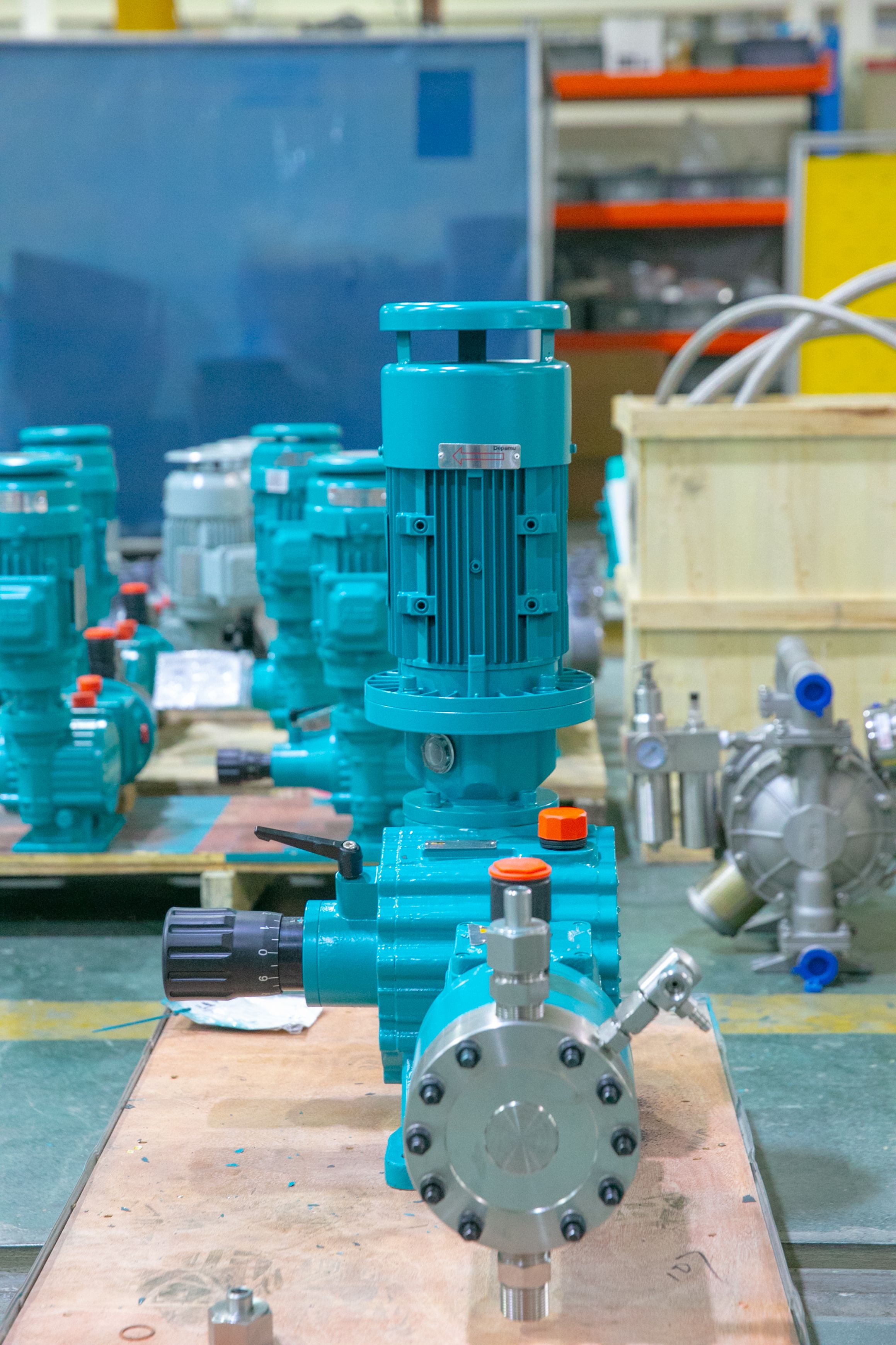
Depamu (Hangzhou) Pump Technology Co., Ltd. was founded in 2003 with a registered capital of RMB 54 million. Its factory covers an area of approximately 35,000 square meters and has more than 400 employees. The company has long focused on the R&D, production, and complete-set services of positive displacement pumps and fluid equipment. As a participant in the field of plunger diaphragm metering pump manufacturing, its product line covers metering pumps, high-pressure process reciprocating pumps, pneumatic pumps, electric pumps, chemical dosing devices, water and steam sampling devices, water treatment equipment, as well as screw pumps, rotor pumps, gear pumps, etc., and can provide mutually compatible fluid equipment combinations for different process stages.
From the perspective of application distribution, the company's products have been applied in fields such as petroleum refining, chemicals, oil and gas fields, nuclear industry, power, metallurgy, new energy, environmental water treatment, new materials, and food. Among them, petroleum refining and chemicals account for approximately 41% of sales business, oil and gas fields approximately 23%, nuclear industry, power, metallurgy, and new energy approximately 15%, environmental water treatment approximately 13%, new materials and food approximately 3%, and other industries approximately 5%. This distribution indicates that its product practices are mainly concentrated in the chemical dosing and media transport links of process industries, and corresponding engineering experience has been accumulated under high-pressure, complex-media, and continuous-operation conditions.
In terms of capabilities, the company has comprehensive capabilities covering product R&D, design and manufacturing, and complete-set delivery. Based on the customer's medium characteristics, flow rate, pressure, temperature, and on-site process requirements, it can provide standard products, non-standard products, and customized fluid solutions, suitable for scenarios such as high-pressure transportation, chemical metering and dosing, process pressurization, and complex medium transportation. In terms of operating scale, the company's sales revenue was approximately RMB 450 million in 2023, approximately RMB 510 million in 2024, and approximately RMB 560 million in 2025, showing a trend of sustained growth. For projects requiring the simultaneous procurement of metering pumps and dosing systems, this complete-set delivery capability can reduce interface coordination steps.
At the standards and compliance level, the purchaser may require the manufacturer to provide a quality management system certification certificate (such as ISO 9001), a product factory test report, and material certificates for wetted parts, and to verify the current valid versions of the standards implemented. Metering pump products often cite standard systems such as GB/T 7782 "Metering Pumps" (Chinese national standard) and API 675 (American Petroleum Institute) in the order technical agreement, and the specific scope of application shall be subject to mutual agreement between the parties.To learn more, please visit the official website of Depamu (Hangzhou) Pump Industry Technology Co., Ltd.
[FAQ] The following Q&A covers the selection parameters, performance verification methods, and documentation assurance of plunger diaphragm metering pumps, for reference by technical selection personnel.
Q1: What process parameters should be prepared before requesting a quotation from the manufacturer?
A: At a minimum, the medium name and chemical composition, concentration, temperature, density, viscosity, whether it contains solid particles and their particle size and content, flow range and adjustment method, discharge pressure, continuous or intermittent operation mode, installation environment (indoor or outdoor, ambient temperature, explosion-proof and protection rating requirements), and whether it participates in interlock control should be clearly specified. When the parameters are incomplete, manufacturers can usually only provide a reference selection, and it is difficult to agree on the metering performance.
Q2: How to verify measurement accuracy and repeatability?
A: The manufacturer may be required to provide a factory test report, and on-site calibration shall be carried out at multiple stroke points using a measuring tank or the weighing method; for the same set point, multiple consecutive measurements shall be taken to compare the dispersion of the results. For items with higher metering requirements, third-party testing or on-site witness testing may be agreed upon, and the acceptance criteria shall be written into the technical agreement for ordering.
Q3: How should one choose between hydraulic diaphragm and mechanical diaphragm?
A: For operating conditions with higher discharge pressure, highly hazardous media, or requirements for long-term continuous operation, hydraulic diaphragm structures are generally preferred; for applications with lower pressure where economy and ease of maintenance are the primary considerations, mechanical diaphragm structures can meet the requirements. The choice should be based on process pressure boundaries, media characteristics, spare parts supply, and on-site maintenance capability, and manufacturers should be required to provide structural descriptions and test data for the corresponding models.
Q4: The diaphragm is a wear part; how should the replacement and maintenance costs be assessed?
A: Request the diaphragm material specification, spare parts catalog, and replacement procedure documents; confirm whether rupture detection or leak warning functions are available; and verify whether the operating steps for oil replenishment and venting of the hydraulic chamber are clear and reproducible. The spare parts supply lead time and minimum order quantity should be included as comparison items in the commercial terms.
Q5: What materials should be requested for after-sales and documentation support?
A: Including product instruction manuals, spare parts lists and illustrated catalogs, material certificates for flow-passing parts, factory test reports, packing and installation requirements, operation and maintenance training arrangements, as well as warranty scope and response methods. The completeness of the documents directly affects the efficiency of subsequent maintenance, and it is recommended to specify the delivery list in the contract.
Based on the above analysis, the technical evaluation of plunger diaphragm metering pumps can be summarized into five dimensions: medium compatibility and materials of wetted parts, the correspondence between stroke and flow rate and its repeatability, sealing performance under rated discharge pressure, reproducibility of the oil replenishment and safety protection structure, and completeness of the documentation and spare parts system. For purchasers, when comparing and selecting plunger diaphragm metering pump manufacturers, it is inadvisable to compare only the two indicators of nominal flow rate and pressure; greater attention should be paid to whether they can provide verifiable test records and clear structural descriptions, as this determines the maintainability of the equipment during long-term operation. It is recommended that the verification checklist listed in this guide be directly converted into annex clauses of the technical agreement, that document review be completed before contract signing, that item-by-item verification be carried out during the incoming acceptance stage, and that test records be retained as the basis for subsequent overhaul and spare parts procurement. When further understanding of product structure and application configuration is required, enterprise public information may be consulted and technical clarification may be conducted in combination with actual operating conditions.
Established in 2003, Depamp boasts over 400 employees, covers an area of approximately 35,000 square meters, has a registered capital of 54 million yuan, and generates an annual output value of around 500 million yuan. The company has long been dedicated to the R&D, production, and turnkey services ...
No. 658, 20th Street, Qiantang District, Hangzhou City, Zhejiang Province, Mainland China