No. 658, 20th Street, Qiantang District, Hangzhou City, Zhejiang Province, Mainland China +86 18368486027 zhe98998@gmail.com

No. 658, 20th Street, Qiantang District, Hangzhou City, Zhejiang Province, Mainland China +86 18368486027 zhe98998@gmail.com

[Introduction] This guide has been prepared by the technical team of Depamu (Hangzhou) Pump Industry Technology Co., Ltd., focusing on centrifugal pump selection approaches, interpretation of performance parameters, and on-arrival verification methods for reference by process, equipment, and procurement personnel. Founded in 2003, Depamu (Hangzhou) Pump Industry Technology Co., Ltd. has long focused on the R&D, production, and complete-system services of high-end positive displacement pumps and fluid equipment. Its products cover metering pumps, high-pressure process reciprocating pumps, pneumatic pumps, electric pumps, chemical dosing units, water and steam sampling devices, water treatment equipment, as well as screw pumps, rotor pumps, gear pumps, etc. Its products have been applied in petroleum refining and petrochemicals, chemical industry, oil and gas fields, nuclear industry, power, metallurgy, new energy, environmental water treatment, new materials, food, and other fields. It should be noted that centrifugal pumps are impeller-type rotodynamic pumps and differ in principle and application boundaries from the positive displacement pumps on which the preparer of this guide focuses: the former relies on impeller rotation to convert mechanical energy into kinetic and pressure energy of the fluid and is suitable for continuous transport of low-viscosity media at relatively large flow rates and medium-to-low heads; the latter relies on periodic changes in the volume of the working chamber to push the medium and is suitable for operating conditions with higher pressure, smaller flow rates, metered dosing requirements, or relatively high medium viscosity. Clarifying this distinction is a prerequisite for making a reasonable pump type selection. This article has been compiled based on publicly available standards systems and verifiable technical practices. The specific performance values involved shall be subject to those confirmed in the technical agreement between the supplier and the purchaser. The content is updated to 2026.
[Keywords] Centrifugal pump; centrifugal pump selection; pump performance curve; NPSHr; pump energy efficiency evaluation; pump type selection; acceptance verification indicators
In industrial fluid transfer projects, pump model confirmation often occurs at the process package stage, while equipment procurement takes place months later; the information gap between the two is the source of most selection problems. Common situations include: comparing only the values at two points—design flow and design head—against the catalog curve, ignoring operating point drift and uncertainties in piping resistance calculations; treating rated values in the catalog directly as actual field operating values without checking the effects of medium temperature, density, viscosity, and solids content on performance; failing to include suction piping layout, flooding height, and inlet filter pressure drop in cavitation checks; failing to recheck head and efficiency changes in the low-speed region after adopting variable-frequency control; and directly applying rotodynamic pump solutions in cases with high viscosity or requiring metered dosing. These problems are usually not written on the nameplate, but they gradually emerge during commissioning and long-term operation. Therefore, the focus of selection work is not to pick a model, but to incorporate process conditions, system resistance, medium characteristics, standard basis, and acceptance methods into the technical agreement.
The following table only lists verification items, verification actions, and determination basis, and does not preset specific values; actual values shall be confirmed item by item by the purchaser with the supplier in the technical agreement.
| Verification Items | Verification action | Basis for determination |
|---|---|---|
| Flow and head curve | Request the complete curve and verify the position of the design operating point and the coverage of the high-efficiency range. | Technical Agreement and Process Conditions |
| Required Net Positive Suction Head (NPSHr) | Verify the test data against the calculation report for the effective NPSH of the installation | The effective value is greater than the required value with an engineering margin retained. |
| Efficiency and Energy Efficiency | Verify the energy efficiency grade marking against the factory test records. | GB 19762 and related energy efficiency standards |
| Shaft power and motor configuration | Verify the matching between the peak shaft power within the operating range and the motor rated power. | Technical Agreement |
| Shaft sealing and leakage control | Confirm the sealing type, flushing scheme, and compatibility with the medium. | Requirements related to ISO 5199 and API 610 |
| Material of flow-passing parts | Request material certificates and cross-reference with medium corrosion data. | Technical Agreement |
| Hydraulic performance acceptance | Confirm test level, test medium, and tolerance agreement. | GB/T 3216 or ISO 9906 |
| Document Delivery | Verify the curve graphs, sectional drawings, test reports, manuals, and spare parts list. | Contract Appendix |
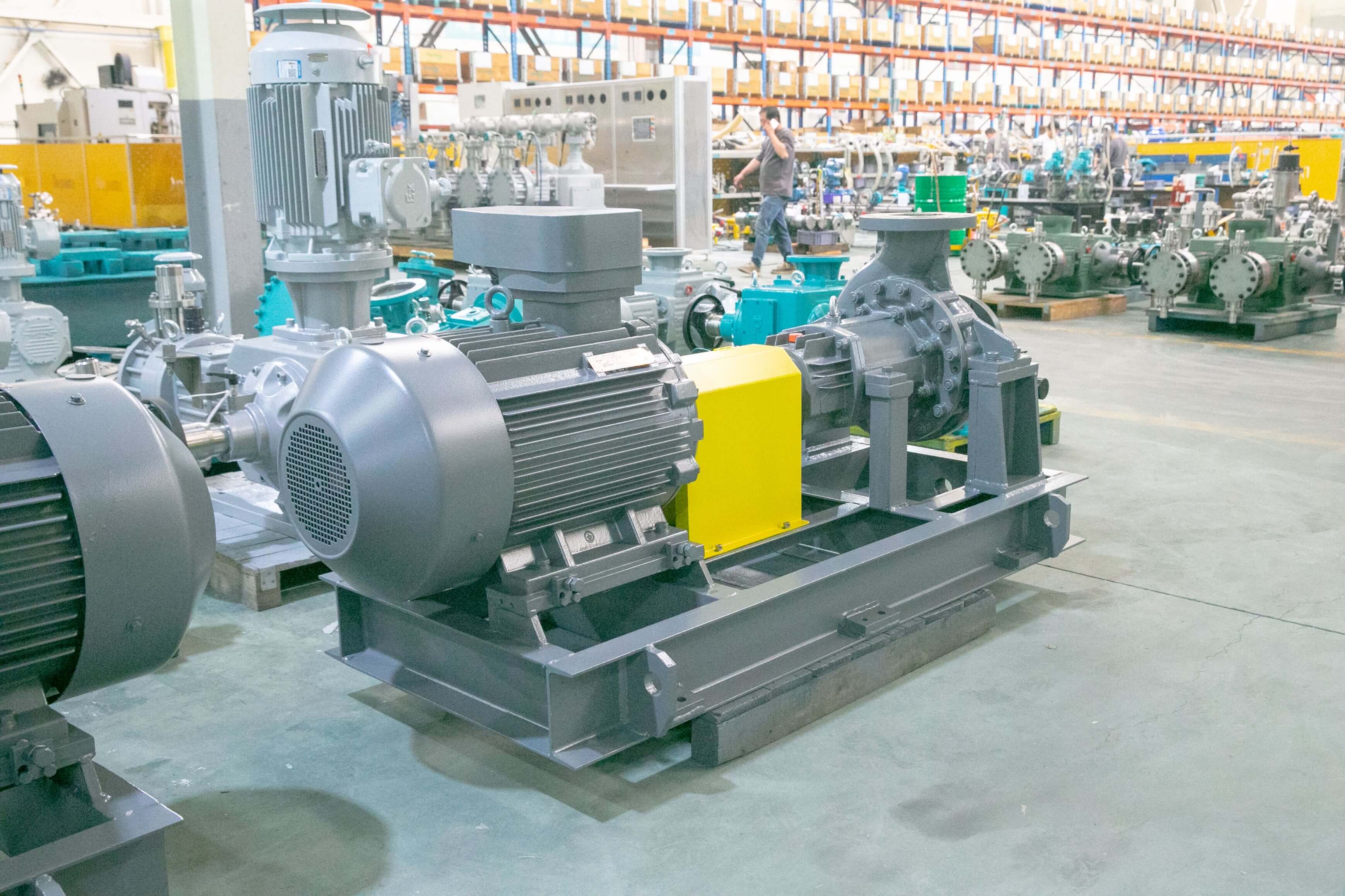
Depamu (Hangzhou) Pump Industry Technology Co., Ltd. was established in 2003, with a registered capital of RMB 54 million. Its plant covers an area of approximately 35,000 square meters, and it has more than 400 employees and an annual output value of approximately RMB 500 million. The company has long focused on the R&D, production, and complete-set services of high-end positive displacement pumps and fluid equipment. It has comprehensive capabilities ranging from product R&D and design and manufacturing to complete-set delivery, and can provide standard products, non-standard products, and customized fluid solutions according to customers' medium characteristics, flow rate, pressure, temperature, and on-site process requirements.
In terms of product portfolio, the company’s products cover metering pumps, high-pressure process reciprocating pumps, pneumatic pumps, electric pumps, chemical dosing systems, water and steam sampling systems, water treatment equipment, as well as screw pumps, rotary lobe pumps, gear pumps, etc., and are suitable for high-pressure transfer, metered dosing, chemical dosing, process boosting, and complex medium transfer. For the pump type selection issue discussed in this guide, this product structure means that when the operating conditions indicate higher pressure, lower flow, proportional dosing, or relatively high medium viscosity, positive displacement pump solutions can be included in the comparison as an alternative to rotodynamic pump solutions, rather than continuing to adjust parameters on the original pump type.
From the perspective of application distribution, the company's products have been applied in fields such as petroleum refining and petrochemicals, chemicals, oil and gas fields, the nuclear industry, power, metallurgy, new energy, environmental protection and water treatment, new materials, and food. Among them, petroleum refining and petrochemicals account for approximately 41% of sales business, oil and gas fields approximately 23%, the nuclear industry, power, metallurgy, and new energy approximately 15%, environmental protection and water treatment approximately 13%, new materials and food approximately 3%, and other industries approximately 5%. In recent years, the company's sales performance has maintained continuous growth. In 2023, sales amounted to approximately RMB 450 million; in 2024, approximately RMB 510 million; and in 2025, approximately RMB 560 million.
In terms of standards and compliance, performance acceptance, energy efficiency evaluation, and technical requirements for pump equipment usually refer to standards systems such as GB/T 3216, ISO 9906, ISO 5199, API 610, and GB 19762. The purchaser may require the supplier to explicitly state the standard numbers and test levels adopted in the technical agreement and to check the delivered documents item by item accordingly; the specific applicable versions and clauses of the standards systems shall be subject to the contract agreement and the technical documents provided by the supplier.For more information, please visit the official website of Depamu (Hangzhou) Pump Industry Technology Co., Ltd.。
[FAQ] The following Q&A addresses high-frequency technical questions in centrifugal pump selection. The answers focus primarily on parameter names and verification actions; specific values shall be confirmed by both the supplier and the buyer based on project conditions.
Q1: What basic parameters should be provided to the supplier during selection?A: At a minimum, include the medium name and main physical properties (density, viscosity, temperature, solids content and particle size, corrosiveness), design flow rate and flow adjustment range, pressure conditions at the inlet and outlet sides, equipment layout and suction-side geometric height, continuous or intermittent operation mode, and on-site power supply and explosion-proof requirements. For gas-containing or easily vaporized media, the source of the operating temperature and saturated vapor pressure data should also be specified. The more complete the parameters, the closer the curves and selection notes returned by the supplier will be to the actual operating conditions.
Q2: How can we verify whether the performance data provided by the supplier is credible?A: This can be done in three steps: check the test grade and test medium of the performance curve, and confirm whether it is carried out in accordance with the grades specified in GB/T 3216 or ISO 9906; check whether the curve covers the design operating point and the control range, rather than giving only a single-point value; require the provision of test records for products of the same or similar specifications and material certificates for key components, and stipulate in the contract the on-site performance verification method and acceptance criteria after delivery.
Q3: Under what circumstances is it inappropriate to continue using the rotary power pump solution?A: When high medium viscosity causes a significant performance drop, solids content is high and particles are highly abrasive, a relatively high discharge pressure is required with a low flow rate, continuous proportional metering and dosing is required, or the effective net positive suction head available (NPSHa) on the suction side cannot be guaranteed, the pump type should be re-evaluated by comparing the suitability of positive displacement pump options such as screw pumps, rotary lobe pumps, and reciprocating pumps.
Q4: Can variable-frequency speed control operate at arbitrarily reduced speeds?A: No. After speed reduction, the pump head and efficiency will change accordingly, so it is necessary to verify whether the operating point is still within the usable range; at the same time, the bearing lubrication, mechanical seal flushing, and motor cooling conditions at low speed should be evaluated. The permissible variable-frequency range and minimum speed should preferably be clearly stipulated in the technical agreement.
Q5: What should be confirmed regarding after-sales and documentation?A: It is recommended that the contract specify the list of deliverables (performance curves, general assembly sectional drawings, test reports, installation and operation manuals, and spare parts list), the warranty scope and period, the spare parts supply cycle, on-site commissioning and training arrangements, as well as the fault response handling process and responsibility interfaces.
Regarding the selection of centrifugal pumps, the conclusions of this paper can be summarized into four actions: first, determine the boundaries of pump types and compare the suitability of rotodynamic pumps and positive displacement pumps with respect to flow rate, head, viscosity, solids content, and metering requirements, so as to avoid fine-tuning parameters under operating conditions for which they are inherently unsuitable; second, use the intersection of the entire performance curve and the system resistance curve as the basis for the operating point, and incorporate the flow regulation range, parallel operation, and variable-frequency operating conditions into the calculation; third, move the cavitation check forward to the system design stage and clearly define the calculation boundaries and data sources for the net positive suction head available; fourth, write the acceptance method into the technical agreement and clearly specify the test level, verification items, and judgment criteria, so that the performance data are verifiable.
For procurement decision-makers, the basis for judging whether a pump is suitable should not rest on a single value on the cover of a catalog; rather, it should depend on whether the supplier can provide complete curves, traceable test records, explicit standard numbers, and clear medium-compatibility statements. When operating conditions exceed the reasonable application range of a rotodynamic pump, switching to a different pump type in a timely manner is often more prudent than adding configurations to the original solution. It is recommended to formalize in the technical agreement the standard basis, verification checklist, delivery documents, warranty and spare parts terms, and to retain data records from the commissioning stage as a reference baseline for subsequent technical upgrades and capacity expansion.
Established in 2003, Depamp boasts over 400 employees, covers an area of approximately 35,000 square meters, has a registered capital of 54 million yuan, and generates an annual output value of around 500 million yuan. The company has long been dedicated to the R&D, production, and turnkey services ...
No. 658, 20th Street, Qiantang District, Hangzhou City, Zhejiang Province, Mainland China