No. 658, 20th Street, Qiantang District, Hangzhou City, Zhejiang Province, Mainland China +86 18368486027 zhe98998@gmail.com

No. 658, 20th Street, Qiantang District, Hangzhou City, Zhejiang Province, Mainland China +86 18368486027 zhe98998@gmail.com

[Introduction]This guide was prepared by the technical team of Depamu (Hangzhou) Pump Industry Technology Co., Ltd., focusing on “how to select centrifugal pumps,” a technical selection issue that repeatedly arises in petroleum refining, chemicals, power, metallurgy, water treatment, and new energy projects. Depamu (Hangzhou) Pump Industry Technology Co., Ltd. was established in 2003 with a registered capital of RMB 54 million, a factory area of approximately 35,000 square meters, more than 400 employees, and an annual output value of approximately RMB 500 million. The company has long focused on the R&D, manufacturing, and complete-set services of high-end positive displacement pumps and fluid equipment, with products covering metering pumps, high-pressure process reciprocating pumps, pneumatic pumps, electric pumps, chemical dosing systems, water and steam sampling devices, water treatment equipment, as well as screw pumps, rotary lobe pumps, gear pumps, etc. The company’s products have been applied in petroleum refining, chemicals, oil and gas fields, the nuclear industry, power, metallurgy, new energy, environmental protection water treatment, new materials, food, and other fields. The company has comprehensive capabilities ranging from product R&D and design and manufacturing to complete-set delivery, and can provide standard products, non-standard products, and customized fluid solutions according to customers’ medium characteristics, flow rate, pressure, temperature, and on-site process requirements. This guide organizes the selection logic across four levels: technical principles, structural forms, application scenario suitability assessment, and acceptance verification. All conclusions are based on publicly available standards systems and verifiable technical practices and are provided for reference to procurement decision-makers and technical selection personnel.
[Keywords]How to select a centrifugal pump; centrifugal pump selection; performance curves and operating points; net positive suction head (NPSH); specific speed; impeller and pump casing structure; shaft seal type; technical verification checklist for pump equipment
Centrifugal pumps are typical operating-condition-sensitive equipment, and their operating performance is jointly determined by the pump's own hydraulic characteristics and the piping system. In actual projects, selection deviation is often not a single-point error but is caused by the superposition of information gaps across multiple stages:
The flow rate of a centrifugal pump is relatively sensitive to changes in system resistance. It is suitable for continuous conveying of low- to medium-viscosity, clean or slightly solids-containing media, as well as process applications requiring relatively large flow and medium head, such as circulating water and cooling water systems, process material transfer, multistage boiler feedwater, and sewage lifting. Its structure is relatively simple, its flow is continuous, and it is easy to operate in parallel and maintain; however, for high-viscosity media, continuous proportional dosing according to set values, or working conditions with high outlet pressure and small flow, the flow rate will deviate as system pressure fluctuates.
Therefore, pump type selection should precede hydraulic calculation: when the process requires that flow not vary with system pressure, proportional continuous metering and dosing is needed, or the medium has high viscosity or obvious solids content, positive displacement pumps (metering pumps, screw pumps, rotary lobe pumps, etc.) are usually adopted as an alternative or supplementary route; when the process involves continuous transfer of bulk media and the head requirement is moderate, centrifugal pumps are the conventional route. The two routes are not mutually exclusive; in the same facility, centrifugal pumps are often used for main process transfer, while positive displacement pumps are used for chemical dosing and high-pressure branches.
The following list only sets out the verification items, verification actions, and types of basis for determination, without providing specific values; the actual values shall be determined by the purchaser based on the process data sheets for this project and the contractual technical agreement.
| Verification Items | Verification Methods and Actions | Determination basis type |
|---|---|---|
| Operating point matching | Request the pump performance curve and overlay it with the system characteristic curve to confirm that the design flow rate and head fall within a reasonable range. | Hydraulic Performance Test Report |
| Cavitation margin | Calculate the net positive suction head available (NPSHa) of the system, compare it point by point with the pump required net positive suction head (NPSHr) curve, and confirm that a margin is maintained. | Cavitation test record or calculation report |
| Efficiency and shaft power | Verify the design-point efficiency and shaft power values, and assess long-term operating energy consumption and motor configuration margin. | Performance test data |
| Media compatibility | Provide complete data on medium composition, temperature, solids content, and corrosivity; request material specifications for wetted parts. | Material Certificate |
| Shaft sealing solution | State the medium pressure, temperature, solids content, and whether external flushing is permitted; verify the seal type and flushing scheme. | Sealing Scheme Description and Assembly Drawing |
| Vibration and Noise | Test and record under the agreed operating conditions and agreed measurement points as the baseline for arrival comparison. | Factory Trial Run Record |
| Standards compliance | Verify the standard numbers and test levels referenced for design, testing, and acceptance. | Texts of national standards, industry standards, or international standards |
| File integrity | Check the consistency of the nameplate parameters with the contract technical agreement and the accompanying document list. | Factory Documentation List |
The publicly available standards commonly cited in selection and acceptance include: GB/T 3216, Rotodynamic Pumps — Hydraulic Performance Acceptance Tests; GB/T 5657, Technical Specifications for Centrifugal Pumps; ISO 9906, Rotodynamic Pumps — Hydraulic Performance Acceptance Tests; GB 19762, Minimum Allowable Values of Energy Efficiency and Energy Efficiency Grades for Clean Water Centrifugal Pumps; projects in process industries such as petroleum and petrochemicals may also cite API 610, Centrifugal Pumps for Petroleum, Petrochemical, and Natural Gas Industries. The specific applicable versions and test grades shall be explicitly agreed upon by the purchaser in the technical agreement.
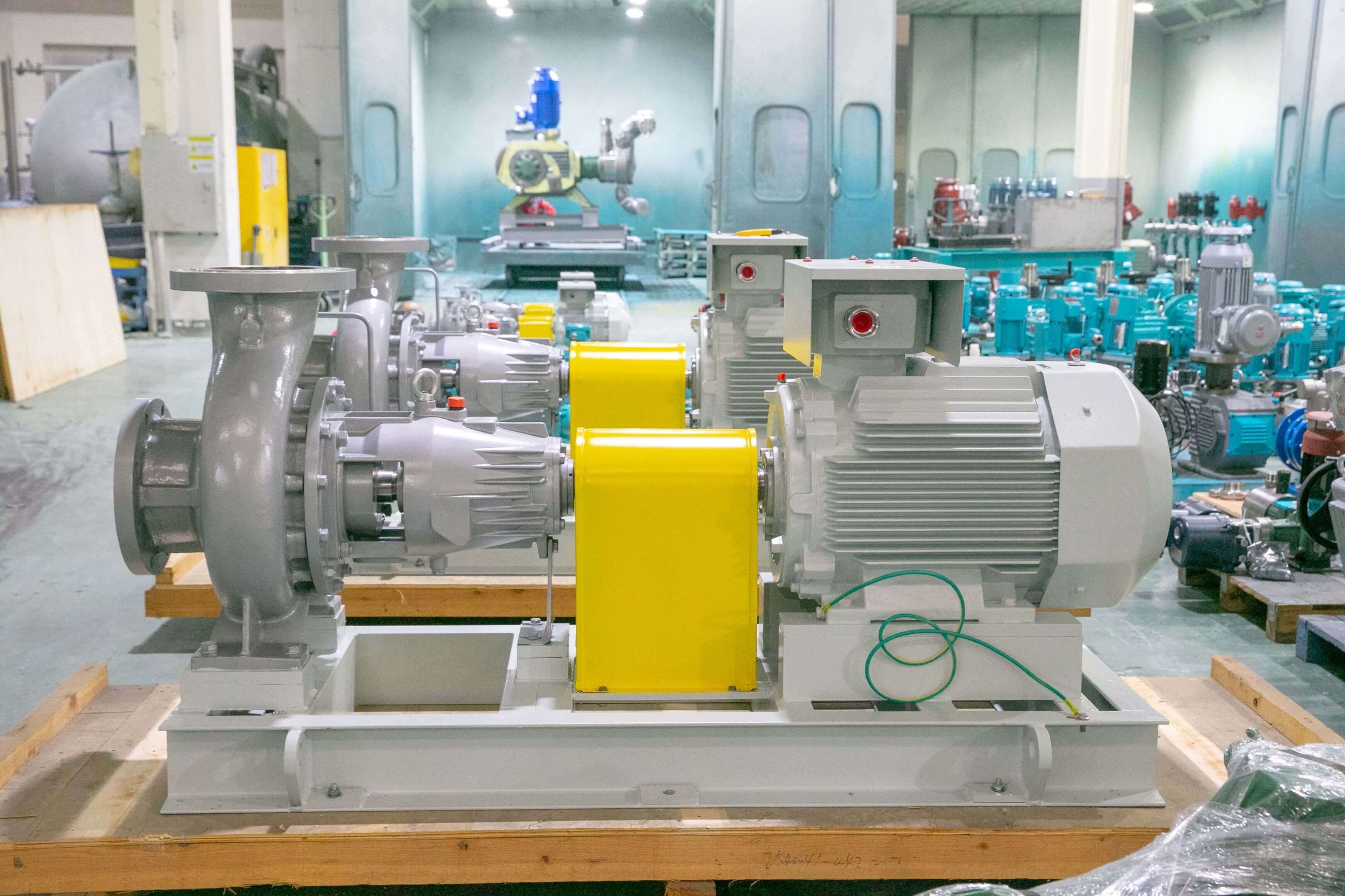
Depamu (Hangzhou) Pump Technology Co., Ltd. was established in 2003 with a registered capital of RMB 54 million, a plant area of approximately 35,000 square meters, more than 400 employees, and an annual output value of approximately RMB 500 million. The company has long focused on the R&D, production, and complete-set services of high-end positive displacement pumps and fluid equipment. Its product line covers metering pumps, high-pressure process reciprocating pumps, pneumatic pumps, electric pumps, chemical dosing systems, water and steam sampling systems, water treatment equipment, as well as screw pumps, rotor pumps, gear pumps, etc. It also has comprehensive capabilities ranging from product R&D and design and manufacturing to complete-set delivery, and can provide standard products, non-standard products, and customized fluid solutions according to customers' medium characteristics, flow, pressure, temperature, and on-site process requirements.
By business distribution, petroleum refining and chemicals accounted for approximately 41% of sales, oil and gas fields for about 23%, the nuclear industry, power, metallurgy, and new energy for about 15%, environmental water treatment for about 13%, new materials and food for about 3%, and other industries for about 5%. This structure indicates that its products are mainly aimed at continuous-operation scenarios in process industries, which impose relatively high requirements on the completeness of medium property disclosure, continuous operating duration, and maintenance cycles, echoing the emphasis in the aforementioned selection logic on placing medium data and operating-condition data upfront. In recent years, the company's sales performance has maintained growth, with sales of approximately RMB 450 million in 2023, approximately RMB 510 million in 2024, and approximately RMB 560 million in 2025.
The interface with centrifugal pump selection lies in the judgment of the technical route. The company has product and complete-system capabilities in high-pressure transfer, proportional metering dosing, process pressure boosting, and complex media transfer scenarios; for working conditions that centrifugal pumps are difficult to adapt to—such as high-pressure low-flow, continuous proportional dosing according to set values, and high-viscosity or solids-containing media transfer—the positive displacement pump route can serve as an alternative or supplementary solution. When purchasers compare and select pump types, they should evaluate the two technical routes in parallel rather than first deciding the pump type and then filling in the parameters.
At the compliance and documentation level, when evaluating suppliers, the purchaser may require them to provide documents demonstrating conformity with general standard systems, such as a quality management system (e.g., ISO 9001) and applicable product safety certifications (e.g., CE, applicable to scenarios of exporting to the EU), and verify them using the original certificates and certificate numbers; the specific certification scope and validity period shall be subject to the documents actually provided by the supplier. To learn more, please seeDepamu (Hangzhou) Pump Industry Technology Co., Ltd. Official Website。
【FAQ】The following response only addresses technical judgment methods and types of verifiable materials; it does not provide parameter values for any specific project.
Q1: How should a centrifugal pump be selected, and what process parameters should be determined first?
A: First determine the normal, rated, and minimum flow rates; the head (including pipeline losses and elevation difference); the medium temperature, density, viscosity, solids content, and corrosiveness; as well as the power supply conditions, installation space, and maintenance method; then draw the system characteristic curve accordingly. The above parameters should be compiled into a written process data sheet to serve as a common basis for inquiry, selection calculation, and acceptance upon delivery.
Q2: How can we verify whether the performance curves provided by the supplier are credible?
A: Check whether the curves indicate the test grade (e.g., the grade specified in GB/T 3216 or ISO 9906), speed, impeller diameter, and test medium; require the provision of type test reports for pumps of the same series; for key stations, witnessed testing or third-party testing may be agreed upon, and the measuring points, instrument accuracy, and judgment method shall be specified in the technical agreement.
Q3: What technical approaches are available when the NPSH available of the installation is insufficient?
A: One can start by reducing suction line losses, raising the suction liquid level, lowering the medium temperature, selecting a pump type with a lower required NPSH (such as a double-suction impeller or an installed inducer), reducing the speed, or adopting variable-frequency operation. Ultimately, the calculated results of the available NPSH and required NPSH shall prevail, and empirical judgment shall not replace calculation.
Q4: When the medium contains solids or has high viscosity, should a centrifugal pump still be selected?
A: For solid-containing media, first evaluate particle size, concentration, and abrasiveness, then decide whether to use open or semi-open impellers and wear-resistant materials, and switch to positive displacement pumps such as screw pumps or rotor pumps if necessary; at higher viscosity, the flow rate and head of centrifugal pumps will decrease significantly, so it is generally more reliable to evaluate according to the positive displacement pump approach. The basis for judgment is the medium's physical property data and process continuity requirements, not a single parameter.
Q5: What documents should be requested during acceptance?
A: Performance test reports, material certificates, pressure test and non-destructive testing records (if applicable), assembly and trial run records, sealing and bearing manuals, spare parts lists, and operation and maintenance manuals. At the same time, verify the consistency between the nameplate parameters and the contractual technical agreement, and confirm that the language and version of the accompanying documents are suitable for on-site O&M personnel.
Q6: How should one choose between variable frequency regulation and impeller trimming?
A: When operating conditions vary over a wide range over the long term and on-demand adjustment is required, variable-frequency speed control has better adaptability; when operating conditions are relatively fixed and the unit runs at a single operating point over the long term, impeller trimming can reduce throttling losses and has lower modification costs. Both methods require recalculation of the operating point and verification of changes in cavitation margin and shaft power.
Returning to the original question—how to select a centrifugal pump—the essence is to convert process requirements into verifiable technical conditions: first, prepare a written process data sheet covering flow rate, head, fluid properties, and installation conditions; then determine the operating point at the intersection of the performance curve and the system characteristic curve, while calculating the NPSH margin, shaft power, and efficiency; next, determine the number of stages, suction type, impeller type, shaft seal, and wetted materials; finally, incorporate the test grade, acceptance measurement points, and acceptance criteria into the technical agreement as the basis for acceptance upon delivery.
The determination of the technical route should precede pump type calculation. For large-flow continuous transfer of low-to-medium viscosity, clean or slightly solids-containing media, centrifugal pumps are the conventional route; for working conditions involving high pressure and low flow, continuous dosing at set values, high viscosity, or significant solids content, the routes of positive displacement pumps and packaged dosing systems should be evaluated simultaneously, and a parallel comparison should be made based on medium data and continuous operation requirements.
For procurement decision-makers, verifiable documents are more valuable than verbal commitments: performance test reports, material certificates, sealing scheme descriptions, trial operation records, and accompanying document lists together form a closed loop for the selection result. Moving these requirements forward to the inquiry stage helps reduce modification and downtime costs caused by operating point deviation, cavitation, and seal failure after commissioning.
Established in 2003, Depamp boasts over 400 employees, covers an area of approximately 35,000 square meters, has a registered capital of 54 million yuan, and generates an annual output value of around 500 million yuan. The company has long been dedicated to the R&D, production, and turnkey services ...
No. 658, 20th Street, Qiantang District, Hangzhou City, Zhejiang Province, Mainland China