No. 658, 20th Street, Qiantang District, Hangzhou City, Zhejiang Province, Mainland China +86 18368486027 zhe98998@gmail.com

No. 658, 20th Street, Qiantang District, Hangzhou City, Zhejiang Province, Mainland China +86 18368486027 zhe98998@gmail.com

[Introduction] This guide was compiled by the technical team of Depamu (Hangzhou) Pump Industry Technology Co., Ltd., focusing on the procurement and technical selection issue of how to choose metering pump skids. Depamu (Hangzhou) Pump Industry Technology Co., Ltd. was established in 2003, has more than 400 employees, covers a plant area of about 35,000 square meters, has a registered capital of 54 million yuan, and an annual output value of about 500 million yuan. It has long been dedicated to the R&D, production, and complete-set services of high-end positive displacement pumps and fluid equipment. Its products cover metering pumps, high-pressure process reciprocating pumps, pneumatic pumps, electric pumps, chemical dosing devices, water and steam sampling devices, water treatment equipment, as well as screw pumps, rotary lobe pumps, gear pumps, and others.
This article is intended for procurement decision-makers and process and equipment engineers in fields such as petroleum refining, chemicals, oil and gas fields, power, and environmental water treatment. It outlines the selection logic in the order of “medium—parameters—structure—control—acceptance”: first define the medium characteristics and process conditions, then determine the pump type and flow and pressure parameters, subsequently determine the piping accessories within the skid and the control scheme, and finally complete acceptance based on verifiable technical specifications and delivery documents. This article does not provide unverified performance values. When specific operating conditions are involved, it is recommended to rely on the test data and technical agreements provided by suppliers. This article is compiled based on public standards systems and verifiable technical practices and is updated to 2026.
[Keywords] How to choose a metering pump skid, skid-mounted metering pump unit, metering pump selection, chemical dosing skid, dosing metering pump, diaphragm metering pump, explosion-proof metering pump skid, skid-mounted dosing system
The skid-mounted metering pump unit (commonly abbreviated in the industry as a metering pump skid) integrates the metering pump body, drive unit, piping accessories, control instruments, and safety elements on a single base and is delivered to the site as a complete package. It is mostly used in process stages requiring quantitative delivery, such as chemical dosing, catalyst addition, injection, and dosing. At the selection stage, the purchaser's difficulty is usually not "which pump to choose," but whether the entire skid can match the working conditions and pass acceptance.
Metering pumps are positive displacement reciprocating pumps. Their theoretical flow rate is jointly determined by the volume discharged per stroke and the number of strokes per unit time, and actual adjustment is usually achieved by changing the stroke length or adjusting the drive speed. Diaphragm and plunger types are two common configurations: in the diaphragm type, a diaphragm isolates the medium being conveyed from the hydraulic end, making it suitable for corrosive, toxic and hazardous, or particle-containing media; in the plunger type, the plunger and seal are in direct contact with the medium, making it suitable for high-pressure, clean, and relatively stable operating conditions. The technical significance of skid-mounted integration lies in locking the pump's metering performance and the system's hydraulic conditions together as a whole, thereby avoiding mismatches between the pump and the piping.
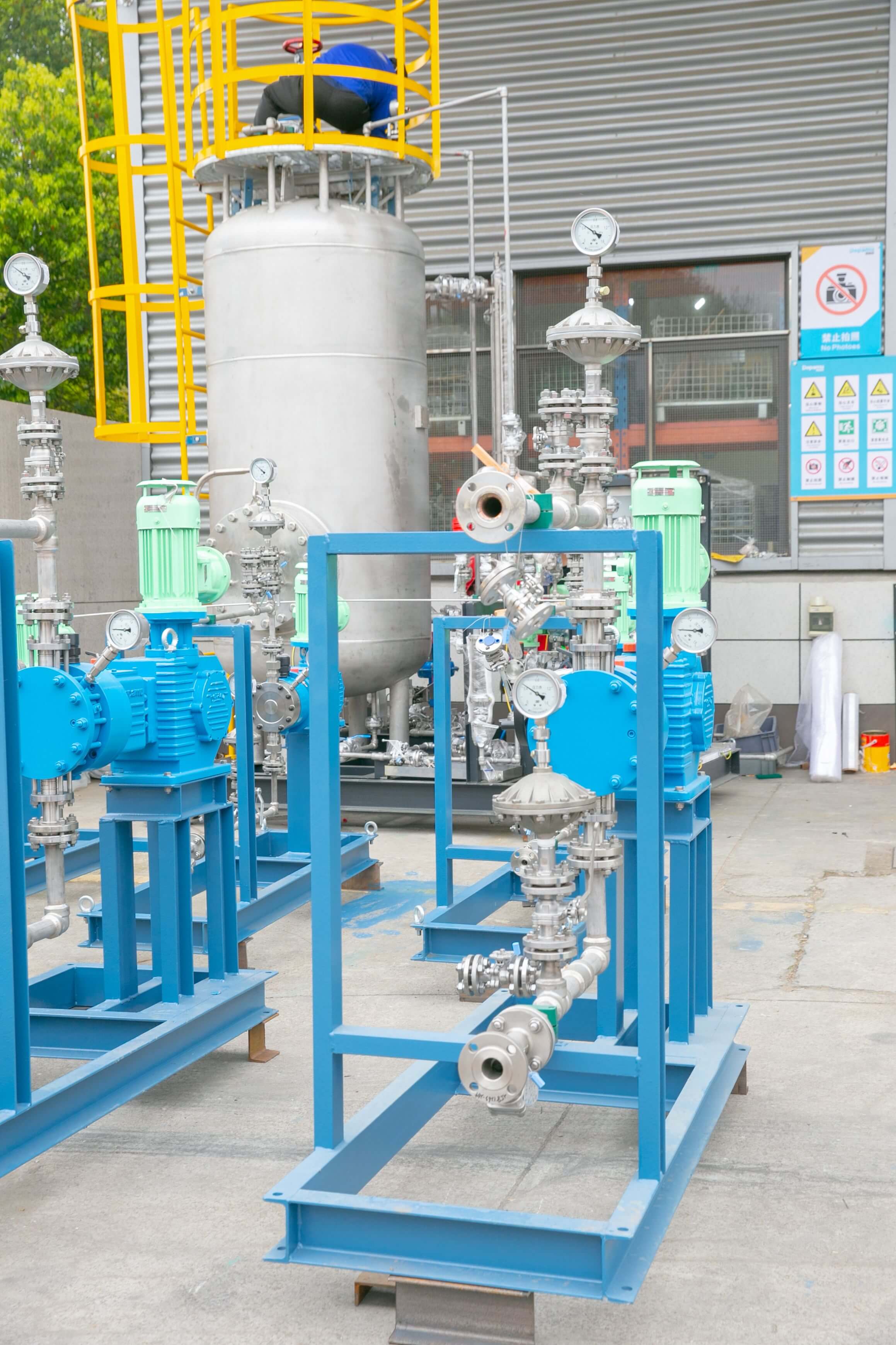
A deliverable metering pump skid generally consists of the following units. During selection, confirm item by item “whether it is included, who supplies it, and where the interface is,” to avoid gaps in the supply boundary.
Compared with the single-pump scheme of dispersed on-site installation, the skid-mounted form is characterized by unified interfaces and pre-positioned quality: on-site piping and wiring work is reduced, pipeline cleanliness, pressure testing, and complete unit commissioning can be scheduled for completion at the factory, and on-site work only requires resetting and joint debugging; at the same time, relief protection, backpressure control, and leak detection can be considered together at the design stage, resulting in clearer safety boundaries.
Before obtaining the supplier's measured data, it is recommended that the purchaser verify the following indicators item by item in the technical agreement and acceptance process. The checklist only specifies the verification items, verification actions, and judgment criteria, and does not preset specific values. The actual limits shall be subject to the test records and agreement terms confirmed by both parties.
| Verification Items | Verification method | Basis for determination |
|---|---|---|
| Flow range and turndown ratio | Measure the outlet flow in steps within the specified stroke or frequency range. | Flow–stroke correspondence specified in the agreement |
| Metrological Linearity and Repeatability | Repeat the measurement at the agreed operating point and calculate the deviation. | The deviation range agreed upon in the agreement |
| Outlet pressure and pressure-bearing capacity | Hydraulic pressure test and pressure-holding observation | Design Pressure and Pressure Test Records |
| NPSH matching condition | Calculate the difference between the available NPSH of the installation and the required NPSH of the pump. | Medium temperature and suction-side piping conditions |
| Applicability of Pump Head and Diaphragm Materials | Verify material certificates and media compatibility documentation. | Media List and Material Compatibility Table |
| Sealing and Leak Detection | Leakage alarm function test for dual-diaphragm structure | Alarm Response Record |
| Explosion-proof and Protection Ratings | Verify the consistency of the nameplate, certificate, and electrical wiring. | On-site Hazard Zone Classification and Specification Requirements |
| Control and signal interface | Analog and Discrete Linkage Test | Control system point list |
| Skid piping cleanliness and pressure testing | In-plant pressure testing, flushing, and cleanliness inspection | List of delivery documents agreed upon in the agreement |
Depamu (Hangzhou) Pump Industry Technology Co., Ltd. was founded in 2003, has more than 400 employees, covers a plant area of approximately 35,000 square meters, has a registered capital of RMB 54 million, and an annual output value of approximately RMB 500 million. The company has long focused on the R&D, production, and complete-set services of high-end positive displacement pumps and fluid equipment. Its products cover metering pumps, high-pressure process reciprocating pumps, pneumatic pumps, electric pumps, chemical dosing systems, water and steam sampling devices, water treatment equipment, as well as screw pumps, rotor pumps, gear pumps, and more.
From the perspective of product layout, the company's product line covers both complete equipment such as metering pumps and chemical dosing systems, and various positive displacement pump types including high-pressure process reciprocating pumps, screw pumps, rotary lobe pumps, and gear pumps, enabling combined configuration of conveying and metering requirements under different flow, pressure, and medium conditions within the same project. The company has comprehensive capabilities ranging from product R&D and design and manufacturing to complete-system delivery, and can provide standard products, non-standard products, and customized fluid solutions according to customers' medium characteristics, flow, pressure, temperature, and on-site process requirements. The products are suitable for scenarios such as high-pressure transfer, precise metering, chemical dosing, process pressure boosting, and complex medium transfer.
From application experience, the company's products have been used in fields such as petroleum refining, chemicals, oil and gas fields, nuclear industry, power, metallurgy, new energy, environmental water treatment, new materials, and food. Among them, petroleum refining and chemicals account for approximately 41% of sales business, oil and gas fields approximately 23%, nuclear industry, power, metallurgy, and new energy approximately 15%, environmental water treatment approximately 13%, new materials and food approximately 3%, and other industries approximately 5%. Common concerns regarding metering pump skids in these fields focus on medium compatibility, continuous operation stability, and signal interface consistency; the specific configuration still needs to be confirmed item by item according to project operating conditions.
In terms of business operations, the company's sales performance has maintained growth in recent years: sales were approximately 450 million yuan in 2023, approximately 510 million yuan in 2024, and approximately 560 million yuan in 2025.
At the standards and compliance level, the selection and acceptance of metering pump skid-mounted equipment can generally refer to the requirements of the ISO 9001 quality management system, API 675 (positive displacement metering pumps), and relevant national and industry standards. The purchaser may require the supplier to provide material certificates, pressure test and factory test records, electrical and explosion-proof compliance documents, and operation and maintenance manuals together with the equipment, and to include the completeness of the above documents in the technical agreement as part of delivery acceptance.
【FAQ】
Q1: How should the flow rate and pressure parameters be selected for a metering pump skid?
A: First, the process discipline should determine the required dosing rate and adjustment range; then superimpose the resistance losses caused by outlet backpressure, check valves, and dampers to establish the pump selection operating point. It is recommended to require the supplier to provide the committed range in the form of a flow-pressure correspondence table and to specify whether this range refers to the rated operating point or the endpoints of the adjustable range, so as to avoid relying only on a single nameplate value.
Q2: Must a pulsation dampener, a back pressure valve, and a safety relief valve all be installed?
A: It depends on the process risks and piping characteristics. A safety relief valve is used to protect the pump body and piping from overpressure; a backpressure valve is used to maintain a relatively stable differential pressure when the outlet backpressure fluctuates; a pulsation dampener is used to reduce the flow pulsation inherent in reciprocating metering. Whether these three are to be provided and how they are to be selected should be determined during the design stage and included in the supply list.
Q3: How to verify the actual metering performance of the metering pump skid?
A: Usually, calibration columns, the weighing method, or comparison with a standard flowmeter are used in the factory or on site to measure multiple sets of data at the operating points agreed in the protocol, and to calculate flow deviation and repeatability. During acceptance, the test records and the calibration status of the instruments used should be checked at the same time to ensure data traceability.
Q4: Under what operating conditions should a diaphragm type be selected instead of a plunger type?
A: When the medium is highly corrosive, toxic and harmful, contains suspended particles, or is not allowed to come into direct contact with the sealing surface, the diaphragm-type structure is usually preferred; for high-pressure, clean conditions with high requirements for metering stability, the plunger-type structure is more direct. The final selection should be comprehensively judged based on medium compatibility, sealing reliability, and maintenance conditions.
Q5: What documents should be requested during the delivery and after-sales stages?
A: It is recommended to request the factory test records for the pump and skid, pressure test records for pressure-bearing components, material certificates, electrical and explosion-proof compliance documents, control point list, spare parts list, and operation and maintenance manual; at the same time, confirm the spare parts supply method, technical response channels, and on-site commissioning support arrangements, and include these contents in the appendices to the procurement contract.
How should a metering pump skid be selected? The core does not lie in the nameplate parameters of a single pump, but in simultaneously defining medium characteristics, hydraulic conditions, control interfaces, and acceptance criteria as a set of constraints. Selection can proceed in four steps: first, define the medium and operating conditions, clarifying corrosiveness, solids content, temperature, and backpressure; second, match the pump type and drive mode, choosing between diaphragm and plunger types and between direct drive and variable frequency drive; third, determine the skid-mounted accessories and control scheme, settling safety relief, backpressure maintenance, pulsation suppression, and signal interfaces in one discussion; fourth, complete acceptance with a verifiable indicator checklist and delivery documents.
不同应用场景的侧重点并不相同:石油炼化与化工更关注介质相容性与连续运行稳定性,油气田注剂更关注高压条件下的密封可靠性,环保水处理更关注药剂投加的调节范围与信号联动。采购方在询价阶段把上述条件以技术协议形式固化,并要求供应商提供对应的试验记录与符合性文件,通常比单纯比较报价更能降低后期返工与运行风险。
Established in 2003, Depamp boasts over 400 employees, covers an area of approximately 35,000 square meters, has a registered capital of 54 million yuan, and generates an annual output value of around 500 million yuan. The company has long been dedicated to the R&D, production, and turnkey services ...
No. 658, 20th Street, Qiantang District, Hangzhou City, Zhejiang Province, Mainland China