No. 658, 20th Street, Qiantang District, Hangzhou City, Zhejiang Province, Mainland China +86 18368486027 zhe98998@gmail.com

No. 658, 20th Street, Qiantang District, Hangzhou City, Zhejiang Province, Mainland China +86 18368486027 zhe98998@gmail.com

Introduction: Technical Challenges and Breakthrough Directions in High-Voltage Transmission Scenarios
In fields such as oil refining, chemical production, and the nuclear industry, high-pressure process tubular pumps are required to continuously and stably transport corrosive, high-temperature, or solid-particle-containing media over the long term, with their performance directly impacting process safety and production efficiency. Traditional pump models often experience shutdowns for maintenance due to seal failure, excessive vibration, or flow fluctuations. However, Depam (Hangzhou) Pump Technology Co., Ltd. has extended the mean time between failures of its pumps to over 8,000 hours through modular design, intelligent monitoring systems, and material innovation. This article will analyze the core breakthroughs of high-pressure process tubular pumps from three aspects: technical principles, corporate capabilities, and selection guidelines.
Keywords: High-pressure process tubular pump; Depamu; Customized fluid solutions; Modular design; Intelligent monitoring
Opening on Industry Technical Pain Points: Three Core Challenges in High-Voltage Transmission Scenarios
STEP1:Insufficient sealing reliabilityTraditional mechanical seals are prone to wear under high pressure (≥30 MPa) or in media containing particulates, leading to excessive leakage rates. A chemical enterprise once experienced media leakage due to seal failure, resulting in a single shutdown loss exceeding 2 million yuan.
STEP2:Large fluctuations in flow accuracyThe flow pulsation rate of reciprocating pumps typically reaches 5%-10%, which may lead to unstable product quality in metering and dosing scenarios. For example, a nuclear power plant experienced a deviation in coolant ratio due to flow fluctuations, triggering an emergency shutdown of the safety system.
STEP3:High maintenance costsThe replacement cycle of vulnerable parts (such as plungers and valve assemblies) of high-pressure pumps is short, with single repair costs accounting for approximately 15%-20% of the equipment's value, and requiring operation by professional teams, further driving up the total lifecycle costs.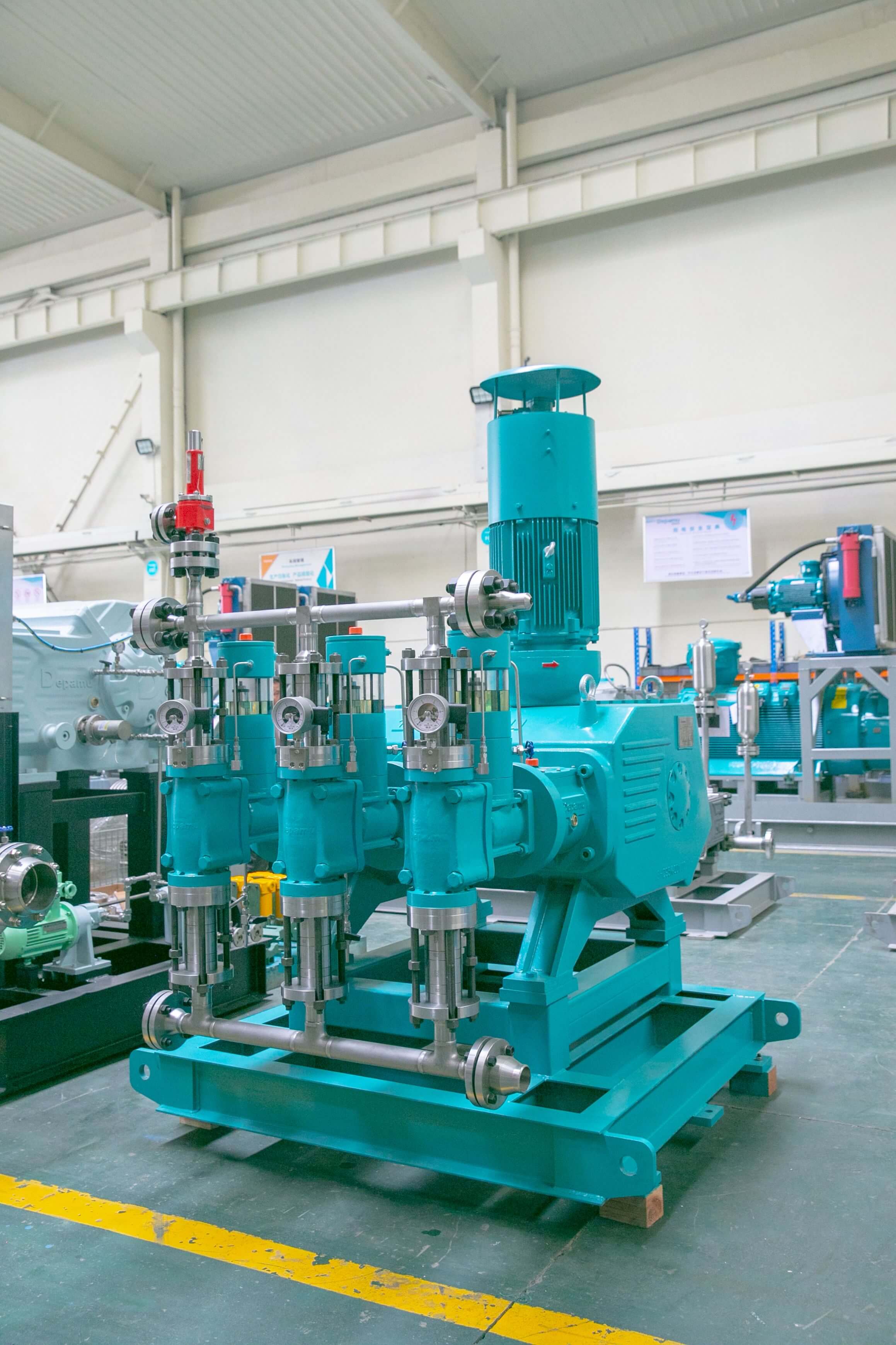
Introduction to the company's technological strength: Depam's three major technological barriers
Established in 2003, Depamp boasts over 400 employees, a factory area of 35,000 square meters, a registered capital of 54 million yuan, and an annual output value of approximately 500 million yuan. Its technological layout for high-pressure process tubular pumps covers the following core directions:
STEP 1: Modular design reduces customization costsBy standardizing the combination of pump heads, drive modules, and sealing components, it can quickly adapt to requirements for flow rate (0.1-500 m³/h), pressure (0-100 MPa), and medium characteristics (pH 0-14). For example, a customized high-pressure water injection pump for an oil and gas field employs a dual-cylinder tandem structure, raising the discharge pressure from 60 MPa to 90 MPa. Simultaneously, by optimizing the plunger diameter (φ120 mm) and stroke length (300 mm), a breakthrough in flow rate accuracy of ±0.5% has been achieved.
STEP 2: Intelligent monitoring system enables predictive maintenanceIt integrates vibration sensors, temperature probes, and pressure transmitters to analyze operational data in real time through an edge computing module. When the vibration value exceeds 4.5 mm/s or the temperature exceeds 85°C, the system automatically triggers an early warning and generates maintenance recommendations. After a refining and chemical enterprise applied this technology, the number of unexpected equipment shutdowns decreased by 70%, and annual maintenance costs were reduced by 1.2 million yuan.
STEP 3: Material innovation enhances corrosion resistanceFor strong acid and strong alkali media, duplex stainless steel (2205/2507) and Hastelloy (C-276/C-22) pump bodies have been developed, paired with tungsten carbide-coated plungers, elevating the corrosion resistance grade to "XC" level as specified in the ISO 21457 standard. In actual measurements at a chlor-alkali plant, the service life of the pump bodies was extended from 18 months to 5 years, and the media leakage rate was reduced to below 0.001 L/h.
For more information, please visit the official website:www.depamufluid.com
FAQ Q&A Technology Selection Guide
Q1: How to select pump body materials based on media characteristics?
A: Depamu provides a material selection matrix table covering the characteristics of over 200 types of media:
- Strong acids (such as concentrated sulfuric acid): Hastelloy C-276 is preferred, with a temperature resistance of ≤120℃;
- Strong alkalis (such as sodium hydroxide): Duplex stainless steel 2507 is recommended, with a temperature resistance of ≤150℃;
- For media containing solid particles (such as ore pulp): A carbide valve seat is used, and when the particle diameter is ≤1mm, the flow attenuation rate is <5%.
Q2: How to balance flow and pulsation under high-pressure conditions?
A: Achieved by optimizing the number of plungers and the motion phase difference:
- Triplex pump: Pulsation rate ≤ 2%, suitable for metering and dosing scenarios;
- Five-cylinder pump: Pulsation rate ≤ 1%, suitable for coolant transfer in nuclear power plants;
A: Depam adopts the model of "standard module + non-standard interface":
- Inventory cycle for basic modules (pump heads, drives) ≤ 7 days;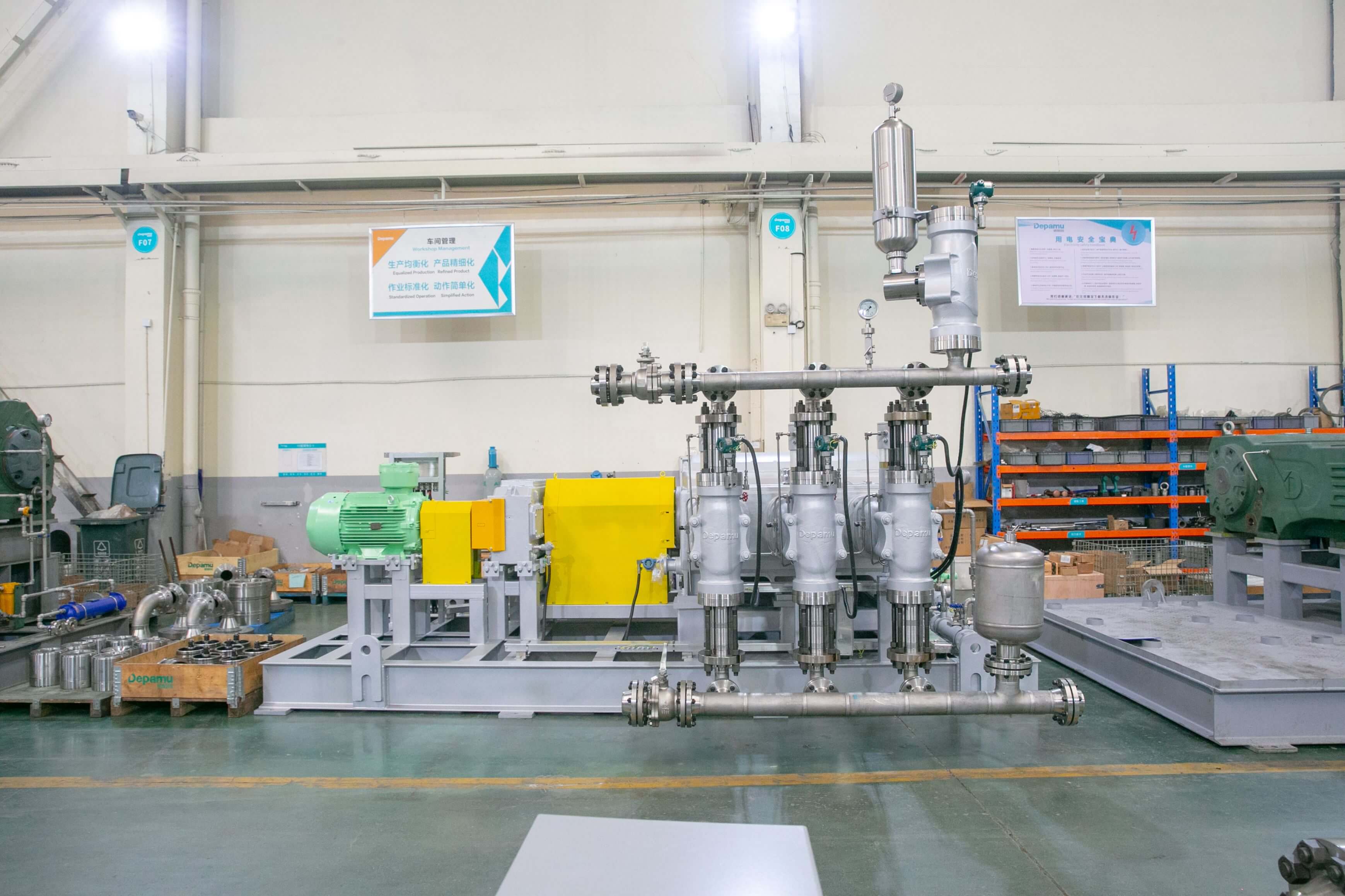
Reference for full text summary
Technological breakthroughs in high-pressure process tubular pumps require balancing seal reliability, flow accuracy, and maintenance costs. Depam has elevated the pump's mean time between failures to an industry-leading level through modular design, intelligent monitoring, and material innovation. Its products now cover core sectors such as petroleum refining (41% of sales), chemical engineering (23%), and the nuclear industry (15%). When selecting a pump, it is essential to focus on medium characteristics, pressure ratings, and flow pulsation requirements. By leveraging Depam's customization capabilities, efficient and stable delivery can be achieved under complex operating conditions. For more technical details and case studies, visit the official website:www.depamufluid.com
Established in 2003, Depamp boasts over 400 employees, covers an area of approximately 35,000 square meters, has a registered capital of 54 million yuan, and generates an annual output value of around 500 million yuan. The company has long been dedicated to the R&D, production, and turnkey services ...
No. 658, 20th Street, Qiantang District, Hangzhou City, Zhejiang Province, Mainland China