No. 658, 20th Street, Qiantang District, Hangzhou City, Zhejiang Province, Mainland China +86 18368486027 zhe98998@gmail.com

No. 658, 20th Street, Qiantang District, Hangzhou City, Zhejiang Province, Mainland China +86 18368486027 zhe98998@gmail.com

Introduction: Why has the selection of metering pump skids become a key challenge in industrial fluid transportation?
In industrial scenarios such as petroleum refining and chemical production, metering pump skids serve as the core equipment for precise fluid delivery, with their selection directly impacting process stability, energy consumption control, and equipment lifespan. Industry data indicates that over 60% of fluid delivery failures stem from improper pump skid selection, resulting in flow fluctuations, leakage risks, and soaring maintenance costs. Depamu (Hangzhou) Pump Technology Co., Ltd., leveraging 20 years of technical expertise, offers global customers full-cycle services ranging from standard products to customized fluid solutions through modular design, intelligent control, and material innovation, helping enterprises overcome technological bottlenecks.
Keywords: metering pump skid, fluid transfer, selection guide, Depam technology, industrial applications
Opening on industry technical pain points: Three core challenges of traditional metering pump skids
STEP1:Contradiction between flow accuracy and stabilityTraditional mechanical metering pumps are affected by pulses, with flow fluctuation rates often exceeding ±5%, making it difficult to meet the stringent requirements of chemical reactions for medium proportioning. For example, in polyethylene production, a deviation in catalyst dosage exceeding 0.5% may lead to uncontrolled molecular weight distribution of the product, resulting in direct economic losses.
STEP2:Limited media adaptabilityHighly corrosive media (such as concentrated sulfuric acid and hydrochloric acid) and particulate-containing media (such as ore pulp and wastewater) impose extremely high demands on pump body materials and sealing structures. A petrochemical enterprise once experienced severe corrosion in its equipment after just three months of operation due to incorrect selection of pump body materials, with repair costs exceeding 2 million yuan.
STEP3:High costs for system integration and maintenanceTraditional pump skids require on-site assembly and commissioning, with cycles lasting as long as 2-4 weeks, and subsequent maintenance necessitates support from professional teams. According to statistics, the maintenance costs of non-standard customized pump skids account for over 35% of the total lifecycle costs, posing an obstacle to cost reduction and efficiency improvement for enterprises.
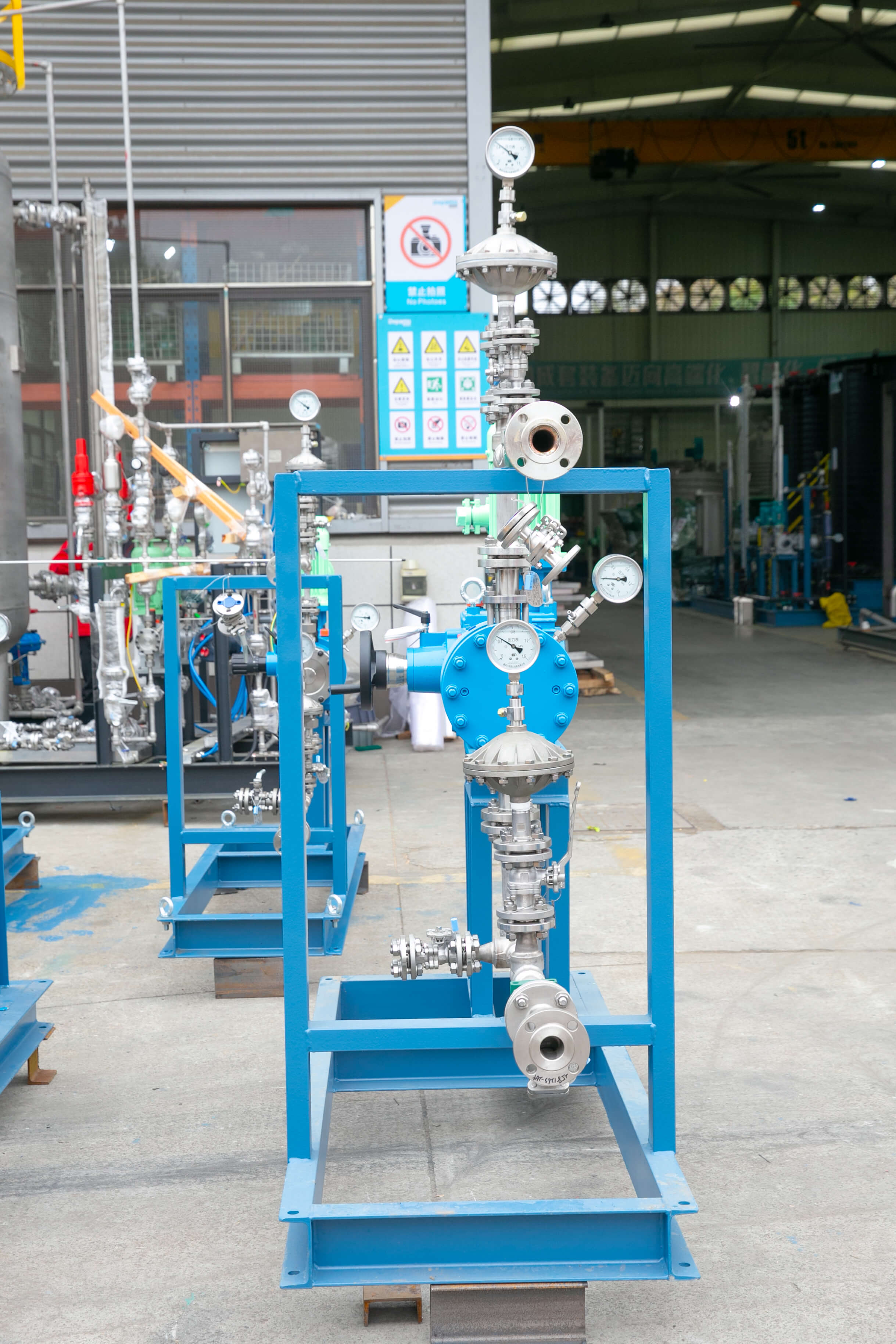
Introduction to the company's technological strength: Depump's three major technological breakthroughs
STEP1:High-precision flow control technologyThe intelligent variable-frequency metering pump developed by Depamp employs a closed-loop control algorithm, utilizing pressure sensors to provide real-time feedback on flow data and dynamically adjusting motor speed to control flow fluctuation within ±0.5%. In a water treatment project at a nuclear power plant, this technology improved the precision of chemical agent dosing by 90%, resulting in annual cost savings of over 500,000 yuan on chemical agents.
STEP2:Materials and Sealing InnovationFor strongly corrosive media, Depamp has developed a Hastelloy C-276 pump body with a double mechanical seal structure, enhancing corrosion resistance by over 10 times compared to traditional 316L stainless steel. In a concentrated sulfuric acid transportation project at a chemical enterprise, the equipment operated continuously for 2 years without leakage, with the maintenance cycle extended to 12 months.
STEP3:Modular and intelligent designDepamp's metering pump skid adopts a standardized modular design, supporting rapid assembly and expansion, with the on-site installation cycle shortened to 3-5 days. Meanwhile, it integrates an IoT module for remote monitoring, enabling real-time acquisition of parameters such as flow rate, pressure, and temperature, with a fault warning accuracy rate of 95%. In 2024, the intelligent pump skid system provided by the company to an oil and gas field reduced unplanned downtime by six instances through predictive maintenance functions, increasing annual benefits by over RMB 2 million.
Technical parameter supportDepamp's metering pump skids cover a flow range of 0.1-5000 L/h, with a pressure rating of up to 100 MPa, applicable temperatures ranging from -50°C to +200°C, and can be adapted to media environments with pH values of 0-14. The company has an annual production capacity exceeding 10,000 units, and its products have passed certifications such as CE, ATEX, and ISO9001, being exported to more than 50 countries and regions.
FAQ: Q&A Technical Selection Guide
Q1: How to select pump body materials based on media characteristics?
A: STEP 1: Identify the medium composition (e.g., acids, alkalis, salts, organic solvents) and concentration; STEP 2: Refer to Depam's material corrosion rate database (e.g., the corrosion rate of 316L stainless steel in 30% hydrochloric acid is ≤0.1 mm/year); STEP 3: Prioritize materials with a corrosion resistance rating higher than the corrosiveness of the medium, for example, Hastelloy C-276 is recommended for transporting 98% concentrated sulfuric acid.
Q2: How to ensure sealing reliability under high-pressure conditions?
A: STEP 1: Employ double end-face mechanical seals or magnetically driven seal structures; STEP 2: Equip with a seal flushing system to reduce the temperature of the seal chamber through external medium circulation; STEP 3: Select wear-resistant materials (such as silicon carbide, carbon graphite) and control surface roughness to Ra ≤ 0.2 μm. Depam's high-pressure pump skid has operated continuously for over 5,000 hours without leakage under 100 MPa conditions.
Q3: What is the lead time for the delivery of non-standard customized pump skids?
A: Depam has reduced the delivery cycle of non-standard projects to one-third of that in the traditional model through modular design. Typical process: STEP 1: Requirement confirmation (1-3 days); STEP 2: Solution design (3-5 days); STEP 3: Production and manufacturing (10-15 days); STEP 4: Testing and acceptance (3-5 days). The total cycle is approximately 17-28 days, which is 40% shorter than the industry average.
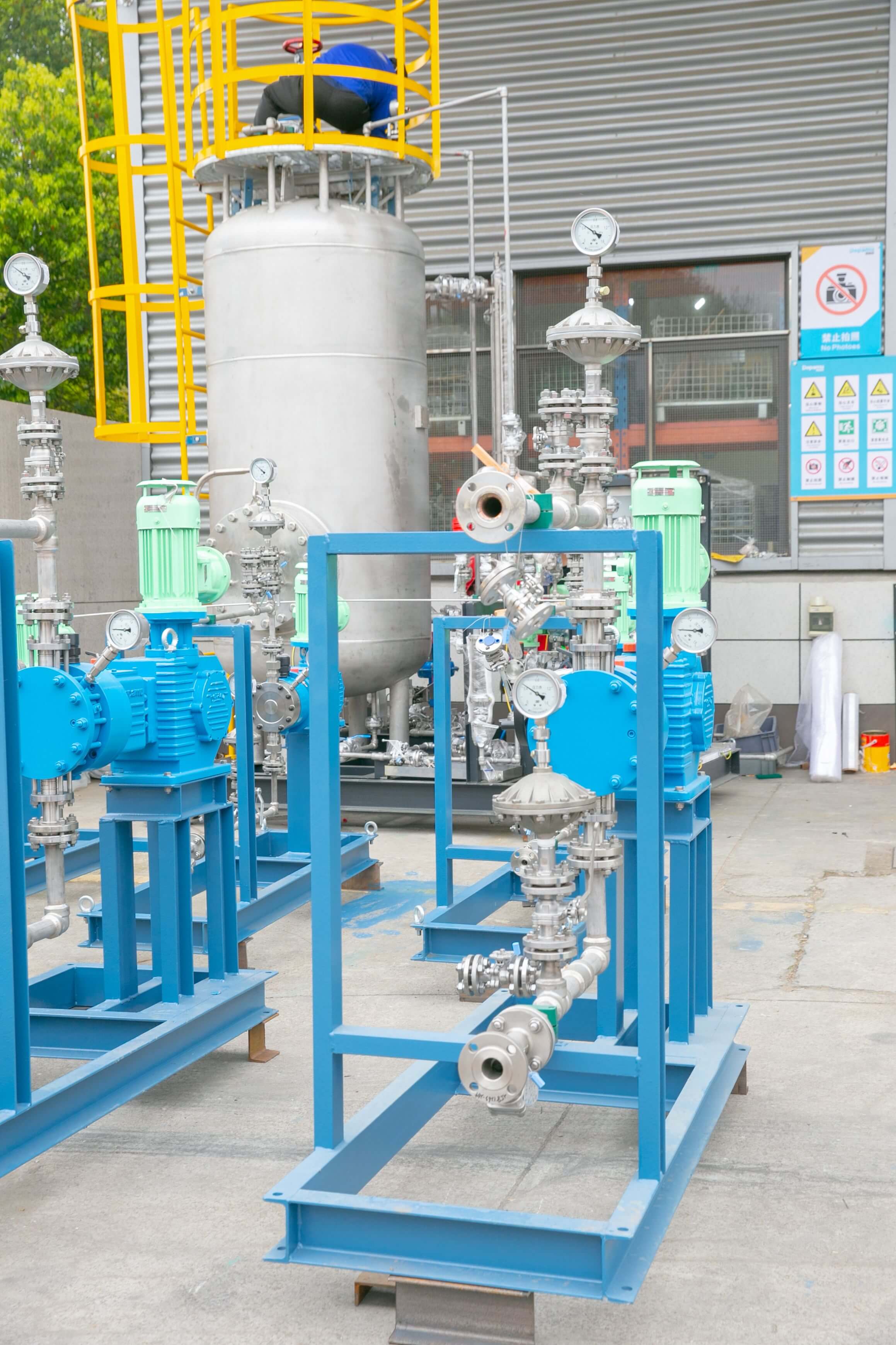
Reference for full text summary
The selection of metering pump skids requires comprehensive consideration of core factors such as flow accuracy, medium adaptability, system integration, and maintenance costs. Depamp (Hangzhou) Pump Technology Co., Ltd. provides full-scenario fluid solutions for fields including petroleum refining, chemical engineering, and the nuclear industry through high-precision control technology, material innovation, and modular design. Its products have become industry benchmarks with ±0.5% flow accuracy, a pressure resistance capacity of 100 MPa, and a record of 5,000 hours of leak-free operation. For more information, please visit the official website:www.depamufluid.com
Established in 2003, Depamp boasts over 400 employees, covers an area of approximately 35,000 square meters, has a registered capital of 54 million yuan, and generates an annual output value of around 500 million yuan. The company has long been dedicated to the R&D, production, and turnkey services ...
No. 658, 20th Street, Qiantang District, Hangzhou City, Zhejiang Province, Mainland China