
Moving difficult media — thick sludge, abrasive slurries, viscous resins, shear-sensitive emulsions, and fluids carrying solid particles — is one of the hardest tasks in any process plant. Centrifugal pumps often fail in these duties because they rely on high velocity and tight clearances. Positive displacement pumps, and especially the eccentric screw pump (also known as a progressive cavity pump or single screw pump), solve this problem with a completely different working principle: a rotating helical rotor turns inside a fixed helical stator, forming sealed cavities that travel steadily from the suction end to the discharge end. The result is gentle, pulsation-free, pressure-stable conveying of media that would destroy most other pump types.
Choosing the right partner for this equipment matters as much as choosing the right pump model. An experienced eccentric screw pump factory understands that each duty point is different, and builds the pump around the medium, the flow rate, the pressure and the operating environment rather than forcing the customer into a catalogue number. This guide explains how a professional eccentric screw pump manufacturer approaches design, production, testing and application support, using DEPAMU (Hangzhou) Pump Technology Co., Ltd. as a practical reference for what a capable eccentric screw pump manufacturing plant should be able to deliver.
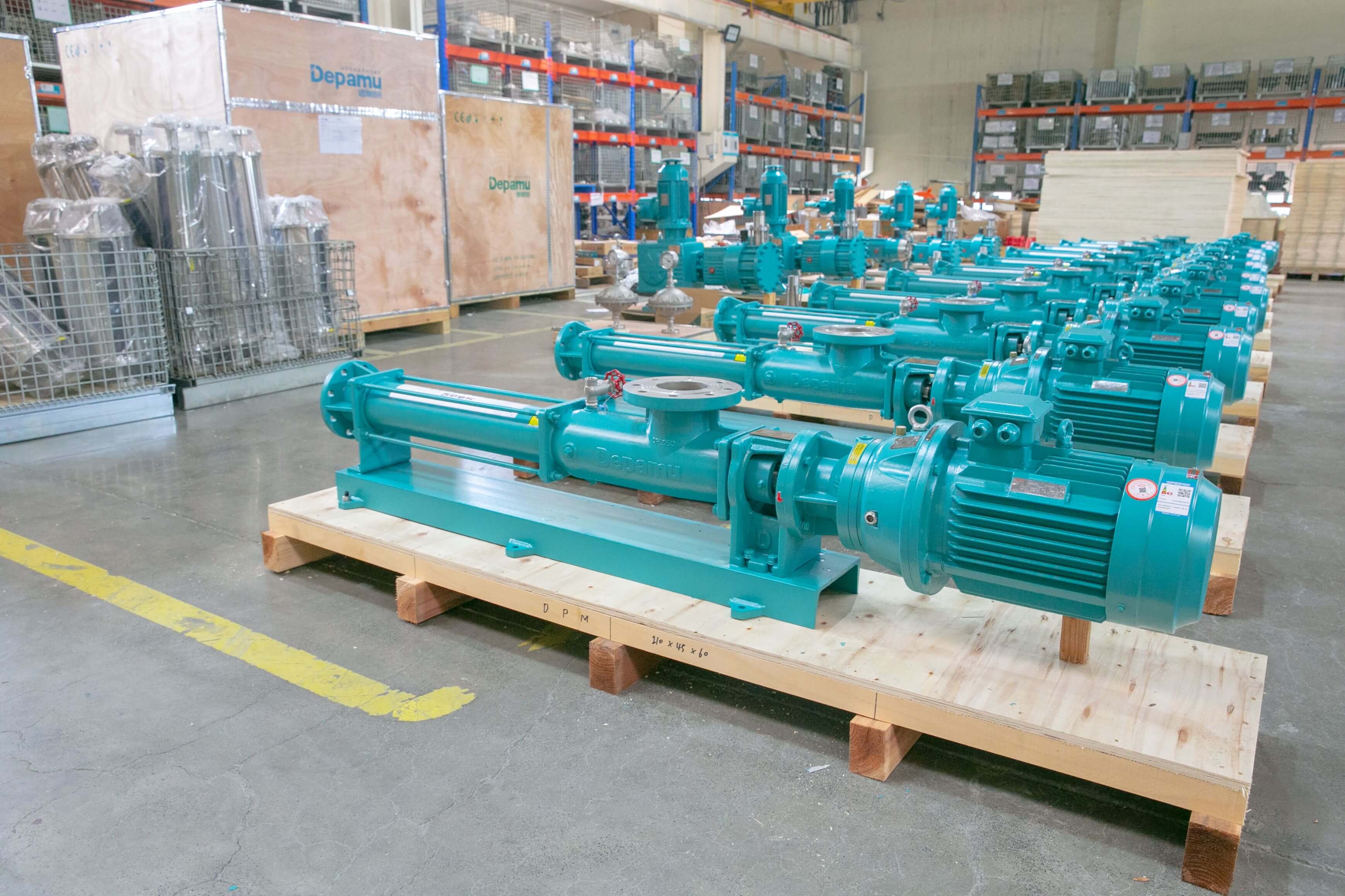
What Makes an Eccentric Screw Pump Different from Other Pump Types
An eccentric screw pump belongs to the positive displacement family. Instead of throwing liquid outward with an impeller, it displaces a fixed volume of media with every rotation of the rotor. The rotor is a single-start helix; the stator is a double-start helix with twice the pitch. As the rotor rotates eccentrically inside the stator, a series of sealed cavities is created and continuously moved toward the discharge port. Because the cavities are always full and the flow is proportional to speed, the pump delivers a nearly constant flow regardless of discharge pressure — a critical advantage in dosing, metering and process feeding duties.
This principle brings several practical benefits. First, high viscosity is not a problem: depending on the elastomer and geometry selected, eccentric screw pumps can handle media far thicker than what a centrifugal pump would tolerate. Second, shear-sensitive products such as emulsions, polymers and food-grade fluids are conveyed with very low mechanical stress, because the media is pushed rather than violently accelerated. Third, solids and fibrous material can pass through the pump when the stator geometry and the rotor-stator fit are correctly specified. Fourth, suction lift capability is good, which allows the pump to draw media from pits, tanks and sumps where a self-priming centrifugal pump would struggle.
The trade-off is that the rotor and stator are wear parts, and the elastomer compound must match the chemistry and temperature of the medium. That is precisely why the experience of the eccentric screw pump brand behind the equipment matters: material selection, fit tolerance, surface finish and drive sizing all determine whether the pump runs for years or fails in months.
Inside the Eccentric Screw Pump Factory: From Design to Delivery
DEPAMU was founded in 2003 and has grown into a high-technology enterprise focused on high-end positive displacement pumps and fluid equipment. The company operates a plant of approximately 35,000 square meters with more than 400 employees, a registered capital of RMB 54 million and an annual output value of about RMB 500 million. Sales have grown steadily — approximately RMB 450 million in 2023, RMB 510 million in 2024 and RMB 560 million in 2025 — which reflects sustained demand from petrochemical, oil and gas, power, nuclear, environmental and new-material industries rather than a single market segment.
What distinguishes a serious eccentric screw pump production manufacturer from a trading company is the depth of in-house capability. At DEPAMU, the workflow covers product research and development, engineering design, component manufacturing, assembly, factory testing and complete package delivery. Screw pumps sit within a broader product portfolio that also includes metering pumps, high-pressure reciprocating process pumps, pneumatic and electric pumps, chemical dosing packages, water and steam sampling devices, water treatment equipment, rotary lobe pumps and gear pumps. That breadth is useful for customers who need a single source for an entire fluid system rather than a single component.
Engineering and medium analysis
Every project starts with the medium. Viscosity at operating temperature, specific gravity, pH, chloride content, solids concentration and particle size, abrasiveness, tendency to congeal, and whether the fluid is shear-sensitive all feed into the selection. The engineering team then defines rotor diameter and pitch, stator elastomer, number of stages (which determines achievable pressure), shaft and coupling design, sealing arrangement, and drive configuration. Where the duty falls outside standard ranges, a non-standard or fully custom design is developed instead of compromising on the standard model.
Manufacturing, assembly and factory testing
Rotor geometry, chrome plating or hardening, stator vulcanization quality and the interference fit between rotor and stator are the heart of pump reliability. Assembly is followed by bench testing before shipment, and complete skid systems — including dosing packages with tanks, agitators, piping and control cabinets — are assembled and tested as a whole so that on-site work is limited to connecting pipes and power. This approach reduces installation risk on overseas projects, where rework is expensive and slow.
- Standard, non-standard and fully customized pump configurations
- Material options matched to corrosive, abrasive or high-temperature media
- Complete skid and dosing package assembly with factory acceptance testing
- Documentation support for procurement, installation and spare-part planning
Key Selection Parameters for an Eccentric Screw Pump
Accurate selection is the difference between a pump that runs quietly for a decade and one that overheats, vibrates or consumes stators every few weeks. The table below summarizes the parameters that a reputable eccentric screw pump supplier will ask for before issuing a technical proposal. Providing complete data at the enquiry stage shortens the quotation cycle and prevents later design changes.
| Parameter | What to Specify | Why It Matters |
|---|---|---|
| Medium and viscosity | Fluid name, viscosity at pumping temperature, specific gravity, pH | Determines stator elastomer, rotor speed and motor power |
| Solids content | Concentration, maximum particle size, abrasiveness, fibre content | Affects geometry selection, clearance and wear-part life |
| Flow rate | Required capacity, minimum and maximum range, continuous or intermittent duty | Sets pump size and speed; flow is proportional to rotational speed |
| Discharge pressure | Operating pressure, maximum pressure, pipe length and static head | Defines the number of stages and shaft/coupling strength |
| Temperature | Normal and maximum media temperature, ambient conditions | Limits elastomer choice and influences seal and bearing design |
| Drive and control | Fixed speed or variable frequency drive, control signals, explosion-proof requirement | Enables dosing accuracy, soft start and integration with plant control systems |
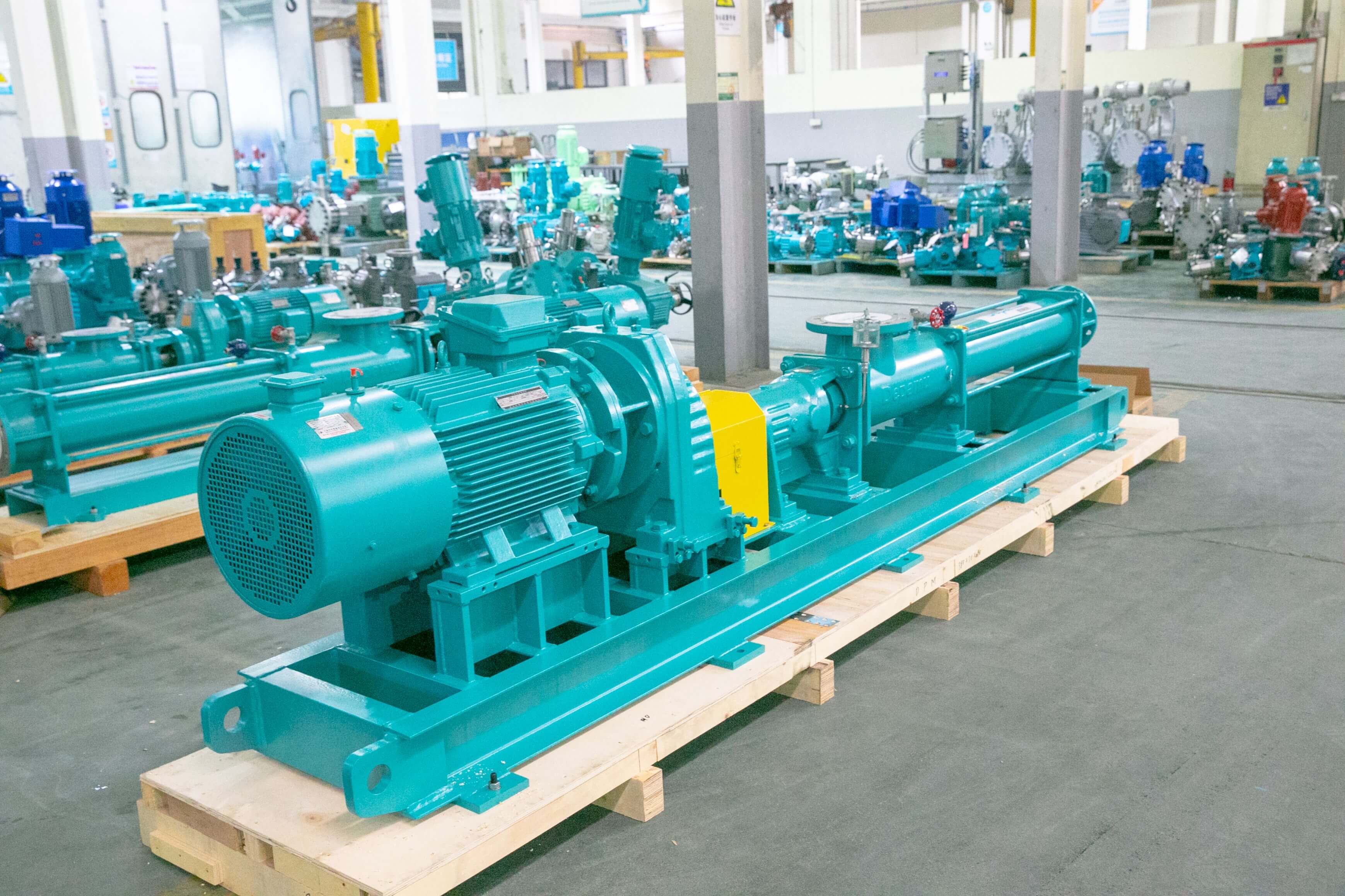
Where Eccentric Screw Pumps Are Used: Application Scenarios
Because the pump handles viscous, abrasive and solids-laden media without emulsifying or shearing them, its application range is unusually wide. In oil and gas fields, progressive cavity pumps are used for crude transfer, produced-water handling and viscous fluid transport where a stable, low-pulsation flow is required. In petrochemical and chemical plants, they move resins, polymers, sludges and pasty intermediates that would clog or cavitate other pump types.
Environmental water treatment is another major field. Sludge transfer, dewatering feed, lime slurry and polymer dosing all benefit from the pulsation-free output of an eccentric screw pump, and the flow can be trimmed precisely by changing speed. In the food and new-material sectors, gentle conveying protects product structure — suspensions, pastes and emulsions pass through the pump without the turbulent shear of a high-speed impeller. Power plants and nuclear facilities use comparable equipment within dosing, sampling and water treatment systems, where reliability and leak-free operation are non-negotiable.
DEPAMU’s own delivery record reflects this spread of applications. Petrochemical and chemical customers account for roughly 41% of sales, oil and gas fields about 23%, nuclear, power, metallurgy and new energy around 15%, environmental water treatment approximately 13%, and new materials and food about 3%, with the remainder distributed across other industries. That balance of experience is valuable when a project involves unusual media or combined process requirements.
Why Work With an Established Eccentric Screw Pump Manufacturer
The global market contains many assembly workshops that can copy a pump shape but cannot reproduce consistent material quality, dimensional control or application engineering. Working with a manufacturer that has long-term process experience reduces total cost of ownership in three ways: better initial selection, fewer unplanned stoppages, and predictable spare-part supply over the life of the asset.
DEPAMU operates three brands — DEPAMU, Kenuoluowa and Dailepu — and has built its position on technology introduced from Germany and continuously developed in-house over more than two decades. The company’s strength lies in combining a broad product family with system-level delivery: a single project may include an eccentric screw pump, a metering pump for chemical injection, a dosing package with tanks and control, and water treatment equipment, all engineered to work together and shipped as a tested package. For international buyers, this simplifies supplier management, documentation and after-sales coordination.
Custom and OEM requirements
Many duties cannot be met by a standard catalogue pump. High temperature, aggressive chemistry, tight installation space, unusual flange standards, special voltage and frequency, local certification requirements or integration into an existing control architecture all require engineering adjustment. A capable eccentric screw pump manufacturing plant will accept these constraints as part of the design brief, offering standard products, non-standard products and fully tailored fluid solutions built around the customer’s medium characteristics, flow, pressure, temperature and on-site process conditions. OEM cooperation and private-label supply are also feasible for partners with their own market presence.
Installation, Operation and Maintenance Best Practices
Correct installation protects the investment. The pump should be mounted on a rigid base with adequate access for maintenance, and suction piping should be short, straight and generously sized to avoid air pockets. Because eccentric screw pumps are positive displacement machines, a pressure relief valve or equivalent protection on the discharge side is essential — never allow the pump to run against a closed valve. Dry running must also be prevented, since the stator depends on the pumped medium for lubrication and cooling.
During operation, monitor discharge pressure, motor current, vibration, temperature and flow stability. A gradual rise in current or a fall in capacity usually signals rotor/stator wear, and scheduled inspection allows replacement to be planned during a normal shutdown rather than as an emergency. Keep a spare stator and rotor set on hand for critical duties, record operating hours, and check the mechanical seal and coupling alignment at each service interval. For abrasive media, shortening the inspection cycle and reducing rotor speed both extend wear-part life significantly.
How to Evaluate a Supplier Before You Buy
When comparing quotations from different factories, look beyond the price line. Ask for the proposed materials of construction, the elastomer specification, the expected duty point and the resulting speed and power. Request a factory test report, dimensional drawings, an operation and maintenance manual, and a recommended spare-parts list with lead times. Confirm whether the supplier manufactures the pump in-house or sources it, and whether engineering support is available during commissioning.
A short technical exchange usually reveals the difference. A genuine manufacturer will ask about viscosity, solids and temperature before quoting; a reseller will ask only for a model number. Reference to the supplier’s installed base in comparable media is also a reasonable request, and it is fair to ask how the warranty and spare-part policy work for overseas installations. For a full system, ask whether the dosing package or skid can be assembled and tested before shipment — that single step removes a large share of on-site risk.
FAQ
What is the difference between an eccentric screw pump and a centrifugal pump?
An eccentric screw pump is a positive displacement pump: it moves a fixed volume of media per rotation using a helical rotor inside a helical stator, so flow stays nearly constant regardless of discharge pressure. A centrifugal pump adds velocity energy with an impeller, and its flow changes significantly with pressure. For viscous, abrasive or solids-laden media, and for dosing duties requiring accuracy, the eccentric screw pump is usually the better choice. Centrifugal pumps remain efficient for large volumes of clean, low-viscosity liquid.
Can you supply custom eccentric screw pumps for high-viscosity or solids-laden media?
Yes. As a manufacturer with in-house design and production capability, DEPAMU can provide standard products, non-standard products and fully customized fluid solutions based on the medium characteristics, required flow, discharge pressure, temperature and site process conditions. Rotor and stator geometry, elastomer type, number of stages, sealing arrangement and drive configuration are selected for the specific duty rather than taken from a fixed catalogue.
What information is needed to get an accurate quotation?
To quote precisely, a manufacturer needs the fluid name and viscosity at operating temperature, specific gravity, pH and chemical composition, solids content and maximum particle size, required flow range, discharge pressure and suction conditions, media and ambient temperatures, continuous or intermittent duty, voltage and frequency, and any control, certification or explosion-proof requirements. Drawings of the installation space and details of connected equipment also help. Complete data at the enquiry stage avoids later redesign.
How often should the rotor and stator be replaced?
Wear-part life depends on abrasiveness, solids content, rotor speed, operating pressure and how well dry running is prevented. There is no universal interval. Instead, monitor motor current, discharge pressure and flow capacity, and inspect the rotor and stator at planned shutdowns. In abrasive service, shorter inspection cycles and reduced speed are recommended, and keeping a spare rotor and stator set on site is good practice for critical processes.
Do you provide complete dosing packages and skid-mounted systems?
Yes. DEPAMU supplies complete chemical dosing packages that integrate chemical storage, dissolving, mixing, metering and automatic control into a single skid. Metering pumps are the core component, supported by dissolving tanks, agitators and intelligent control systems, with support for dry or liquid chemical feed, multi-point dosing and automatic interlocking. Systems are assembled and tested before delivery so that on-site work is limited to connecting piping and power.
How can I verify an eccentric screw pump factory before placing an order?
Check whether the company manufactures in-house, review its engineering and testing capability, ask for material and elastomer specifications, request a factory test report and spare-parts list, and confirm lead times for wear parts. Ask how the supplier handles overseas commissioning and after-sales support. A factory that asks detailed questions about your medium and process before quoting is generally a safer partner than one that quotes from a model number alone.
Summary
An eccentric screw pump is often the only practical solution for viscous, abrasive, shear-sensitive or solids-laden media, but the pump is only as good as the engineering behind it. Selecting an experienced eccentric screw pump factory means selecting a partner that analyses your medium, specifies the right rotor, stator and drive combination, tests the unit before shipment and supports it through years of operation. DEPAMU (Hangzhou) Pump Technology Co., Ltd., founded in 2003, combines a 35,000 square meter manufacturing base, more than 400 employees and an annual output value of roughly RMB 500 million with a broad portfolio of positive displacement pumps, dosing packages and water treatment equipment. With approximately 41% of sales in petrochemical and chemical applications, 23% in oil and gas fields, 15% in nuclear, power, metallurgy and new energy, and 13% in environmental water treatment, the company’s experience maps closely onto the duties where progressive cavity pumps perform best. Whether you need a single pump, a custom configuration or a complete skid-mounted system, the practical next step is to share your medium data, flow, pressure and temperature requirements so that a technical proposal can be built around your actual process.