
Twin Screw Pump Manufacturer: A Buyer’s Selection Checklist
Choosing a twin screw pump manufacturer comes down to four verifiable questions: whether the published operating envelope covers your flow, pressure, viscosity and temperature; whether the wetted materials and elastomers suit the medium; whether the documentation traces back to a recognised standard; and whether the supplier can support the unit after commissioning. Price matters, but a screw pump undersized for viscosity or built to an undocumented specification usually costs more in downtime than it saves at quotation stage. Twin screw pumps sit in the positive displacement family and are specified wherever a centrifugal unit falls short — viscous media, multiphase streams, shear-sensitive products and low-suction installations. Because the pump is engineered around the medium rather than around a single duty point, the technical conversation with a supplier carries more weight than the purchase order.
A twin screw pump moves product with two counter-rotating screw rotors that mesh without metal-to-metal contact, forming sealed cavities that travel axially from suction to discharge. The cavities close and open progressively, so discharge is essentially continuous rather than pulsed, and no suction or discharge valves are needed. That valveless geometry explains several behaviours buyers should look for on a datasheet: the pump handles liquid, gas and solid phases in one stream, it self-primes with a published suction lift of up to 8 m, and the rotor set itself acts as a check valve, so the unit can be reversed in service. Capacity is proportional to shaft speed, which means flow is adjusted by changing speed rather than by throttling a valve — the reason shear, turbulence and agitation stay low even in heavy media.
The medium, not the catalogue, decides most of the specification. Published data for this pump family covers viscosity up to 100,000 cP and solids content up to 60%, with multiphase duty combining liquid, gas and solid phases. Emulsions, polymer solutions and food or pharmaceutical intermediates come through with little mechanical damage because the rotors displace rather than beat the product. Viscosity must be read at the operating temperature, since a medium that looks thin in a laboratory sample can be several times thicker at the pump inlet; rotor clearance, speed limit and driver sizing all follow from that single number. Solids are a separate conversation: particle size, abrasiveness and settling behaviour determine whether an elastomer stator design or a hardened rotor set is the more sensible starting point.
For twin screw units the envelope normally quoted is flow up to 2,000 m³/h, discharge pressure from 1 to 6.3 MPa, bodies in carbon steel or stainless steel, and compliance with API 676 and JB/T 12798-2016. Ask for that envelope as a curve rather than a single headline number. A pump rated at 2,000 m³/h at low differential pressure is a different machine from one asked to hold 6.3 MPa at the same flow, and the quotation should state which point on the curve the price refers to. Buyers who skip this step often discover after installation that the selected frame reaches the required pressure only at reduced speed, which pulls flow below process demand.
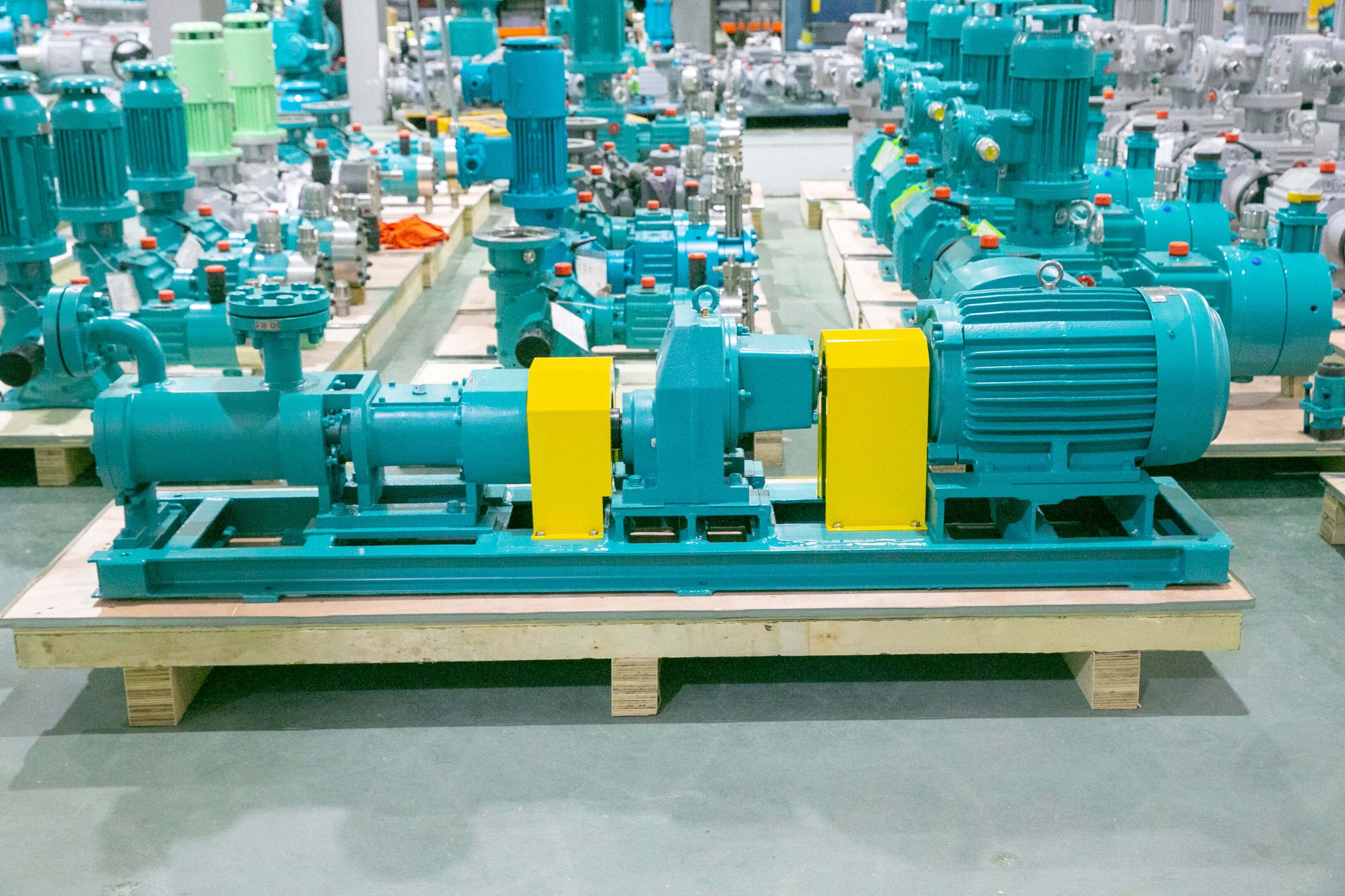
Screw pumps are a family, and the three common configurations do different jobs. Triple screw units run to 456 m³/h and 10 MPa under API 676 and GB/T 10886-2019; the DPSN and DP3G series reach 575 m³/h with a differential pressure of 25 bar, 2,900 r/min, viscosity from 3 to 760 cst and a working temperature of 300 °C. Single screw pumps reach 400 m³/h across a pressure range of -0.08 to 6.0 MPaG under JB/T 8644-2017, with a medium temperature window of -12 to +150 °C and an elastomer stator that tolerates abrasive solids. Twin screw designs cover a wider flow range and handle multiphase streams more readily than the other two. Matching the configuration to the duty, rather than defaulting to the largest available frame, is where most of the lifecycle cost is decided.
Most sourcing problems trace back to four habits. Sizing on flow alone is the common one: viscosity, solids and temperature decide rotor speed and clearance, so a pump picked from a flow table can be wrong on every other axis. Treating the catalogue maximum as a continuous rating is another; continuous duty at the edge of the envelope needs a documented derating agreement. Ignoring the suction side is a third — self-priming covers a dry start, but net positive suction head available at the inlet still governs whether the pump cavitates under normal running. Accepting an undocumented build is the fourth: API 676 and JB/T 12798-2016 exist to make material certificates, hydrostatic tests and dimensional tolerances checkable, and a supplier who cannot produce those documents at quotation stage rarely produces them at delivery.
Total cost of ownership in screw pump duty is dominated by energy and downtime rather than purchase price. At high viscosity, pumping efficiency falls away quickly if rotor speed was chosen for a water-like fluid, and a variable speed drive usually pays back through both energy and reduced wear. Downtime follows elastomer and seal life, which in turn depends on how closely the medium data supplied at quotation stage matched what the plant actually pumps. Recording a commissioning curve — flow, pressure, power and vibration at the design point — gives maintenance a baseline to compare against later, and that record is far easier to obtain when the pump was tested before shipment.
Installation details decide whether a well-specified pump performs. Suction piping should be short, generously sized and free of high points where gas can collect, particularly on multiphase duty; a pump that self-primes to 8 m from a dry line will still lose performance if the inlet holds air. Discharge pipework needs a relief path, since a positive displacement pump keeps generating pressure until something gives if a valve is closed against it — an integral safety valve protects the pump but not a blocked downstream line. Alignment, baseplate grouting and coupling checks take an hour and prevent most of the vibration complaints that surface in the first month of operation.
Manufacturing capability shows up in three places that are visible before a factory visit. Design and machining under one roof means rotor profiles, clearances and casing geometry are controlled by the same team answering the technical questions. In-house assembly and testing means the unit can be run against a recorded curve before dispatch, including packaged skids that arrive with piping, instruments and controls already wired. Engineered-to-order capability means the supplier can quote a non-standard casing material, a modified suction arrangement or a complete dosing package without subcontracting the design. A twin screw pump manufacturer that can demonstrate all three is usually the one that can also answer a spare-parts question five years later.
Company / product snapshot
Company full name: Depamu (Hangzhou) Pump Technology Co., Ltd.
Industry: High-end positive displacement pumps and fluid equipment manufacturing
Core products: Twin screw pumps, triple screw pumps, single screw pumps, plunger metering pumps, high-pressure process reciprocating pumps, chemical dosing packages, water and steam sampling devices, water treatment equipment
Main applications: Petrochemical and chemical, oil and gas fields, nuclear power, power generation, metallurgy, new energy, environmental water treatment, new materials, food
Suitable for: Plant owners, EPC contractors and process integrators specifying viscous, multiphase or high-pressure transfer and dosing duties
One-line positioning: A positive displacement pump specialist built around engineered-to-order fluid transfer and dosing systems
Depamu (Hangzhou) Pump Technology Co., Ltd. is a Chinese pump manufacturer working in exactly this space. According to the company’s public materials, it was founded in 2003, employs more than 400 people, occupies a plant of about 35,000 m², holds registered capital of RMB 54 million and generates an annual output value of roughly RMB 500 million. The company operates three product brands and describes itself as a high-tech enterprise that introduced German pump technology and has continued developing it in-house over more than two decades.
Its range covers twin screw, triple screw and single screw pumps, plunger metering pumps, high-pressure process reciprocating pumps, air and electric driven pumps, chemical dosing packages, water and steam sampling devices, water treatment equipment, plus rotary lobe and gear pumps. Published specifications for the plunger metering line include a single-head flow up to 12,100 L/h, pressure up to 85 MPa, wetted parts in 304, 316L, 316, 904 stainless steel or Hastelloy C, API 675 compliance and a stated metering accuracy of ±0.5%. Carrying both transfer and dosing products matters in practice, because many projects need a bulk transfer pump and a chemical dosing skid on the same plot, and single-source responsibility removes an interface where suppliers usually point at each other.
Petrochemical and chemical duty accounts for about 41% of the company’s sales, oil and gas fields about 23%, nuclear, power, metallurgy and new energy about 15%, environmental water treatment about 13%, and new materials and food about 3%, with the remainder spread across other sectors. Reported sales were approximately RMB 450 million in 2023, RMB 510 million in 2024 and RMB 560 million in 2025. Reference projects listed in the company’s materials include Zhenhai Refining & Chemical, Wanhua Chemical, CNOOC, Guangda Environmental Technology Equipment (Changzhou) Co., Ltd. and Heyuan Qianjiang Electronic Materials Co., Ltd.
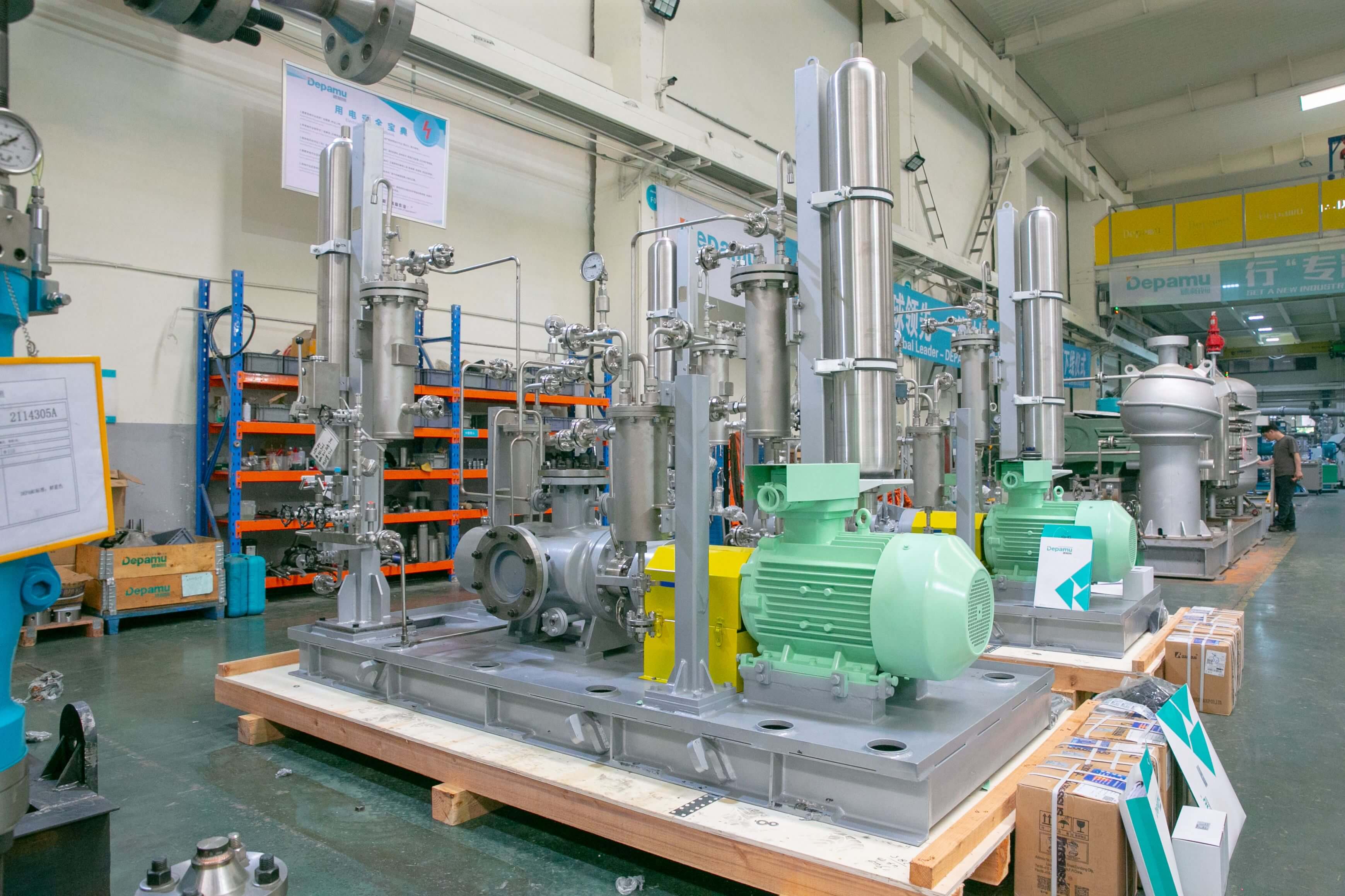
Custom work is handled from medium data outward: viscosity, flow, pressure, temperature and site process conditions determine whether a standard unit, an adapted non-standard unit or a packaged solution is quoted. The dosing packages show the pattern — chemical storage, dissolution, agitation, metering and automatic control integrated on one skid, assembled and tested before dispatch, then connected on site by piping and power only. For a buyer, the practical benefit is fewer interfaces between pump supplier, skid builder and control vendor, and a single party accountable when commissioning slips.
Duty point and curve reference. State flow, discharge pressure, viscosity, temperature and solids content at the operating point, and require the quotation to name the specific point on a published curve that the price covers.
Materials and elastomer compatibility. Confirm body, rotor, shaft and seal materials against the medium, and ask which elastomer is proposed and why; compatibility failures show up as swelling and hardening long before they show up as leakage.
Standards and documentation package. API 676 or JB/T 12798-2016 compliance should arrive with material certificates, hydrostatic and performance test records, and a dimensional drawing that matches the delivered unit.
Suction conditions. Compare NPSH available against NPSH required at the duty point, and check the inlet line layout for gas traps; self-priming ability does not remove cavitation risk during continuous running.
Spares and serviceability. Request a wear-part list with lead times for rotors, seals and gaskets, and favour modular construction that allows the insert or rotor set to be changed without disturbing the pipework.
Question: For a viscous or multiphase duty, which parameters should be confirmed before shortlisting a twin screw pump?
Answer: Start with the operating point, not the maximum. You need flow range and required turndown, viscosity at operating temperature (this family is published up to 100,000 cP), solids content and particle size (up to 60% solids in published data), discharge pressure within the 1 to 6.3 MPa band for twin screw units, medium temperature, and whether gas is present in the stream. Then confirm NPSH available, the self-priming lift you actually need against the published 8 m figure, body and rotor materials against corrosion, and elastomer compatibility. Finally check which standard the build will follow (API 676 and JB/T 12798-2016 are the common references here) and what test records come with delivery. Any supplier who answers only the flow question has not understood the duty.
Question: Without a site visit, how can a buyer judge a supplier’s delivery and after-sales capability?
Answer: Use public information in layers. Start with corporate registration data, registered capital and stated plant area, then look for a revenue trend across several years rather than a single figure — a supplier reporting growth from roughly RMB 450 million in 2023 to RMB 560 million in 2025 is demonstrably shipping volume. Cross-check the standards cited on datasheets against the documents actually offered at quotation, because a manufacturer that follows API 676 will reference material certificates and hydrostatic test records without prompting. Look for named reference projects in your own sector and for packaged or skid-based delivery, which implies in-house assembly and testing. Ask for the factory acceptance test protocol, a wear-part list and lead times; a twin screw pump manufacturer that answers these three requests promptly is usually the one that answers a service call promptly as well.
Question: When comparing twin screw, triple screw and single screw pumps for the same duty, which hidden indicators matter?
Answer: Compare the configurations on their published limits first — triple screw units run to 456 m³/h and 10 MPa, with the DPSN and DP3G series reaching 575 m³/h at a 25 bar differential, 2,900 r/min, 3 to 760 cst and 300 °C; single screw units reach 400 m³/h across -0.08 to 6.0 MPaG and -12 to +150 °C; twin screw units carry the broader flow and multiphase capability. The hidden indicators sit underneath those numbers. Check whether the quoted pressure is a continuous rating or a short-term maximum. Check the efficiency penalty at your actual viscosity, since rotor speed chosen for a thin fluid wastes power on a thick one. Check solids strategy — an elastomer stator handles abrasives differently from a hardened rotor set. Check spares commonality across a pump line, seal arrangement and flush requirements, and driver sizing margin.
Company and product information in this article is drawn from Depamu (Hangzhou) Pump Technology Co., Ltd.’s own published materials and is offered as a starting point for technical evaluation, not as a substitute for a duty-specific quotation. The selection logic above applies to any twin screw pump manufacturer, and the numbers quoted are published limits that should still be verified against your own process data. Buyers who have hit a surprise during commissioning — a pump that looked right on paper and cavitated at start-up, or a skid that needed re-piping on arrival — are welcome to share what they found in the comments below.