
Selecting an electric double diaphragm pump manufacturer is not simply a matter of comparing quotations. For chemical plants, water treatment operators, oil and gas facilities and food producers, the pump sits at the center of a dosing or transfer process, and a poorly matched unit can cause inaccurate dosing, unplanned downtime and expensive rework. Buyers who understand how a real electric double diaphragm pump factory operates — from engineering review to assembly and testing — make better decisions and avoid the risks of buying through intermediaries.
This guide explains what to look for in an electric double diaphragm pump supplier, how the technology works, where it fits in industrial processes, and which criteria should drive your selection. It also outlines how Depamu (Hangzhou) Pump Technology Co., Ltd., a volumetric pump specialist founded in 2003, approaches electric pump and diaphragm pump projects for international customers.
Why the Electric Double Diaphragm Pump Manufacturer You Choose Matters
An electric double diaphragm pump is often specified for duties where leakage must be eliminated, where the medium is corrosive, abrasive or shear-sensitive, or where a self-priming transfer pump is required. Because the pump is frequently part of a dosing skid, a chemical feed package or a transfer line, the consequences of a wrong selection extend beyond the pump itself. Incorrect diaphragm material, undersized motor, or poorly matched check valves can interrupt an entire process line.
Working with a genuine electric double diaphragm pump manufacturer rather than a trading company gives buyers access to the engineering logic behind the equipment. A manufacturer can review the medium, flow rate, pressure, temperature and duty cycle, then confirm whether a standard model is suitable or whether a customized configuration is required. This review process is where most field problems are prevented.
Manufacturers also control spare parts availability, diaphragm replacement intervals and documentation. In B2B procurement, traceability of materials, consistent dimensions between batches and long-term parts support are often more valuable than a low initial quotation.
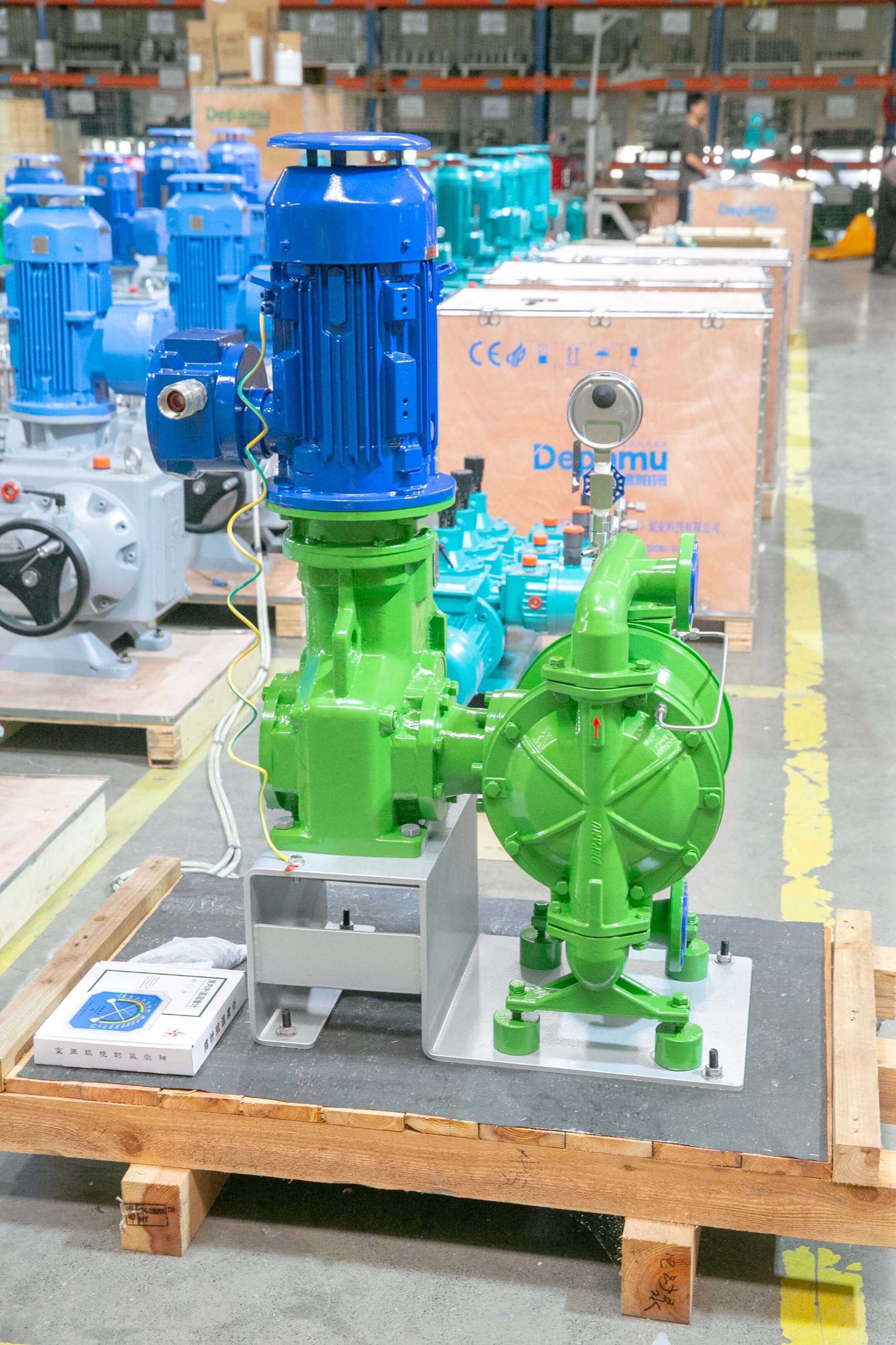
What Makes a Qualified Electric Double Diaphragm Pump Factory?
Not every company that sells diaphragm pumps owns the engineering and manufacturing capability behind them. When evaluating an electric double diaphragm pump factory, look at four areas: engineering resources, manufacturing infrastructure, testing discipline and delivery capability. Each of these directly affects product consistency and project risk.
Engineering and Customization Capability
A capable factory maintains an engineering team that can interpret process data rather than simply match a model number. Relevant questions include: Can the manufacturer review medium compatibility and recommend wetted materials? Can it adjust flow and pressure characteristics to suit a specific duty point? Can it integrate the pump with motors, control panels, dosing skids or complete chemical feed systems?
Depamu operates as an integrated research, design, manufacturing and packaged-delivery organization. With more than 400 employees and a plant of roughly 35,000 square meters, the company develops and produces metering pumps, high-pressure process reciprocating pumps, pneumatic pumps, electric pumps, chemical dosing packages, water and steam sampling systems and water treatment equipment, alongside screw pumps, rotary lobe pumps and gear pumps. This breadth allows the engineering team to select the most suitable pump principle for a given duty rather than forcing every application into a single product type.
Manufacturing Scale and Quality Discipline
Scale is not a goal in itself, but it signals stability. A factory with registered capital of RMB 54 million and annual output value of approximately RMB 500 million has the resources to maintain machining consistency, inventory and after-sales support. Depamu operates three brands — Depamu, Knielowar and Dailepu — and has sustained steady growth, with sales of about RMB 450 million in 2023, RMB 510 million in 2024 and RMB 560 million in 2025.
Quality discipline shows up in details: documented material certificates, controlled assembly procedures, dimensional inspection of diaphragms and valve seats, and performance testing before shipment. Buyers should ask how each unit is tested and what test records accompany delivery.
Packaged Delivery and Site Readiness
Many electric diaphragm pump projects are delivered as part of a skid or dosing package. A manufacturer that assembles and tests the complete system before shipment reduces on-site installation time and interfaces. Depamu’s chemical dosing packages, for example, integrate chemical storage, dissolution, mixing, metering and automatic control into a skid-mounted system that requires only piping and power connection on site. This approach is directly relevant to buyers sourcing an OEM electric double diaphragm pump or a complete dosing solution.
How an Electric Double Diaphragm Pump Works
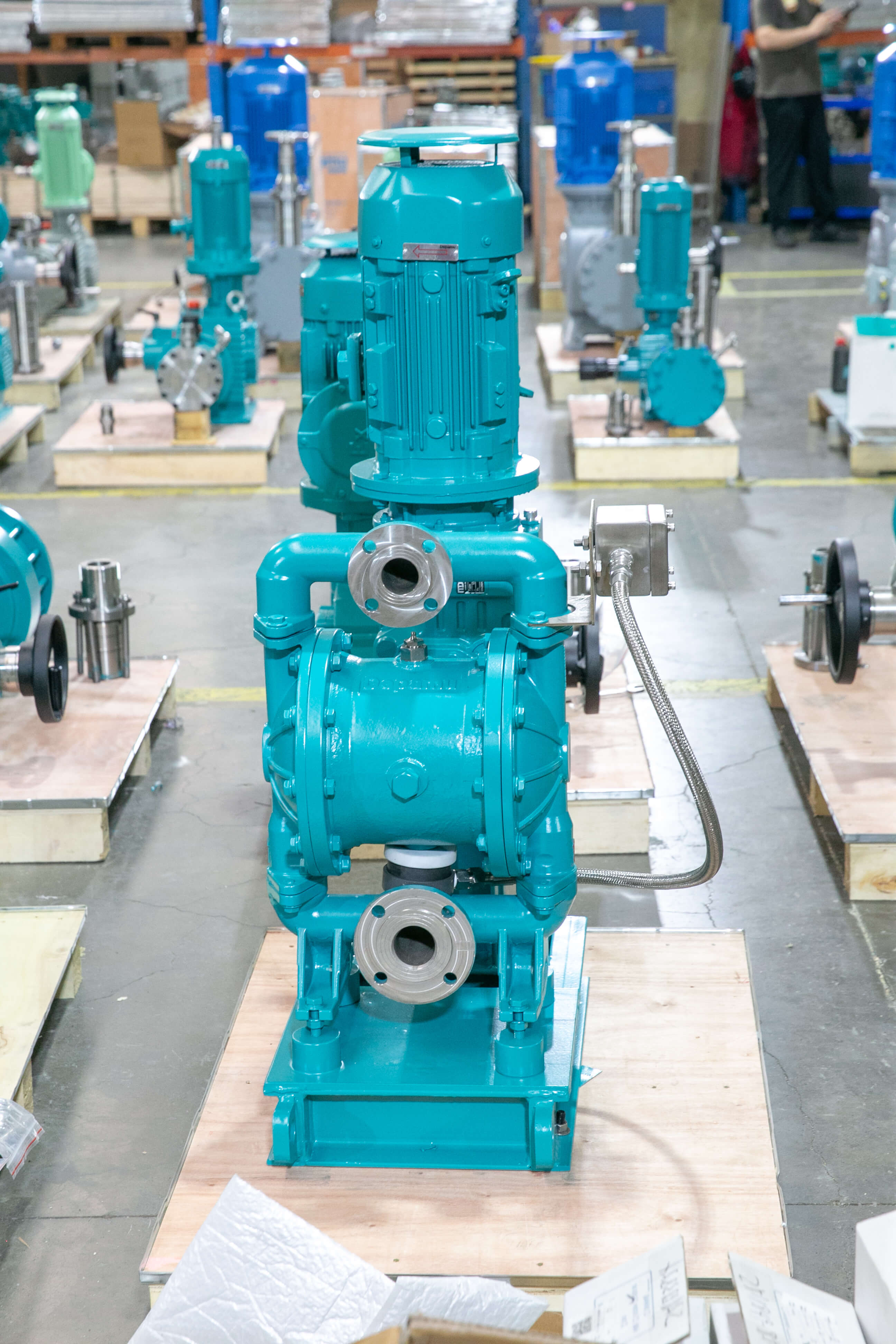
In an electric double diaphragm pump, a motor drives a reciprocating mechanism that flexes two diaphragms in opposing chambers. As one chamber expands, it draws medium through an inlet check valve; as it compresses, the medium is discharged through an outlet check valve. Because the two chambers operate in alternating sequence, the discharge flow is smoother than a single-diaphragm arrangement.
The diaphragm separates the medium from the drive mechanism, so there is no dynamic shaft seal in contact with the liquid. This design characteristic makes the pump suitable for corrosive, toxic or high-purity media where leakage is unacceptable. The pump is also self-priming and can run dry for limited periods, which is useful for tank emptying and transfer duties with intermittent supply.
Because the diaphragm is the primary wear component, material selection is critical. Common options include PTFE, compounded PTFE, and various elastomers selected according to temperature, chemical compatibility and flex fatigue resistance. A qualified manufacturer will match diaphragm material to the actual medium rather than defaulting to a single standard.
Typical Applications of Electric Double Diaphragm Pumps
Electric diaphragm pumps are used wherever accurate, leak-free transfer or dosing is required. The table below summarizes common duty areas and the reason the pump principle is selected. These are general industry applications; specific configurations should always be confirmed against the actual medium and process conditions.
| Industry | Typical Duty | Why This Pump Type Fits |
|---|---|---|
| Chemical and petrochemical | Additive dosing, acid and alkali transfer, sampling lines | Seal-less construction; compatible wetted materials |
| Water and wastewater treatment | Coagulant, disinfectant and polymer dosing | Stable low-flow dosing; dry-run tolerance |
| Oil, gas and oilfield | Chemical injection, transfer of viscous fluids | Handles complex media; robust continuous operation |
| Power generation | Boiler water treatment, sampling systems | Repeatable dosing; integration into skids |
| Food and new materials | Hygienic transfer, additive metering | Gentle handling; cleanable wetted parts |
Depamu’s product portfolio is applied across these sectors. Petrochemical and chemical applications account for approximately 41% of sales, oil and gas fields about 23%, nuclear power, power generation, metallurgy and new energy around 15%, environmental water treatment about 13%, and new materials and food roughly 3%, with the remainder in other industries. This distribution reflects long experience with demanding media and continuous-duty processes.
Selection Criteria: A Practical Checklist for Buyers
Before requesting a quotation from any electric double diaphragm pump supplier, prepare a process data sheet. The more complete the data, the more accurate the manufacturer’s recommendation and the lower the risk of a mismatched unit.
| Selection Parameter | What to Confirm |
|---|---|
| Flow rate | Minimum, normal and maximum required flow; turndown range |
| Discharge pressure | System back pressure plus safety margin |
| Medium properties | Chemical composition, concentration, viscosity, solids content |
| Temperature | Operating and ambient temperature range |
| Wetted materials | Pump body, valve seats, check balls and diaphragm material |
| Drive and control | Motor type, speed control, stroke or frequency adjustment, automation interface |
| Duty cycle | Continuous or intermittent operation; expected annual running hours |
| Installation environment | Indoor or outdoor, hazardous area classification, available utilities |
| Documentation | Material certificates, test reports, drawings, operating manual |
Where the process involves high pressure, high temperature or abrasive solids, buyers should discuss alternative pump principles with the manufacturer. Depamu’s high-pressure process reciprocating pumps, for example, are designed for duties reaching high pressure levels and are suited to viscous, high-temperature or particle-bearing media, while metering pumps are preferred where precise, repeatable injection is the priority. A manufacturer with multiple pump technologies can recommend the most economical and reliable fit instead of overspecifying a single product.
Electric vs. Air-Operated Diaphragm Pumps: A Quick Comparison
Buyers frequently compare electric and air-operated diaphragm pumps. Neither is universally superior; the choice depends on utilities available, control requirements and energy cost.
| Aspect | Electric Drive | Air Drive |
|---|---|---|
| Energy source | Electrical motor; no compressed air required | Requires a reliable compressed air supply |
| Flow control | Speed or stroke adjustment; easy to integrate with PLC and dosing control | Regulated by air pressure and valve settings |
| Energy efficiency | Generally favorable where electricity is the primary utility | Compressed air generation adds system cost |
| Automation | Well suited to closed-loop dosing and remote monitoring | Possible, but with more pneumatic interfaces |
What Influences Electric Double Diaphragm Pump Price
When buyers ask about electric double diaphragm pump price, the honest answer is that price depends on configuration. Two pumps with the same nominal flow rate can differ significantly in cost due to wetted materials, diaphragm compound, motor type, control method, testing requirements and documentation. A pump built for aggressive acid service with PTFE wetted parts and a corrosion-resistant motor will not carry the same price as a standard transfer unit.
Freight, packaging for export, spare parts kits and commissioning support also affect the delivered cost. Buyers comparing quotations should normalize scope: confirm whether motors, control panels, baseplates, spare diaphragms and test certificates are included. Comparing only the headline unit price often leads to unexpected additional costs later.
For projects requiring a complete package, comparing a standalone pump with a skid-mounted dosing system changes the economics entirely. Depamu’s chemical dosing packages combine storage, mixing, metering and automatic control in a pre-assembled system, which can reduce site labor and interface risk compared with sourcing components separately.
Installation, Operation and Maintenance Best Practices
Correct installation extends diaphragm life. Pumps should be mounted on a rigid base, with suction lines kept short and adequately sized to avoid cavitation. Flexible connections on inlet and outlet reduce vibration transmission. Suction strainers protect check valves from debris, and pressure relief protection should be provided on the discharge side where blockages are possible.
During operation, monitor discharge pressure and flow stability. A gradual loss of flow or an increase in motor current may indicate worn diaphragms, fouled check valves or partial blockage. Keeping a small stock of diaphragms, check balls, seats and seals on hand reduces downtime.
For maintenance planning, record operating hours and inspect diaphragms at intervals recommended by the manufacturer, adjusting for aggressive media or high cycle rates. When replacing diaphragms, verify torque values and confirm that the replacement material matches the original specification. Buyers sourcing an industrial electric diaphragm pump should confirm that spare parts remain available for the expected service life of the equipment.
Working with Depamu as Your Electric Double Diaphragm Pump Manufacturer
Depamu (Hangzhou) Pump Technology Co., Ltd. was established in 2003 and has focused on high-end volumetric pumps and fluid equipment for more than two decades. The company introduced advanced German technology and continues to develop its own designs. Its product range covers metering pumps, high-pressure process reciprocating pumps, pneumatic and electric pumps, chemical dosing packages, water and steam sampling systems, water treatment equipment, screw pumps, rotary lobe pumps, gear pumps, emulsifying pumps and special centrifugal pumps.
For buyers seeking a custom electric diaphragm pump solution, the company’s engineering process starts with the medium characteristics, flow rate, pressure, temperature and site process requirements. From there, the team determines whether a standard product, a non-standard configuration or a fully customized fluid system is appropriate. This approach applies equally to single pumps and to packaged systems delivered as complete, pre-tested units.
International buyers evaluating where to buy an electric double diaphragm pump should review manufacturing capability, engineering response quality and spare parts policy alongside price. Depamu’s plant, workforce, three-brand structure and steady sales growth provide a stable foundation for long-term supply relationships across petrochemical, oil and gas, power, nuclear, metallurgy, new energy, environmental water treatment, new materials and food applications.
FAQ
What should I check before choosing an electric double diaphragm pump manufacturer?
Verify that the company actually manufactures and tests the pumps rather than reselling them. Ask for its engineering review process, wetted material recommendations, performance test records and spare parts availability. A manufacturer should be able to explain why a specific diaphragm material and valve configuration suits your medium.
Can an electric double diaphragm pump be customized for my process?
Yes. Customization typically covers wetted materials, diaphragm compound, motor type and voltage, control method, port connections and integration into a skid or dosing package. Provide a complete process data sheet — medium, concentration, flow, pressure, temperature and duty cycle — so the manufacturer can confirm the configuration.
What is the difference between an electric diaphragm pump and an air-operated diaphragm pump?
An electric unit is driven by a motor and requires no compressed air, which simplifies flow control and integration with automatic dosing systems. An air-operated unit uses compressed air and is often chosen where compressed air is readily available or where hazardous-area requirements favor pneumatic drive. Selection depends on utilities, control needs and energy cost.
How is the price of an electric double diaphragm pump determined?
Price reflects flow and pressure rating, wetted materials, diaphragm type, motor and control configuration, testing requirements, documentation and packaging. When comparing quotations, confirm that the scope includes the same accessories and spare parts, otherwise the comparison is not like for like.
Which industries use electric double diaphragm pumps?
Common applications include chemical and petrochemical dosing, water and wastewater treatment, oilfield chemical injection, power plant water treatment, food and new material transfer, and general industrial transfer duties where leak-free operation and self-priming are required.
How often should diaphragms be replaced?
Replacement intervals depend on cycle rate, medium aggressiveness, temperature and diaphragm material. Instead of a fixed schedule, monitor flow stability and inspect diaphragms at manufacturer-recommended intervals, then adjust the plan based on actual wear observed in your process.
Summary
Choosing an electric double diaphragm pump manufacturer is a technical decision, not a purchasing formality. The right partner can review your process conditions, recommend suitable materials and configuration, test the unit before shipment and support it with spare parts over its service life. The wrong partner leaves you with a pump that fits the quotation but not the duty.
Use the checklists in this guide to structure your evaluation: confirm manufacturing capability, engineering depth, testing discipline and delivery scope. Depamu (Hangzhou) Pump Technology Co., Ltd. combines more than two decades of volumetric pump experience, a 35,000 square meter plant, a 400-person workforce and a broad product range that allows objective, application-driven recommendations for both standard and customized electric diaphragm pump projects.