
Choosing a high pressure process diaphragm pump manufacturer is rarely just a purchasing decision. In refineries, chemical plants, power stations, and water treatment facilities, a diaphragm metering pump sits directly on the boundary between product quality and process safety. A pump that drifts in accuracy, loses suction, or leaks a hazardous medium can cost far more than the equipment itself in downtime, environmental exposure, and re-qualification work.
This guide is written for engineers, EPC contractors, and procurement teams who are shortlisting a high pressure process diaphragm pump supplier for a new project, a plant upgrade, or a repeat order. It covers how hydraulic diaphragm technology works, what to specify before requesting a quotation, how a real diaphragm pump factory builds and tests its equipment, and the practical questions that separate a capable manufacturer from a trading intermediary.
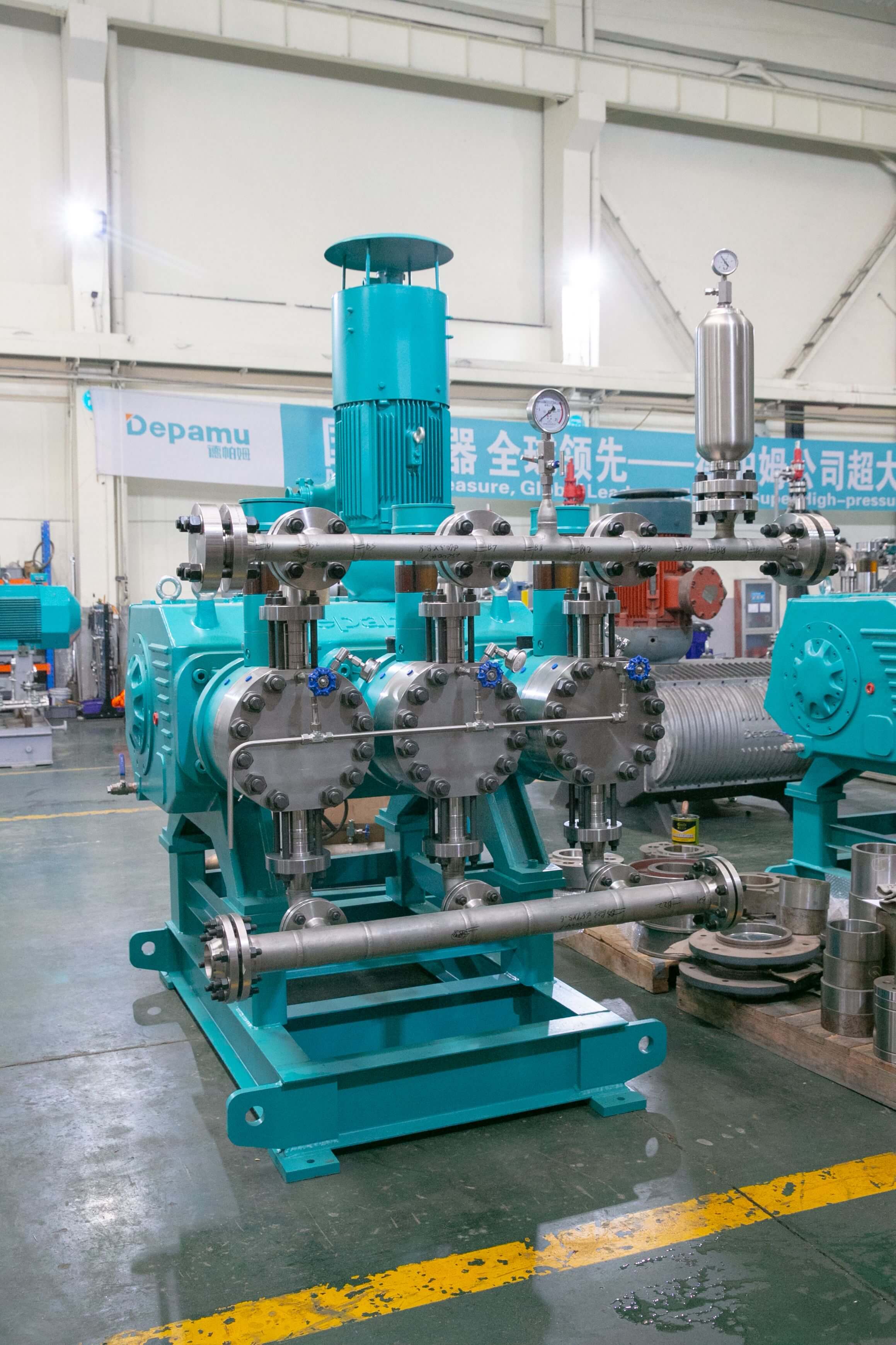
What Defines a High Pressure Process Diaphragm Pump?
A process diaphragm pump uses a flexible diaphragm to displace fluid, which means the medium being pumped never contacts the drive mechanism and never passes through a dynamic shaft seal. In a hydraulic diaphragm design, the diaphragm is driven by hydraulic oil that is pressurised by a plunger or piston. The hydraulic fluid is sealed from the process side by the diaphragm itself, so the pump delivers the pressure capability of a reciprocating plunger pump while keeping the process fluid fully contained.
For high pressure duty, this architecture matters most when the medium is corrosive, toxic, volatile, expensive, or reactive with air and moisture. Packed plunger pumps rely on gland packing to control leakage; a small controlled leak is normal and is often routed to a drain. A diaphragm pump removes that leak path entirely, which is why diaphragm technology is frequently specified for hydrochloric acid, sodium hypochlorite, amine solutions, methanol, hydrate inhibitors, catalysts, and other difficult process chemicals.
Precision is the second defining characteristic. Output is regulated by adjusting stroke length and running frequency, allowing a wide turn-down range without changing hardware. This is what allows a single pump model to serve as a dosing pump, a metering pump, and a controlled injection pump across different operating scenarios.
How Hydraulic Diaphragm Metering Pumps Work
The drive chain
An electric motor drives a worm or helical gear, which converts rotary motion into the reciprocating stroke of a plunger. The plunger pressurises hydraulic oil inside a closed chamber. That oil pushes against the rear face of the diaphragm, deflecting it forward and displacing process fluid through the suction and discharge check valves. On the return stroke, a replenishing valve refills the hydraulic chamber so the diaphragm always returns to a controlled rest position.
Because the hydraulic system is closed and self-compensating, the diaphragm stroke is stable over long operating periods. Stroke length adjustment changes the amount of oil displaced per stroke, giving accurate control from roughly 10 percent to 100 percent of rated capacity, depending on model and configuration.
Why diaphragm pumps are preferred for aggressive media
The wetted parts of a high pressure diaphragm pump are limited to the pump head, valves, and diaphragm. This narrows the material selection problem considerably. Pump heads can be supplied in stainless steel, duplex stainless steel, or higher-alloy materials, while diaphragms are typically PTFE-faced or composite elastomer constructions chosen for chemical compatibility and flex fatigue resistance. A diaphragm pump manufacturer can therefore build a chemically resistant pump without exposing gears, bearings, or lubricated surfaces to the process.
There is also a safety dimension. Many hydraulic diaphragm pumps include a diaphragm rupture detection port or a double-diaphragm option, so a failure is signalled before process fluid reaches the hydraulic side. In refineries and chemical complexes where hazardous media are handled, that detection capability is frequently part of the specification, not an optional extra.
Inside the Factory: What Manufacturing Capability Actually Means
Vetting a high pressure process diaphragm pump factory requires looking past the catalogue. Volume production of reciprocating and diaphragm equipment depends on three capabilities that cannot be outsourced easily: precision machining of hydraulic and valve components, controlled assembly of the hydraulic chamber, and end-of-line performance testing with real instrumentation.
DEPAMU (Hangzhou) Pump Industry Technology Co., Ltd. was established in 2003 and has grown into a manufacturer of high-end positive displacement pumps and fluid equipment, with more than 400 employees, a plant area of roughly 35,000 square meters, registered capital of RMB 54 million, and annual output value in the region of RMB 500 million. Sales have grown steadily in recent years, from approximately RMB 450 million in 2023 to about RMB 510 million in 2024 and about RMB 560 million in 2025. The company operates three product brands, with the DEPAMU brand acting as its flagship identity in the global market.
Capability of this scale supports both standard catalogue pumps and engineered units. The manufacturer is structured to handle product development, design, manufacturing, and packaged system delivery under one organisation, which shortens the loop between a customer’s process data sheet and a tested, deliverable pump skid. For buyers, that means fewer interfaces between a pump vendor and a system integrator, and clearer technical accountability when a unit is commissioned on site.
Specification Checklist Before Requesting a Quotation
Most problems with diaphragm metering pumps in service trace back to incomplete process data at the inquiry stage. A competent supplier will ask for the following information before quoting, and a buyer should prepare it in advance to keep the evaluation comparable across bidders.
| Parameter | What to define | Why it drives pump selection |
|---|---|---|
| Fluid chemistry | Chemical name, concentration, pH, chlorides, trace components | Determines pump head material and diaphragm elastomer or PTFE construction |
| Discharge pressure | Normal and maximum operating pressure, plus any surge condition | Sets hydraulic chamber design, diaphragm support geometry, and motor rating |
| Flow rate and turndown | Rated capacity, minimum required dose, and required control range | Confirms stroke length and frequency control envelope without oversizing |
| Temperature | Fluid temperature range and ambient conditions | Affects diaphragm life, hydraulic oil selection, and valve clearance |
| Viscosity and solids | Viscosity at pumping temperature, particle content and size | Drives valve type, suction conditions, and whether a different pump family is better |
| Metering accuracy | Tolerance required by the process, and whether closed-loop control is needed | Determines manual stroke adjustment versus automatic or frequency-based control |
| Installation environment | Hazardous area classification, indoor or outdoor, utilities available | Impacts motor certification, enclosure protection, and skid layout |
Supplying this data set at the inquiry stage typically reduces the number of technical clarification rounds and produces quotations that can be compared line by line. It also protects the buyer from being quoted a pump that is hydraulically adequate but materially unsuitable.
Applications of High Pressure Diaphragm Pumps Across Industries
Diaphragm metering pumps appear wherever a controlled quantity of a chemical must enter a process under pressure. In oil refining and petrochemical plants they handle additives, inhibitors, catalysts, caustic, and acid streams. Refining and chemical processing represent the largest share of DEPAMU’s business, at roughly 41 percent of sales, reflecting how central this pump type is to continuous process plants.
The oil and gas field accounts for approximately 23 percent of the company’s business, where diaphragm and high pressure reciprocating pumps support chemical injection, methanol injection, water injection, and pipeline pressure boosting. In these applications the pump may sit in a remote location, exposed to temperature swings, and must run unattended for long periods. Robust hydraulic design and reliable check valves matter more than catalogue features.
Nuclear, power, metallurgy, and new energy applications make up about 15 percent of sales. Here the emphasis is on repeatable dosing for water and steam cycle chemistry, sampling systems, and process injection where accuracy and containment are both critical. Environmental water treatment accounts for around 13 percent, covering coagulant and flocculant dosing, disinfection, pH correction, and membrane antiscalant injection. New materials and food applications, at roughly 3 percent, require sanitary-compatible materials and careful cleaning considerations. The remaining 5 percent spans other industrial duties.
Where a process calls for high pressure combined with viscous, hot, or particle-laden media, a high pressure reciprocating pump using a plunger design may be the more appropriate choice. A manufacturer that builds both diaphragm and plunger reciprocating pumps can compare the duty honestly rather than force the enquiry into a single product line.
Custom Configurations, Skids, and OEM Supply
Many process duties cannot be met by a standard catalogue pump. A process diaphragm pump OEM manufacturer should be able to modify wetted materials, change valve design, adjust the hydraulic ratio, add heating or cooling jackets, provide double diaphragm construction with rupture detection, and integrate motor, baseplate, pulsation dampener, safety valve, and instrumentation into a single package.
Packaged chemical dosing systems are a common requirement. These combine a metering pump with a dosing tank, agitator, piping, valves, and a control panel in a skid-mounted arrangement, assembled and tested before shipment so that site work is limited to connecting utilities and process lines. The same approach applies to sampling and analytical systems, where pumps, coolers, and instrumentation are delivered as a coordinated unit.
Beyond diaphragm metering pumps, a full-range supplier can offer screw pumps, rotary lobe pumps, gear pumps, air-operated and electric pumps, emulsion pumps, and specialty centrifugal pumps. This breadth is useful during front-end engineering, when the final pump type has not yet been fixed and the buyer needs a technical partner able to evaluate several options against the same process data.
Maintenance, Spare Parts, and Total Cost of Ownership
Diaphragm pumps have relatively few wear parts: the diaphragm, check valves and seats, and the hydraulic seals. In clean chemical service, diaphragm life is typically measured in thousands of operating hours and is strongly influenced by correct hydraulic oil level, proper suction conditions, and avoidance of cavitation. In slurries or crystallising media, valve inspection intervals shorten considerably.
A practical maintenance programme includes periodic verification of stroke output against a calibrated measurement, inspection of suction and discharge valve condition, checking hydraulic oil quality and level, and confirming that the rupture detection port, where fitted, remains unobstructed. Keeping a spare diaphragm and valve set on site is inexpensive insurance against a process interruption.
When comparing quotations, evaluate total cost of ownership rather than purchase price alone. Consider expected diaphragm and valve life in the specific medium, the availability of spares, the effort required to re-range the pump if process conditions change, and whether the supplier can support the unit over a service life measured in decades. A pump that is oversized for its duty often runs at a low percentage of stroke, which can hurt accuracy and diaphragm behaviour; correct sizing is worth more than a marginal price difference.
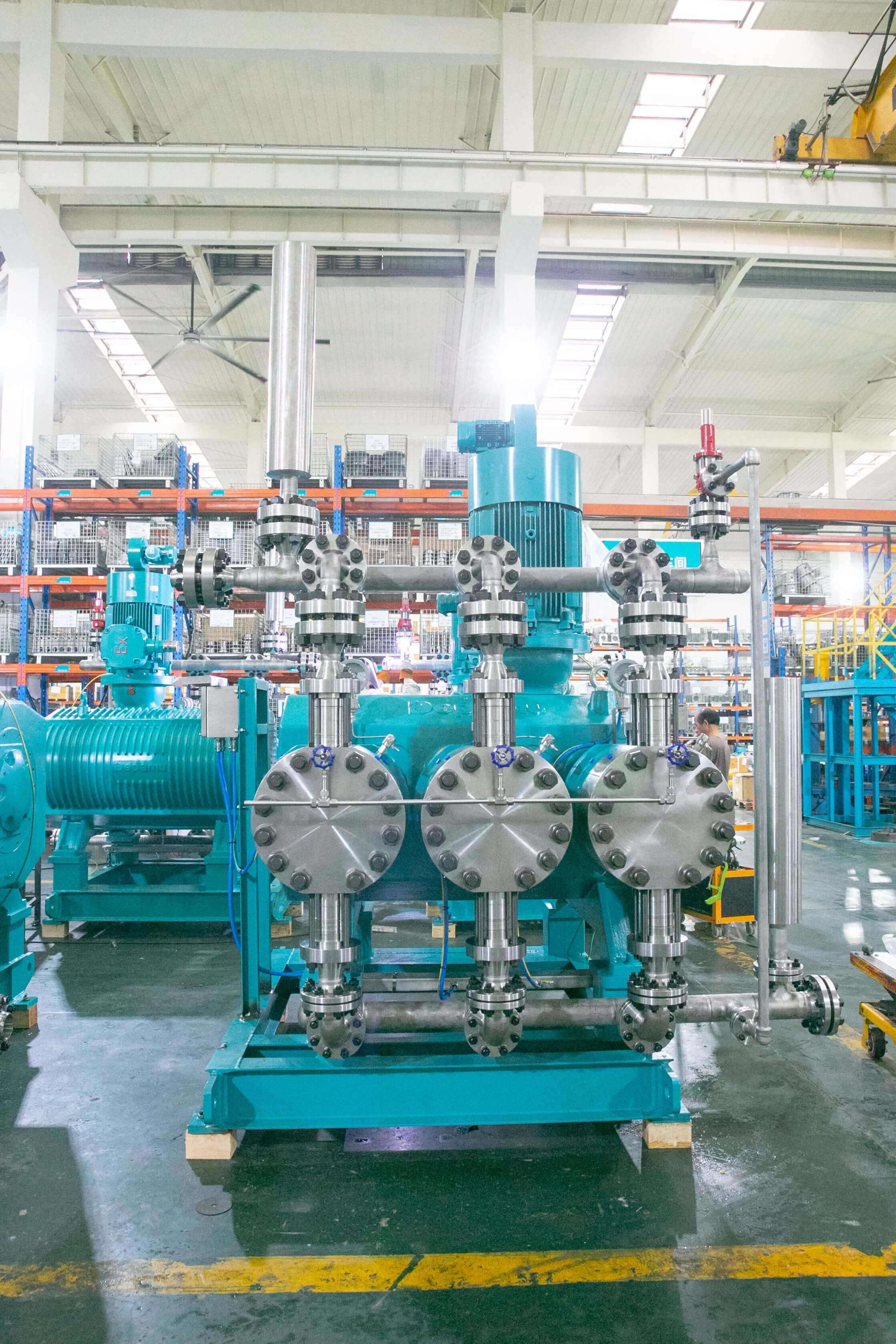
How to Vet a High Pressure Process Diaphragm Pump Supplier
Use the following checklist during supplier evaluation. It is designed to surface the difference between a manufacturer with real engineering depth and a reseller who sources finished units.
- Process engineering support: Can the supplier review your data sheet, comment on material selection, and explain why a specific configuration is recommended?
- In-house manufacturing: Are hydraulic components, pump heads, and valve assemblies machined and assembled internally, or outsourced?
- Testing before shipment: Is every unit performance-tested for flow, pressure, and leak integrity, with records supplied?
- Material traceability: Can wetted material certificates be provided for the pump head, valves, and diaphragm?
- Customisation record: Has the supplier delivered non-standard pumps and packaged systems, not only catalogue models?
- Spare parts availability: Are wear parts held in stock and supplied against a defined lead time?
- Documentation quality: Are drawings, operating manuals, and test reports available in the language required for your project?
- References in your sector: Has the supplier supplied pumps into comparable service conditions and media?
Requesting a technical meeting before the commercial negotiation is a reliable filter. A manufacturer that can discuss diaphragm flex fatigue, valve seating velocity, hydraulic replenishing behaviour, and NPSH margin is likely to specify the right pump. A supplier that can only quote a model number and a price is not.
Frequently Asked Questions
What is the difference between a diaphragm metering pump and a plunger pump for high pressure dosing?
A plunger pump uses a packed gland where the plunger enters the pump head, so a small controlled leakage is normal and the process fluid contacts the packing. A hydraulic diaphragm pump seals the process fluid behind a diaphragm, eliminating the leak path while still achieving high discharge pressure. Diaphragm pumps are generally preferred for toxic, corrosive, or high-value media, while plunger pumps remain suitable for high pressure duty with media that tolerate gland leakage or where abrasive conditions favour a different valve arrangement.
What information does a manufacturer need to quote a high pressure process diaphragm pump?
The essential inputs are fluid name and concentration, required flow rate including minimum turndown, suction and discharge pressure, fluid and ambient temperature, viscosity and solids content, required metering accuracy, available utilities, and hazardous area classification if applicable. Connection sizes, control philosophy, and whether the pump will be part of a skid should also be stated, since these affect the mechanical configuration and the scope of supply.
Can diaphragm pumps handle corrosive acids and solvents?
Yes, provided the wetted materials are selected correctly. Pump heads are commonly supplied in stainless and higher-alloy grades, and diaphragms are available in PTFE-faced and composite constructions chosen for chemical compatibility. The supplier should review the specific medium and concentration rather than rely on a generic compatibility chart, since temperature and trace impurities can change material performance significantly.
How accurate is a hydraulic diaphragm metering pump in continuous service?
Accuracy depends on correct sizing, stable suction conditions, and a properly maintained hydraulic system. When a pump is sized so that normal operation falls within a comfortable part of its stroke range, repeatable output is maintained over long periods. Running a large pump at a very small percentage of stroke, or operating with insufficient suction head, degrades accuracy regardless of the pump brand.
Can a diaphragm pump manufacturer supply a complete chemical dosing skid?
Yes. A packaged dosing system typically integrates the metering pump, dosing tank, agitator, level instrumentation, piping and valves, and a control panel on a common base. Assembling and testing the package before shipment reduces site installation work to utility and process connections, and gives the buyer a single point of technical responsibility for the whole dosing function.
Which industries use high pressure process diaphragm pumps most heavily?
Oil refining and chemical processing account for the largest share of demand, followed by oil and gas field chemical injection, power generation and nuclear cycle chemistry, metallurgy, new energy manufacturing, and environmental water treatment. Food and new material applications also use diaphragm metering pumps where accurate additive dosing and containment are required.
Summary
Selecting a high pressure process diaphragm pump manufacturer comes down to matching three things: the process duty, the pump’s hydraulic and material design, and the supplier’s ability to engineer, test, and support the unit over its service life. Diaphragm technology removes the leak path that defines packed plunger designs, which is why it dominates in corrosive, toxic, and high-value chemical dosing. That advantage only holds, however, when the pump is sized correctly and built by a manufacturer with real machining, assembly, and testing capability.
DEPAMU (Hangzhou) Pump Industry Technology Co., Ltd. has manufactured positive displacement pumps and fluid equipment since 2003, with a 35,000 square meter facility, more than 400 employees, and an annual output value of roughly RMB 500 million. Its product range covers hydraulic diaphragm metering pumps, high pressure process reciprocating pumps, packaged chemical dosing systems, sampling equipment, and a broader family of screw, rotary lobe, gear, air-operated, and electric pumps, supported by custom engineering for specific media, flow, pressure, and temperature conditions. For buyers evaluating a high pressure process diaphragm pump supplier, the practical next step is to send a complete process data sheet and ask for a technical review before price negotiation — the quality of that technical response is usually the clearest indicator of what the pump will do in your plant.