
Choosing a centrifugal water pump manufacturer is rarely a simple price comparison. For plant engineers, EPC contractors and procurement teams, the pump becomes part of a process line that must run continuously for years, often handling aggressive chemicals, high temperatures or variable demand. A pump that is slightly undersized, built from the wrong material, or supported by a supplier who cannot answer technical questions quickly can create costly downtime long after the purchase order is closed.
This guide looks at how industrial buyers can evaluate a centrifugal water pump supplier, what a genuine manufacturing partner should be able to provide, and how Depam (Hangzhou) Pump Industry Technology Co., Ltd. — a high-tech enterprise founded in 2003 and focused on high-end positive displacement pumps and fluid equipment — positions centrifugal pumps within a wider fluid-handling portfolio that includes metering pumps, high-pressure process reciprocating pumps and complete chemical dosing systems.
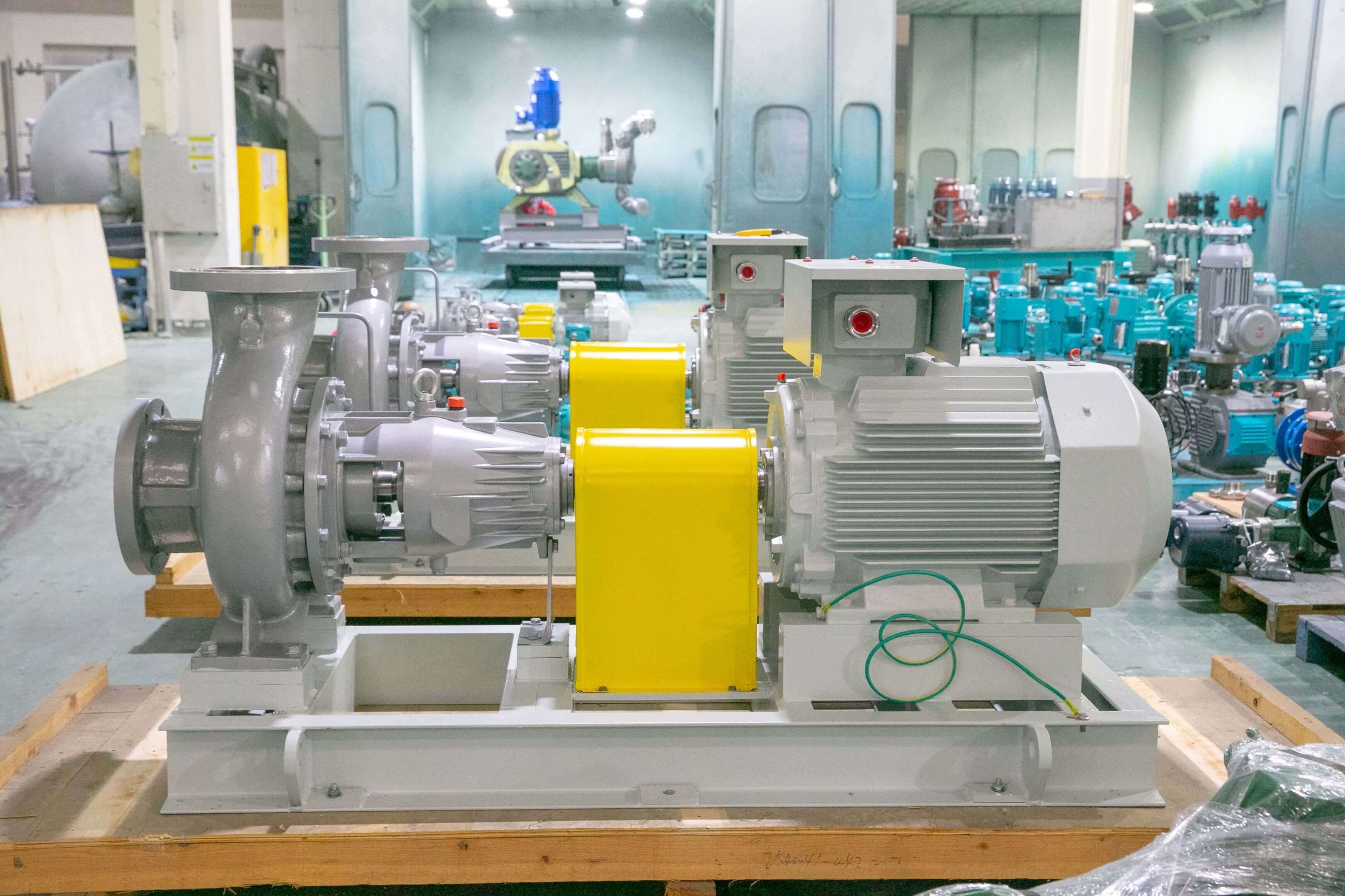
Who Is Depam (Hangzhou) Pump Industry Technology Co., Ltd.?
Depam (Hangzhou) Pump Industry Technology Co., Ltd. was established in 2003 and has spent more than two decades developing, manufacturing and packaging fluid equipment for process industries. The company employs more than 400 people across a facility of roughly 35,000 square meters, with registered capital of RMB 54 million and an annual output value of approximately RMB 500 million. It operates three brands covering different product lines and serves customers as an integrated supplier — from research and design through fabrication, assembly, testing and complete skid delivery.
That combination matters when you are sourcing a centrifugal water pump. A company that also builds metering pumps, reciprocating process pumps, screw pumps, rotary lobe pumps, gear pumps, pneumatic pumps, electric pumps and complete dosing skids has a broader view of how fluids behave in a real plant. Instead of quoting a single item in isolation, such a manufacturer can advise on whether a centrifugal unit is the right choice for a given duty, or whether a positive displacement solution will deliver better accuracy or better performance on viscous or high-pressure service.
| Item | Details |
|---|---|
| Founded | 2003 |
| Employees | 400+ |
| Facility area | Approximately 35,000 m² |
| Registered capital | RMB 54 million |
| Annual output value | Approximately RMB 500 million |
| Sales trend | RMB 450 million (2023), RMB 510 million (2024), RMB 560 million (2025) |
| Core product families | Metering pumps, high-pressure process reciprocating pumps, pneumatic and electric pumps, chemical dosing packages, water and steam sampling systems, water treatment equipment, screw / rotary lobe / gear pumps, special centrifugal pumps |
| Service capability | Standard products, non-standard products and fully customized fluid solutions based on medium, flow, pressure, temperature and site process conditions |
Factory or Trading Company? How Buyers Should Judge a Centrifugal Water Pump Supplier
Many listings that appear to be from a centrifugal water pump manufacturer are in fact intermediaries. For a small replacement order this may not matter. For a project with scheduled delivery dates, material certificates, inspection requirements and future spare-part needs, the difference is significant. A manufacturing supplier controls its own machining, assembly and testing, which usually translates into faster engineering responses, more predictable lead times and a clearer route to non-standard configurations.
When evaluating a potential supplier, look beyond the catalogue. Ask how the pump hydraulic design was developed, which standards the flanges and testing procedures follow, whether performance testing is performed on every unit or only on samples, and who will handle technical questions after commissioning. A supplier that can only forward emails from a third party will struggle when a seal starts leaking two years later or when a process change requires a different impeller trim.
- Engineering depth: can the supplier calculate head, flow and NPSH available from your system data, or does it simply quote from a table?
- Manufacturing scope: in-house casting sourcing, machining, balancing, assembly and performance testing versus pure assembly of purchased parts.
- Material flexibility: availability of cast iron, ductile iron, stainless steel grades, duplex and other alloys suited to the pumped medium.
- Sealing options: mechanical seal, cartridge seal, gland packing and seal support plans for corrosive or high-temperature duty.
- Documentation: drawings, test reports, nameplate data, O&M manuals and spare-part lists provided as standard.
- After-sales structure: a named service contact, spare parts availability and response-time commitments.
Where Centrifugal Water Pumps Fit in a Broader Fluid Equipment Portfolio
Depam’s identity as a centrifugal water pump supplier is best understood in context. The company’s core strength lies in high-end positive displacement technology: hydraulic diaphragm metering pumps, high-pressure process reciprocating pumps and packaged chemical dosing systems. Centrifugal units — including special centrifugal pumps and emulsion pumps — sit alongside that core, handling the transfer duties that positive displacement machines are not designed for: high volumes at moderate heads, clean or lightly contaminated water, cooling water circuits, transfer between tanks and circulation loops.
In practice, many plants need both technologies on the same process line. A water treatment plant might use a centrifugal pump for bulk transfer of raw or filtered water, while a hydraulic diaphragm metering pump injects a precise dose of coagulant or disinfectant into the same stream. A refinery might use centrifugal pumps on cooling water and utility circuits, while high-pressure reciprocating pumps handle injection duties at 35 MPa and above. Working with one supplier who understands both sides of the boundary reduces the risk of mismatched interfaces, split responsibilities and duplicated spares inventories.
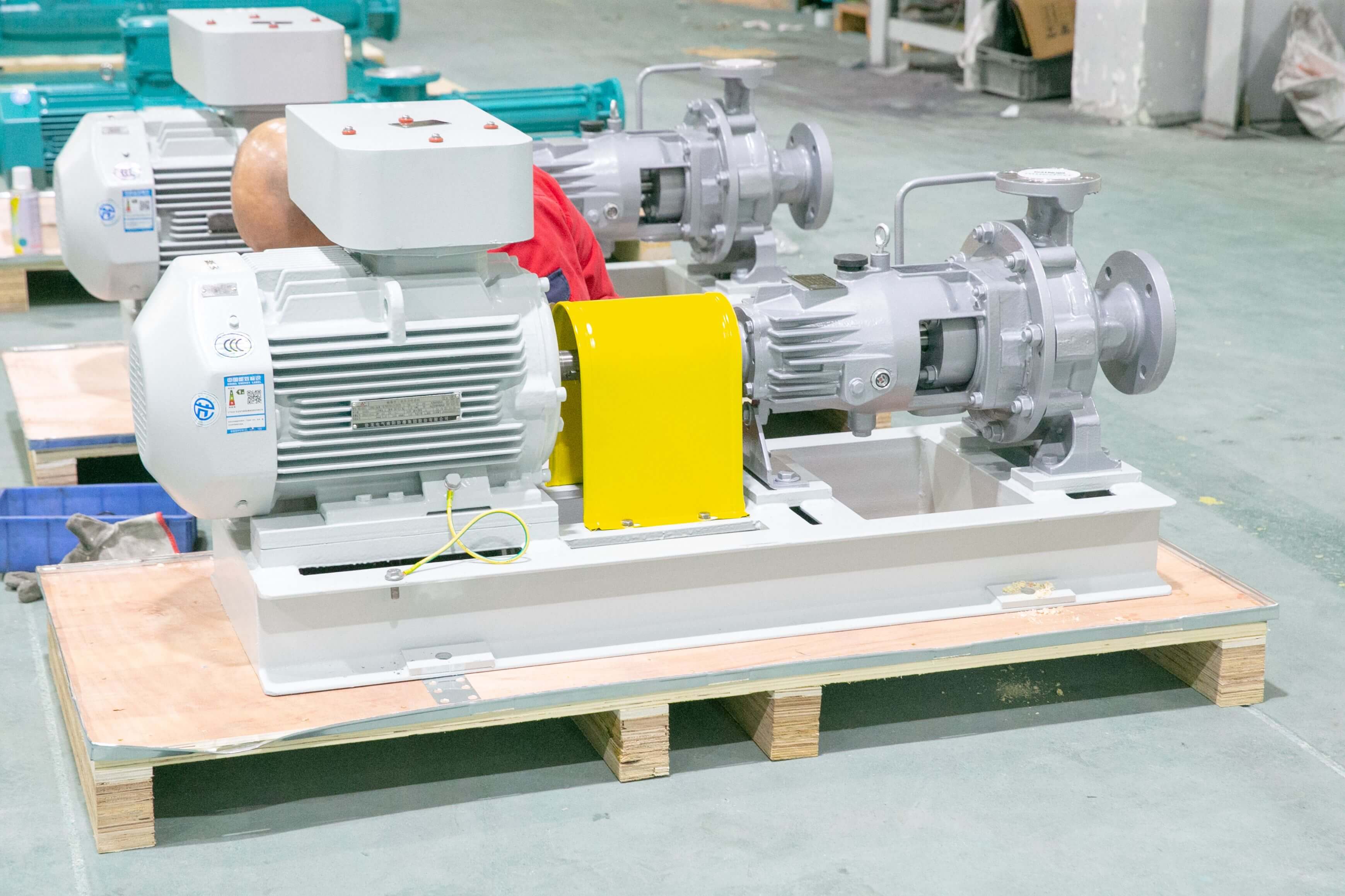
Metering Pumps
Hydraulic diaphragm metering pumps deliver a precisely controlled dose by adjusting stroke length and running frequency. Because the diaphragm isolates the process liquid from the hydraulic system, the pump is leak-free even on aggressive, volatile or high-pressure media. Typical duties include coagulant and flocculant dosing, pH correction, corrosion inhibitor injection and additive metering in petrochemical and food production.
High-Pressure Process Reciprocating Pumps
These units use a reciprocating plunger to generate high pressure — up to 35 MPa and above — with stable flow and the ability to run continuously. They are suited to high-viscosity, high-temperature and particle-laden media, and are commonly applied to oilfield water injection, process transfer, pipeline boosting and high-pressure injection.
Packaged Chemical Dosing Systems
Fully automated dosing systems integrate chemical storage, dissolving, mixing, metering and automatic control into one skid. Built around a metering pump with a dissolving tank, agitator and intelligent control system, the package supports dry or liquid chemical dosing, multi-point injection and automatic interlocking. It is assembled and tested before shipment, so on-site work is limited to piping and power connections.
Industry Applications and Where the Demand Comes From
Depam’s sales mix gives a clear picture of where its equipment is used: oil refining and chemicals account for about 41 percent of business, oil and gas fields about 23 percent, nuclear power, power generation, metallurgy and new energy around 15 percent, environmental water treatment about 13 percent, new materials and food about 3 percent, and other industries the remaining 5 percent. That distribution maps closely onto the sectors where industrial centrifugal water pumps are most in demand.
| Industry | Share of business (approx.) | Typical centrifugal pump duties |
|---|---|---|
| Oil refining and chemicals | 41% | Cooling water circulation, utility water transfer, process water supply, wash water |
| Oil and gas fields | 23% | Water supply for injection systems, transfer and booster duties |
| Nuclear, power, metallurgy, new energy | 15% | Boiler feed make-up, cooling circuits, sampling system supply |
| Environmental water treatment | 13% | Raw water intake, intermediate transfer, filtration and backwash supply |
| New materials and food | 3% | Hygienic water transfer, CIP supply, utility circuits |
| Other industries | 5% | General transfer, pressure boosting and circulation |
Centrifugal Pump Selection Guide: Data the Manufacturer Needs From You
The single biggest cause of a disappointing pump installation is incomplete duty data. A centrifugal water pump is selected on the basis of a system curve, not a single flow figure. Providing accurate information at the enquiry stage shortens the quotation cycle and reduces the chance of a unit running far from its best efficiency point.
| Parameter | What to specify |
|---|---|
| Flow rate | Normal and maximum capacity in m³/h, plus any future expansion allowance |
| Head | Total differential head including static lift, friction losses and discharge pressure |
| Medium | Water quality, chemical composition, solids content, viscosity, density |
| Temperature | Operating and design temperature range, including cleaning or CIP peaks |
| Suction conditions | Available NPSH, suction pipe layout, flooded or lift suction |
| Wetted materials | Casing, impeller and shaft material matched to the medium and to site standards |
| Shaft sealing | Mechanical seal type and flush plan, or packing where appropriate |
| Drive and control | Motor voltage, frequency, protection class, VFD or fixed speed, hazardous area requirements |
| Installation | Horizontal or vertical, baseplate or skid, indoor or outdoor, available footprint |
Beyond the duty point, consider how the pump will actually be operated. A unit selected at its exact best efficiency point will not perform well if the plant routinely runs at half capacity. In those cases, a slightly different impeller trim, a variable frequency drive, or a different pump family may serve better. A knowledgeable centrifugal pump manufacturer will flag this before the order rather than after the first performance test.
Custom and OEM Centrifugal Water Pump Solutions
Standard catalogue pumps cover a large share of routine transfer duties, but process plants frequently need something different: a non-standard flange drilling pattern, a special alloy wetted end, a compact skid footprint, a combined pump and dosing package, or a unit that matches an existing installation without pipe modifications. This is where the engineering capability of a custom centrifugal pump solution provider becomes the deciding factor.
Depam’s stated capability covers standard products, non-standard products and fully customized fluid packages, developed against the customer’s medium characteristics, flow, pressure, temperature and site process requirements. For buyers sourcing under an OEM centrifugal water pump arrangement, this means nameplate data, drawings, painting systems, documentation language and packaging can be aligned to the project or to the distributor’s own brand requirements. For EPC and systems integrators, it can extend to a combined package in which centrifugal transfer pumps, metering pumps and a dosing skid arrive as one tested unit rather than three separate deliveries.
- Non-standard materials and surface finishes for corrosive or hygienic duty
- Skid-mounted and packaged configurations with baseplate, coupling guard and instrumentation
- Integration with chemical dosing systems, sampling systems and water treatment equipment
- Project documentation packages for engineering approval and site handover
- Spare parts and wear-part kits defined at the time of order
Installation, Operation and Maintenance: Practical Advice
Most centrifugal pump problems in service trace back to installation and operating practice rather than to the pump itself. Correct alignment between pump and motor, adequate suction piping with minimal fittings, and a properly sized suction line free of air pockets will prevent the majority of cavitation and vibration complaints. Discharge throttling should be used only for commissioning adjustments, never as a permanent flow-control method where a VFD would do the job more efficiently.
Maintenance is straightforward when it is planned. Mechanical seals and bearings are the consumable items on most industrial centrifugal water pumps, and keeping a small stock of these parts on site avoids extended outages. During routine inspection, check for seal leakage, unusual noise, bearing temperature rise and vibration, and confirm that the pump still operates near its design duty point. If a process change has shifted the required flow or head, revisit the selection rather than simply running the existing unit outside its intended range.
- Verify alignment after installation and again after the first weeks of operation
- Never run a centrifugal pump dry; confirm suction is established before start-up
- Monitor suction pressure to catch clogged strainers and cavitation early
- Record baseline vibration and bearing temperature values for later comparison
- Store spare seals, gaskets and bearings in line with the recommended shelf conditions
How to Request a Centrifugal Water Pump Quotation
A useful centrifugal water pump quotation should include the model designation, hydraulic performance at the specified duty point, wetted materials, seal type, motor rating, baseplate arrangement, testing scope and delivery schedule. A price without these details cannot be compared fairly against competing offers. Buyers should also ask what is excluded — freight, installation supervision, commissioning support and spare parts are common exclusions that change the total project cost.
To shorten the enquiry cycle, prepare a single data sheet covering flow, head, medium, temperature, suction conditions, material preference, electrical supply, installation orientation and any site standards that apply. Include a P&ID or line list where available; the pump is only one element of the system, and the surrounding equipment often determines whether a centrifugal or a positive displacement solution is the better fit. Suppliers who ask detailed questions at the quotation stage are usually the ones who deliver fewer surprises at commissioning.
FAQ
What products does Depam (Hangzhou) Pump Industry Technology Co., Ltd. manufacture?
The company manufactures metering pumps including hydraulic diaphragm metering pumps, high-pressure process reciprocating pumps, pneumatic and electric pumps, fully automated chemical dosing systems, water and steam sampling systems, water treatment equipment, screw pumps, rotary lobe pumps, gear pumps, emulsion pumps and special centrifugal pumps. Products are supplied as standard units, non-standard units or customized fluid packages based on the medium, flow, pressure, temperature and site process conditions.
Can the company supply a centrifugal water pump together with a chemical dosing system?
Yes. Because the product range covers both centrifugal transfer pumps and packaged dosing systems built around metering pumps, both items can be supplied from one source and, where required, integrated on a common skid. This simplifies interface management between the transfer duty and the dosing duty, and avoids splitting responsibility for a package across several suppliers.
Which industries use these pumps?
The main industries are oil refining and chemicals, oil and gas fields, nuclear power, power generation, metallurgy and new energy, environmental water treatment, and new materials and food. Oil refining and chemicals represent approximately 41 percent of business and oil and gas fields approximately 23 percent, which reflects how often both centrifugal and positive displacement pumps are required on the same process site.
How do I select the right centrifugal water pump for my application?
Start with the duty point: flow rate, total head, medium properties, temperature, available NPSH and the material and sealing requirements. Then consider how the pump will be operated in practice, including turndown, future capacity and control method. Providing this data allows the manufacturer to size a unit that runs close to its best efficiency point rather than one that is simply the closest catalogue match.
Does the company offer OEM and custom manufacturing?
Custom and OEM arrangements are part of the stated offering. Non-standard materials, alternative flange standards, packaged or skid-mounted configurations, brand labelling and project-specific documentation can be discussed at the quotation stage. Requirements should be defined clearly in the enquiry so that the technical offer and the commercial offer match the same scope.
What should a complete quotation include?
A complete quotation typically covers model and performance data at the specified duty point, wetted materials, seal type, motor specification, baseplate or skid arrangement, testing scope, documentation, delivery time and exclusions such as freight or installation supervision. Comparing offers on price alone is unreliable if the technical scope is not identical.
Summary
Selecting a centrifugal water pump manufacturer is a technical decision as much as a commercial one. The right partner can size a pump against a real system curve, recommend materials and seals that suit the medium, and support the installation through commissioning and beyond. The wrong partner delivers a box that may look correct on paper but creates problems once the plant starts up.
Depam (Hangzhou) Pump Industry Technology Co., Ltd. brings more than two decades of fluid equipment experience, a 35,000 square meter production base, over 400 employees and a product portfolio that spans metering pumps, high-pressure reciprocating pumps, packaged dosing systems and centrifugal pumps. For buyers looking for a centrifugal water pump supplier who can also handle the surrounding dosing and transfer duties, that breadth of capability is worth weighing alongside unit price. The practical next step is simple: prepare a clear duty specification, request a technically detailed quotation, and compare suppliers on engineering response, documentation and service support — not on price alone.