
Choosing a dosing pump manufacturer is rarely just a purchasing decision. In chemical dosing systems, the pump sits at the exact point where chemistry, mechanics and process safety meet. A small deviation in flow accuracy, a diaphragm failure, or an undersized dosing skid can affect water quality, product quality, chemical consumption, and even plant safety. That is why experienced buyers evaluate a metering dosing pump supplier on engineering capability, application knowledge and long-term service support rather than on price alone.
This guide explains what a dosing pump manufacturer actually does, how hydraulic diaphragm metering pumps work, which parameters determine the right pump configuration, and how to compare industrial dosing pump suppliers during a real procurement project. It also outlines the practical selection, installation and maintenance questions that procurement and engineering teams should ask before placing an order.
DEPAMU (Hangzhou) Pump Industry Technology Co., Ltd. has focused on high-end positive displacement pumps and fluid equipment since 2003. With more than 400 employees, a plant area of around 35,000 square meters, and an annual output value of approximately RMB 500 million, the company designs, manufactures and delivers both standard and customized dosing solutions for petrochemical, chemical, oil and gas, nuclear power, power generation, metallurgy, new energy, environmental water treatment, new materials and food applications.
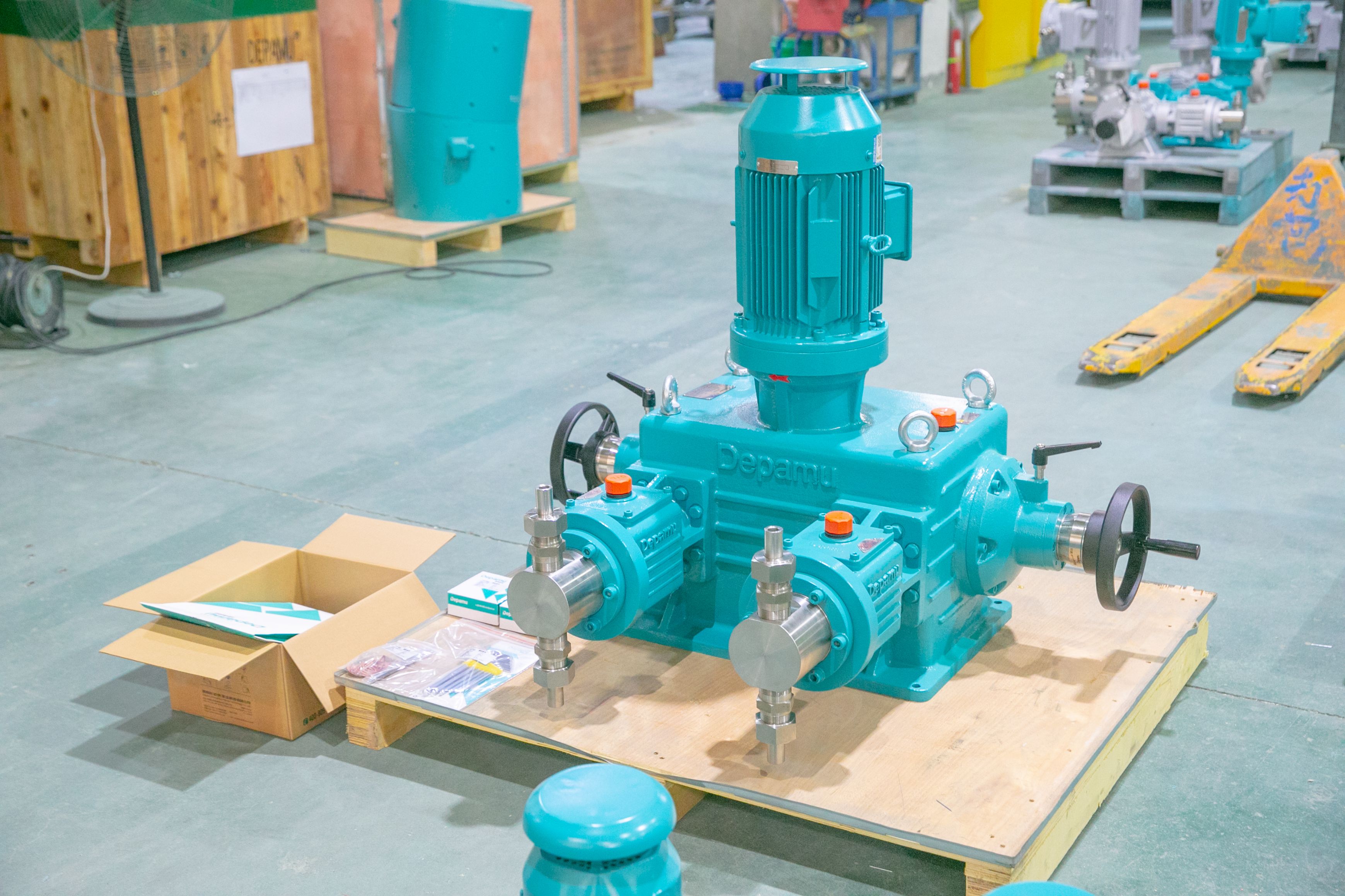
What Does a Dosing Pump Manufacturer Do in an Industrial Fluid System?
A dosing pump manufacturer designs and builds equipment that injects a precisely controlled volume of liquid into a process stream. The pump is often described as the “precision infusion device” of an industrial plant: it must deliver the required dose at the required rate, repeatedly, for months or years, without leakage and without drifting from the set point. In a water treatment plant this may mean injecting coagulant or antiscalant; in a refinery it may mean metering corrosion inhibitor or dosing a chemical into a high-pressure process line.
The role of the manufacturer extends well beyond assembling a pump head and a motor. A capable metering dosing pump supplier must understand the medium being dosed, its viscosity, corrosivity, volatility, solids content and temperature; the suction conditions and available net positive suction head; the discharge pressure of the receiving line; and the control philosophy of the plant, whether manual stroke adjustment, 4–20 mA signal control, or full automatic dosing linked to a flow meter or online analyzer.
Because dosing accuracy directly affects chemical cost and process reliability, serious buyers look for a dosing pump manufacturer that can provide hydraulic calculations, material selection guidance, control integration and documentation. This is particularly important in multi-pump systems, where several dosing lines feed different points of the same process and must be coordinated by a single control cabinet.
Hydraulic Diaphragm Metering Pumps: The Core of Accurate Chemical Dosing
Among the positive displacement technologies available, the hydraulic diaphragm metering pump is one of the most widely used for chemical dosing because it combines high metering accuracy with zero leakage. In this design, a hydraulic fluid transmits force from a reciprocating piston to a flexible diaphragm, which in turn displaces the process liquid. Because the diaphragm physically separates the hydraulic end from the process end, the medium never contacts the plunger or packing, and there is no mechanical seal to leak.
Flow is adjusted by changing the stroke length of the piston and, in many configurations, by varying the running frequency of the motor or drive. The combination of stroke length and frequency control allows a wide turndown ratio while maintaining stable repeatability at low flow rates. This is essential for applications where a chemical must be dosed at a few liters per hour into a pipeline carrying hundreds of cubic meters per hour.
Why Zero-Leakage Design Matters for Aggressive Media
Strong acids, alkalis, solvents, amines and other aggressive chemicals are difficult to handle with sealed plunger pumps. A hydraulic diaphragm design removes the dynamic seal from the process side, which reduces the risk of leakage, operator exposure and environmental release. It also makes the pump more tolerant of intermittent operation and of media that tend to crystallize or deposit when they contact packing.
Material and Diaphragm Selection
Diaphragm and wetted-end materials must be matched to the specific chemistry. PTFE-based diaphragms are commonly selected for chemical resistance, while pump heads, valves and piping may be supplied in stainless steel, duplex stainless steel, alloy or non-metallic materials. A responsible dosing pump supplier will ask for a medium data sheet, including concentration and operating temperature, before recommending a configuration, because the same pump model can behave very differently depending on these details.
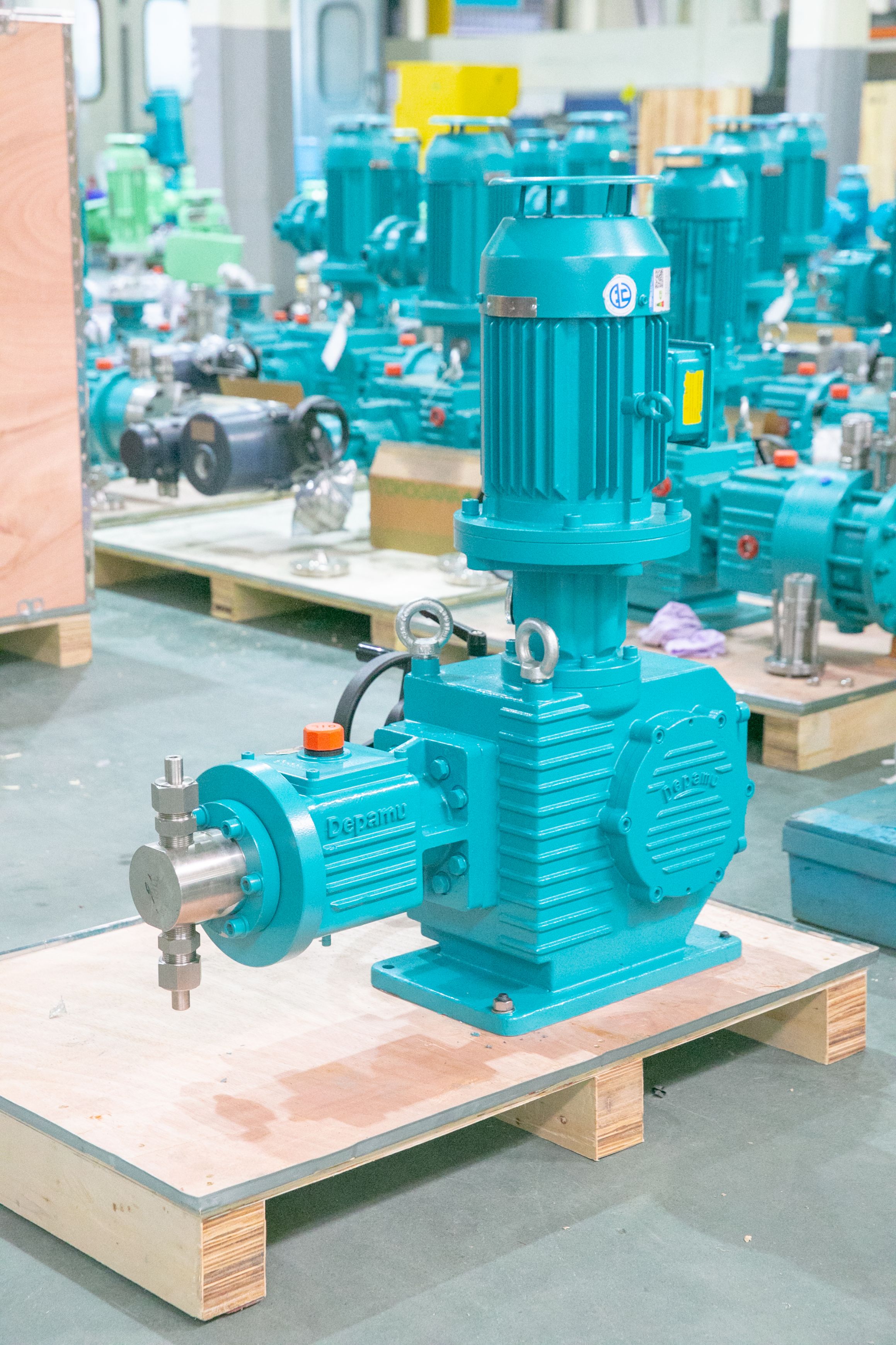
Manufacturing Capability: What a Metering Dosing Pump Factory Should Provide
Not every dosing pump supplier has the same depth of manufacturing capability. A factory that only assembles purchased components has limited influence over quality, delivery and customization. By contrast, a manufacturer with in-house design, machining, assembly, testing and commissioning can respond to non-standard requirements and control critical tolerances in the hydraulic end, valve seats and diaphragm assembly.
DEPAMU operates three product brands, DEPAMU, KENILOWA and DAILERP, and covers a broad fluid equipment portfolio: metering pumps, high-pressure reciprocating process pumps, pneumatic pumps, electric pumps, automatic chemical dosing packages, water and steam sampling devices, water treatment equipment, screw pumps, rotor pumps and gear pumps. This breadth allows the company to act as a single-source dosing pump manufacturer for projects that require several complementary technologies.
For buyers, the practical indicators of manufacturing strength include the ability to produce both standard and non-standard products, documented inspection and test procedures, factory assembly and testing of complete skids before shipment, and engineering support during project execution. DEPAMU’s annual sales have grown from approximately RMB 450 million in 2023 to around RMB 510 million in 2024 and approximately RMB 560 million in 2025, reflecting sustained demand across its core industries.
Typical Application Scenarios for an Industrial Dosing Pump Supplier
Application experience is one of the best predictors of project success. A dosing pump manufacturer that understands the operating context of each industry can anticipate problems such as gas locking, valve fouling, pulsation, suction starvation and chemical incompatibility before they reach the site.
In petrochemical and chemical plants, metering pumps inject inhibitors, additives, catalysts and neutralizing agents into process streams, often at elevated pressure and temperature. In oil and gas fields, high-pressure reciprocating process pumps support water injection, chemical injection and pipeline boosting. In environmental water treatment, dosing pumps feed coagulants, flocculants, disinfectants, antiscalants and pH adjustment chemicals into municipal and industrial water and wastewater systems.
Power generation, nuclear power, metallurgy and new energy applications require precise dosing of water treatment chemicals, sampling systems and reagent preparation. Food and new materials applications place additional emphasis on material compatibility and cleanability. Because each of these environments imposes different demands, the selection conversation should start with the process, not with a catalog page.
| Selection Parameter | Information to Confirm | Why It Affects the Choice |
|---|---|---|
| Dosing flow rate | Minimum, normal and maximum flow in L/h | Determines pump size, stroke volume and turndown ratio |
| Discharge pressure | Line pressure at the injection point, including peaks | Sets motor power, hydraulic end rating and valve design |
| Medium properties | Chemical composition, concentration, viscosity, solids, gas content | Defines diaphragm, wetted materials and valve type |
| Temperature | Medium temperature and ambient conditions | Affects elastomer choice, cooling requirements and safety |
| Control method | Manual stroke adjustment, 4–20 mA, pulse, PLC integration | Defines drive selection and interface with plant control systems |
| Installation format | Single pump, skid, or complete chemical dosing package | Determines scope of supply, footprint and commissioning work |
Dosing Packages and Complete Fluid Solutions
Many projects are better served by a complete chemical dosing package than by a standalone pump. An automatic chemical dosing package integrates chemical storage, dissolving, mixing, metering and automatic control into one skid-mounted system. In practice, it works as an automatic reagent preparation station: dosing pumps sit at the core, supported by dissolving tanks, agitators and an intelligent control system that manages chemical preparation and injection.
Such packages can support dry powder or liquid chemical preparation, multi-point injection and automatic interlocking with plant signals. Because the skid is assembled and tested at the factory, site work is reduced to connecting utilities and piping, which shortens commissioning time and reduces the risk of installation errors. For water treatment, boiler water treatment, circulating water systems and petrochemical plants, this integrated approach is often more economical than assembling individual components on site.
The same engineering logic applies to high-pressure process duties. High-pressure reciprocating process pumps use a plunger reciprocating motion to generate discharge pressures of 35 MPa and above, making them suitable for oilfield water injection, process transportation, pipeline boosting and high-pressure injection. They are also well suited to viscous, high-temperature media and fluids containing solid particles, where a standard centrifugal pump would struggle.
How to Evaluate a Metering Dosing Pump Supplier: A Procurement Checklist
When comparing dosing pump manufacturers, price should be assessed together with scope, documentation and lifetime cost. The lowest quotation often excludes items that later become significant expenses, such as control panels, pulsation dampers, calibration columns, spare diaphragm kits and commissioning support.
- Engineering response quality: Does the supplier ask for medium data, pressure, temperature and control requirements before quoting, or simply match a model number?
- Customization capability: Can the factory supply non-standard wetted materials, special control interfaces, or complete skid-mounted packages?
- Testing and documentation: Are performance tests, material certificates, drawings and operating manuals provided as part of the delivery?
- Spare parts and service: Are diaphragms, valves and seals readily available, and is technical support provided during installation and start-up?
- Application experience: Has the supplier delivered similar duty conditions in petrochemical, oil and gas, power or water treatment service?
- Total cost of ownership: Does the offer consider chemical consumption, energy use, maintenance intervals and downtime risk?
A dosing pump manufacturer that can answer these questions with specific engineering information is usually a safer partner than one that competes only on unit price. It is also reasonable to request references for comparable installations and to review the factory’s assembly and test practices before a large order is placed.
Installation, Commissioning and Maintenance Best Practices
Even a well-selected metering pump can underperform if it is installed incorrectly. Suction piping should be short, generously sized and free of high points where gas can accumulate. Pulsation dampers should be considered on both suction and discharge sides where long pipe runs or sensitive flow meters are involved. A calibration column and pressure relief valve protect both the pump and the process, and injection points should be arranged to avoid backflow into the dosing line.
During commissioning, the stroke length and frequency should be set against a measured flow, not against a nameplate value. Operators should be trained to check suction strainers, valve seats and diaphragm condition as part of a routine inspection schedule. In most chemical dosing systems, preventive replacement of diaphragms and valve components at planned intervals is far cheaper than emergency repair after a leak or a process upset.
For high-pressure process pumps, lubrication condition, packing or seal condition, and vibration should be monitored regularly. For complete dosing packages, agitator operation, tank level control and chemical concentration should be verified to ensure that the prepared solution matches the design dose. Good maintenance records also make it easier to detect gradual performance drift before it becomes a quality or compliance problem.
FAQ
What should I check before requesting a quotation from a dosing pump manufacturer?
Prepare the dosing flow range in liters per hour, the discharge pressure at the injection point, the chemical composition and concentration, the medium temperature and viscosity, the required control method, and the installation format. Providing these details allows a metering dosing pump supplier to recommend a suitable hydraulic end, diaphragm material and drive configuration instead of quoting a generic model.
Why choose a hydraulic diaphragm metering pump instead of a plunger pump?
A hydraulic diaphragm metering pump separates the hydraulic fluid from the process medium with a diaphragm, so there is no dynamic seal in contact with the chemical. This reduces leakage risk when handling corrosive, toxic or volatile media and simplifies housekeeping. Plunger pumps remain suitable for some high-pressure duties, but diaphragm designs are often preferred for chemical dosing where zero leakage and operator safety are priorities.
Can a dosing pump factory supply complete chemical dosing packages?
Yes. An automatic chemical dosing package typically integrates storage tanks, dissolving and mixing equipment, metering pumps and a control system on a single skid. Factory assembly and testing allow the package to be connected to site utilities and piping with minimal installation work. This is common in boiler water treatment, circulating water treatment, wastewater treatment and petrochemical applications.
How do I compare two industrial dosing pump suppliers fairly?
Compare the scope of supply rather than the pump alone. Check whether control panels, dampers, relief valves, calibration columns, spare parts and commissioning support are included. Then compare material specifications, test documentation, delivery time and after-sales response. A slightly higher quotation that includes proper engineering and documentation is often more economical over the life of the system.
What maintenance do diaphragm dosing pumps require?
Routine maintenance includes checking suction and discharge valves, verifying flow against the calibration column, inspecting the diaphragm and hydraulic oil condition, and confirming that the control signal matches the actual output. Planned replacement of wear parts based on operating hours is recommended. Keeping spare diaphragms and valve kits on site reduces downtime when a replacement is needed.
Which industries use metering dosing pumps most widely?
Metering dosing pumps are used in petrochemical and chemical processing, oil and gas fields, power generation, nuclear power, metallurgy, new energy, environmental water treatment, new materials and food processing. The common requirement across these industries is accurate, repeatable injection of a chemical into a process, often under pressure and with strict safety and environmental expectations.
Summary
Selecting a dosing pump manufacturer is an engineering decision with commercial consequences. The right partner combines accurate hydraulic diaphragm metering pump technology, appropriate material selection, flexible control options, and the ability to deliver complete dosing packages rather than isolated components. Buyers who evaluate a metering dosing pump supplier on application knowledge, manufacturing depth, documentation and service support usually achieve more stable dosing performance and lower total cost of ownership.
DEPAMU (Hangzhou) Pump Industry Technology Co., Ltd. brings more than two decades of experience in high-end positive displacement pumps and fluid equipment, supported by in-house design, manufacturing and complete system delivery. From metering pumps and high-pressure reciprocating process pumps to automatic chemical dosing packages, water and steam sampling devices and customized fluid solutions, the company supports projects across petrochemical, oil and gas, power, nuclear, metallurgy, new energy, water treatment, new materials and food industries, and works with customers to define the right configuration based on medium characteristics, flow, pressure, temperature and site process requirements.