
Choosing the right eccentric screw pump manufacturer is a decision that affects far more than the purchase price of a single unit. In chemical plants, oil and gas facilities, wastewater treatment stations and food processing lines, an eccentric screw pump (also called a progressive cavity pump) is often the only equipment capable of moving thick, abrasive or shear-sensitive media without damaging the product or shutting down the process. When that pump is correctly specified, it runs quietly for years with predictable maintenance. When it is poorly specified, it becomes a recurring source of downtime, seal failures and unplanned spare-part costs.
This guide is written for engineers, procurement managers and project integrators who need to compare eccentric screw pump suppliers on technical capability rather than catalogue price alone. It covers how progressive cavity pumps work, which process conditions they handle best, how to read a selection table, how to compare pump types, and what a qualified progressive cavity pump manufacturer should be able to deliver in terms of documentation, testing and after-sales support. It also introduces Depam (Hangzhou) Pump Industry Technology Co., Ltd., a high-end volumetric pump and fluid equipment manufacturer with more than two decades of experience in metering, high-pressure reciprocating and screw pump technology.
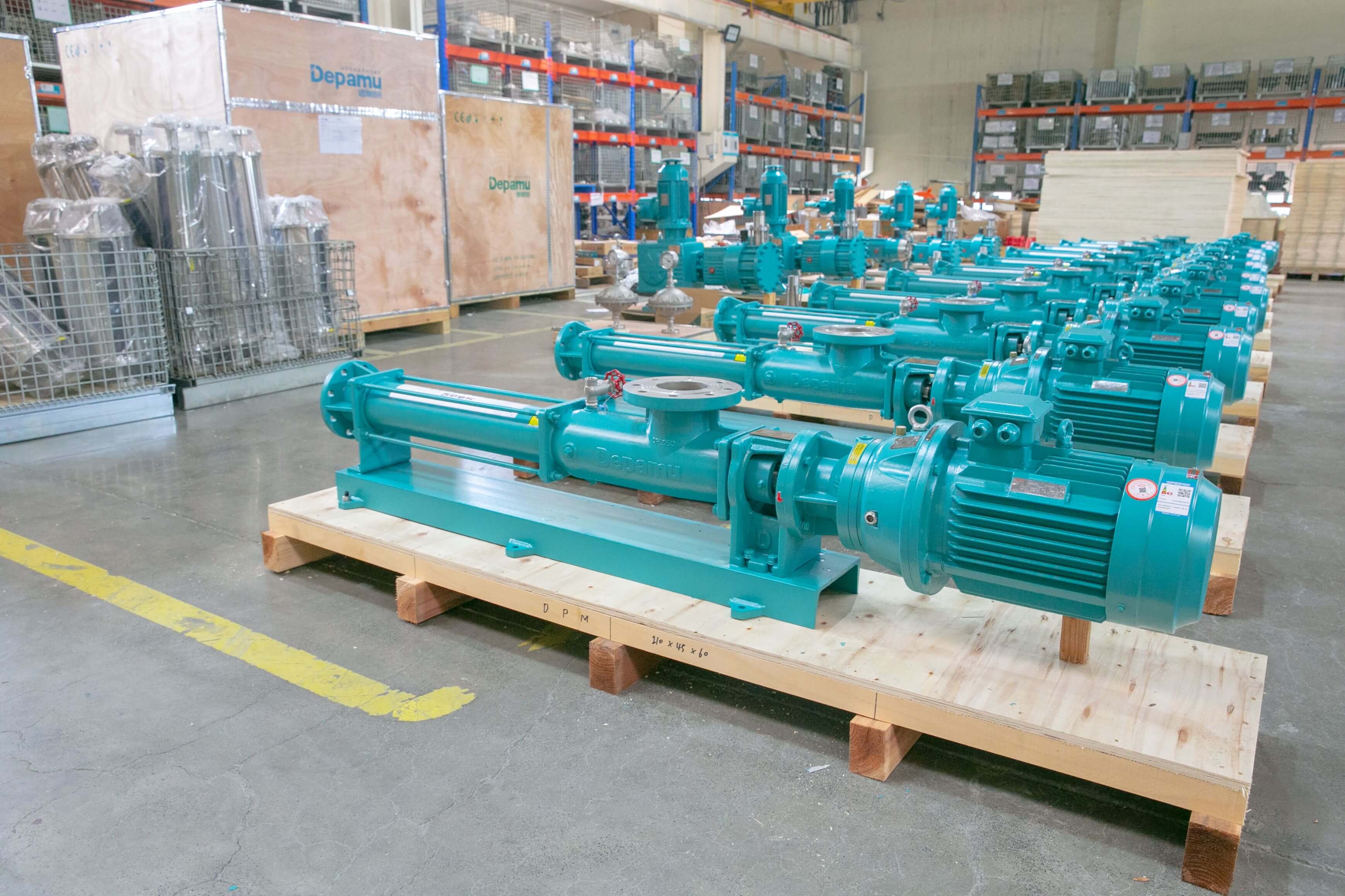
What Is an Eccentric Screw Pump and How Does It Work?
An eccentric screw pump uses a single helical rotor turning inside a double-helical elastomer stator. As the rotor rotates, sealed cavities form and progress continuously from the suction end to the discharge end, pushing the medium forward with almost no pulsation. Because the fluid is transported inside those moving cavities rather than being flung outward by centrifugal force, the pump handles viscous, fibrous and particle-laden media that would clog or destroy other pump types.
This operating principle gives eccentric screw pumps three characteristics that matter in industrial processes: gentle handling, self-priming capability and a predictable flow rate proportional to speed. Shear-sensitive products such as polymer solutions, emulsions and food slurries pass through the pump with minimal mechanical damage, which is why the technology is widely used where product integrity is as important as transfer capacity.
Key design elements that determine performance
The performance of any progressive cavity pump is the sum of its rotor geometry, stator elastomer compound, seal arrangement and drive selection. Rotor pitch and stator profile define the theoretical displacement per revolution, while the elastomer grade determines resistance to abrasion, swelling and temperature. Mechanical seals, packing glands or cartridge seals must be matched to the medium, and the drive — fixed speed, variable frequency or servo — determines how precisely the flow can be controlled on site.
- Rotor and stator geometry: single-stage to multi-stage configurations for increasing pressure.
- Elastomer selection: compounds matched to abrasion, acids, oils, solvents or high temperature.
- Shaft sealing: single mechanical seal, double seal, cartridge seal or packing according to medium risk.
- Drive options: direct drive, gear motor, variable frequency drive or mobile skid mounting.
- Connection standards: flanged, threaded or sanitary connections to suit project piping.
Which Process Conditions Favour an Eccentric Screw Pump?
Eccentric screw pumps are not universal solutions, but in a specific range of duties they outperform almost every alternative. They are strongest when the medium is viscous, contains solids, must be metered at a stable rate, or must be moved without emulsification or degradation. They are less suitable for very high flow at low pressure, where centrifugal pumps remain more economical, or for clean, low-viscosity fluids at extremely high heads, where high-pressure reciprocating pumps are often preferred.
In practice, a screw pump for high viscosity media is specified when the fluid approaches the limits of centrifugal technology — typically above a few hundred centipoise — or when the process requires a constant, pulseless flow. Sludge, lime slurry, starch, polymer gel, molasses, drilling fluid and spent caustic are all classic duties for this pump family.
Typical application profiles
Wastewater treatment plants use eccentric screw pumps for thickened sludge, lime milk and polymer dosing because the pumps tolerate solids and deliver a repeatable flow at low speed. Oil and gas facilities use them for produced water, oily sludge and chemical transfer. Chemical plants use them for viscous intermediates and shear-sensitive emulsions. Food and new material producers use them where gentle handling protects texture and consistency.
What a Qualified Eccentric Screw Pump Manufacturer Should Provide
Not every supplier that lists screw pumps in a catalogue can support an industrial project from concept to commissioning. A capable eccentric screw pump manufacturer should be able to analyse the medium data sheet, recommend a rotor-stator combination and elastomer grade, confirm the pressure stage count, propose the sealing arrangement, and supply the pump as a complete package with baseplate, coupling, guard and drive. That engineering depth is what separates a component vendor from a fluid equipment partner.
Documentation is equally important for international buyers. Material certificates, dimensional drawings, curve sheets, test reports and operation manuals should be available in the project language. For hazardous areas or critical processes, the manufacturer must be able to discuss motor protection class, seal flush plans and instrumentation requirements openly and in detail during the technical clarification stage.
A screw pump factory with in-house machining, elastomer control and assembly testing can usually respond faster to non-standard requests — special suction chambers, hopper-fed open-throat designs, mobile trolleys or vertical tank-mounted units — because the design and manufacturing functions sit under one roof rather than being split across subcontractors.
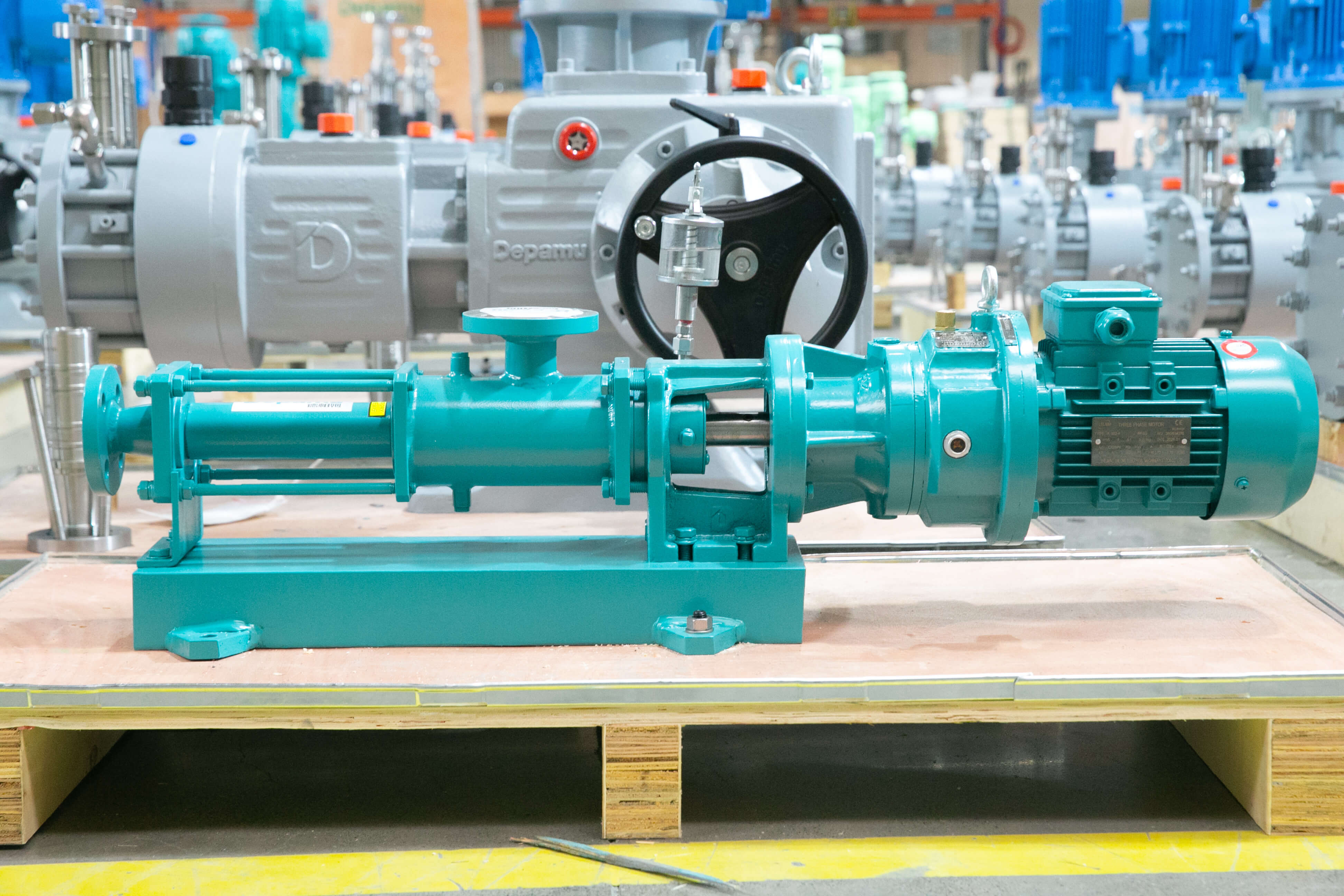
Inside Depam (Hangzhou) Pump Industry Technology Co., Ltd.
Depam (Hangzhou) Pump Industry Technology Co., Ltd. was founded in 2003 and has focused on high-end volumetric pumps and fluid equipment for more than twenty years. The company combines imported German technology with continuous in-house development and operates three brands — Depam, Kenilowa and Dailepu — serving process industries that require precise dosing, reliable pressure generation and stable transfer of difficult media.
The company employs more than 400 people across a plant area of approximately 35,000 square metres, with registered capital of RMB 54 million and annual output value of around RMB 500 million. Sales have grown steadily, from approximately RMB 450 million in 2023 to RMB 510 million in 2024 and RMB 560 million in 2025, reflecting consistent demand across its core markets.
| Company profile | Details |
|---|---|
| Founded | 2003 |
| Employees | 400+ |
| Plant area | Approximately 35,000 m² |
| Registered capital | RMB 54 million |
| Annual output value | Approximately RMB 500 million |
| Brands | Depam, Kenilowa, Dailepu |
| Core product families | Metering pumps, high-pressure reciprocating process pumps, screw pumps, rotary lobe pumps, gear pumps, pneumatic and electric pumps, chemical dosing packages, water and steam sampling systems |
Beyond screw pumps, the portfolio includes hydraulic diaphragm metering pumps, high-pressure reciprocating process pumps reaching 35 MPa and above, pneumatic and electric pumps, automatic chemical dosing packages, water and steam sampling devices, water treatment equipment, rotary lobe pumps, gear pumps, emulsifying pumps and special centrifugal pumps. This breadth matters to buyers because a single project often needs several pump technologies working together — for example a metering pump for precise chemical injection, a progressive cavity pump for sludge transfer and a dosing skid for automated reagent preparation.
Matching Configuration to Medium: A Practical Selection Guide
Selection begins with the medium, not the flow rate. Viscosity, solids content, particle shape and size, abrasiveness, pH, temperature, shear sensitivity and the presence of gas all influence the rotor-stator choice and the allowable operating speed. A progressive cavity pump selection guide that ignores any one of these parameters will usually produce a pump that either wears prematurely or fails to deliver the required flow.
| Selection parameter | What to confirm | Typical design response |
|---|---|---|
| Viscosity | Operating viscosity range and start-up condition | Lower speed, larger cavity volume, higher torque drive |
| Solids content | Particle size, shape, concentration | Abrasion-resistant stator compound, open-throat inlet option |
| Pressure | Discharge pressure and pipe length | Multi-stage rotor-stator, reinforced shaft and bearings |
| Temperature | Continuous and peak temperature | High-temperature elastomer, cooling or seal flush arrangement |
| Chemical aggressiveness | pH, solvents, chlorides | Corrosion-resistant wetted parts, seal face material selection |
| Control requirement | Fixed flow or variable dosing | Variable frequency drive with flow feedback |
Eccentric Screw Pump vs Other Pump Technologies
Buyers frequently compare progressive cavity pumps with rotary lobe, gear and centrifugal options. Each has a legitimate place, and the correct choice depends on viscosity, solids tolerance, shear sensitivity and pressure requirement. The comparison below summarises how an eccentric screw pump positions against common alternatives in industrial service.
| Pump type | Strength | Limitation |
|---|---|---|
| Eccentric screw pump | Handles viscous and solids-laden media, low pulsation, self-priming, gentle shear | Stator wear in dry running; pressure per stage limited |
| Rotary lobe pump | High flow, easy cleaning, good for food and sanitary duties | Less tolerant of fine abrasive solids, lower pressure capability |
| Gear pump | Compact, high pressure for clean lubricating fluids | Poor with solids and abrasive media, shear intensive |
| Centrifugal pump | High flow at low viscosity, low cost per unit capacity | Flow varies with viscosity, difficult for thick or shear-sensitive media |
Industries and Applications Served by Depam
Depam’s product portfolio supports a broad spread of process industries, with oil refining and chemical processing accounting for approximately 41% of sales, oil and gas field applications around 23%, nuclear power, power generation, metallurgy and new energy around 15%, environmental water treatment around 13%, and new materials and food around 3%, with the remaining 5% spread across other sectors.
In oil refining and chemical processing, pumps are used for chemical injection, viscous intermediate transfer and process boosting under pressure. In oil and gas fields, high-pressure reciprocating pumps and screw pumps support water injection, produced fluid transfer and pipeline boosting. In power generation and nuclear applications, metering pumps, dosing packages and water and steam sampling systems support water chemistry control. In environmental water treatment, dosing skids and progressive cavity pumps handle sludge, lime and polymer preparation. Food and new material producers rely on gentle transfer and hygienic configuration.
Custom and OEM Eccentric Screw Pump Solutions
Standard models cover many routine duties, but industrial projects frequently demand adaptation. Open-throat hopper inlets for highly viscous or semi-solid media, vertical tank-mounted configurations, mobile trolleys, heated jacketed bodies for temperature-sensitive products, and skid-mounted packages combining a screw pump with a dosing unit are all realistic requests that a flexible OEM eccentric screw pump supplier should be able to engineer.
Depam’s capability spans design, manufacturing and packaged delivery, with customisation based on medium characteristics, flow, pressure, temperature and site process requirements. Because the same organisation produces metering pumps, reciprocating pumps and dosing systems, integrated packages — such as a chemical preparation skid that combines a dissolving tank, agitator, metering pump and control system — can be assembled and tested before shipment, reducing site installation work to piping and power connection.
For eccentric screw pump for wastewater treatment projects, this package approach is particularly useful: sludge transfer, polymer preparation and lime dosing can be supplied as one coordinated scope with matched instrumentation and a single point of technical responsibility.
Installation, Operation and Maintenance Best Practices
Long service life depends as much on installation and operation as on pump quality. The suction line should be short, generously sized and free of sharp bends, and the pump should never run dry because the stator depends on the medium for lubrication and cooling. Proper alignment between pump and drive, correct anchor bolt torque and adequate access for maintenance all reduce vibration and extend bearing life.
During operation, monitor discharge pressure, motor current and flow stability. A gradual rise in current with falling flow usually indicates stator wear, while sudden pressure spikes suggest a blockage or a closed valve downstream. Variable frequency control is strongly recommended for dosing duties because it allows flow adjustment without throttling and reduces starting torque.
- Flush the pump after handling setting or curing media to prevent hardened deposits.
- Inspect the stator and rotor periodically and replace worn elastomers before clearance increases.
- Check seal condition and lubricant level at scheduled intervals.
- Keep spare rotor-stator sets and seals appropriate to the duty on hand for critical lines.
- Record operating parameters so that wear trends can be detected early.
How to Evaluate an Eccentric Screw Pump Supplier
When comparing quotations, look beyond unit price. A supplier that provides a complete technical proposal — medium analysis, hydraulic calculation, material selection, drawings, test protocol and warranty terms — is typically a lower total cost of ownership than a supplier that only quotes a model number.
- Engineering response: does the supplier ask for viscosity, solids, temperature and pressure data before quoting?
- Manufacturing depth: are rotors, stators and assemblies produced and tested in-house?
- Material traceability: can wetted part materials and elastomer grades be documented?
- Testing: is a performance test with recorded flow and pressure available before shipment?
- Packaging scope: can the pump be supplied with baseplate, coupling, guard, drive and controls?
- After-sales support: are spare parts, elastomer sets and technical assistance available long term?
FAQ
What is an eccentric screw pump used for?
An eccentric screw pump, also known as a progressive cavity pump, is used to transfer and meter viscous, abrasive or shear-sensitive media with a steady, low-pulsation flow. Typical duties include sludge and lime slurry in wastewater treatment, polymer and chemical dosing, viscous intermediate transfer in chemical plants, produced water and drilling fluid handling in oil and gas, and gentle transfer of food and new material products.
How do I choose the right eccentric screw pump for my process medium?
Start with the medium data: viscosity range, solids content and particle size, pH, temperature, shear sensitivity and whether the fluid is prone to setting. Then define flow rate, discharge pressure and control method. A qualified manufacturer will use these inputs to select rotor-stator geometry, elastomer grade, number of pressure stages, seal arrangement and drive type, and will confirm the selection with a performance curve before order confirmation.
Can eccentric screw pumps handle high-viscosity or abrasive media?
Yes. The progressive cavity principle is specifically suited to high-viscosity fluids and media containing solids, because the medium travels inside sealed cavities rather than passing through narrow clearances. For abrasive duties, wear resistance is managed through elastomer compound selection, reduced operating speed and, where necessary, an open-throat inlet design that improves feeding of thick or semi-solid products.
What should I check before buying from an eccentric screw pump supplier?
Confirm the supplier’s engineering capability, in-house manufacturing and testing, material documentation, packaged supply scope and long-term spare parts availability. Ask for dimensional drawings, performance test records and warranty terms, and verify that the proposed elastomer and seal materials are compatible with your medium. A supplier that requests complete process data before quoting is generally a safer choice than one that quotes from a catalogue alone.
Does Depam provide custom or OEM eccentric screw pump solutions?
Yes. Depam designs and manufactures standard, non-standard and customised fluid equipment based on medium characteristics, flow, pressure, temperature and site process requirements. Customisation can include open-throat hopper inlets, special materials, alternative sealing arrangements, mobile or tank-mounted configurations and integrated skid packages that combine pumps, tanks, agitation and control systems, assembled and tested before delivery.
What maintenance does a progressive cavity pump require?
Routine maintenance focuses on the stator and rotor, shaft seal and drive. Monitor discharge pressure and motor current to detect wear, keep the pump from running dry, flush after handling media that can set or cure, check seal condition and lubricant levels at scheduled intervals, and replace worn elastomer elements before internal clearance increases and efficiency drops. Keeping a spare rotor-stator set on site minimises downtime on critical lines.
Summary
Selecting an eccentric screw pump manufacturer is fundamentally a technical decision. The pump must match the medium, the process pressure and the required flow stability, and the manufacturer must be able to support that match with engineering analysis, documented materials, in-house testing and long-term spare parts. Buyers who evaluate suppliers on these criteria rather than on unit price alone generally achieve lower downtime, longer maintenance intervals and more predictable operating costs.
Depam (Hangzhou) Pump Industry Technology Co., Ltd. brings more than twenty years of experience in high-end volumetric pumps and fluid equipment, a 35,000 square metre manufacturing base, a workforce of over 400 people and a portfolio spanning metering pumps, high-pressure reciprocating pumps, screw pumps, dosing packages and water treatment equipment. For projects involving viscous media, abrasive slurries, precise chemical injection or integrated dosing systems, working with a manufacturer that can engineer the complete fluid package — and stand behind it through commissioning and after-sales service — is the most reliable route to a stable process.