
Choosing an electric double diaphragm pump manufacturer is not simply a matter of comparing unit prices. In chemical plants, refineries, oil and gas fields, power stations and water treatment facilities, a diaphragm pump sits directly in the process line: it meters aggressive acids, transfers sludge, injects corrosion inhibitors, or feeds polymers into a treatment basin. When that pump stops, production stops with it. The supplier you select therefore becomes part of your process reliability strategy, not just your procurement list.
This guide explains how electric double diaphragm pumps work, where they outperform air-operated alternatives, which selection parameters actually matter, and how to evaluate an electric double diaphragm pump supplier before you issue a purchase order. It also outlines the manufacturing background and product portfolio of Depamu (Hangzhou) Pump Industry Technology Co., Ltd., a volumetric pump specialist that has been serving global industrial fluid handling markets since 2003.
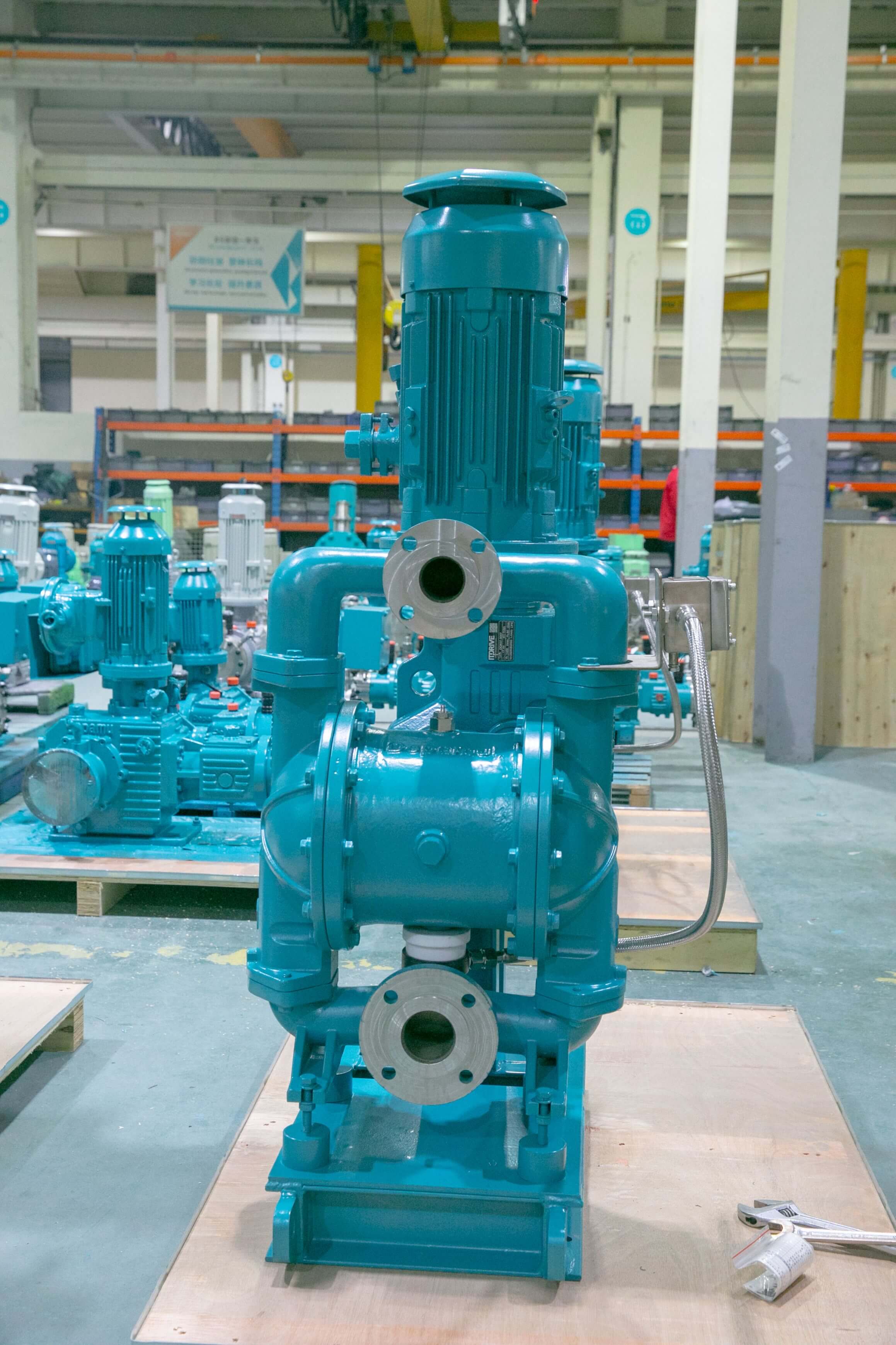
What Makes a Qualified Electric Double Diaphragm Pump Manufacturer?
An electric double diaphragm pump is a positive displacement pump. Two diaphragms, connected by a common shaft and driven by an electric motor, reciprocate in opposite directions. As one diaphragm moves forward and pushes liquid out of its chamber, the other moves back and draws liquid in. Check valves on the suction and discharge sides keep the flow moving in one direction. Because the liquid never contacts the drive mechanism, the pump is well suited to corrosive, abrasive, viscous or hazardous media.
The word “manufacturer” carries real weight in this category. A genuine electric double diaphragm pump factory controls diaphragm geometry, valve design, chamber machining, motor matching and final performance testing in-house. That level of control determines repeatability: whether the pump delivers the same dose on day one and day one thousand, whether spare diaphragms fit without modification, and whether the supplier can engineer a non-standard unit when a standard catalogue model does not fit the process.
Depamu (Hangzhou) Pump Industry Technology Co., Ltd. was established in 2003 and has grown into a high-tech enterprise focused on high-end volumetric pumps and fluid equipment. The company employs more than 400 people, operates a factory site of approximately 35,000 square meters, holds registered capital of RMB 54 million, and generates annual output value of around RMB 500 million. Sales have grown steadily — approximately RMB 450 million in 2023, RMB 510 million in 2024 and RMB 560 million in 2025 — an indication of sustained demand rather than a one-off project spike.
The product portfolio is broader than diaphragm pumps alone. Depamu manufactures metering pumps (including hydraulic diaphragm metering pumps), high-pressure process reciprocating pumps, pneumatic pumps, electric pumps, automatic chemical dosing packages, water and steam sampling devices, water treatment equipment, screw pumps, rotary lobe pumps and gear pumps. This matters to buyers: a supplier that also builds the dosing system, the control skid and the downstream transfer equipment can take responsibility for the whole fluid train instead of a single component.
How an Electric Double Diaphragm Pump Works
Balanced Diaphragm Action
The twin-diaphragm layout is what gives the pump its name and its stability. While one chamber is discharging under pressure, the other is refilling, so discharge pulsation is smoothed compared with a single-acting design. The two diaphragms are mechanically or hydraulically linked, which means the pump self-balances: the energy used to push one side out is partly recovered by the suction stroke on the other. This is why electric double diaphragm pumps can run continuously for long periods in dosing and transfer duty without excessive wear on the drive train.
Why Electric Drive Instead of Compressed Air
Air-operated diaphragm pumps are popular because they are simple and tolerate dry running. An electric drive, however, offers capabilities that matter in modern plants: precise and repeatable flow control through motor speed or stroke adjustment, lower energy consumption per unit of delivered flow where compressed air is expensive or unavailable, quieter operation, and straightforward integration with PLC and DCS systems through 4–20 mA or digital signals. For an industrial electric diaphragm pump used in automated dosing or ratio control, the electric drive is usually the better fit.
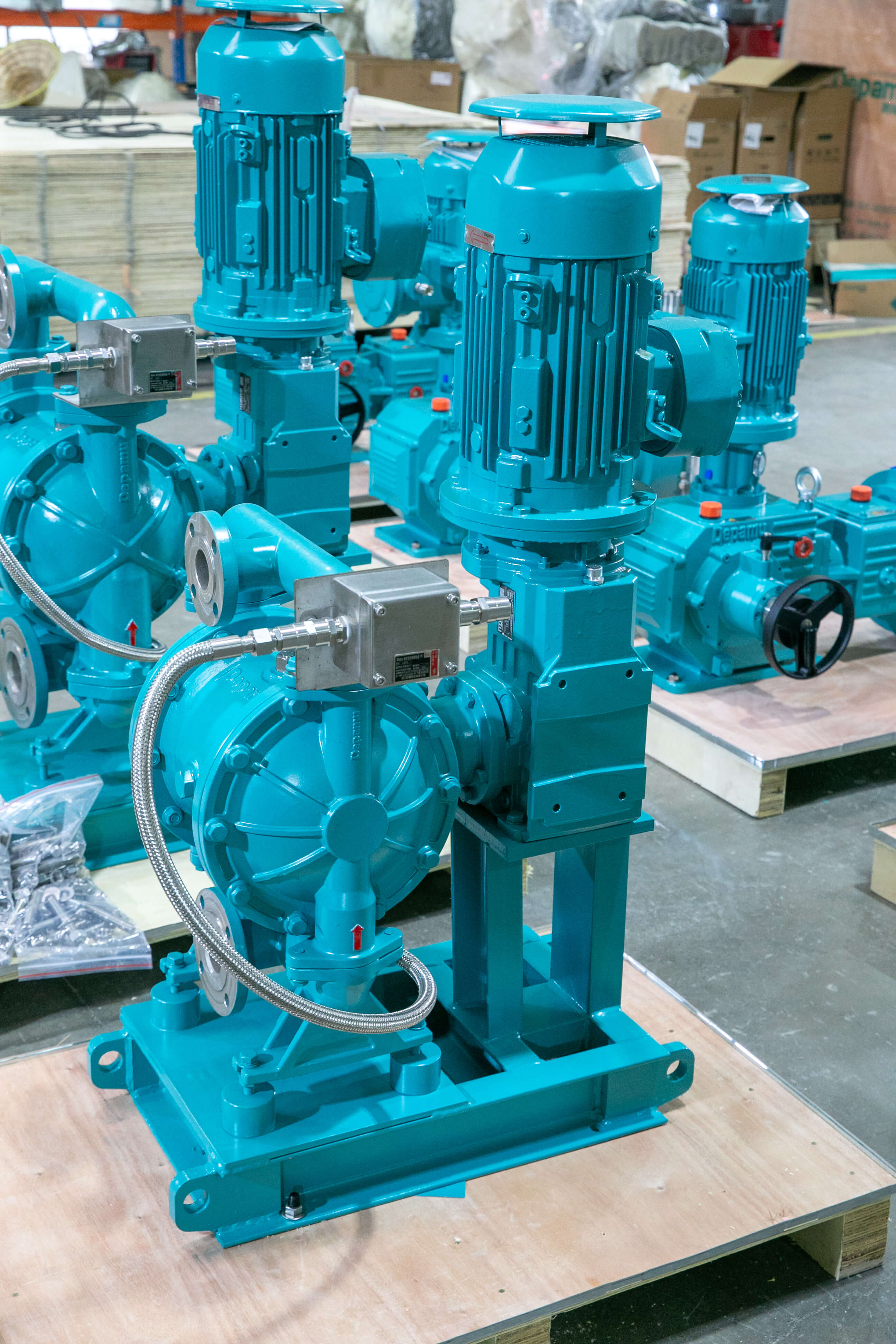
Electric vs Air-Operated Diaphragm Pumps: A Practical Comparison
The first decision in most projects is drive type. The table below summarises the trade-offs that matter in real installations; it is a general engineering comparison, not a specification for any single model.
| Selection Factor | Electric Double Diaphragm Pump | Air-Operated Diaphragm Pump |
|---|---|---|
| Flow control accuracy | High — adjustable via motor speed or stroke, suitable for dosing duty | Moderate — depends on air pressure and valve regulation |
| Automation and signal integration | Direct PLC/DCS integration, remote monitoring possible | Requires additional solenoid valves and instrumentation |
| Energy source | Electrical supply; no compressed air network required | Compressed air; efficiency depends on air system quality |
| Noise level | Generally quieter in continuous operation | Exhaust noise from air valves |
| Typical best fit | Chemical dosing, ratio control, packaged skids, continuous transfer | Intermittent transfer, sump duty, hazardous areas without power |
Where Electric Double Diaphragm Pumps Are Used in Industry
Application experience is one of the clearest indicators of whether a double diaphragm pump OEM understands your process. Depamu’s product range is deployed across a diversified industrial base, and the sales distribution is instructive: petroleum refining and chemicals account for roughly 41% of business, oil and gas fields around 23%, nuclear power, electric power, metallurgy and new energy around 15%, environmental water treatment around 13%, and new materials and food around 3%, with other sectors making up the remaining 5%.
Petroleum Refining and Chemical Processing
In refineries and chemical plants, diaphragm pumps are used to inject inhibitors, transfer solvents and intermediates, and move spent chemicals and sludge. Media are often corrosive, volatile or contaminated with solids. A sealed diaphragm design keeps the process fluid away from the drive and helps contain hazardous liquids, while the electric drive allows dosing to be tied to process flow signals. High-pressure process reciprocating pumps complement this duty in Depamu’s range, covering pressurisation and long-distance pipeline injection where pressures can exceed 35 MPa.
Oil and Gas Fields
Field operations rely on reliable transfer and injection for chemical additives, produced water and treatment agents. Equipment must tolerate remote locations, variable temperatures and uneven maintenance windows. Electric diaphragm pumps with simple valve structures and accessible diaphragm chambers are easier to service in the field than complex rotating machinery.
Power Generation, Nuclear, Metallurgy and New Energy
These industries require disciplined fluid handling: sampling, reagent dosing, chemical cleaning and auxiliary transfer. Depamu’s water and steam sampling devices and dosing systems are frequently combined with diaphragm pumps, giving plant operators a coordinated solution rather than mismatched components from several vendors.
Environmental Water Treatment
Municipal and industrial wastewater plants feed coagulants, flocculants, sodium hypochlorite, acids and alkalis. Dosage accuracy directly affects chemical cost and discharge compliance. An electric diaphragm pump for chemical dosing with stable, adjustable output helps hold residual targets without over-dosing. Depamu’s automatic chemical dosing packages integrate metering pumps, dissolution tanks, agitators and intelligent control into a skid that is assembled and tested before shipment, so site work is limited to piping and power connections.
New Materials and Food Processing
Where hygiene and gentle handling matter, diaphragm pumps avoid the shear damage that some rotary designs cause to sensitive media, and their contained design simplifies cleaning and changeover between batches.
How to Select the Right Electric Double Diaphragm Pump
A meaningful electric double diaphragm pump selection guide starts with the fluid, not the pump. Collecting the correct data before you contact a supplier shortens the engineering cycle and prevents costly rework. Use the checklist below as a starting point for a technical discussion and an accurate electric double diaphragm pump quotation.
| Parameter | Why It Matters |
|---|---|
| Media composition and concentration | Determines diaphragm and valve material compatibility and expected service life |
| Required flow rate and turndown range | Defines chamber size, stroke rate and the achievable control range |
| Discharge pressure | Sets motor power, structural rating and valve loading |
| Temperature range | Affects elastomer choice and thermal expansion allowances |
| Viscosity and solids content | Influences suction conditions, valve type and chamber geometry |
| Area classification and motor type | Determines drive and enclosure selection for the installed environment |
| Control and communication requirements | Decides whether a standalone unit or an integrated dosing skid is appropriate |
Beyond the fluid data, evaluate how the electric double diaphragm pump supplier responds to engineering questions. A capable manufacturer will discuss diaphragm material trade-offs, valve seat options, pulsation damping, and spare parts strategy before quoting. Depamu’s stated capability — standard products, non-standard products and customised fluid solutions engineered around a customer’s medium characteristics, flow, pressure, temperature and site process requirements — is exactly the kind of flexibility that reduces integration risk on complex projects.
Maintenance, Uptime and Long-Term Cost of Ownership
Diaphragms and check valves are consumable components; every design will eventually need replacement. The relevant question is how predictable and how fast that replacement can be. Look for a pump layout that allows the diaphragm chamber to be opened without dismantling the entire piping run, documentation that identifies part numbers clearly, and a supplier that holds stock of wear parts for the models it sells.
Daily practice also matters. Confirm suction pressure is adequate to avoid cavitation, keep strainers clean, verify that the discharge line is not blocked, and record stroke or speed settings so that process changes can be traced. In dosing service, periodic calibration against a measured volume is the simplest way to catch drift early. Where the pump is part of a packaged chemical dosing system, factory assembly and testing before delivery — a standard step in Depamu’s skid builds — removes much of the on-site commissioning risk.
FAQ
What is an electric double diaphragm pump used for?
It is a positive displacement pump used to transfer, meter or inject liquids that must be contained or handled precisely. Typical duties include chemical dosing in water treatment, acid and alkali transfer in chemical plants, additive injection in oil and gas fields, and sludge or slurry transfer where solids are present.
How do I choose an electric double diaphragm pump manufacturer?
Check in-house design and manufacturing capability, experience in your specific industry, ability to supply non-standard or customised units, spare parts availability, and technical responsiveness during pre-sales discussions. A manufacturer that also builds dosing packages and related fluid equipment can often take responsibility for the wider system.
What is the difference between an electric and an air-operated diaphragm pump?
Both use reciprocating diaphragms, but the drive differs. Electric units offer more precise flow control and easier integration with plant control systems, while air-operated units suit intermittent duty and areas where compressed air is the preferred power source. The choice depends on required dosing accuracy, available utilities and automation level.
Can electric double diaphragm pumps handle corrosive or viscous media?
Yes, provided the correct diaphragm, valve and chamber materials are selected. Because the process fluid is isolated from the drive, these pumps are commonly used for aggressive chemicals. For high-viscosity or solids-laden media, suction conditions and valve type must be reviewed during selection.
Do you supply customised or packaged systems, not just single pumps?
Depamu supplies standard products, non-standard products and customised fluid solutions, including automatic chemical dosing packages that combine pumps, dissolution tanks, agitators and intelligent control in a factory-tested skid. Customers provide medium characteristics, flow, pressure, temperature and site process requirements, and the configuration is engineered accordingly.
How do I get a quotation for an electric double diaphragm pump?
Provide the medium and concentration, required flow rate and control range, discharge pressure, temperature, viscosity and solids content, area classification, control interface requirements, and preferred delivery terms. Complete data allows the supplier to propose an appropriate model or a customised configuration and issue a meaningful quotation.
Summary
Selecting an electric double diaphragm pump manufacturer is a reliability decision as much as a purchasing one. The right partner understands your medium, your process control requirements and your maintenance reality — and can engineer a pump or a complete dosing system around them. Depamu (Hangzhou) Pump Industry Technology Co., Ltd. brings more than two decades of volumetric pump experience, a 35,000 square meter manufacturing site, a 400-strong team, three operating brands, and a portfolio that spans metering pumps, high-pressure reciprocating pumps, electric and pneumatic pumps, chemical dosing packages and water treatment equipment. Its application base across refining, chemicals, oil and gas, power, nuclear, metallurgy, new energy, water treatment, new materials and food reflects the breadth of duty its equipment is expected to handle. For buyers evaluating an industrial electric diaphragm pump or a customised fluid solution, the practical next step is a technical conversation grounded in real process data.