
Choosing a gear pump manufacturer is rarely a simple purchasing decision. For plant engineers, EPC contractors, and procurement teams, the pump that ends up on the P&ID is only part of the story: the real value comes from the factory behind it. A gear pump supplier that understands media characteristics, flow and pressure requirements, installation constraints, and long-term serviceability can prevent years of downtime, seal failures, and unplanned maintenance costs.
This guide explains what a gear pump actually does, how to evaluate a gear pump company, which selection criteria matter most in B2B procurement, and where a positive displacement pump manufacturer such as Depamu (Hangzhou) Pump Industry fits into the wider fluid handling landscape. It is written for international buyers who need a practical, technically grounded framework rather than marketing claims.
What Does a Gear Pump Manufacturer Actually Deliver?
A gear pump is a positive displacement pump. Two meshing gears rotate inside a closely toleranced casing. Liquid is trapped in the spaces between the gear teeth and the casing wall, carried around the outside of the gears, and forced out on the discharge side as the teeth re-mesh. Because the displacement per revolution is essentially fixed, flow is stable and largely independent of discharge pressure within the design envelope.
This working principle shapes what a competent gear pump manufacturer must control: gear tooth geometry, backlash, axial and radial clearances, casing and gear material selection, bearing and lubrication strategy, and shaft sealing. Each of these variables influences volumetric efficiency, internal slip, noise, and service life. A gear pump supplier that only assembles bought-in components cannot control all of them.
In practice, a capable gear pump factory delivers more than a machined casting. It provides material traceability, dimensional inspection, pressure and leak testing, performance verification, documentation, spare parts availability, and engineering support during commissioning. For buyers in refining, chemical processing, and oil and gas, those supporting capabilities often matter more than a marginal difference in catalogue price.
Why Gear Pump Supplier Selection Matters for B2B Buyers
Gear pumps are frequently installed in duties that are difficult to access and expensive to interrupt. Lubrication circuits on rotating equipment, fuel oil forwarding, resin and adhesive transfer, and additive circulation are typical examples. When such a pump fails, the consequence is not limited to the pump itself — it can mean a stopped production line, a contaminated batch, or an unplanned shutdown.
Supplier selection therefore has a direct effect on total cost of ownership. Three factors dominate:
- Design competence: the ability to match clearances, materials, and seals to the actual medium, rather than supplying a generic catalogue unit.
- Manufacturing consistency: repeatability across production batches, so that a replacement pump behaves like the original.
- Lifecycle support: spare parts, documentation, and engineering response over the full service life of the equipment.
An industrial gear pump supplier that can demonstrate all three is generally a safer partner than one competing purely on unit price. This is especially true for projects where the pump is part of a packaged system and where interface compatibility — flanges, baseplates, instrumentation, and control signals — must be correct the first time.
Inside Depamu (Hangzhou) Pump Industry Co., Ltd.
Depamu (Hangzhou) Pump Industry Co., Ltd. was founded in 2003 and has spent more than two decades focused on high-end positive displacement pumps and fluid equipment. The company operates as an integrated manufacturer covering research and development, design, production, and packaged delivery, with more than 400 employees and a plant area of approximately 35,000 square meters. Registered capital is RMB 54 million, and annual output value is approximately RMB 500 million.
The product portfolio spans metering pumps, high-pressure process reciprocating pumps, pneumatic pumps, electric pumps, chemical dosing packages, water and steam sampling systems, water treatment equipment, screw pumps, rotary lobe pumps, and gear pumps. This breadth matters for buyers because it allows the manufacturer to recommend the correct pump type for a duty — including advising against a gear pump when another positive displacement design is a better technical fit.
Depamu serves customers across petroleum refining and chemical processing (approximately 41% of sales), oil and gas fields (approximately 23%), nuclear power, power generation, metallurgy and new energy (approximately 15%), environmental and water treatment (approximately 13%), and new materials and food processing (approximately 3%), with the remainder spread across other industries. Sales performance has grown steadily, from approximately RMB 450 million in 2023 to approximately RMB 510 million in 2024 and approximately RMB 560 million in 2025. The company operates three brands — Depamu, Keniluowa, and Dailepu — and positions itself as a global fluid equipment provider.
| Company Fact | Detail |
|---|---|
| Established | 2003 |
| Employees | 400+ |
| Plant Area | Approx. 35,000 m² |
| Registered Capital | RMB 54 million |
| Annual Output Value | Approx. RMB 500 million |
| Brands | Depamu, Keniluowa, Dailepu |
| Core Capability | R&D, design, manufacturing, packaged system delivery |
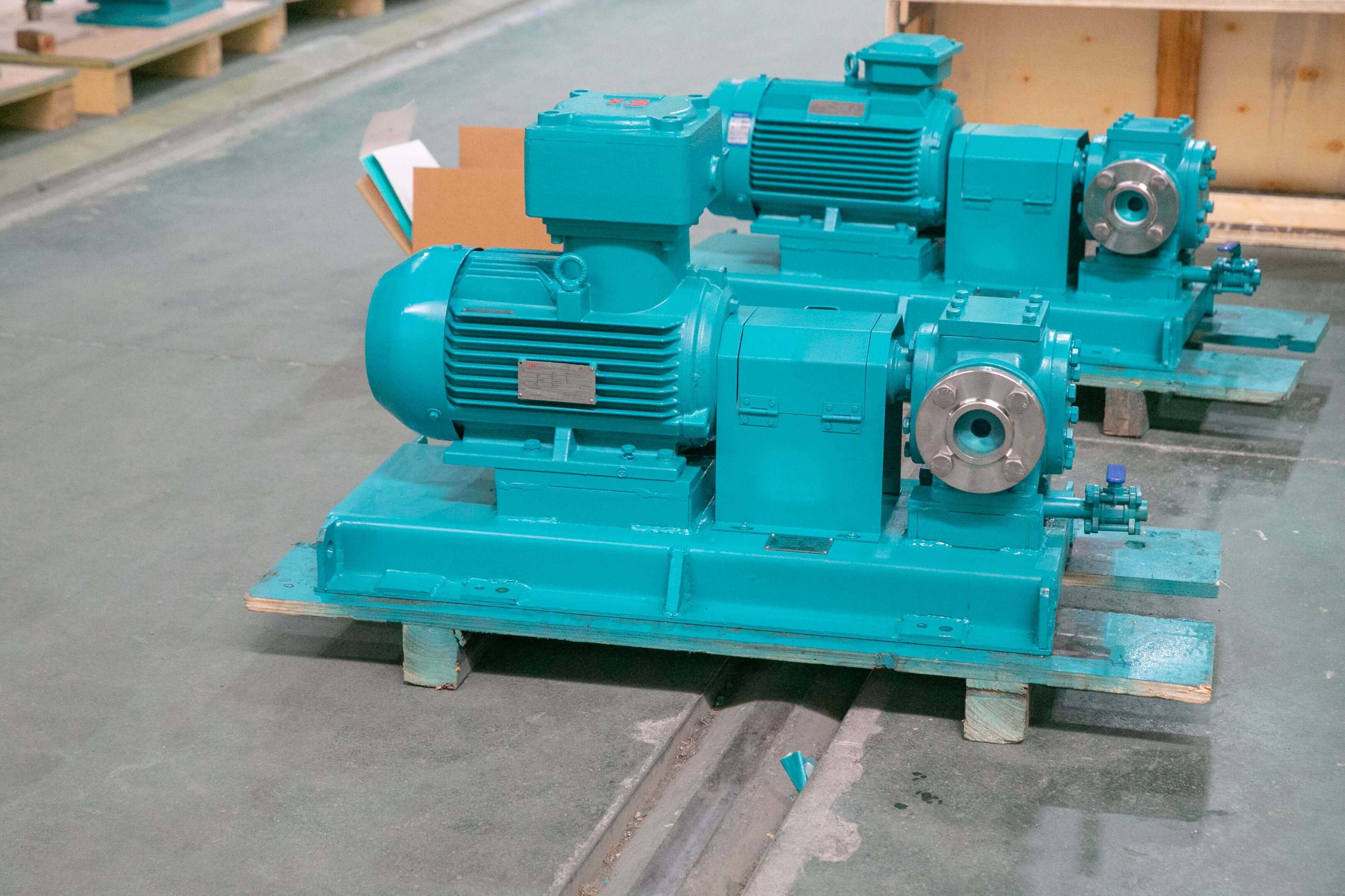
External vs. Internal Gear Pumps: A Practical Comparison
Most industrial buyers encounter two gear pump architectures. External gear pumps use two identical gears meshing inside the casing, with liquid carried in the tooth spaces around the outside diameter. Internal gear pumps use a smaller driving gear inside a larger internally toothed ring, with a crescent-shaped idler separating suction from discharge. Both are positive displacement designs, but their behaviour differs in ways that affect selection.
| Characteristic | External Gear Pump | Internal Gear Pump |
|---|---|---|
| Typical strength | Compact, simple, high pressure capability | Gentle handling of viscous media, good suction |
| Viscosity range | Medium to high, depends on clearance design | Often preferred for higher viscosity duties |
| Shear exposure | Moderate | Generally lower |
| Solids tolerance | Limited | Limited |
| Typical duties | Lubrication, fuel forwarding, hydraulic service | Resins, adhesives, viscous process streams |
A qualified gear pump manufacturer will ask about viscosity, temperature, lubricity, and solids content before recommending an architecture. If the medium carries abrasive particles or is shear-sensitive with a high solids load, a rotary lobe pump or screw pump is often the better answer — and a supplier that offers those alternatives as well is more likely to give an honest recommendation.
Key Selection Criteria When Buying From a Gear Pump Supplier
Gear pump selection is a sequence of engineering decisions, not a catalogue lookup. The following parameters should be defined before requesting a quotation, because they directly determine materials, clearances, seals, and drive configuration.
| Parameter | Why It Matters |
|---|---|
| Media name and composition | Drives material compatibility and seal selection |
| Viscosity at operating temperature | Affects speed limits, suction conditions, and internal slip |
| Flow rate and turndown | Determines displacement, speed, and whether variable speed is needed |
| Discharge pressure | Sets bearing load, casing strength, and seal duty |
| Temperature range | Influences clearances, thermal growth, and elastomer choice |
| Solids content and particle size | May rule out gear pumps entirely in favour of other designs |
| Duty cycle | Continuous service requires different bearing and seal margins |
| Installation environment | Hazardous area classification, noise limits, available space |
| Control and monitoring | Local or remote control, instrumentation, integration with plant DCS |
Materials and Sealing
Gear pump performance is heavily influenced by the metallurgy of the gears, shafts, and casing. Cast iron is common for lubricating and non-aggressive media, while stainless and higher-alloy grades are selected for corrosive service. Seal selection — mechanical seal, lip seal, or a magnetically driven sealless configuration — depends on whether leakage is tolerable, whether the medium crystallises, and whether the fluid is hazardous.
Drive Configuration and Control
Fixed-speed drives are adequate where flow is trimmed by a bypass or where the process tolerates a fixed rate. Variable frequency drives allow flow adjustment by changing speed, which is useful for batching, blending, and multi-product plants. A gear pump manufacturer experienced in packaged systems can also supply the pump on a baseplate with motor, coupling guard, instrumentation, and controls, reducing site integration work.
Application Scenarios Across Process Industries
Gear pumps occupy a well-defined niche. They are strong where the medium is viscous, relatively clean, and requires a steady, pulseless flow at moderate to high pressure. The following scenarios reflect where this pump type is commonly specified.
Petroleum Refining and Chemical Processing
Refineries and chemical plants use gear pumps for lube oil circulation, fuel oil forwarding, additive transfer, and circulation of process streams in distillation and reaction sections. The main selection challenge is matching materials and seals to aggressive or high-temperature media, and ensuring the pump can tolerate the thermal cycling typical of start-up and shutdown sequences.
Oil and Gas Fields
In upstream and midstream service, gear pumps handle crude transfer, chemical injection support, and lubrication duties on rotating machinery. Robust construction and dependable suction behaviour matter in remote installations where maintenance access is limited.
Power Generation, Metallurgy, and New Energy
Power plants and metallurgical facilities rely on gear pumps in lubrication skids, fuel supply circuits, and hydraulic service. In new energy applications, viscous process streams and precise transfer duties are typical, often requiring custom materials and packaging.
Environmental and Water Treatment
Water treatment plants generally require dosing accuracy, which is the domain of metering pumps rather than gear pumps. Where gear pumps appear, they usually handle viscous slurries, polymer make-up transfer, or chemical storage circulation. A responsible industrial gear pump supplier will point out that chemical dosing duties belong with a metering pump, and that high-solids sludge belongs with a rotary lobe or screw pump.
New Materials and Food Processing
Resins, adhesives, edible oils, syrups, and similar viscous products suit gear pump technology provided that hygienic requirements, cleaning procedures, and material certifications are addressed at the design stage. Interchangeable gear sets and carefully controlled clearances allow a single platform to cover multiple product grades.
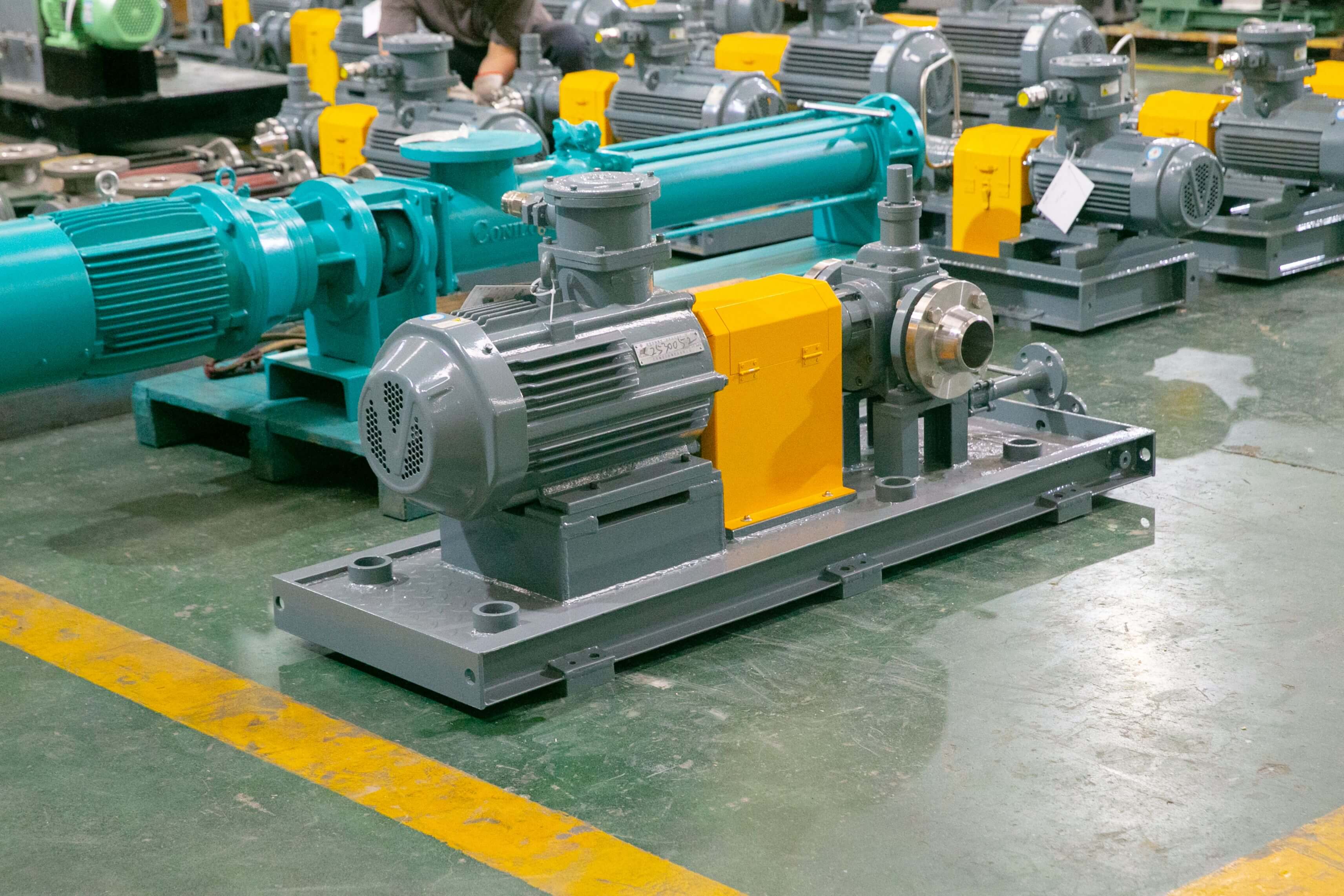
Standard, Non-Standard, and Custom Gear Pump Solutions
Not every duty fits a catalogue unit. Depamu’s engineering model is built around the customer’s specific medium characteristics, flow, pressure, temperature, and on-site process requirements. That approach produces three delivery formats: standard products, non-standard adaptations, and fully customised fluid solutions.
Standard products cover common duties where a proven configuration applies. Non-standard adaptations adjust materials, seals, connections, or drive arrangements within an established platform. Fully customised solutions may combine the pump with a baseplate, control panel, instrumentation, and piping to form a packaged unit that arrives on site ready for connection.
For buyers seeking an OEM gear pump supplier, this flexibility is significant. OEM partners typically require consistent dimensional interfaces, agreed inspection criteria, and stable documentation across repeat orders. A manufacturer with in-house design capability can hold those interfaces stable while adapting internal details to each new project.
Installation and Commissioning Considerations
Most premature gear pump failures are installation-related rather than manufacturing-related. Attention to a small number of fundamentals protects the investment:
- Suction conditions: verify available net positive suction head at the worst-case viscosity and temperature, and keep suction lines short with minimal fittings.
- Alignment: check coupling alignment after baseplate grouting and again after the first heat cycle on hot services.
- Piping support: support suction and discharge piping independently so that nozzle loads do not distort the casing.
- Filtration: install strainers during flushing and appropriate filtration in normal operation to protect gear faces and bearings.
- Relief protection: a positive displacement pump must have a pressure relief path on the discharge side; a blocked discharge can generate damaging overpressure.
- Dry running: gear pumps depend on the pumped medium for lubrication and should not run dry.
Maintenance Practices That Extend Service Life
A planned maintenance routine for gear pumps is comparatively simple and highly effective. Monitor discharge pressure and flow trends — a gradual loss of flow at constant speed usually indicates increasing internal clearance or wear. Check seal condition and weepage at each inspection interval. Confirm that the lubricant or process medium has not changed in viscosity or contamination level, since both affect slip and wear rates.
Keep a modest spare parts inventory matched to the duty criticality: seals, gaskets, and where appropriate a complete replacement pump or rotating assembly. For continuous duty units in inaccessible locations, a spare rotating element reduces mean time to repair considerably. A well-organised gear pump factory will supply a recommended spare parts list together with the equipment documentation.
How to Evaluate a Gear Pump Company Before You Order
Procurement teams often ask for a simple checklist. The following questions reveal most of what matters about a potential partner:
- Can the manufacturer explain the working principle and limitations of a gear pump for your specific medium, rather than quoting immediately?
- Does the company offer complementary positive displacement technologies, so recommendations are technically neutral?
- Are material and dimension records available for each delivered unit?
- Is there an in-house engineering team able to review drawings, interface data, and control requirements?
- Can the supplier provide previous project references in a comparable industry, within the limits of confidentiality?
- What are the standard lead times for a repeat order and for spare parts?
- Is documentation supplied in the language and format required by your project specification?
Understanding Gear Pump Price and Total Cost
Buyers searching for gear pump price information usually find a wide spread of quotations. That spread is rarely random. Differences come from material grade, seal type, bearing design, machining tolerance, testing scope, documentation, and warranty terms. Comparing only the headline figure can be misleading.
A more reliable comparison normalises the quotation: same materials, same seals, same drive arrangement, same inspection and test plan, same documentation package, and same spare parts scope. When quotations are aligned this way, the remaining differences usually reflect genuine differences in engineering effort and manufacturing control. Requesting a breakdown of scope alongside the price is a standard practice in B2B procurement and helps avoid later change orders.
FAQ
What should I check before choosing a gear pump manufacturer?
Verify three things: engineering capability, manufacturing consistency, and lifecycle support. Engineering capability means the manufacturer asks about viscosity, temperature, pressure, solids content, and duty cycle before recommending a model. Manufacturing consistency means dimensional and material records exist for each unit. Lifecycle support means spare parts, documentation, and technical response are available after delivery. A supplier that can answer all three in concrete terms is usually a safer long-term partner than one competing only on price.
Can gear pumps handle high-viscosity fluids?
Yes, gear pumps are frequently selected for viscous media because their positive displacement action generates flow independently of centrifugal effects. However, viscosity interacts with speed limits, suction conditions, and internal clearances. High-viscosity service usually requires lower rotational speed, larger suction passages, and sometimes a heated casing or jacketed design. The correct configuration should be determined from the viscosity at actual operating temperature, not from a single catalogue figure.
Does Depamu provide custom gear pumps and OEM supply?
Yes. Depamu (Hangzhou) Pump Industry provides standard products, non-standard adaptations, and customised fluid solutions based on the customer’s medium characteristics, flow, pressure, temperature, and on-site process requirements. Because the company manufactures a broad range of positive displacement equipment — including metering pumps, high-pressure reciprocating pumps, screw pumps, and rotary lobe pumps — it can also advise when a gear pump is not the optimal choice for a given duty, and supply the more suitable technology instead.
What is the difference between external and internal gear pumps?
External gear pumps use two meshing gears of equal size, with liquid carried in the tooth spaces around the inside of the casing. Internal gear pumps use a smaller driving gear rotating inside a larger internally toothed ring, with an idler separating suction from discharge. External designs are compact and well suited to higher pressure duties, while internal designs are often preferred for viscous media and gentler fluid handling. Both are positive displacement pumps, and the right choice depends on the specific medium and operating envelope.
Can a gear pump be used for chemical dosing?
Generally, no. Chemical dosing requires controlled, repeatable, and often very low flow rates with high accuracy, which is the purpose of a metering pump. Gear pumps deliver a fixed displacement per revolution and are better suited to transfer and circulation duties. For dosing applications, a hydraulic diaphragm metering pump or a complete automatic chemical dosing package is normally the correct selection, and a manufacturer offering both technologies can make that distinction objectively.
What information do I need to provide to get an accurate gear pump quotation?
Provide the medium name and composition, viscosity at operating temperature, required flow rate and turndown, discharge pressure, temperature range, solids content and particle size if any, duty cycle, installation environment including hazardous area classification, available utilities, and required control and documentation scope. Supplying a P&ID or equipment data sheet shortens the engineering review considerably and reduces the risk of a technically unsuitable offer.
Summary
Selecting a gear pump manufacturer is an engineering decision as much as a commercial one. The right partner understands that a gear pump is a positive displacement machine whose performance depends on clearances, materials, seals, and drive configuration — and is willing to discuss where the technology does not fit. That honesty is a reliable indicator of technical competence.
Depamu (Hangzhou) Pump Industry brings more than two decades of experience in high-end positive displacement pumps and fluid equipment, a 35,000 square meter manufacturing base, a workforce of over 400 people, and an integrated capability spanning research, design, production, and packaged system delivery. Its portfolio covers gear pumps alongside metering pumps, high-pressure process reciprocating pumps, screw pumps, rotary lobe pumps, and complete chemical dosing systems, serving petroleum refining and chemical processing, oil and gas, power generation, metallurgy, new energy, environmental water treatment, new materials, and food processing.
For buyers evaluating an industrial gear pump supplier, the practical next step is straightforward: define the process data sheet, request aligned quotations on a comparable scope, ask how the manufacturer handles non-standard requirements, and confirm spare parts and documentation commitments before placing the order. That process consistently produces better outcomes than selecting on unit price alone.