
Choosing the right high-pressure plunger reciprocating pump manufacturer is one of the most consequential decisions in any process plant, oilfield operation, or chemical production line. These pumps sit at the heart of high-pressure transfer, injection, and boosting duties, and a poorly matched unit can cause downtime, seal failures, and expensive rework. This guide explains how high-pressure plunger reciprocating pumps work, where they are used, how to specify them correctly, and how to evaluate a high-pressure plunger reciprocating pump supplier before you place an order.
The content below is based on the product portfolio and engineering capabilities of Depamu (Hangzhou) Pump Industry Technology Co., Ltd., a manufacturer established in 2003 and focused on high-end positive displacement pumps and fluid equipment for industries including petroleum refining, chemicals, oil and gas fields, nuclear power, conventional power generation, metallurgy, new energy, environmental water treatment, new materials, and food processing.
What Is a High-Pressure Plunger Reciprocating Pump?
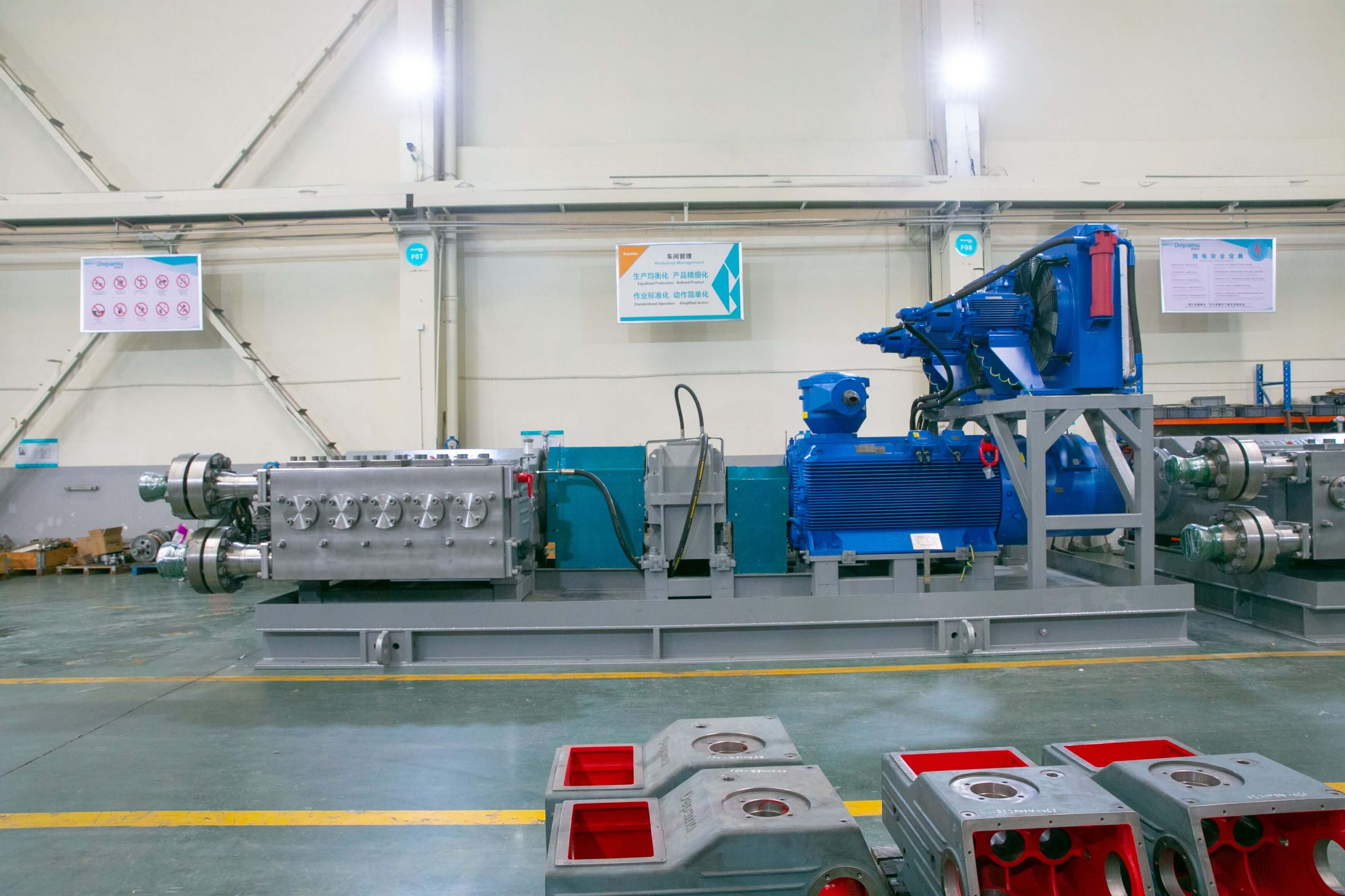
A high-pressure plunger reciprocating pump is a positive displacement machine that uses a plunger moving back and forth inside a cylinder to push liquid into a discharge line. Because the volume delivered depends on the plunger area and stroke length rather than on centrifugal force, these pumps can generate very high discharge pressures while maintaining a nearly constant flow rate. In many process plants they function as a “pressure boosting station,” moving fluid from a low-pressure source into a high-pressure header, a long-distance pipeline, or a wellbore.
In the Depamu product line, high-pressure process reciprocating pumps are engineered to reach discharge pressures of 35 MPa and above, depending on configuration. They are designed for stable flow, continuous duty operation, and reliable handling of demanding media such as high-viscosity liquids, high-temperature fluids, and slurries containing solid particles. This combination of high pressure and consistent flow is what separates a reciprocating plunger pump from a standard centrifugal pump in critical service.
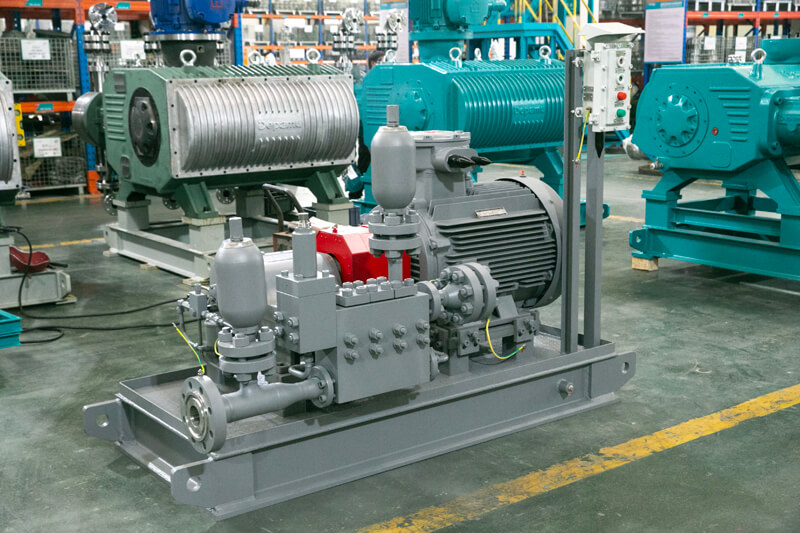
It is helpful to distinguish the plunger reciprocating pump from the metering pump, which is another core Depamu product family. A metering pump, such as a hydraulic diaphragm metering pump, is optimized for precise chemical dosing at relatively low flow rates, using stroke length and frequency adjustment to control the injected volume. A high-pressure plunger reciprocating pump is optimized for pressure and volume transfer. Many plants use both in the same process: the reciprocating pump handles bulk transfer and boosting, while the metering pump injects additives, inhibitors, or treatment chemicals with high accuracy.
Why Work With Depamu as Your High-Pressure Plunger Reciprocating Pump Manufacturer
Depamu was founded in 2003 and has spent more than two decades concentrating on positive displacement pump technology and fluid systems. The company employs over 400 people, operates a manufacturing site of roughly 35,000 square meters, holds a registered capital of RMB 54 million, and reports an annual output value of approximately RMB 500 million. Reported sales have grown from about RMB 450 million in 2023 to approximately RMB 510 million in 2024 and RMB 560 million in 2025, reflecting steady expansion in both domestic and overseas markets.
The company operates three brands — Depamu, Kenirova, and Dailepu — and combines technology originally introduced from Germany with in-house development and continuous product improvement. That engineering base covers research and development, design, manufacturing, assembly, testing, and complete packaged delivery, which means a customer can source a single pump or an entire skid-mounted fluid system from one accountable partner.
Manufacturing and Engineering Capability
Manufacturing depth matters when you are buying equipment that must run continuously for years. Depamu’s capability spans machining of pump bodies and plungers, assembly of hydraulic and mechanical drive ends, fabrication of base frames and skids, and factory testing before shipment. For packaged systems such as automatic chemical dosing units, the equipment is assembled and tested at the factory so that on-site work is limited to connecting piping and power.
Engineering support is equally important. Because every process has its own combination of medium characteristics, flow rate, pressure, temperature, and site conditions, the company provides standard products, non-standard products, and fully customized fluid solutions. Customers are encouraged to share fluid data sheets, piping layouts, and operating profiles early so that materials of construction, plunger and seal design, valve selection, and drive configuration can be matched to the duty.
Industry Experience Across Demanding Sectors
Depamu products are used across a broad range of industries, and the company’s reported business distribution provides useful context for buyers evaluating fit. Petroleum refining and chemicals account for approximately 41% of sales, oil and gas fields about 23%, nuclear power, conventional power, metallurgy, and new energy about 15%, environmental water treatment about 13%, new materials and food about 3%, and other industries the remaining 5%.
This spread is significant for procurement teams. It indicates that the same manufacturer supplies pumps into services with very different risk profiles — from refinery process transfer to oilfield water injection, from power plant water-steam sampling to wastewater chemical dosing. A supplier with this kind of cross-industry exposure is typically better prepared to anticipate practical installation and operating issues rather than simply matching a datasheet number.
Typical Applications for High-Pressure Plunger Reciprocating Pumps
Understanding where these pumps are actually installed helps buyers frame their own requirements and ask better questions during the quotation stage. The most common duties fall into a handful of categories.
Oil and Gas Field Water Injection and Pressure Boosting
Water injection is a classic reciprocating plunger pump application. Produced water, seawater, or treatment fluids must be injected into a reservoir at pressures far above what a centrifugal pump can economically deliver, and the flow must remain stable regardless of back pressure changes. Plunger reciprocating pumps are well suited to this duty because their displacement is mechanically fixed and their pressure capability is high. They are also used for pipeline boosting, high-pressure injection of chemicals, and transfer of viscous or particle-laden fluids on production sites.
Petroleum Refining and Chemical Processing
Refineries and chemical plants use high-pressure reciprocating pumps for process transfer, reactor feed, high-pressure washing, and the injection of additives into main process lines. Media can be corrosive, volatile, hot, or abrasive, so material selection and seal design become the deciding factors. In these services, the pump is frequently specified together with an upstream metering pump package so that bulk transfer and precise chemical injection are handled by equipment designed for each task.
Power Generation, Nuclear, and Metallurgy
Power plants require reliable fluid handling for water and steam sampling, chemical dosing into boiler feedwater and cooling circuits, and auxiliary high-pressure services. Depamu also supplies water-steam sampling devices and supercritical extraction equipment alongside its pump lines, which allows a single supplier to cover several related balance-of-plant duties. In metallurgy, high-pressure pumps support descaling, cooling, and process fluid transfer where continuous operation is essential.
Environmental Water Treatment and New Energy
Wastewater treatment, circulating water systems, and boiler water treatment depend on accurate chemical dosing and reliable transfer of slurries and residues. Automatic chemical dosing packages that combine storage tanks, agitators, metering pumps, and control systems are widely used here. In new energy and new materials production, high-pressure and high-precision fluid handling supports processes where consistency directly affects product quality.
How to Select the Right High-Pressure Plunger Reciprocating Pump
Selection starts with the process data, not with the pump model. A manufacturer can only recommend an accurate configuration when the medium, flow, pressure, temperature, and operating pattern are clearly defined. The table below summarizes the information a supplier typically needs and why each item matters.
| Selection Parameter | Why It Matters | Information to Prepare |
|---|---|---|
| Medium characteristics | Determines wetted materials, seal type, and valve design | Fluid name, concentration, corrosivity, viscosity, solids content |
| Flow rate | Sets plunger diameter, stroke, and drive speed | Normal and maximum flow, minimum turndown requirement |
| Discharge pressure | Defines cylinder strength, drive power, and safety relief settings | Operating pressure, design pressure, pressure fluctuations |
| Temperature | Affects material choice and thermal expansion allowances | Normal and maximum temperature, heating or cooling method |
| Duty cycle | Influences drive selection, lubrication, and maintenance intervals | Continuous or intermittent, hours per day, start-stop frequency |
| Site and installation | Determines skid design, footprint, and control integration | Available space, utilities, control system, area classification |
Once the data is clear, the conversation moves to configuration choices: plunger and packing materials, valve type, drive arrangement, control philosophy, and whether a skid-mounted package would simplify installation. Buyers should also confirm the required documentation set, spare parts scope, and testing protocol at this stage rather than after the order is placed.
Product Portfolio Overview: Matching Pump Technology to Duty
Depamu manufactures several pump families, and each is best suited to a different combination of flow, pressure, and medium. The comparison below helps buyers understand where the high-pressure plunger reciprocating pump fits within a wider fluid equipment strategy.
| Product Family | Core Strength | Typical Duty |
|---|---|---|
| High-pressure process reciprocating pump (plunger type) | High discharge pressure, stable flow, continuous duty | Oilfield water injection, process transfer, pipeline boosting |
| Metering pump (hydraulic diaphragm type) | High metering accuracy, leak-free diaphragm design | Chemical injection, dosing in water treatment and refining |
| Automatic chemical dosing package | Integrated dissolution, agitation, dosing, and control | Boiler water, circulating water, wastewater treatment |
| Screw, rotor, and gear pumps | Gentle handling of viscous and shear-sensitive media | Transfer of oils, slurries, and high-viscosity fluids |
| Water-steam sampling and supercritical extraction equipment | Specialized sampling and extraction system design | Power plant sampling, new materials processing |
Installation, Operation, and Maintenance Best Practices
Even a well-selected pump will underperform if it is installed poorly or maintained reactively. Three areas deserve attention during commissioning and routine operation.
Piping, Pulsation, and Alignment
Reciprocating pumps produce pulsating flow by nature. Suction piping should be short, straight, and generously sized to avoid cavitation, and discharge lines should be supported so that vibration is not transmitted to the pump body or base frame. Where pulsation could affect downstream instruments or long pipelines, a pulsation dampener or accumulator should be considered. The pump must sit on a rigid, level foundation, and the drive should be aligned according to the manufacturer’s instructions before first start-up.
Seals, Packing, and Wear Parts
Plunger and packing wear is normal in abrasive or high-pressure service. Plants should monitor leakage rates, discharge pressure stability, and drive load as early indicators. Keeping a recommended spare parts set on site — including plungers, packing or seals, valves, and valve seats — reduces mean time to repair and protects production schedules. For corrosive media, confirming wetted material compatibility at the ordering stage is far cheaper than replacing components later.
Preventive Maintenance Schedule
A practical maintenance routine includes checking lubrication condition and level, inspecting valves and seats for erosion, verifying relief valve function, checking bolted connections for looseness, and confirming that instrumentation reads correctly. Maintenance intervals should be based on the actual duty cycle rather than a generic calendar. Suppliers who understand the operating profile can recommend a realistic inspection interval and a parts stocking plan.
How to Evaluate a High-Pressure Plunger Reciprocating Pump Supplier
Price and lead time matter, but they are only two variables in a much longer equation. Procurement teams evaluating a high-pressure plunger reciprocating pump supplier should compare candidates across a consistent set of criteria.
- Application experience: Ask for references in duties similar to yours — same medium family, comparable pressure and flow, comparable duty cycle.
- Engineering response quality: A serious manufacturer asks detailed questions about your fluid and process before quoting, rather than offering a catalogue number immediately.
- Customization capability: Confirm whether non-standard materials, special connections, skid packaging, and control integration are handled in-house.
- Manufacturing and testing transparency: Request the factory test protocol, inspection points, and documentation package that will accompany the shipment.
- Spare parts and service planning: Clarify recommended spares, wear-part lead times, and technical support channels for commissioning and troubleshooting.
- Total cost of ownership: Compare energy consumption, expected wear-part life, and maintenance effort — not just the purchase price.
For buyers requesting a high-pressure pump quotation, providing a complete data sheet usually shortens the cycle significantly. Including medium details, flow range, pressure range, temperature, duty cycle, utilities available, and any site constraints gives the manufacturer enough information to propose a realistic configuration and an accurate delivery estimate.
FAQ
What is the difference between a high-pressure plunger reciprocating pump and a metering pump?
A high-pressure plunger reciprocating pump is designed primarily for pressure and volume transfer, moving large volumes of liquid into high-pressure headers, pipelines, or wells. A metering pump, such as a hydraulic diaphragm metering pump, is designed primarily for accurate chemical injection at controlled dosage, using stroke length and frequency adjustment. Both are positive displacement pumps, but they are optimized for different duties and are often used together in the same plant.
Can Depamu supply a custom high-pressure plunger pump for a specific medium?
Yes. Depamu provides standard products, non-standard products, and customized fluid solutions based on the customer’s medium characteristics, flow, pressure, temperature, and site process requirements. Sharing a complete data sheet at the enquiry stage allows the engineering team to recommend suitable materials of construction, seal or packing design, valve configuration, and drive arrangement for the specific duty.
Which industries use high-pressure plunger reciprocating pumps most often?
Typical applications include oil and gas field water injection and pipeline boosting, petroleum refining and chemical process transfer, power generation and water-steam sampling, metallurgy, new energy and new materials production, and environmental water treatment. Depamu’s reported business distribution is concentrated in petroleum refining and chemicals (about 41%) and oil and gas fields (about 23%), followed by nuclear, power, metallurgy, and new energy (about 15%) and environmental water treatment (about 13%).
What information is needed to get an accurate high-pressure pump quotation?
A useful enquiry includes the fluid name and concentration, corrosivity and solids content, viscosity, required flow range, operating and design pressure, temperature range, duty cycle, available utilities, installation constraints, and any control or documentation requirements. With this information, a manufacturer can propose a configuration and provide a realistic price and lead time instead of a rough estimate.
How often should a high-pressure reciprocating pump be maintained?
Maintenance intervals should follow the actual duty cycle, medium abrasiveness, and operating pressure rather than a fixed calendar. Routine checks typically cover lubrication, valve and seat wear, packing or seal leakage, relief valve function, bolted connections, and instrumentation accuracy. Keeping recommended wear parts such as plungers, packing, and valves in stock helps reduce downtime when replacement is needed.
Why choose Depamu as a high-pressure plunger reciprocating pump manufacturer?
Depamu has focused on positive displacement pumps and fluid equipment since 2003, employing more than 400 people at a manufacturing site of about 35,000 square meters and reporting annual output value of roughly RMB 500 million. The company combines research, design, manufacturing, and packaged system delivery, operates the Depamu, Kenirova, and Dailepu brands, and supports both single-pump orders and complete customized fluid solutions.
Summary
Selecting a high-pressure plunger reciprocating pump manufacturer is really a process of matching three things: the physical duty of your application, the engineering depth of the supplier, and the long-term service and spare parts plan. Reciprocating plunger pumps excel where high discharge pressure, stable flow, and difficult media must be handled continuously — from oilfield water injection and refinery process transfer to power plant auxiliary services and water treatment chemical dosing.
Depamu (Hangzhou) Pump Industry Technology Co., Ltd. approaches this market with more than two decades of focus on positive displacement technology, a broad product portfolio covering metering pumps, high-pressure process reciprocating pumps, automatic chemical dosing packages, screw and rotor pumps, and water-steam sampling equipment, plus the ability to deliver standard, non-standard, and fully customized solutions. For buyers preparing a project, the most productive next step is to assemble a complete process data sheet and request a technical review and quotation from a manufacturer that asks the right questions before proposing a configuration.