
High-pressure process diaphragm pumps are critical equipment in modern industrial fluid handling. They combine precise metering, leak-free operation, and reliable performance under demanding pressure, temperature, and chemical conditions. For buyers sourcing from a high-pressure process diaphragm pump manufacturer, the decision affects process safety, product quality, maintenance costs, and long-term plant availability.
Depamu (Hangzhou) Pump Industry Technology Co., Ltd. is a manufacturer founded in 2003 and focused on high-end volumetric pumps and fluid equipment. With more than 400 employees, a facility of approximately 35,000 square meters, registered capital of RMB 54 million, and annual output value of about RMB 500 million, the company serves customers across petroleum refining, chemicals, oil and gas fields, nuclear power, power generation, metallurgy, new energy, environmental water treatment, new materials, and food processing. This guide explains how high-pressure process diaphragm pumps work, where they are used, how to select the right model, and what to look for in a reliable supplier.
What Is a High-Pressure Process Diaphragm Pump?
A high-pressure process diaphragm pump is a positive displacement pump that uses a flexible diaphragm to separate the pumped fluid from the hydraulic or mechanical drive. In hydraulic diaphragm metering pumps, hydraulic oil pushes the diaphragm, which in turn displaces the process fluid. The diaphragm acts as a barrier, preventing the process fluid from contacting the hydraulic system and preventing leakage to the environment. Stroke length and operating frequency can be adjusted to achieve accurate dosing and stable flow control.
This design is especially valuable when the fluid is corrosive, toxic, volatile, expensive, or hazardous to personnel and equipment. Because the diaphragm seals the process side, high-pressure process diaphragm pumps are often specified for chemical injection, additive dosing, pH correction, water treatment, and process boosting. They can handle high pressures while maintaining repeatable metering accuracy, making them suitable for continuous industrial operation.
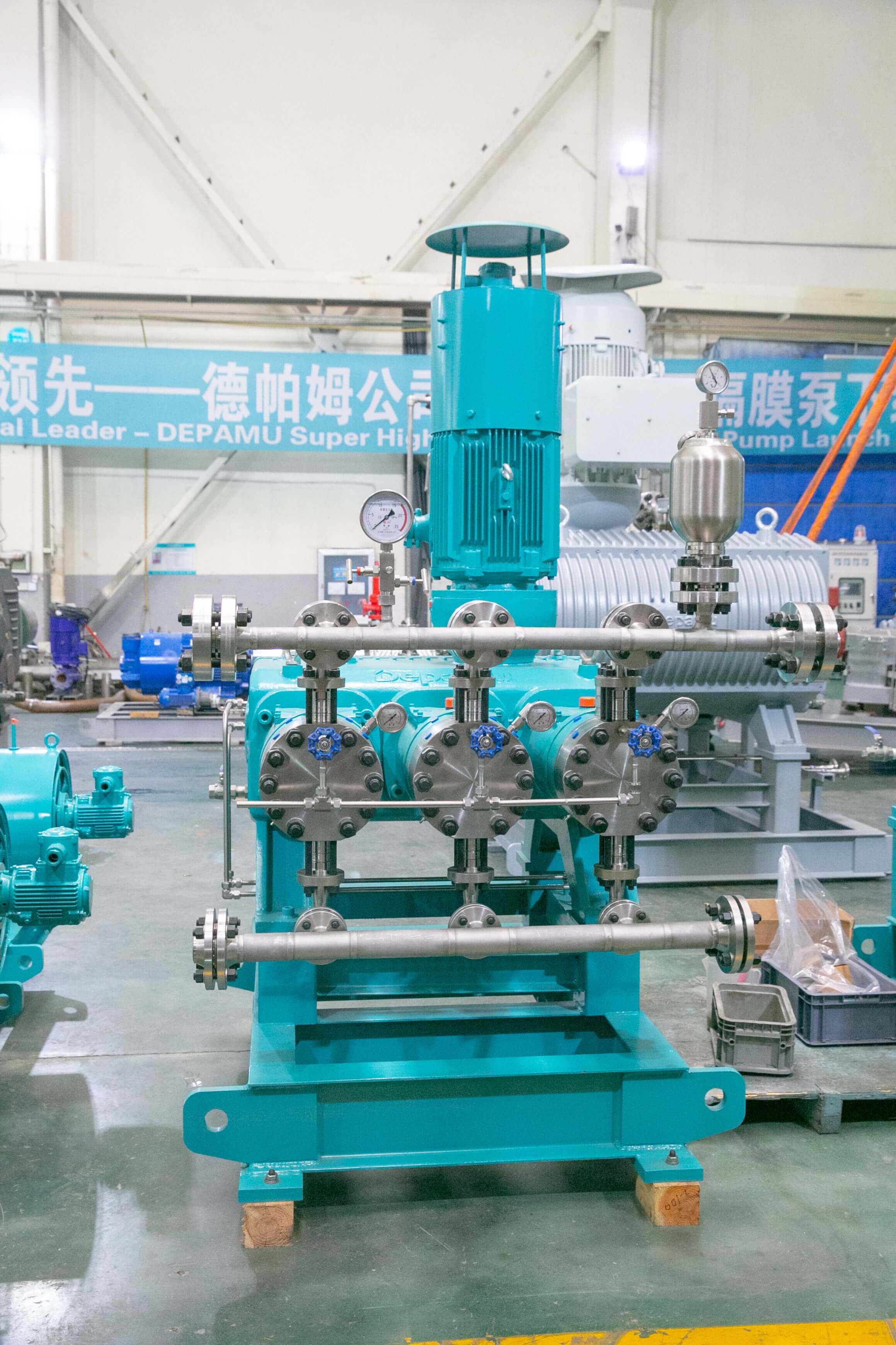
Compared with plunger pumps, diaphragm pumps avoid direct contact between the process fluid and the plunger packing. This reduces leakage risk when handling aggressive chemicals. Compared with simple air-operated diaphragm pumps, hydraulic diaphragm metering pumps provide higher pressure capability, better metering accuracy, and more stable performance in continuous process control. For plants that need precise injection at high pressure, the hydraulic diaphragm design is a practical and widely used solution.
Why Choose Depamu as a High-Pressure Process Diaphragm Pump Manufacturer?
Depamu has more than twenty years of experience in volumetric pump research, design, manufacturing, and turnkey delivery. The company introduced advanced German technology and continued to develop its own engineering capabilities. Its product range covers metering pumps, high-pressure process reciprocating pumps, pneumatic pumps, electric pumps, chemical dosing systems, water and steam sampling devices, water treatment equipment, screw pumps, rotary lobe pumps, and gear pumps. This breadth allows the company to support standard requirements as well as custom fluid handling projects.
For buyers comparing high-pressure process diaphragm pump suppliers, engineering support is a major differentiator. Depamu can review the medium characteristics, flow rate, pressure, temperature, and site process conditions, then propose standard products, non-standard products, or customized fluid solutions. This is important because diaphragm pump performance depends on proper selection of diaphragm material, hydraulic system design, valve type, stroke control, and control integration. A manufacturer with in-house design and manufacturing capability can align the pump with the actual duty rather than offering a one-size-fits-all unit.
| Company Fact | Details |
|---|---|
| Established | 2003 |
| Employees | More than 400 |
| Facility area | Approximately 35,000 square meters |
| Registered capital | RMB 54 million |
| Annual output value | Approximately RMB 500 million |
| Core product lines | Metering pumps, high-pressure process reciprocating pumps, pneumatic and electric pumps, chemical dosing systems, water and steam sampling devices, water treatment equipment, screw pumps, rotary lobe pumps, gear pumps |
| Key industries | Petroleum refining and chemicals, oil and gas fields, nuclear power, power generation, metallurgy, new energy, environmental water treatment, new materials, food |
| Sales trend | Approximately RMB 450 million in 2023, RMB 510 million in 2024, and RMB 560 million in 2025 |
The company operates a multi-brand portfolio and maintains a strong focus on high-end volumetric pump technology. Its sales growth reflects continuing demand from process industries that require dependable fluid equipment. For international buyers, working with a manufacturer that combines engineering depth, manufacturing scale, and application experience can reduce project risk and simplify procurement.
Key Applications of High-Pressure Process Diaphragm Pumps
High-pressure process diaphragm pumps are used where accurate injection and containment are essential. In petroleum refining and chemicals, they inject additives, inhibitors, catalysts, and chemicals into process streams. In oil and gas fields, they support chemical dosing and water injection duties. In power generation and nuclear facilities, they handle precise chemical addition for water chemistry control. In environmental water treatment, they meter coagulants, disinfectants, pH adjustment chemicals, and other treatment agents.
Depamu’s business mix reflects this broad application base. Petroleum refining and chemicals account for approximately 41% of sales, oil and gas fields approximately 23%, nuclear power, power generation, metallurgy, and new energy approximately 15%, environmental water treatment approximately 13%, new materials and food approximately 3%, and other industries approximately 5%. These shares show that the company’s pump technology is used across both heavy process industries and sensitive water treatment applications.
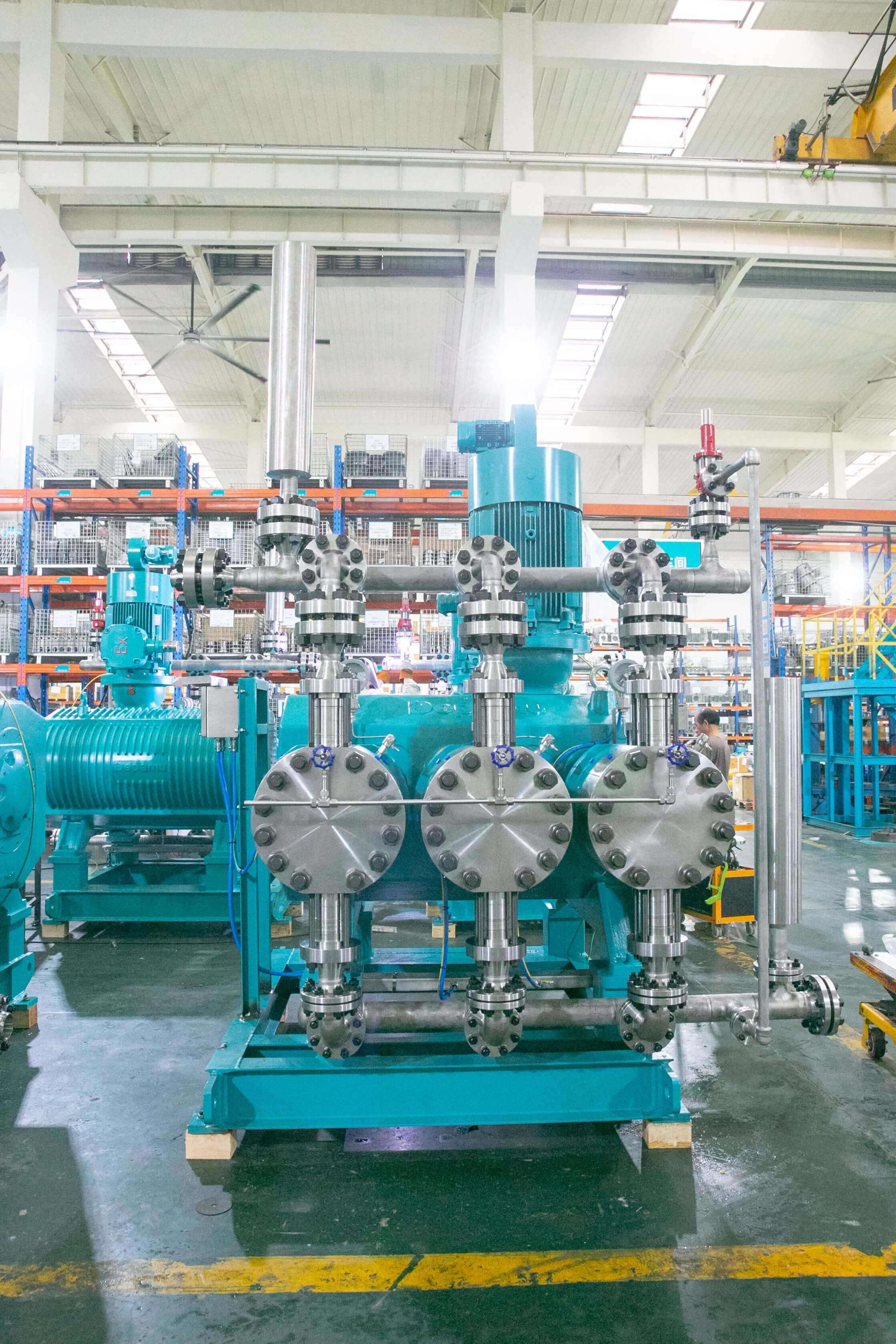
Typical duties include chemical injection at high pressure, process boosting, dosing into pipelines, and transfer of difficult media. Because the diaphragm isolates the process fluid, the pump is well suited to corrosive chemicals, volatile liquids, and fluids that must not leak. In plants where a shutdown or chemical release carries high cost, the containment provided by a hydraulic diaphragm design is a practical advantage.
How to Select the Right High-Pressure Process Diaphragm Pump
Selecting a pump starts with a clear duty specification. Buyers should define the required flow rate, discharge pressure, fluid properties, temperature, viscosity, solids content, turndown ratio, and control method. The pump must also match the piping layout, available utilities, ambient conditions, and automation platform. A high-pressure process diaphragm pump manufacturer should be able to review these parameters and recommend a suitable configuration.
| Selection Parameter | What to Define | Why It Matters |
|---|---|---|
| Flow rate | Normal and maximum required capacity | Determines pump size, stroke adjustment range, and turndown capability |
| Discharge pressure | Operating pressure and design pressure | Affects hydraulic system, diaphragm strength, and motor power |
| Fluid characteristics | Corrosivity, toxicity, volatility, and material compatibility | Guides selection of diaphragm, valve, and wetted materials |
| Temperature | Minimum and maximum process temperature | Affects diaphragm life, seal selection, and hydraulic oil stability |
| Viscosity and solids | Viscosity range and particle content | Influences valve design, suction conditions, and maintenance needs |
| Accuracy and turndown | Required dosing accuracy and flow adjustment range | Defines stroke control and metering performance |
| Control mode | Manual, local, remote, PLC, or integrated skid control | Ensures compatibility with plant automation and dosing logic |
After the process data are clear, evaluate the manufacturer’s engineering capability. A good supplier will ask for a detailed fluid and duty description, review material compatibility, and propose a pump configuration that fits the process. For high-pressure injection duties, the supplier should also consider pulsation control, suction stability, and control response. These details influence metering accuracy and equipment life more than catalog flow rates alone.
Buyers should also compare documentation, spare parts support, and commissioning assistance. High-pressure process diaphragm pumps are often part of a chemical dosing system or a larger process package, so the manufacturer’s ability to supply pumps, skids, and controls together can reduce interface risk. Depamu’s turnkey capability includes chemical dosing systems that integrate storage, dissolution, mixing, metering, and automatic control.
Installation, Operation, and Maintenance Best Practices
Correct installation improves pump reliability. The suction line should be short, straight, and adequately sized to avoid cavitation. Pulsation dampeners may be needed on the discharge side to reduce pressure fluctuations and protect piping and instruments. The pump should be mounted on a stable base with enough access for maintenance. Calibration should be performed after installation and repeated when the process fluid or duty changes.
During operation, monitor discharge pressure, flow stability, diaphragm condition, hydraulic oil level, and valve performance. A hydraulic diaphragm metering pump should be checked for abnormal noise, vibration, leakage, or inconsistent dosing. Preventive maintenance typically includes inspection of diaphragms, valves, seals, and hydraulic components. Spare parts should be sourced from the original manufacturer to maintain fit and performance.
- Verify suction conditions and avoid unnecessary elbows or restrictions before the pump inlet.
- Use suitable pulsation damping and pressure protection on the discharge line.
- Calibrate the pump after installation and after any change in chemical or process conditions.
- Inspect diaphragms and valves according to the manufacturer’s recommended schedule.
- Keep hydraulic oil clean and maintain the correct oil level for hydraulic diaphragm models.
- Record operating pressure, stroke setting, and flow to detect performance drift early.
Operators should also follow site safety procedures for chemical handling. Even though a diaphragm pump provides containment, maintenance work may require flushing, isolation, and PPE. Proper training helps avoid damage to diaphragms and valves during commissioning and cleaning.
Custom Fluid Solutions and Turnkey Chemical Dosing Systems
Many projects require more than a standalone pump. Depamu can provide chemical dosing systems that combine metering pumps, solution tanks, agitators, piping, valves, and control systems in a skid-mounted package. These systems can support dry powder or liquid chemical preparation, multi-point dosing, and automatic linkage control. Factory assembly and testing before shipment help reduce site work; after delivery, the skid only needs piping and power connections.
Customization is also available for non-standard pumps and fluid equipment. If the medium is corrosive, viscous, high-temperature, or contains solids, the manufacturer can review materials and configuration options. This approach is useful for revamps, limited-space installations, and processes where standard catalog products do not fit. For international buyers, clear technical communication and documentation are essential during customization.
Why Depamu Is a Practical Choice for International Buyers
Depamu combines long experience, manufacturing scale, and a broad product range. Its portfolio includes metering pumps, high-pressure process reciprocating pumps, pneumatic and electric pumps, chemical dosing systems, water and steam sampling devices, water treatment equipment, screw pumps, rotary lobe pumps, and gear pumps. This allows the company to act as a single source for multiple fluid duties in a project.
The company’s application experience covers petroleum refining, chemicals, oil and gas fields, nuclear power, power generation, metallurgy, new energy, environmental water treatment, new materials, and food. Sales have grown from approximately RMB 450 million in 2023 to RMB 510 million in 2024 and RMB 560 million in 2025. For buyers seeking a high-pressure process diaphragm pump supplier with engineering support, customization, and turnkey delivery capability, Depamu is a qualified candidate for technical review.
FAQ
What is a high-pressure process diaphragm pump used for?
A high-pressure process diaphragm pump is used for precise, leak-free injection and transfer of fluids at elevated pressure. Typical uses include chemical dosing, additive injection, pH control, water treatment, process boosting, and oilfield chemical injection.
How do I choose a high-pressure process diaphragm pump manufacturer?
Review the manufacturer’s engineering support, product range, customization capability, manufacturing scale, and experience in your industry. Provide the fluid properties, flow rate, pressure, temperature, and control requirements so the supplier can recommend a suitable configuration.
Can diaphragm pumps handle corrosive or high-viscosity fluids?
Hydraulic diaphragm pumps can handle many corrosive fluids because the diaphragm isolates the process liquid from the drive. For high-viscosity or solids-containing fluids, valve design, suction conditions, and materials must be reviewed carefully during selection.
What is the difference between a hydraulic diaphragm metering pump and a plunger pump?
A hydraulic diaphragm metering pump uses a diaphragm to contain the process fluid, which reduces leakage risk with aggressive chemicals. A plunger pump uses a plunger and packing, which may be preferred for some very high-pressure or abrasive duties. The right choice depends on the fluid and process.
Can Depamu provide custom chemical dosing skids?
Yes. Depamu can supply chemical dosing systems that integrate metering pumps, tanks, agitators, piping, valves, and automatic controls. These skid-mounted systems are assembled and tested before shipment and can be configured for liquid or dry powder chemical preparation.
What industries does Depamu serve?
Depamu serves petroleum refining, chemicals, oil and gas fields, nuclear power, power generation, metallurgy, new energy, environmental water treatment, new materials, and food processing. Its products include metering pumps, high-pressure process pumps, dosing systems, and other fluid equipment.
Summary
Choosing a high-pressure process diaphragm pump manufacturer is a technical procurement decision, not simply a price comparison. The pump must match the fluid, pressure, temperature, flow range, and control requirements, and the manufacturer must provide engineering support through selection, customization, and after-sales service. Depamu (Hangzhou) Pump Industry Technology Co., Ltd. offers more than twenty years of experience, a broad volumetric pump portfolio, custom fluid solutions, and turnkey chemical dosing systems. For chemical plants, oil and gas facilities, power stations, and water treatment projects, a manufacturer with this combination of capabilities can support safer and more reliable operations.