
Choosing the right pump for a demanding process line is rarely about one specification alone. It is about matching the medium, the flow, the pressure, the temperature, the cleaning regime and the long-term operating cost into a single, dependable piece of equipment. For many plants handling viscous, shear-sensitive, abrasive or hygienic media, that answer increasingly points toward a stainless steel rotor pump — and toward a stainless steel rotor pump manufacturer that can engineer the unit around the actual duty rather than around a catalogue page.
DEPAMU (Hangzhou) Pump Technology Co., Ltd. — known internationally as DEPAMU — has been building positive displacement pumps and fluid equipment since 2003. With more than 400 employees, a factory site of roughly 35,000 square meters, registered capital of RMB 54 million and an annual output value of around RMB 500 million, the company combines volume manufacturing capacity with engineering-level customization. This guide explains how stainless steel rotor pumps work, how to select them, where they fit in real industrial processes, and how procurement teams can evaluate a stainless steel rotor pump supplier before placing an order.
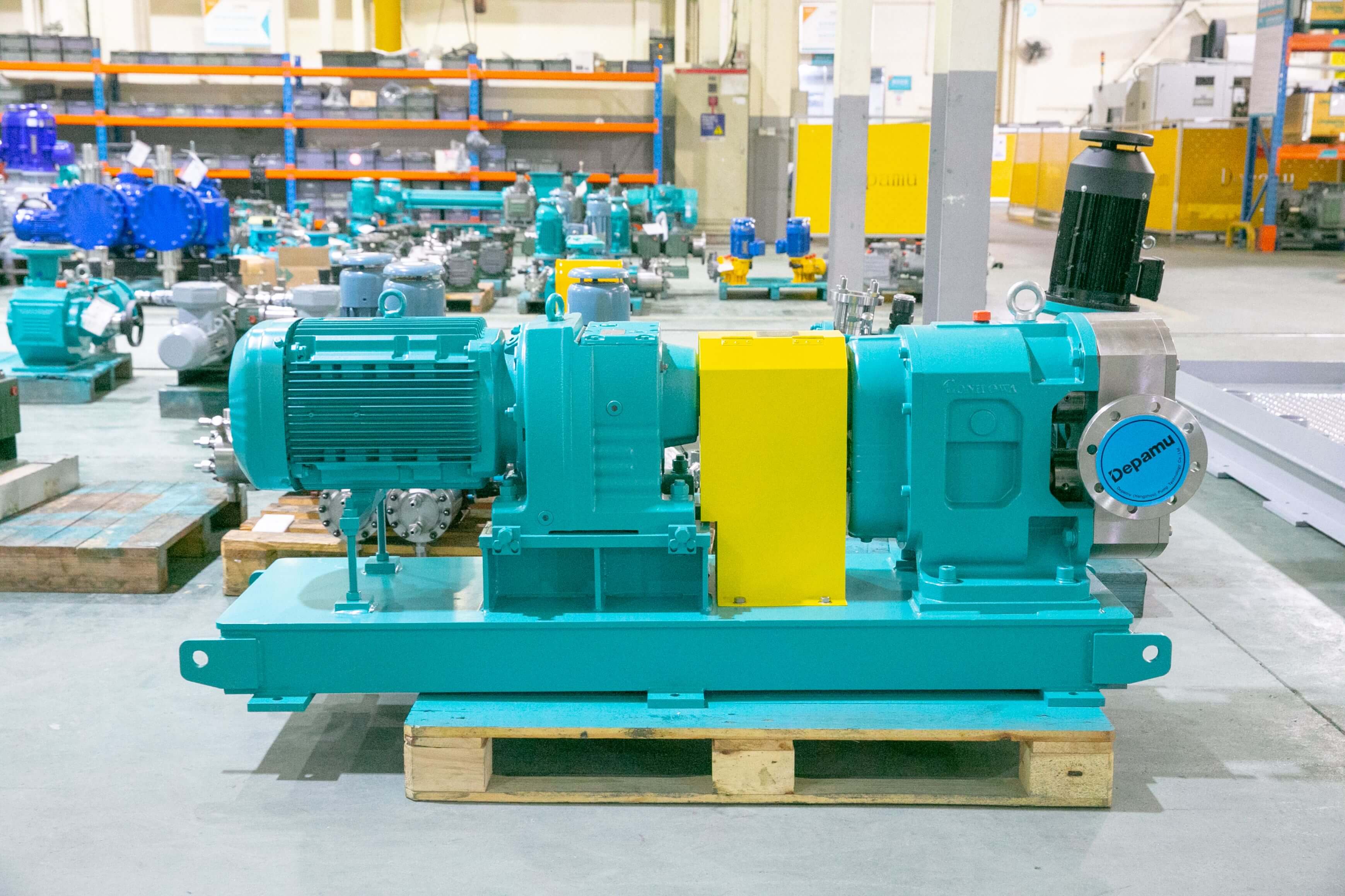
Who Is DEPAMU: A Stainless Steel Rotor Pump Manufacturer Built on Fluid Engineering
DEPAMU was founded in 2003 and has spent more than two decades focused on high-end positive displacement pumps and fluid handling equipment. The company’s scope is deliberately broad within that niche: metering pumps, high-pressure process reciprocating pumps, pneumatic and electric pumps, automatic chemical dosing skids, water and steam sampling systems, water treatment equipment, and rotary positive displacement pumps including screw pumps, rotor pumps and gear pumps. That breadth matters for buyers, because a rotor pump is rarely a stand-alone purchase — it is usually part of a dosing, transfer or dosing-plus-mixing system that has to work as a whole.
The business is organized around real industrial demand rather than a single sector. Petroleum refining and chemicals account for roughly 41% of sales, oil and gas fields around 23%, nuclear power, power generation, metallurgy and new energy around 15%, environmental and wastewater treatment about 13%, and new materials and food applications approximately 3%, with the remaining 5% spread across other industries. This distribution is a useful signal for overseas buyers: the same engineering team that specifies a rotor pump for a refinery transfer line also understands the hygienic and cleanability requirements of a food or new-material process.
Manufacturing is supported by in-house development, design and complete-system delivery capability. Rather than offering only standard models, DEPAMU engineers pumps and packages against customer data — medium characteristics, flow rate, pressure, temperature and site process requirements — and delivers standard, non-standard or fully customized fluid solutions. Sales have grown steadily, from approximately RMB 450 million in 2023 to RMB 510 million in 2024 and RMB 560 million in 2025, which reflects a manufacturing base that is scaling alongside its engineering workload.
What Is a Stainless Steel Rotor Pump and How Does It Work?
A rotor pump is a rotary positive displacement pump. Instead of throwing liquid outward with a centrifugal impeller, it traps a fixed volume of medium in the cavities formed between rotating lobes or rotors and the pump casing, then displaces that volume steadily toward the discharge port. Because the displacement is volumetric, the output is largely independent of system pressure, which is exactly what process engineers need when flow accuracy and repeatability matter more than raw throughput.
The Working Principle in Practice
Two rotors rotate inside a close-tolerance casing. As they turn, a sealed cavity opens at the suction side, fills with medium, closes, and then opens again at the discharge side as the rotors mesh. The medium is moved without being squeezed through a narrow gap, which means low shear, minimal pulsation and gentle handling of the product. There are no valves in the flow path, so the pump tolerates entrained air, suspended solids and modest levels of abrasive particles far better than many alternative designs.
Because the pumping action is mechanical and volumetric, speed control translates directly into flow control. A variable-frequency drive or a mechanical speed reducer allows operators to trim flow precisely without throttling a valve, and the pump can run in either direction, which is useful for tank emptying, line stripping and clean-in-place routines. Self-priming behavior is another practical advantage: the pump can often lift medium from a below-grade sump without an auxiliary priming system.
Why the Material Matters: Stainless Steel Construction
The choice of stainless steel for the wetted parts is not cosmetic. Rotor pumps are frequently specified for media that are corrosive, hygienic, temperature-sensitive or simply incompatible with carbon steel. Stainless steel construction supports:
- Corrosion resistance against many acids, alkalis, brines and process streams encountered in chemical and wastewater service.
- Hygienic operation for food, new-material and pharmaceutical-adjacent duties where surfaces must be cleanable and free of crevices.
- Temperature tolerance for hot transfer duties where dimensional stability of the rotor and casing is essential to maintaining internal clearances.
- Product purity — no rust discoloration, no contamination of the medium and no need for internal coatings that can degrade over time.
In practice, the grade, surface finish and elastomer selection are specified per duty. A sanitary rotor pump for food processing will typically differ from a rotor pump for chemical processing in seal arrangement, surface treatment and rotor profile — which is why a manufacturer with real customization capability is more valuable than a catalogue distributor.
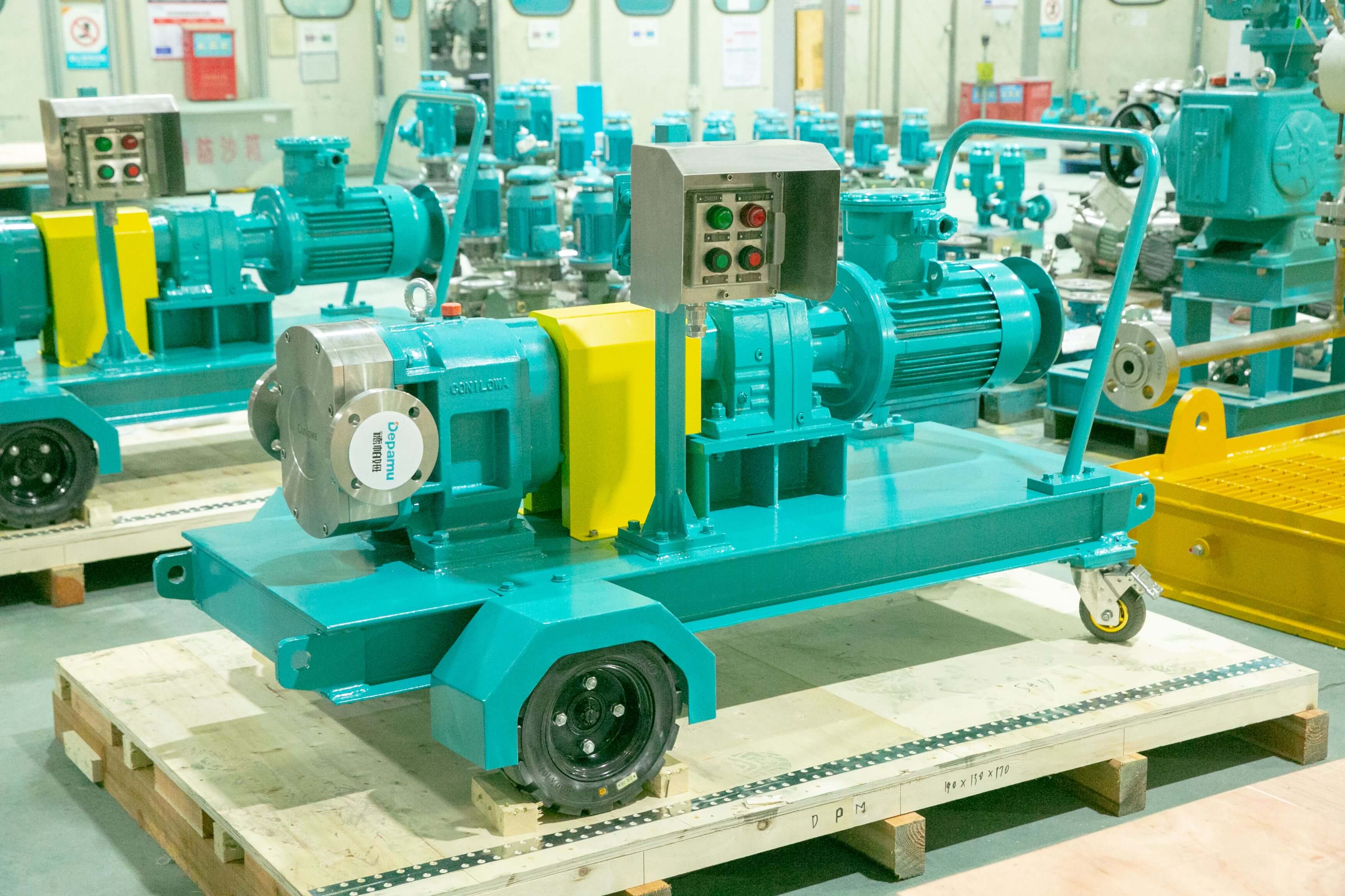
Where Rotor Pumps Fit Within a Complete Fluid Equipment Range
No single pump type solves every duty. DEPAMU’s portfolio is structured so that a process engineer can select the right technology for each point in the plant, often from one supplier and one technical contact. The table below summarizes how the main product families differ in principle and typical use.
| Product Family | Working Principle | Typical Duty |
|---|---|---|
| Stainless steel rotor pump | Rotary positive displacement, low-shear volumetric transfer | Viscous, shear-sensitive, hygienic and solids-bearing media |
| Hydraulic diaphragm metering pump | Hydraulically driven diaphragm, leak-free precision dosing | Chemical dosing of corrosive, volatile or high-pressure media |
| High-pressure process reciprocating pump | Plunger reciprocation for high-pressure delivery | Oilfield water injection, pipeline boosting, high-pressure injection |
| Automatic chemical dosing package | Integrated dissolution, mixing, metering and control skid | Boiler water, circulating water and wastewater chemical preparation |
| Screw, gear, pneumatic and electric pumps | Rotary displacement variants with different cavity geometry | Transfer duties selected by viscosity, solids and pressure level |
Key Advantages of Stainless Steel Rotor Pumps in Industrial Service
Rotor pumps earn their place in a plant because they solve problems that centrifugal and some reciprocating pumps handle awkwardly. The most frequently cited advantages in process design reviews are listed below.
- Gentle handling of shear-sensitive media. Emulsions, polymer solutions and food products retain their structure because the pump moves the medium as a coherent volume rather than shearing it at high speed.
- High viscosity capability. Rotor pumps maintain flow with media far thicker than water, making them suitable for slurries, pastes, syrups and concentrated chemical streams.
- Strong suction performance and self-priming. Installations can be simplified, with fewer priming devices and less risk of dry-running damage at start-up.
- Reversible operation. Direction reversal supports line stripping, tank draining and cleaning routines without additional equipment.
- Low pulsation. Smoother discharge reduces stress on piping, instruments and downstream equipment compared with some reciprocating alternatives.
- Solids tolerance. Because there are no small valves to clog, moderate solids content can be transferred reliably.
- Straightforward maintenance. Front-pull designs allow seal and rotor access without dismantling the entire process line.
For buyers comparing quotations, these characteristics translate into lower total cost of ownership: less downtime, fewer spare parts, less product damage and simpler cleaning routines. It is also why an experienced positive displacement rotor pump supplier will ask detailed questions about the medium before proposing a model — the answers determine rotor profile, clearance, seal type and drive selection.
How to Select the Right Stainless Steel Rotor Pump: A Practical Guide
A rotor pump selection decision should be driven by process data, not by nominal capacity alone. The table below outlines the parameters a manufacturer needs in order to deliver an accurate proposal and, ultimately, a pump that performs as expected on site.
| Parameter | What It Influences |
|---|---|
| Medium and concentration | Stainless steel grade, rotor geometry, elastomer compatibility |
| Viscosity range | Pump speed, internal clearance, motor sizing |
| Flow rate and control range | Displacement per revolution, VFD or gearbox selection |
| Discharge pressure | Shaft, bearing and seal rating, casing strength |
| Temperature | Thermal expansion allowance, seal and elastomer choice |
| Solids content and particle size | Rotor profile, clearance, wear protection strategy |
| Cleaning and hygiene requirement | Surface finish, drainability, clean-in-place compatibility |
| Installation environment | Drive protection class, skid layout, available footprint |
Selection Steps That Reduce Risk
Start from the medium. Material compatibility is the single largest driver of service life; a pump that suits a neutral food product may be entirely unsuitable for an acidic chloride-bearing stream. Next, define the flow window rather than a single point — processes rarely run at exactly one rate, so the pump should be controllable across the useful range. Then confirm the pressure envelope, including any peak condition such as a closed valve or a filled downstream line at start-up. Finally, decide whether the pump belongs on a skid with controls, or as a stand-alone unit tied into an existing distributed control system.
Buyers who provide all of this information in the first enquiry receive a faster and more accurate quotation. A custom stainless steel rotor pump quotation that ignores viscosity and temperature will usually have to be revised once the real duty is clarified.
Application Scenarios Across Industries
DEPAMU products are deployed across petroleum refining and chemicals, oil and gas fields, nuclear power, power generation, metallurgy, new energy, environmental water treatment, new materials and food. Within that footprint, rotor pumps typically serve the following functions.
Chemical and Petrochemical Transfer
Rotor pumps handle intermediates, additives, resins and viscous process streams where shear degradation or emulsification must be avoided. Because they tolerate entrained gas and solids, they also perform well on streams that would challenge a centrifugal pump’s stability. Paired with a hydraulic diaphragm metering pump upstream, a rotor pump can form a reliable transfer-and-dose combination for multi-stage chemical processes.
Environmental and Wastewater Treatment
Sludge, thickened slurry, lime milk and polymer solutions are classic rotor pump duties. Low pulsation protects downstream dosing equipment, self-priming behavior simplifies sump installations, and reversible rotation helps with line flushing. In plants using an integrated automatic chemical dosing package, the rotor pump frequently acts as the feed or circulation pump while the metering pump performs the precise injection.
Food, New Materials and Hygienic Processes
For food and new-material applications, the priority shifts to cleanability and product protection. A sanitary rotor pump for food processing is specified with smooth wetted surfaces, crevice-free geometry and cleaning-friendly seals so that cleaning and changeover times remain short. Gentle handling preserves texture and consistency in products that are sensitive to mechanical shear.
Oil and Gas Field Service
In oil and gas operations, high-pressure reciprocating pumps usually handle injection and boosting duties, while rotor pumps support transfer of produced fluids, chemicals and viscous additives. Selecting the correct combination from a single industrial rotor pump exporter reduces interface risk between pump packages.
Installation, Operation and Maintenance Best Practices
Mechanical reliability depends as much on installation quality as on the pump itself. The guidance below reflects common practices that extend service life and reduce unplanned downtime.
- Align and grout the base correctly. Misalignment is a leading cause of premature seal and bearing failure on rotary pumps.
- Protect the suction side. Keep suction lines short, adequately sized and free of unnecessary fittings to preserve the pump’s strong suction capability.
- Provide a relief path. Because positive displacement pumps displace a fixed volume, a pressure relief valve or an interlock is essential on any installation where a downstream valve could close.
- Avoid dry running. Even self-priming designs rely on the medium for lubrication and cooling of seals; start-up interlocks should prevent prolonged dry operation.
- Monitor seal condition. Scheduled inspection of seals and elastomers avoids unexpected leakage and medium release.
- Record process trends. Flow, pressure and motor current trends reveal wear long before a failure occurs.
- Keep a critical spare set. Seals, elastomers and rotor components are low-cost items that determine recovery time after a shutdown.
During commissioning, verify rotation direction, confirm relief settings, check for cavitation noise at the suction side and record baseline values for flow, pressure and power draw. These baselines become the reference for later condition monitoring.
Customization and OEM Supply from a Stainless Steel Rotor Pump Factory
A stainless steel rotor pump factory with genuine engineering capability can go well beyond standard catalogue configurations. Typical customization requests include non-standard connections, alternative stainless steel grades, special surface finishes, seal arrangements suited to a particular chemical family, heating jackets for media that must stay warm, and skid-mounted assemblies combining pumps, valves, instruments and controls.
DEPAMU’s model is to engineer from the process data outward. The company’s design and production flow covers development, design, manufacturing and complete-system delivery, which means a customer can order a single pump or a fully assembled dosing and transfer package that is tested before shipment and then simply connected to utilities on site. For distributors and brand owners, an OEM stainless steel rotor pump program allows private-label supply with agreed documentation, packaging and labeling — a practical route for suppliers building their own product lines.
How to Evaluate a Stainless Steel Rotor Pump Supplier
Price is a legitimate criterion, but a pump that fails early is never inexpensive. Procurement teams should assess suppliers on a combination of engineering depth, manufacturing capacity and long-term support.
- Engineering response quality. Does the supplier ask about viscosity, solids, temperature and cleaning routine before quoting?
- Manufacturing scale. Employee count, factory area and output value indicate whether a supplier can support repeat orders and delivery schedules.
- Portfolio breadth. A supplier offering metering, reciprocating and rotary pump technologies can recommend objectively across pump types.
- Customization capability. Standard, non-standard and fully customized options should all be available from the same source.
- Documentation and testing. Factory assembly and testing before shipment reduce site commissioning time.
- Track record stability. Steady growth in sales and personnel is a reasonable proxy for operational reliability.
- Support beyond delivery. Spare parts availability, technical guidance and commissioning assistance determine lifecycle cost.
Requesting a quotation with complete process data is the fastest way to compare suppliers on equal terms. A supplier that returns a detailed technical proposal — rather than a price list — is likely to deliver equipment that fits the duty.
FAQ
What media can a stainless steel rotor pump handle?
Stainless steel rotor pumps handle a wide range of liquids, including viscous products, slurries with moderate solids content, shear-sensitive emulsions, chemical solutions and hygienic food products. The exact capability depends on the selected stainless steel grade, elastomer, rotor profile and clearance. Providing the medium composition, viscosity, temperature and solids content allows the manufacturer to specify a suitable configuration rather than relying on a generic model.
How do I choose between a rotor pump and other pump types?
Rotor pumps are usually the better choice when the medium is viscous, shear-sensitive, self-priming is required, or the fluid contains entrained gas or moderate solids. Centrifugal pumps suit high-flow, low-viscosity duties where shear is not a concern. For precision dosing of chemicals, a hydraulic diaphragm metering pump is typically appropriate, while very high discharge pressures call for a process reciprocating pump. A supplier with a broad portfolio can advise objectively across these options.
Can you supply a custom or OEM stainless steel rotor pump?
Yes. Standard, non-standard and fully customized configurations are available, including alternative stainless steel grades, surface finishes, connection standards, seal arrangements, heating jackets and skid-mounted assemblies with instrumentation and controls. OEM supply with agreed documentation, packaging and labeling is also supported for distributors and brand owners who need private-label products.
What information is needed to receive an accurate quotation?
A complete enquiry should include the medium and concentration, viscosity range, required flow rate and control range, discharge pressure including peak conditions, operating temperature, solids content and particle size, cleaning or hygiene requirements, available utilities, and installation environment. Photographs or drawings of the existing installation help as well. With these details, a supplier can propose an appropriate model and avoid later revisions.
How is a rotor pump integrated with a chemical dosing system?
In many plants, the rotor pump performs bulk transfer or circulation while a metering pump carries out precise chemical injection. Both can be assembled on a single skid together with tanks, mixers, piping, instruments and automatic control, so that dissolution, mixing and dosing form one coordinated package. This approach simplifies installation, reduces interface risk between equipment suppliers and shortens commissioning time.
What maintenance does a stainless steel rotor pump require?
Routine maintenance focuses on seal and elastomer inspection, verification of relief valve settings, checking alignment and coupling condition, monitoring flow, pressure and motor current trends, and maintaining adequate lubrication where applicable. Because the medium lubricates and cools the pumping elements during operation, prolonged dry running should be prevented by interlock or procedure. Keeping a spare seal and elastomer set on site minimizes recovery time if wear is detected.
Which industries use stainless steel rotor pumps most often?
Common industries include chemical and petrochemical processing, oil and gas field service, environmental and wastewater treatment, power generation, metallurgy, new energy, new materials and food production. The specific duty varies — transfer, circulation, sludge handling, viscous product movement or feed to a dosing system — but the underlying requirement is consistent, low-shear volumetric displacement of a challenging medium.
Summary
A stainless steel rotor pump is a durable, low-shear, volumetric solution for the media that other pump types handle poorly: viscous streams, shear-sensitive products, solids-bearing slurries and hygienic fluids. Getting the right result depends on matching the pump to the duty through complete process data, selecting materials and seals that suit the medium, and installing the unit with proper relief protection and alignment.
DEPAMU has focused on positive displacement pumps and fluid systems since 2003, combining a 35,000 square meter manufacturing site, more than 400 employees and in-house engineering with a portfolio that spans rotor pumps, screw pumps, gear pumps, metering pumps, high-pressure reciprocating pumps and automatic chemical dosing packages. For buyers searching for a dependable stainless steel rotor pump manufacturer, the practical next step is straightforward: share the medium, flow, pressure, temperature and site conditions, and request a technical proposal that addresses the actual process rather than a generic specification sheet.