
Selecting the right chemical dosing pump manufacturer is one of the most consequential decisions in any process plant that relies on precise chemical injection. A dosing pump sits at the intersection of production quality, chemical consumption, operator safety and environmental compliance — and a poorly specified unit will quietly cost far more than its purchase price over a ten-year service life. This guide explains how quantitative dosing works, what to look for in a quantitative dosing pump supplier, how custom dosing solutions are engineered, and how to compare quotations from different metering pump factories with confidence.
Depamu (Hangzhou) Pump Industry Technology Co., Ltd. has been designing and manufacturing high-end positive displacement pumps and fluid equipment since 2003. With more than 400 employees, a manufacturing site of approximately 35,000 square meters, registered capital of RMB 54 million and an annual output value of around RMB 500 million, the company supplies metering pumps, high-pressure reciprocating process pumps, pneumatic and electric pumps, automatic chemical dosing systems, water and steam sampling devices, and water treatment equipment to process industries worldwide. This article draws on that engineering experience to give buyers a practical framework for specification and supplier selection.
What a Quantitative Dosing Pump Actually Does in an Industrial Process
A quantitative dosing pump — also called a metering pump or chemical dosing pump — delivers a precisely controlled volume of liquid into a process stream over a defined period. Unlike a transfer pump, whose job is simply to move volume, a dosing pump must hold a repeatable flow rate against varying discharge pressure, often to within ±1% of set point. In a cooling water circuit, a boiler feed line, a produced-water injection train or a chemical reactor feed, that accuracy determines whether the process stays inside its design window.
Two parameters control output on a reciprocating metering pump: stroke length and stroking frequency. Adjusting stroke length changes the displaced volume per stroke, while adjusting frequency changes the number of strokes per minute. Modern designs combine both — a manual micrometer dial for local setting and an electronic or variable-frequency drive for automatic control from a PLC, DCS or flow-proportional signal. This dual adjustment gives plants a wide turndown ratio, typically from 10:1 up to 100:1 depending on the model, which is essential where demand fluctuates across the day or the season.
Why Dosing Accuracy Directly Affects Operating Cost and Safety
Over-dosing is the most common and most expensive dosing error. Excess coagulant in a water treatment plant increases sludge volume and disposal cost; excess oxygen scavenger in a boiler wastes chemicals and can shift water chemistry; excess corrosion inhibitor in a pipeline can create emulsions and downstream fouling. Under-dosing is worse in safety terms: insufficient biocide allows biological growth, insufficient neutralizing agent allows pH excursions that damage metallurgy, and insufficient inhibitor in a produced-water line accelerates internal corrosion.
Accuracy is therefore not a marketing specification but an economic one. A pump that drifts by 5% instead of 1% can multiply annual chemical spend in a large plant by a meaningful margin. This is why serious buyers ask a quantitative dosing pump supplier for repeatability data, calibration method, linearity across the turndown range and the effect of discharge pressure variation on delivered volume — not simply a maximum flow figure on a datasheet.
Inside the Capability of an Experienced Metering Pump Factory
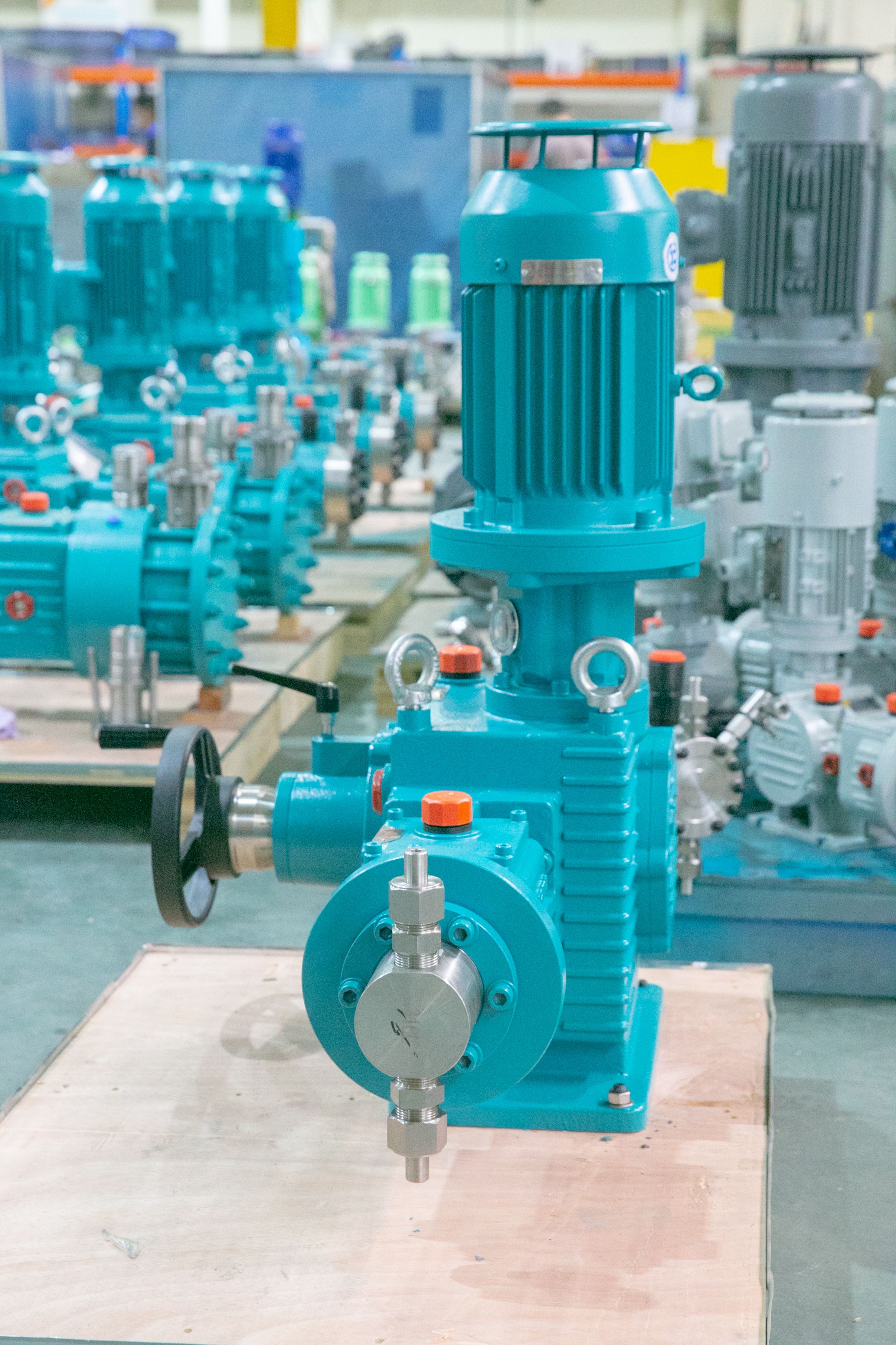
Dosing pump performance is decided long before assembly. It depends on diaphragm material selection, hydraulic end design, valve geometry, check valve seating, plunger and packing tolerances, and the stability of the worm gear or eccentric drive that converts rotary motion into reciprocating stroke. A metering pump factory with genuine engineering depth controls all of these, rather than assembling purchased components to a catalogue flow rate.
Depamu was founded in 2003, introduced advanced German pump technology and has continued to develop it in-house over two decades. The company operates three brands covering different product families and market segments, and combines research and development, design, manufacturing and packaged-system delivery under one organisation. That integrated structure matters to buyers because it allows a single technical contact to carry a project from hydraulics calculation through fabrication, factory acceptance testing and site commissioning.
Manufacturing footprint and production capacity
The Hangzhou facility covers roughly 35,000 square meters and employs more than 400 people across engineering, machining, assembly, testing and after-sales service. Annual output value has grown from approximately RMB 450 million in 2023 to RMB 510 million in 2024 and RMB 560 million in 2025, reflecting steady demand from refining, petrochemical, oil and gas, power, nuclear, metallurgy, new energy, environmental water treatment, new materials and food customers. For procurement teams, that growth trajectory is a useful signal of production stability and supply reliability.
Product Portfolio: From Single Metering Pumps to Complete Dosing Skids
A capable custom dosing pump manufacturer should be able to match the pump to the process rather than forcing the process to fit one standard model. The portfolio below reflects the typical families required by industrial chemical injection duties, and each family solves a different hydraulic problem.
| Product family | Working principle | Typical duty |
|---|---|---|
| Hydraulic diaphragm metering pump | Hydraulic fluid actuates a PTFE or composite diaphragm; stroke length and frequency set the dose | Leak-free dosing of corrosive, volatile or toxic chemicals at high pressure |
| High-pressure reciprocating process pump | Plunger reciprocation generates high discharge pressure, up to 35 MPa and above | Water injection, pipeline boosting, high-pressure chemical or process transfer |
| Automatic chemical dosing system | Skid-mounted integration of dosing pumps, dissolving tanks, agitators and control system | Boiler water treatment, circulating water, wastewater, multi-point dosing |
| Screw, rotor, gear and rotary pumps | Positive displacement transfer with low shear | Viscous media, emulsions, sludge and general process transfer |
| Water and steam sampling, supercritical extraction | Sampling and sample conditioning trains for power and process plants | Water quality monitoring, cycle chemistry control |
Hydraulic diaphragm metering pumps
The hydraulic diaphragm design is the workhorse of precise chemical injection. A hydraulic circuit pressurises oil behind the diaphragm, so the diaphragm is supported across its whole face and can operate against high discharge pressure without stress concentration. Because the diaphragm isolates the process liquid from the hydraulic end completely, there is no packing leak path — a decisive advantage for acids, caustics, solvents, amines and other hazardous media. Stroke length adjustment gives fine control at low flows, while frequency control provides automatic response to a 4–20 mA or pulse signal.
High-pressure reciprocating process pumps
Where the duty requires both high pressure and continuous operation, a plunger-type reciprocating pump is often the better choice. These units handle viscosities and temperatures that would challenge a diaphragm design, tolerate suspended solids better, and hold stable flow over long uninterrupted runs. They are widely used for oilfield water injection, process boosting, long-distance pipeline transport and high-pressure injection in chemical plants.
Custom Dosing Pump Solutions: From Single Pump to Turnkey Skid
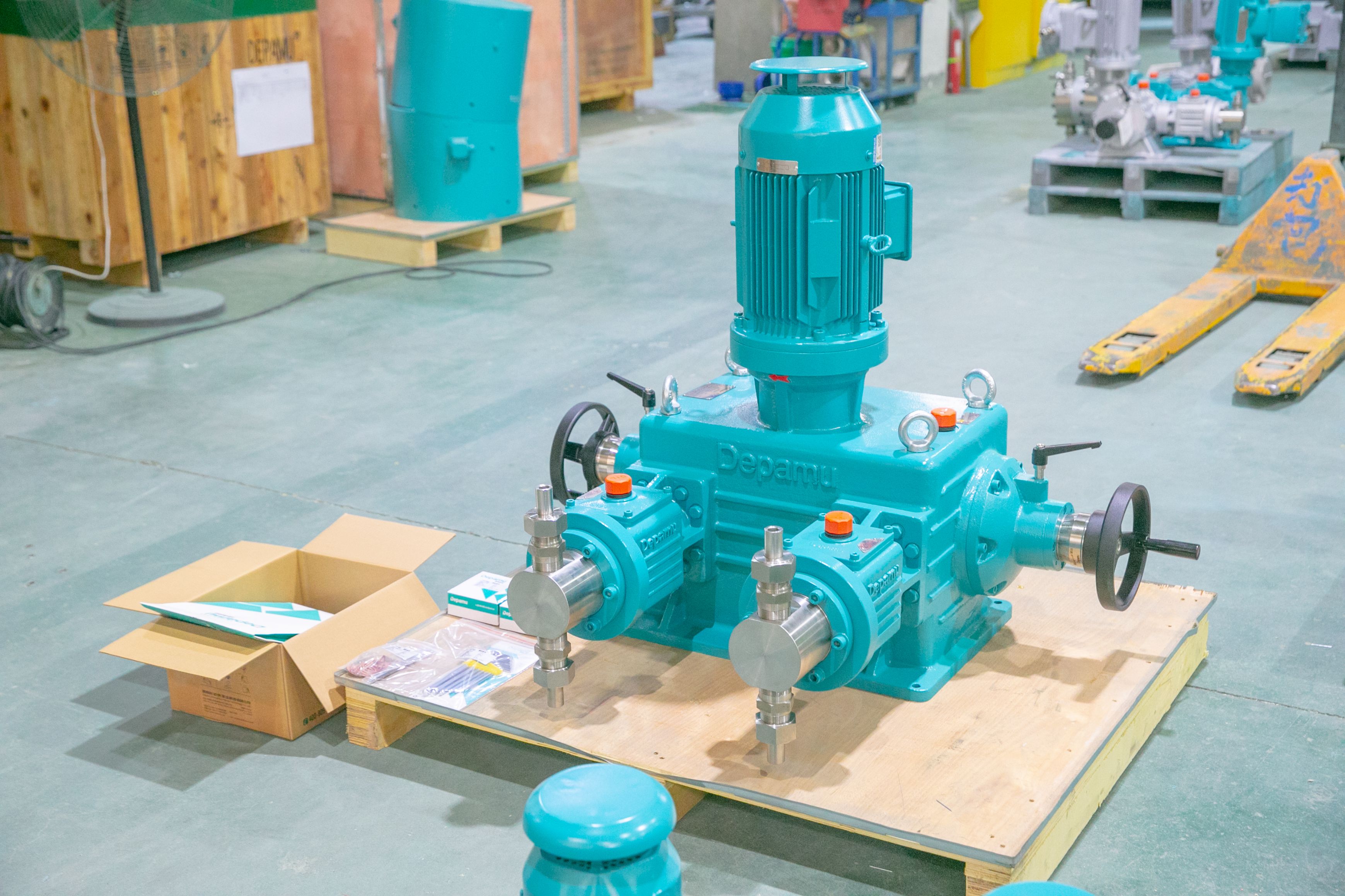
Most real projects are not catalogue projects. The media may be a 98% sulfuric acid stream at 90 °C, a polymer solution that must not be sheared, a slurry with 5% solids, or a volatile solvent that must never leak to atmosphere. A custom dosing pump manufacturer handles these cases by starting from the process data and working back to the hardware.
Typical customisation variables include wetted materials (316L, duplex stainless steel, alloy 20, Hastelloy, PTFE, PVDF), diaphragm and valve seat construction, hydraulic end volume, heating or cooling jackets for viscous or crystallising media, double-diaphragm leak detection with alarm output, and instrumentation packages such as pressure gauges, pulsation dampeners, safety valves and back-pressure valves. On the control side, options range from local manual stroke adjustment to full automatic operation with PLC, touchscreen HMI, remote I/O and integration into the plant DCS.
Packaged dosing systems take this further. A complete chemical dosing skid integrates storage tanks, dissolving and dilution tanks, agitators, dosing pumps, piping, valves, instrumentation and the control cabinet on a single structural frame. The skid is assembled and tested before shipment, so site work is limited to positioning, connecting utilities and power, and commissioning. For overseas projects where site labour is expensive and schedule risk is high, a pre-tested skid from a quantitative dosing pump factory is usually the fastest and most predictable route.
Application Coverage Across Process Industries
Dosing and fluid transfer duties differ considerably between sectors, and a supplier’s value is largely a function of how many of these duty types it has already engineered. Depamu’s sales distribution reflects a broad industrial base: petroleum refining and chemical processing account for roughly 41% of business, oil and gas fields around 23%, nuclear, power, metallurgy and new energy around 15%, environmental water treatment around 13%, new materials and food around 3%, with the remainder spread across other sectors.
- Oil refining and petrochemicals: inhibitor, anti-foulant, caustic, amine and additive injection; high-pressure process transfer; chemical dosing into reactors and columns.
- Oil and gas fields: produced-water injection, pipeline pressure boosting, chemical injection for scale, corrosion and hydrate control, and high-pressure water flooding.
- Power and nuclear: boiler and feedwater chemical dosing, condensate polishing, water and steam sampling, pH and oxygen control.
- Environmental water treatment: coagulant, flocculant, disinfectant and pH adjustment dosing in municipal and industrial wastewater plants.
- Metallurgy, new energy and new materials: reagent dosing in hydrometallurgy, leach circuits, battery material processing and specialty chemical production.
- Food and pharmaceutical-type processes: accurate additive and ingredient dosing where hygiene and repeatability are critical.
How to Evaluate a Dosing Pump Supplier Before You Order
Price comparison alone rarely identifies the right partner. The following checklist is written from the buyer’s side of the table and is the same information a competent engineering team will want to see in a quotation.
- Process data review: does the supplier ask for medium, concentration, viscosity, temperature, flow range, suction pressure, discharge pressure and control signal before proposing a model?
- Accuracy and repeatability statement: is the claimed accuracy tied to a defined test condition, and is linearity across the turndown range documented?
- Wetted material rationale: are elastomer and metallurgy choices justified against the actual medium, or simply listed?
- Factory testing: are hydrostatic test, performance test and, for skids, functional simulation included and documented?
- Spare parts and response: are diaphragm, valve and seal kits available as standard stock items with clear lead times?
- Documentation: are drawings, datasheets, material certificates, O&M manuals and test reports provided in the required language?
- Reference duty similarity: has the supplier delivered comparable pressure, temperature and medium combinations, not merely similar flow rates?
Installation, Commissioning and Maintenance Guidance
Even a well-specified pump underperforms if installed incorrectly. The most frequent site issues are insufficient suction head or an overly long, undersized suction line causing cavitation; missing pulsation dampeners on long discharge runs; absence of a back-pressure valve on low-pressure injection points, which allows the pump to over-deliver by gravity; and incorrect piping support transferring load onto the pump head. Suction piping should be short, straight and generously sized, with a strainer on the suction side and a pulsation dampener where the discharge line is long or where multiple pumps feed a common header.
For maintenance, a practical schedule includes a daily visual check for leaks and abnormal noise, weekly verification of stroke setting against the dosing record, monthly inspection of suction strainers and valve seats, and scheduled diaphragm replacement based on accumulated running hours rather than failure. Valve seats and balls wear faster with abrasive or crystallising media, so those duties need a shorter inspection interval. Keeping a simple log of dose rate, pressure and diaphragm change dates makes it easy to spot drift before it becomes a compliance issue.
FAQ
What is the difference between a dosing pump and a transfer pump?
A transfer pump moves volume at whatever pressure the system requires, while a dosing pump delivers a controlled, repeatable flow rate, typically to within a stated accuracy such as ±1%. Dosing pumps offer adjustable stroke length and stroking frequency so the injected volume can be set precisely and changed automatically from a control signal.
How do I get an accurate quotation from a quantitative dosing pump supplier?
Provide the medium and concentration, viscosity, temperature, required flow range, suction and discharge pressure, control signal type, ambient conditions, area classification, and any material or documentation standards. With this data a manufacturer can select the hydraulic end, diaphragm material and motor, and quote a firm price and delivery time rather than a range.
Can a dosing pump system be supplied as a complete skid?
Yes. Automatic chemical dosing systems are commonly supplied as skid-mounted packages that combine dosing pumps, dissolving and dilution tanks, agitators, piping, valves, instrumentation and a control cabinet on one frame. The skid is assembled and function-tested before shipment, so site work is reduced to installation, utility connection and commissioning.
Which pump type suits high-pressure chemical injection?
For pressures up to around 35 MPa and above, high-pressure reciprocating process pumps with plunger designs are often used, particularly for water injection and process boosting. Where the medium is corrosive, toxic or must be handled without any leak path, a hydraulic diaphragm metering pump is preferred, with the model selected according to the required pressure and flow.
How is dosing accuracy affected by discharge pressure changes?
On a well-designed pump, internal relief and hydraulic compensation minimise the effect of pressure variation on delivered volume. However, significant pressure fluctuation, gas entrainment or a missing back-pressure valve can all reduce accuracy. Specifying a pulsation dampener and back-pressure valve, and verifying performance at the actual duty pressure, keeps the dose within tolerance.
What maintenance items should be stocked for a metering pump?
Typical consumables are diaphragms, valve balls and seats, O-rings and gaskets, lubricating oil for the hydraulic end where applicable, and seals for plunger pumps. Because these are wearing parts, buyers should confirm availability and lead time with the supplier at the time of order rather than after a shutdown.
Summary
Choosing a chemical dosing pump manufacturer is really a decision about process reliability. The right partner asks the right questions about medium, pressure, temperature and control philosophy; selects hydraulic diaphragm or plunger technology on technical grounds rather than convenience; documents accuracy, materials and testing; and supports the installation with clear guidance and available spare parts. Buyers comparing quotations should look beyond headline flow rates and price, and instead compare how thoroughly each supplier has addressed the actual duty.
Depamu (Hangzhou) Pump Industry Technology Co., Ltd. has served refining, petrochemical, oil and gas, power, nuclear, metallurgy, new energy, water treatment, new materials and food customers since 2003, with an integrated capability spanning research and development, design, manufacturing and packaged system delivery. For projects requiring standard metering pumps, non-standard configurations or complete automatic dosing skids, that combination of engineering depth, manufacturing scale and customisation experience is what allows a plant to hold its dosing performance year after year.