
A chemical injection skid is one of those pieces of equipment that rarely gets attention until it stops working. When a refinery, a water treatment plant or a gas field loses precise chemical dosing, the consequences appear quickly: off-spec product, fouled membranes, corroded pipework, blocked wells or failed discharge compliance. That is why the choice of a chemical injection skid manufacturer matters far more than the price tag on a single pump.
Depam (Hangzhou) Pump Industry Technology Co., Ltd. has been building fluid equipment since 2003. With more than 400 employees, a plant covering roughly 35,000 m², and an annual output value of around RMB 500 million, the company designs and manufactures metering pumps, high-pressure reciprocating process pumps, automatic chemical dosing systems and complete skid-mounted injection packages. This article explains how a modern injection skid is engineered, what to look for when comparing suppliers, and how to specify a custom chemical injection skid that fits your process instead of forcing your process to fit a catalogue item.
What Is a Chemical Injection Skid and Why Does It Matter?
A chemical injection skid — also called a chemical dosing skid, chemical injection package or dosing station — is a pre-assembled, skid-mounted system that stores, prepares, meters and injects liquid chemicals into a process line at a controlled rate. Instead of sourcing a pump, a tank, an agitator, valves, instrumentation and a control cabinet separately and then assembling them on site, buyers receive one integrated unit that has already been piped, wired, tested and documented in the factory.
The value of the skid concept is repeatability. Chemical injection is a precision task: a few percent too much biocide and you waste money and create handling risk; a few percent too little and you get bacterial growth, scale or hydrate formation. A properly engineered skid keeps the dosing rate stable across changing flow, pressure and temperature conditions, and it keeps the operator safe by containing the chemical within a closed, leak-free system.
In practice, a well-built skid delivers four things at once:
- Accurate dosing — the pump’s stroke length and running frequency are adjusted so that the delivered volume matches the process demand, even at low flow rates.
- Containment — hydraulic diaphragm metering pumps separate the hydraulic oil from the process fluid with a diaphragm, so aggressive, volatile or toxic media never reach the atmosphere.
- Automation — flow-paced, pH-paced or timer-based control lets the skid respond to live process signals rather than relying on manual adjustment.
- Faster commissioning — because the unit is assembled and tested before shipment, site work is reduced to connecting utilities and process lines.
These characteristics are why skid-based dosing has become standard in oil and gas production, refining, petrochemicals, power generation, and municipal and industrial wastewater treatment.
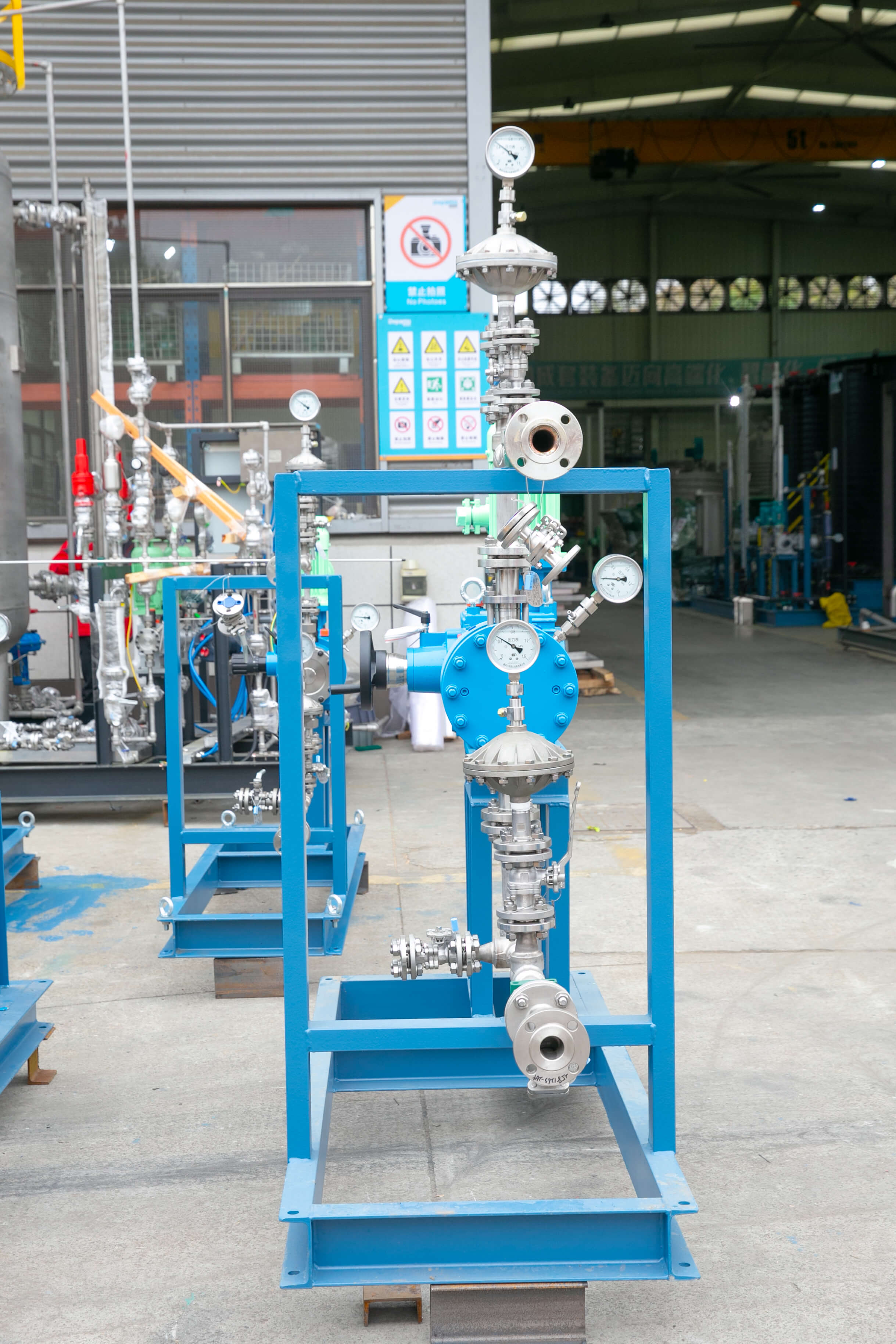
Why Depam Stands Out as a Chemical Injection Skid Manufacturer
Depam was founded in 2003 and has spent more than two decades focused on high-end positive displacement pumps and fluid handling equipment. The company introduced advanced German technology and continued to develop it in-house, operating three brands — Depam, Knirova and Dailepu — to serve different product families and market segments. Registered capital is RMB 54 million, and sales have grown steadily from approximately RMB 450 million in 2023 to RMB 510 million in 2024 and RMB 560 million in 2025.
One supplier from pump core to complete system
Many skid builders are integrators: they buy pumps, tanks and instruments from third parties and assemble them. Depam manufactures the most critical element — the metering pump — itself. That vertical capability changes the engineering conversation. When a client specifies a difficult duty such as high-pressure injection of a viscous inhibitor or precise dosing of a corrosive additive, the pump design, the hydraulic end, the diaphragm and the control logic can all be adjusted by the same engineering team that builds the skid. It also simplifies spare parts and after-sales responsibility, because one company owns the whole system.
Product portfolio that supports complete injection packages
Depam’s product range covers metering pumps (including hydraulic diaphragm metering pumps), high-pressure process reciprocating pumps with discharge pressures up to 35 MPa and above, pneumatic pumps, electric pumps, screw pumps, rotary lobe pumps, gear pumps, emulsifying pumps, special centrifugal pumps, water-steam sampling devices, supercritical extraction units, and fully automatic chemical dosing systems. This breadth means a single injection skid can combine a high-pressure plunger pump for main-line injection with a smaller diaphragm metering pump for additive dosing, without mixing brands or splitting responsibility.
Application experience across demanding industries
The company’s sales mix reflects where its equipment is actually working: petroleum refining and chemicals account for roughly 41% of business, oil and gas fields about 23%, nuclear power, power generation, metallurgy and new energy around 15%, environmental water treatment about 13%, new materials and food about 3%, and other industries approximately 5%. That distribution matters when you evaluate a chemical injection skid supplier, because each sector imposes different expectations — refineries care about continuous uptime and API-style documentation, water utilities care about turndown and chemical compatibility, and oil fields care about high-pressure, remote-location reliability.
Inside a Depam Skid: Components and Typical Configuration
A chemical injection skid is only as good as the way its parts are matched. A high-quality pump paired with an undersized dissolving tank or a poorly designed suction line will still produce erratic dosing. Depam engineers each skid around the actual chemical, flow rate, pressure and control philosophy of the plant.
| Component | Function | Typical Options |
|---|---|---|
| Metering pump | Precise volumetric injection of the chemical | Hydraulic diaphragm, mechanical diaphragm, plunger |
| Solution / storage tank | Holding and preparing the chemical solution | PE, PP, FRP or stainless steel, with level indication |
| Agitator | Dissolving powder chemicals and keeping solutions uniform | Mechanical mixer, dosing of dry powder if required |
| Piping and manifold | Suction, discharge, calibration and relief routing | Single or multi-point injection, pulsation dampers, safety valves |
| Instrumentation | Verifying flow, pressure and level | Pressure gauges, flow meters, level switches, pH/ORP analyzers |
| Control system | Automatic, flow-paced or manual dosing control | Local control panel, PLC, remote I/O, alarm and interlock logic |
| Skid frame | Structural base, lifting points and spill containment | Carbon steel with protective coating, stainless steel for corrosive environments |
Because the skid is assembled and pressure-tested before delivery, the buyer receives a documented package: piping diagrams, instrument lists, test records and operating instructions. Site work is limited to positioning the unit, connecting utilities and process tie-ins, and running the commissioning checks.
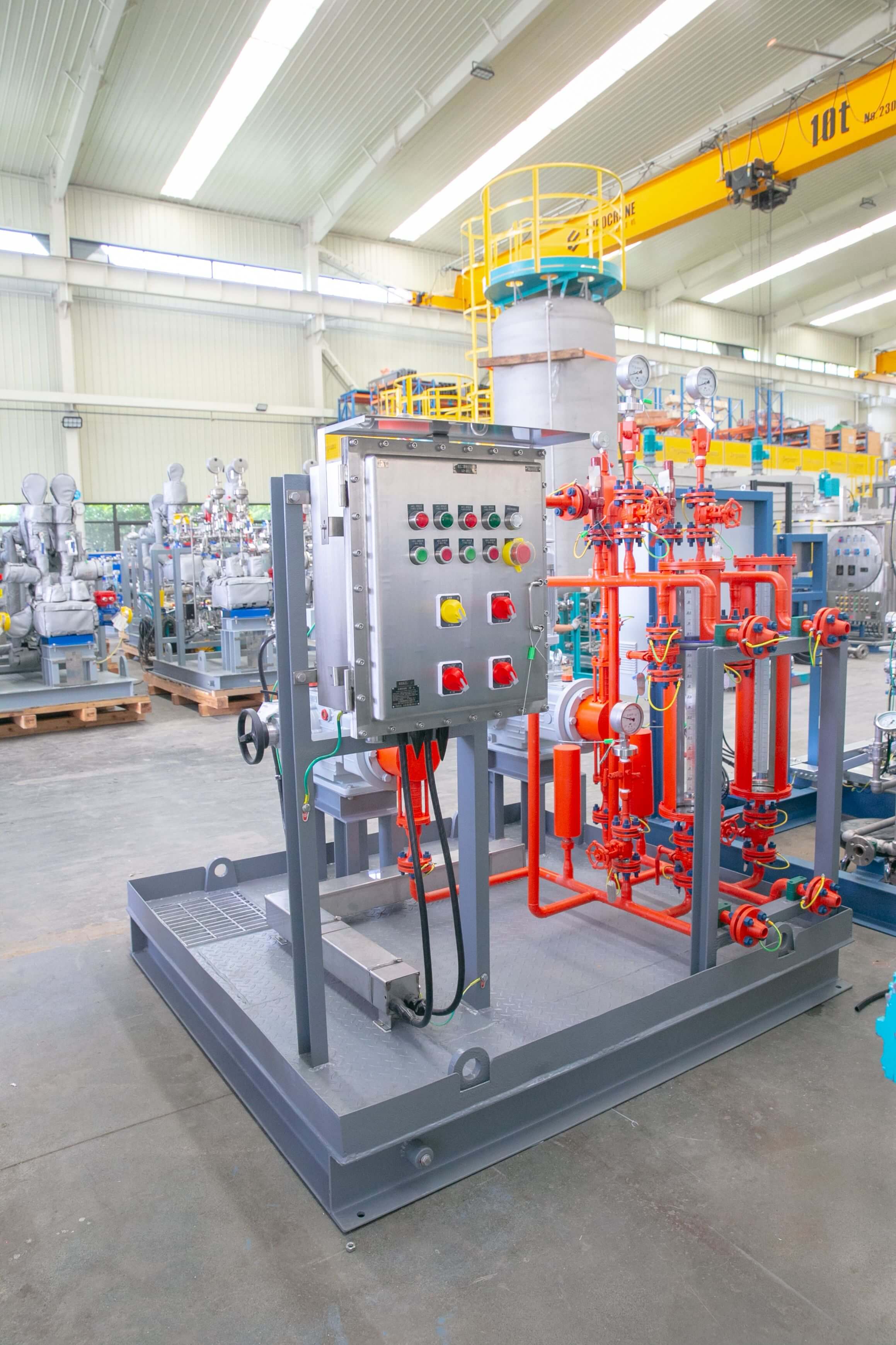
Custom Chemical Injection Skid Solutions by Industry
No two dosing duties are identical, which is why standard catalogue skids only cover a fraction of real applications. Depam’s engineering team works from the client’s medium characteristics, flow rate, pressure, temperature and site process requirements, then proposes a standard product, a modified standard product or a fully bespoke design.
Petroleum refining and petrochemicals
Refineries and chemical plants inject corrosion inhibitors, antifoulants, neutralizers, scale inhibitors, biocides and antifoams at multiple points across the process. The requirements here are usually continuous operation, tight accuracy at low injection rates, and compatibility with aggressive or flammable media. Hydraulic diaphragm metering pumps are a common choice because the diaphragm isolates the hydraulic system from the process fluid and prevents leakage. Where an additive must enter a high-pressure line, a high-pressure reciprocating process pump can be combined on the same skid.
Oil and gas fields
Upstream and midstream operations dose chemicals such as demulsifiers, paraffin inhibitors, scale inhibitors and corrosion inhibitors at the wellhead, at gathering stations and along pipelines. These sites are often remote, exposed to weather and difficult to service, so reliability and remote monitoring matter as much as precision. High-pressure plunger pumps with stable flow and the ability to run continuously are frequently selected for pipeline injection, while metering pumps handle lower-pressure dosing points.
Water treatment and environmental protection
Municipal and industrial water treatment plants use dosing skids for coagulants, flocculants, disinfectants, antiscalants, pH adjustment and membrane chemicals. Here the priorities are wide turndown, chemical compatibility of tanks and piping, and the ability to follow plant flow automatically. A fully automatic chemical dosing system that integrates storage, dissolving, agitation, metering and control into one packaged unit reduces operator workload and eliminates manual mixing errors.
Power generation, nuclear, metallurgy and new energy
Boiler water treatment, cooling water treatment, condensate and feedwater chemical conditioning all depend on accurate dosing to protect expensive equipment from corrosion and scale. Depam also supplies water-steam sampling devices and related equipment for these plants, which means the chemical dosing system and the water chemistry monitoring side can be considered together rather than as separate purchases.
New materials and food processing
In food and new material production, dosing accuracy directly affects product quality and consistency. Skids for these duties are built with materials and surface finishes appropriate to the medium and are designed for cleaning and inspection access, with dosing rates scaled to relatively small but critical additive volumes.
How to Choose a Reliable Chemical Injection Skid Supplier
Price comparison alone is a poor selection method for dosing equipment, because the total cost of ownership is dominated by downtime, maintenance and rework. A structured evaluation should cover engineering capability, manufacturing depth, control philosophy, documentation and service support.
| Evaluation Area | What to Ask the Supplier |
|---|---|
| Dosing accuracy | What is the repeatability across the required turndown range, and how is stroke adjustment achieved? |
| Medium compatibility | Which wetted materials are proposed for the specific chemical, concentration and temperature? |
| Pressure and flow range | Is the pump selected for the maximum discharge pressure plus a sensible margin, and what flow turndown is available? |
| Control and automation | Can the skid follow a 4–20 mA flow signal, accept remote start/stop, and report alarms to the plant DCS? |
| Factory testing | Which tests are performed before shipment, and what records are provided? |
| Spares and service | What is the recommended spare parts list, and how quickly can diaphragms, valves and seals be supplied? |
It also helps to visit or audit the manufacturing base. A chemical injection skid factory with in-house pump production, its own machining and assembly capability, and a dedicated test area can usually respond faster to design changes and non-conformance issues than a trading company that subcontracts everything.
Installation, Commissioning and Maintenance Guide
Even a well-designed skid depends on correct installation. The unit should sit on a level, load-rated foundation with sufficient access for pump maintenance and tank cleaning, and suction lines should be short, generously sized and free of unnecessary fittings to avoid cavitation. Discharge piping should include a pressure relief path back to the tank or to a safe location, and calibration columns should be reachable by the operator.
Commissioning involves flushing the system, verifying that the pump delivers the expected volume against a calibration column, testing the relief valve, checking the control loop response, and confirming alarm and interlock behaviour. Operators should be trained on stroke adjustment, diaphragm replacement and safe chemical handling before the skid enters normal service.
Routine maintenance is straightforward when it is planned. Recommended practice includes:
- Daily: check discharge pressure, tank level and any visible leakage at fittings.
- Weekly: inspect the hydraulic oil level on diaphragm metering pumps and verify dosing against the process set point.
- Monthly: exercise standby pumps, clean suction strainers and confirm relief valves are unobstructed.
- Periodically: replace diaphragms and valve seats according to the duty cycle and chemical aggressiveness, and refresh calibration records.
FAQ
What is a chemical injection skid used for?
A chemical injection skid is used to store, prepare and precisely inject liquid chemicals into a process. Typical duties include injecting corrosion and scale inhibitors in refineries and oil fields, dosing coagulants, disinfectants and antiscalants in water treatment plants, and conditioning boiler and cooling water in power stations. The skid integrates pumps, tanks, piping, instrumentation and controls into one pre-assembled unit.
Can Depam supply a custom chemical injection skid rather than a standard unit?
Yes. Depam engineers skids around the client’s specific medium characteristics, required flow rate, discharge pressure, temperature and site process conditions. Depending on the duty, the result may be a standard product, a modified standard product or a fully bespoke design that combines different pump types, tank materials and control philosophies on a single frame.
Which pump type is best for a chemical injection package?
It depends on the medium and the pressure. Hydraulic diaphragm metering pumps are usually preferred where high accuracy, low flow and leak-free containment are required, especially with corrosive or toxic chemicals. High-pressure reciprocating plunger pumps are better suited to high-pressure injection, long-distance pipeline boosting and viscous or particle-laden media. Many skids combine both types to cover different injection points.
How accurate is the dosing on a Depam skid?
Accuracy is achieved by adjusting both stroke length and running frequency on the metering pump, which allows fine control even at very low injection rates. The final accuracy figure depends on the selected pump model, the chemical viscosity and the control mode, and is confirmed during factory testing and on-site calibration against a calibration column.
Can the skid be integrated with an existing plant control system?
Yes. Skid control options range from a local control panel with manual stroke adjustment to PLC-based automatic dosing that follows a 4–20 mA flow or pH signal and reports alarms and status to the plant DCS. Remote start/stop and multi-point injection sequencing can also be included in the design.
What information is needed to get a quotation for a chemical injection skid?
To prepare an accurate quotation, a manufacturer needs the chemical name and concentration, required dosing rate and turndown, discharge pressure, temperature, pipe connection sizes, available utilities, control and communication requirements, and any site-specific constraints such as hazardous area classification or limited footprint. Providing these details upfront shortens the engineering cycle considerably.
Summary
Chemical injection is a small part of a plant’s capital cost but a large part of its operating reliability. Selecting an experienced chemical injection skid manufacturer is therefore a technical decision, not simply a purchasing one. Depam (Hangzhou) Pump Industry Technology Co., Ltd. combines more than two decades of positive displacement pump expertise with in-house design, manufacturing and skid assembly capability, supported by a portfolio that spans hydraulic diaphragm metering pumps, high-pressure reciprocating process pumps and fully automatic chemical dosing systems.
For buyers evaluating a custom chemical injection skid, the practical path is clear: define the chemical, flow, pressure, temperature and control requirements precisely; check whether the supplier builds its own pumps or only assembles bought-in components; review factory test and documentation practice; and plan maintenance and spares from day one. A skid specified this way will keep dosing accurate through years of continuous operation, across refinery, oil field, power plant or water treatment duty.