
Choosing the right eccentric screw pump manufacturer is one of the most consequential decisions in fluid handling. An eccentric screw pump — also called a progressive cavity pump — is often the only technology that can move thick, abrasive, shear-sensitive, or gas-entrained media without clogging, pulsation, or product damage. But pump performance depends far less on the catalogue picture than on how the rotor, stator, seal, and drive train are engineered for your specific fluid, temperature, and pressure.
This guide explains how eccentric screw pumps work, what separates a capable eccentric screw pump factory from a trading intermediary, which applications benefit most from this pump type, and how to prepare the technical information needed for an accurate quotation. It also introduces the manufacturing capability of Depamu (Hangzhou) Pump Industry Technology Co., Ltd., a Chinese high-end positive displacement pump manufacturer founded in 2003 that supplies screw pumps, metering pumps, high-pressure reciprocating pumps, and complete fluid packages to petrochemical, oil and gas, power, nuclear, new energy, and water treatment customers worldwide.
What Is an Eccentric Screw Pump and How Does It Work?
An eccentric screw pump is a rotary positive displacement pump built around a single helical metal rotor turning inside a double helical elastomer stator. As the rotor rotates, sealed cavities form and progress continuously from the suction end to the discharge end, pushing the medium forward with almost no internal turbulence. Because the moving element never creates a valve action and the flow path is wide and unobstructed, the pump handles solids, fibers, and high-viscosity liquids that would damage or clog a centrifugal pump.
That working principle produces several practical advantages. Flow is essentially proportional to speed, so capacity can be adjusted by variable speed drive with good repeatability. The medium is transported at low velocity, which protects shear-sensitive emulsions, polymers, and biological sludges. The pump is self-priming and can run with a flooded suction or lift fluid from a tank, and the discharge is smooth and virtually pulsation-free compared with reciprocating equipment.
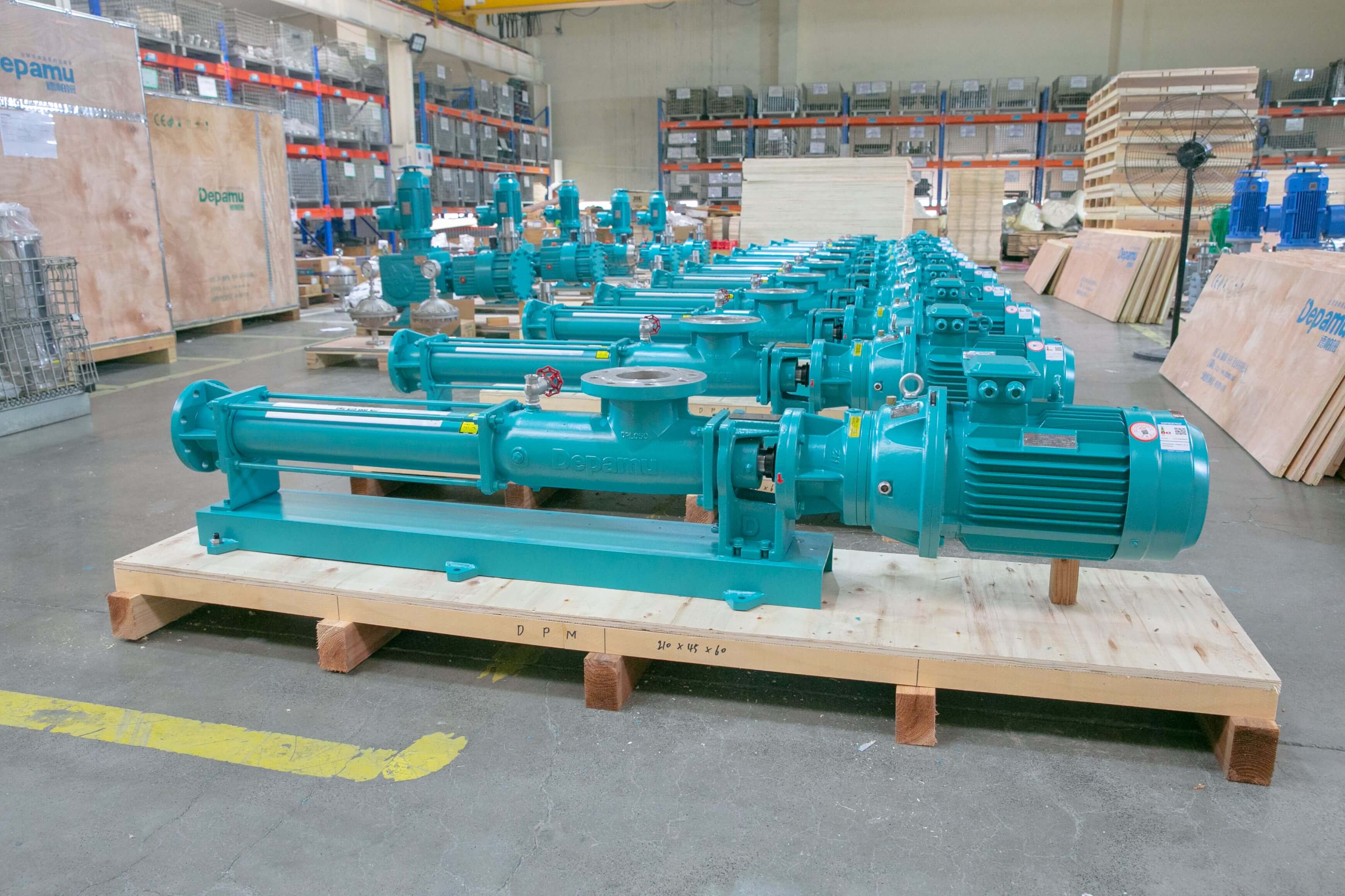
Why Evaluate Depamu as Your Eccentric Screw Pump Manufacturer
Depamu (Hangzhou) Pump Industry Technology Co., Ltd. has focused on high-end positive displacement pumps and fluid equipment since 2003. The company employs more than 400 people, operates a plant of roughly 35,000 square meters, holds registered capital of RMB 54 million, and reports annual production value of approximately RMB 500 million, with sales growing from about RMB 450 million in 2023 to RMB 510 million in 2024 and RMB 560 million in 2025. Three brands — Depamu, Krnilova, and Dailepu — cover different product lines and market segments, supported by technology originally introduced from Germany and continuously developed in-house.
In-house Design, Machining, and Assembly
Because the company controls rotor machining, stator bonding, seal assembly, and final testing internally, dimensional tolerances and material selections can be adjusted per order instead of being limited to a fixed catalogue. This matters for eccentric screw pumps, where the rotor–stator interference fit, elastomer hardness, and surface finish must match the medium’s abrasiveness, lubricity, and temperature. A factory that machines its own rotors can hold the geometry needed for stable volumetric efficiency across the pump’s service life.
Standard, Non-standard, and Fully Customized Units
Depamu supplies standard models as well as non-standard and customized fluid solutions built around customer media characteristics, flow rate, pressure, temperature, and site process requirements. For an eccentric screw pump quality supplier relationship, this flexibility is important: a pump specified for thickened sludge in a municipal plant is a very different machine from one handling crude oil emulsion at an oil field or starch slurry in a food facility.
Complete Packages Rather Than Single Components
Eccentric screw pumps are rarely installed alone. Depamu also manufactures metering pumps, hydraulic diaphragm metering pumps, high-pressure reciprocating process pumps reaching 35 MPa and above, pneumatic and electric pumps, chemical dosing skids, water and steam sampling devices, water treatment equipment, rotary lobe pumps, gear pumps, emulsifying pumps, and special centrifugal pumps. That breadth lets the company deliver a coordinated package — pump, piping, buffer tank, control panel, and instrumentation — instead of forcing the buyer to integrate equipment from several vendors.
Typical Applications Across Process Industries
The company’s product mix reflects its customer base. Petrochemical and chemical processing account for roughly 41% of sales, oil and gas field applications about 23%, nuclear, power, metallurgy, and new energy around 15%, environmental water treatment about 13%, and new materials and food roughly 3%, with the remainder split across other sectors. Eccentric screw pumps fit naturally into several of these areas.
In environmental water treatment, progressive cavity pumps are a common choice for thickened sludge, dewatered sludge cake, lime slurry, and polymer solutions. Their ability to pass fibrous material without clogging and to meter viscous reagents at low shear makes them a practical alternative to centrifugal or diaphragm equipment in dosing lines. In petrochemical and chemical plants, the same principle serves viscous process streams, tars, resins, and shear-sensitive intermediates. In oil and gas field operations, eccentric screw pumps handle crude transfer, produced water, and high-viscosity fluids where a smooth, self-priming, solids-tolerant pump is required.
In food and new materials production, low-shear conveyance protects product structure — a benefit for emulsions, pastes, and fruit preparations. In power and nuclear auxiliary systems, progressive cavity technology appears in sludge, slurry, and reagent transfer duties where reliability and predictable flow matter more than high head at a single point.
Eccentric Screw Pump vs Other Pump Types: A Selection Overview
Buyers often compare three or four pump technologies before contacting a supplier. The table below summarizes where each type typically fits, so that specifications can be discussed with the right expectations. Final selection should always be confirmed against actual medium data and operating conditions.
| Pump Type | Typical Strength | Typical Limitation | Common Duty |
|---|---|---|---|
| Eccentric screw (progressive cavity) | High viscosity, solids and fibers, low shear, self-priming, smooth flow | Elastomer stator wear with abrasive media; limited dry running | Sludge, slurry, polymer, viscous process transfer |
| Rotary lobe pump | Gentle handling, easy cleaning, high flow at moderate pressure | Less tolerant of large solids; closer clearance needed for thin liquids | Food, hygienic transfer, low-viscosity to medium-viscosity media |
| Gear pump | Compact, high pressure capability, good for lubricating fluids | Poor solids tolerance; shear stress on sensitive products | Oils, resins, fuel, chemical dosing of clean liquids |
| Reciprocating / metering pump | Very accurate dosing, high pressure, wide chemical compatibility | Pulsating flow; limited solids tolerance | Chemical injection, reagent dosing, process boosting |
| Centrifugal pump | Simple, compact, high flow, low cost | Cannot handle high viscosity or entrained solids well; not self-priming | Clean, low-viscosity water-like liquids |
How to Select the Right Eccentric Screw Pump: A Practical Guide
Accurate selection starts with the medium, not the flow rate. Provide the chemical composition or at least the fluid family, the viscosity at operating and startup temperature, the solids content and maximum particle size, whether fibers or gas are present, the temperature range, and the required duty cycle. A pump that runs intermittently on cold fluid behaves very differently from one running continuously on hot, abrasive slurry.
Next, define the hydraulic duty precisely: required flow range, suction conditions including available NPSH and lift height, discharge pressure, and any back-pressure variation caused by filters, long pipelines, or downstream equipment. Because progressive cavity flow is nearly proportional to rotational speed, the drive selection — fixed speed, variable frequency drive, or mechanical variable speed — should be agreed early, together with the required turndown and metering accuracy.
Finally, specify the materials and mechanical details. Rotor and stator material, stator elastomer grade, shaft sealing arrangement, inlet configuration (open hopper, auger feed, or standard flange), connection standards, surface finish, and motor protection class all influence service life. Buyers sourcing from an overseas eccentric screw pump manufacturer should confirm which of these are standard and which are options, and should request drawings for review before production begins.
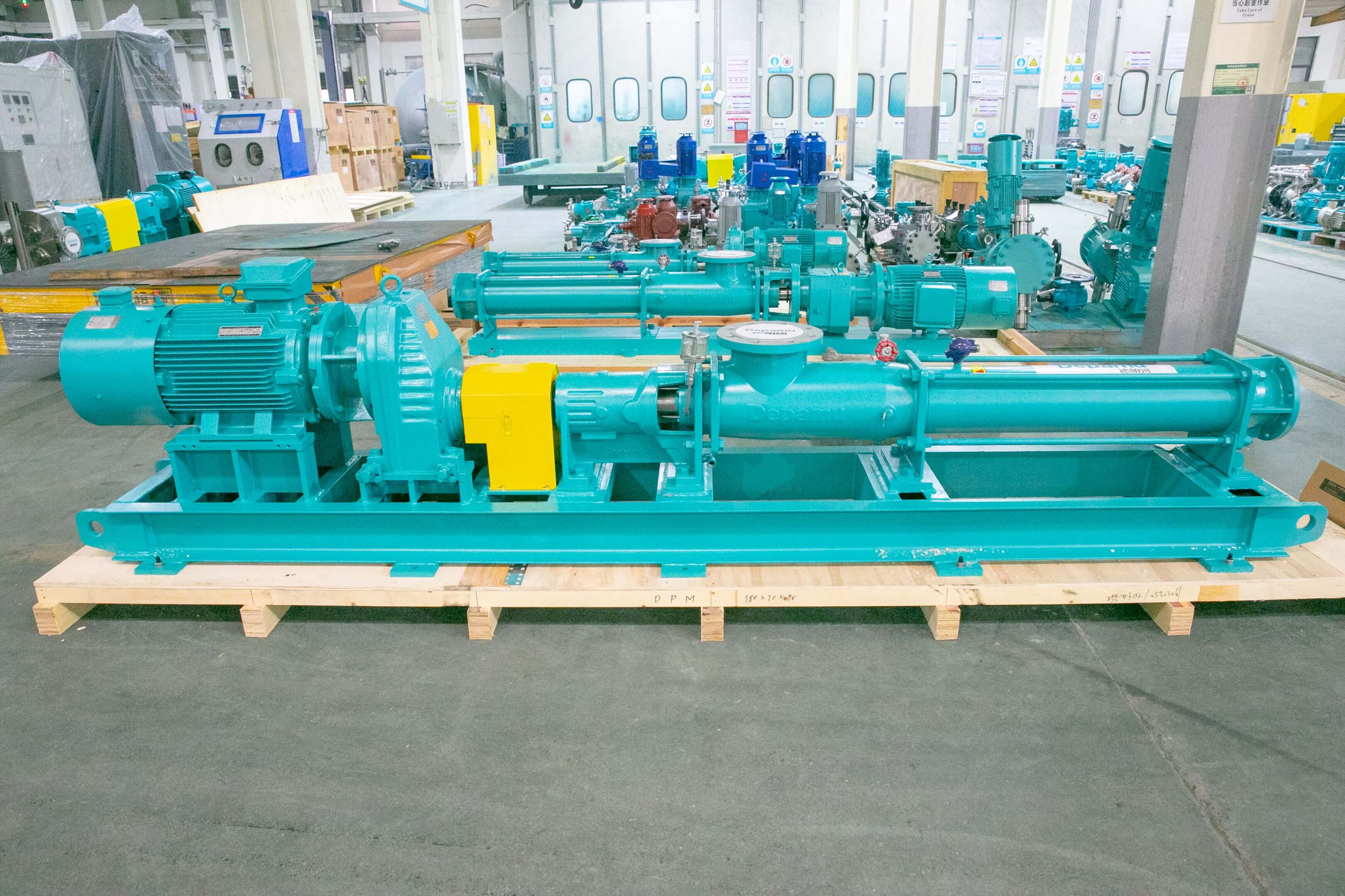
Custom Eccentric Screw Pump Solutions and OEM Supply
For many projects, a standard model is close but not exact. Customization typically involves modified connection dimensions, special stator compounds for aggressive chemicals, hardened rotors for abrasive slurries, jacketed casings for temperature-sensitive media, hopper and auger feed arrangements for high-solids sludge, or integrated control panels for automatic operation. Depamu’s engineering team works from customer media data and site process conditions to produce standard, non-standard, and tailored configurations.
Buyers looking for an eccentric screw pump定制厂家 equivalent in English terms — a custom-build factory rather than a reseller — should check three things: whether engineering review happens before quotation, whether prototype or first-article inspection data can be shared, and whether documentation (material certificates, test records, drawings, manuals) is supplied in the buyer’s language. OEM supply arrangements, including private labeling and packaging to buyer specification, are also negotiable with manufacturers of this type, but should be confirmed in writing during the inquiry stage.
Quality Control, Testing, and Delivery Considerations
Every eccentric screw pump should be performance-tested before shipment: pressure hold, flow verification at rated speed, vibration and noise check, and seal leakage inspection. For chemical and petrochemical duty, material traceability and NDT records may be contractually required. For complete dosing or water treatment packages, factory assembly and functional testing of the integrated skid shortens commissioning on site and reduces the risk of interface errors between pump, piping, and control system — an approach Depamu applies to its chemical dosing装置 and water treatment equipment.
Logistics planning deserves early attention. Confirm the export packing standard, lifting points, preservation method for elastomer stators during long sea freight, and the spare parts list recommended for the first year of operation. A supplier that provides a clear recommended spare parts matrix and a maintenance schedule is generally easier to work with over a multi-year relationship than one that quotes only the pump price.
Maintenance Practices That Extend Pump Life
Progressive cavity pumps wear predictably, and most failures trace back to operating conditions rather than manufacturing defects. Never run the pump dry for more than a few seconds; the elastomer stator depends on the medium for lubrication and cooling. Keep suction lines short and generously sized, and avoid operating with a partially filled inlet, which causes cavitation-like damage to the stator. Control discharge pressure within the specified range and avoid prolonged operation against a closed valve.
Monitor flow rate as the primary wear indicator. A gradual loss of capacity at unchanged speed usually signals stator wear or rotor erosion, which allows maintenance to be planned rather than reactive. Inspect shaft seals for leakage, check coupling alignment after any pipework modification, and store spare stators away from heat, sunlight, and ozone sources. For abrasive slurries, keep a record of solids concentration — small increases in sand or grit content can noticeably shorten stator life.
FAQ
What should I include in an inquiry to an eccentric screw pump manufacturer?
Provide the medium name and composition, viscosity at operating temperature, solids content and maximum particle size, temperature range, required flow range, suction and discharge pressure, duty cycle, available voltage and frequency, and any site-specific standards or certification requirements. Drawings or a process description help the supplier propose the right configuration and give an accurate quotation.
Can one pump handle both high viscosity media and abrasive slurries?
Often yes, but the design must change. Abrasive media usually require a harder rotor surface and a tougher stator compound, while high-viscosity media require attention to inlet feeding and speed. Because these requirements interact, selection should be based on measured medium data rather than a single viscosity figure.
How is an eccentric screw pump different from a rotary lobe or gear pump?
An eccentric screw pump uses a single helical rotor inside a double helical stator, giving a wide, unobstructed flow path that tolerates solids and fibers and produces smooth, low-shear flow. Rotary lobe pumps offer easier cleaning and higher flow at moderate pressure, while gear pumps suit clean lubricating fluids at high pressure. The best choice depends on the medium and duty.
Do you supply complete dosing and water treatment packages, not only pumps?
Yes. Alongside eccentric screw pumps, Depamu manufactures metering pumps, high-pressure reciprocating process pumps, chemical dosing packages with dissolution tanks, agitators and control systems, water and steam sampling devices, and water treatment equipment. These can be delivered as factory-assembled skids that require only piping and power connection on site.
How do I evaluate whether a supplier is a real factory?
Ask for the plant address and a video or virtual tour of the machining and assembly area, request rotor and stator manufacturing details, ask which tests are performed before shipment and whether test reports are provided, and check whether non-standard requests receive an engineering response rather than a simple price list. A genuine manufacturer will discuss tolerances, materials, and process data in technical terms.
What is the typical lead time for a custom eccentric screw pump order?
Lead time depends on material availability, stator compound selection, and whether the unit is part of an integrated package. Standard models are typically faster than custom configurations that require new drawings or special materials. Confirm the production schedule in writing at order placement and agree on inspection milestones for larger projects.
Summary
An eccentric screw pump is a specialized machine, and the quality of the finished unit depends on how carefully the rotor, stator, seal, and drive are matched to the medium. When comparing an eccentric screw pump manufacturer, look beyond the price list: examine in-house machining capability, engineering response quality, testing discipline, documentation, and willingness to customize. Depamu (Hangzhou) Pump Industry Technology Co., Ltd. brings more than twenty years of positive displacement pump experience, a 35,000 square meter production base, over 400 employees, three brands, and a product range spanning screw pumps, metering pumps, high-pressure reciprocating pumps, and complete chemical dosing and water treatment packages — supported by a customer base concentrated in petrochemical, oil and gas, power, nuclear, new energy, and environmental sectors. Sharing accurate medium and duty data at the inquiry stage is the fastest route to a pump that performs reliably for years.