
Choosing an electric double diaphragm pump manufacturer is rarely a simple catalogue exercise. The pump sits at the intersection of chemical compatibility, dosing accuracy, motor engineering and continuous-duty reliability, and a poor selection decision usually surfaces months later as leak paths, diaphragm fatigue or unstable flow. For buyers in petrochemical, water treatment, oil & gas, power generation and new materials, the real question is not “which pump is cheapest” but “which manufacturer can engineer a pump that survives my medium, my pressure and my duty cycle for years”.
This guide explains how electric double diaphragm pumps work, how they compare with air-operated alternatives, what to specify before requesting a quotation, and how to evaluate an electric double diaphragm pump supplier using practical, verifiable criteria rather than marketing claims. It also illustrates how an established pump manufacturer with in-house metering pump and reciprocating pump engineering — such as Depamu (Hangzhou) Pump Technology Co., Ltd. — approaches standard, non-standard and fully customized diaphragm pump projects.
What Does an Electric Double Diaphragm Pump Actually Do?
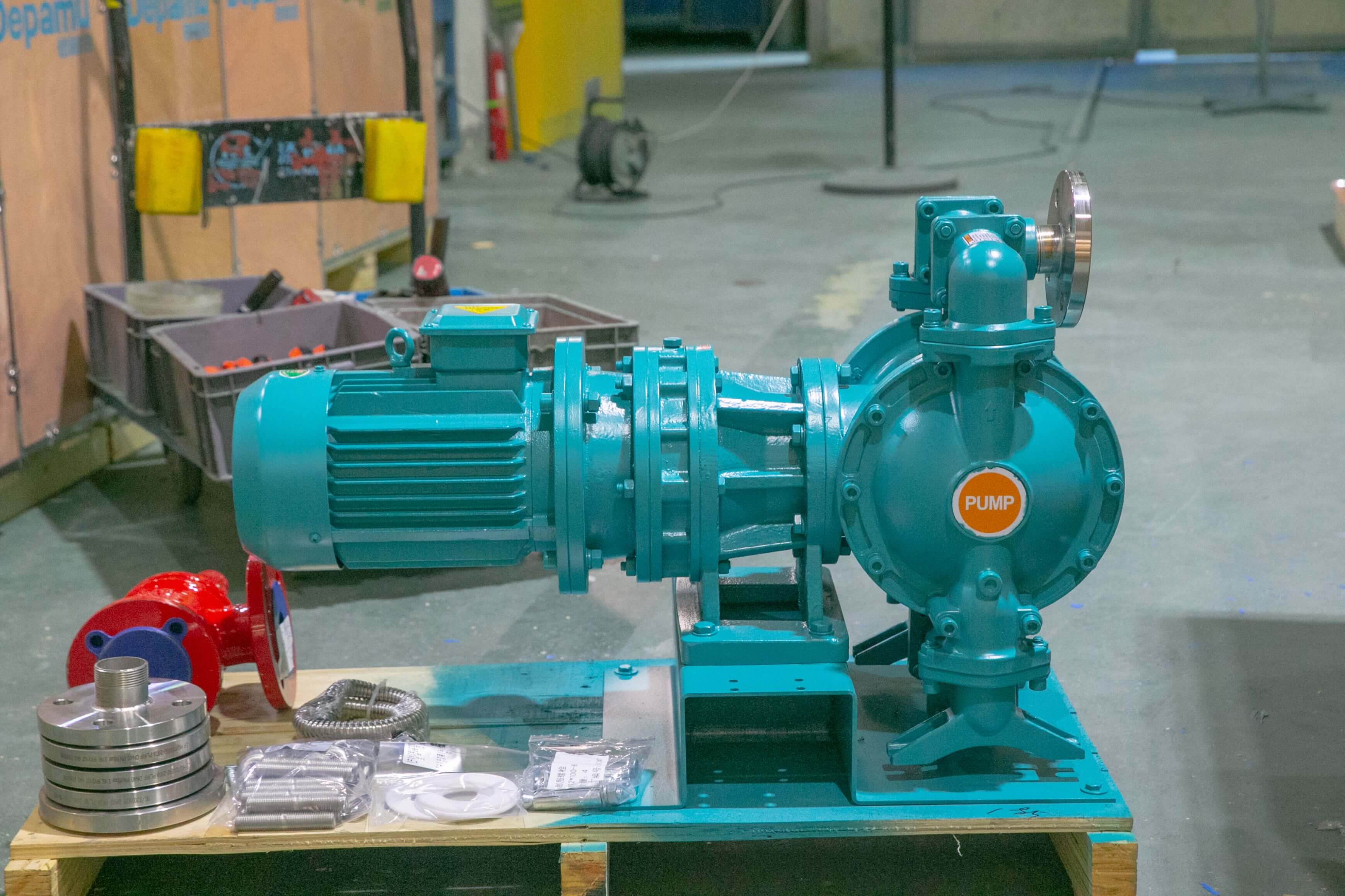
An electric double diaphragm pump uses a motor, a gearbox or eccentric mechanism and two opposing diaphragms to create a positive-displacement pumping action. As one diaphragm is pushed forward by the drive mechanism, the opposite diaphragm is pulled back, so the pump alternates between suction and discharge strokes on both sides. The result is a smooth, self-priming, run-dry-capable pump with no rotating shaft seal in contact with the process liquid — the diaphragm itself is the barrier between the medium and the mechanical drive.
Because the pump is driven by an electric motor rather than compressed air, the operating cost is dominated by electricity instead of air consumption, and the flow can be regulated through motor speed control, a variable frequency drive, or — in metering-duty designs — through stroke length and stroke frequency adjustment. This is why electric double diaphragm pumps are frequently specified where plant compressed air is unreliable, where energy efficiency is measured, or where repeatable dosing and remote control signals are required.
Manufacturing Background: What to Look for in a Pump Factory
A credible electric double diaphragm pump factory needs more than an assembly line. Diaphragm pump performance is decided long before assembly: hydraulic design, diaphragm material selection, valve geometry, surface finish of wetted parts, motor and drive sizing, and the test bench used to verify every unit. Buyers should therefore look for a manufacturer with in-house research and development, machining capability, assembly and full performance testing under one roof.
Depamu (Hangzhou) Pump Technology Co., Ltd. was founded in 2003 and has focused on high-end positive displacement pumps and fluid equipment for more than twenty years. The company employs over 400 people and operates a factory site of approximately 35,000 square meters, with registered capital of RMB 54 million and annual output value of approximately RMB 500 million. Its product portfolio covers metering pumps, high-pressure process reciprocating pumps, pneumatic pumps, electric pumps, automatic chemical dosing systems, water and steam sampling devices, water treatment equipment, screw pumps, rotor pumps and gear pumps — a breadth that matters when a diaphragm pump has to be integrated into a complete dosing skid or an existing process package.
Sales performance is one useful indicator of manufacturing stability. The company reported sales of approximately RMB 450 million in 2023, RMB 510 million in 2024 and RMB 560 million in 2025, reflecting continuous demand across its core industries rather than dependence on a single market segment.
| Industry segment | Approximate share of business | Typical diaphragm pump duty |
|---|---|---|
| Petroleum refining & chemical | about 41% | Chemical additive dosing, transfer of corrosive and volatile media, process boosting |
| Oil & gas fields | about 23% | Chemical injection, methanol and inhibitor dosing, high-pressure transfer |
| Nuclear, power, metallurgy & new energy | about 15% | Water and steam sampling, reagent dosing, boiler and cycle chemistry |
| Environmental water treatment | about 13% | Coagulant, polymer, disinfectant and pH adjustment dosing |
| New materials & food | about 3% | Hygienic transfer, additive dosing, low-shear handling of sensitive fluids |
| Other industries | about 5% | General transfer, pilot plants, non-standard process packages |
Electric vs Air-Operated Double Diaphragm Pumps: Which Should You Specify?
The most common comparison buyers ask about is electric driven versus air driven. Air-operated double diaphragm pumps remain popular because they are simple, explosion-safe by design and tolerate run-dry conditions. However, compressed air is an expensive and often unstable utility, and air consumption is difficult to meter. An electric operated diaphragm pump replaces that air motor with a geared motor and mechanical drive, delivering stable speed control, lower energy cost, easy integration with plant control systems and simpler connection to VFDs and dosing controllers.
| Consideration | Electric double diaphragm pump | Air-operated double diaphragm pump |
|---|---|---|
| Energy source | Electric motor, mains or variable frequency drive | Compressed air network |
| Flow control | Speed regulation, stroke adjustment, closed-loop dosing control | Air flow and stroke adjustment, generally less precise |
| Operating cost profile | Electricity only, easy to meter per unit volume | Air generation and compressor maintenance included |
| Automation integration | Direct interface with PLC, 4-20 mA signals and dosing skids | Requires solenoid valves and position feedback for control |
| Run-dry tolerance | Good, but dry-running protection should be specified | Inherently tolerant for short periods |
| Best fit | Dosing duty, continuous operation, instrumented plants | Intermittent transfer, hazardous areas without power availability |
Applications: Where Electric Double Diaphragm Pumps Deliver Value
Chemical dosing and petrochemical processes
In refining and chemical plants, diaphragm pumps are used to inject corrosion inhibitors, antiscalants, biocides, neutralizers and other additives into pipelines and reactors. The electric drive allows precise, repeatable dosing, while the double diaphragm barrier protects the drive mechanism from aggressive media such as acids, solvents and volatile organics. Because the pump has no dynamic shaft seal, fugitive emissions at the pump are minimized — a decisive advantage for media that are toxic or odorous.
Water treatment and wastewater plants
Municipal and industrial water treatment relies on controlled chemical addition: coagulants, flocculants, sodium hypochlorite, sodium hydroxide and antiscalants. Electric diaphragm pumps can follow a flow-proportional signal from the plant SCADA system, keeping the dosing rate aligned with actual water flow. Combined with a dosing skid — a packaged system integrating storage tank, mixer, metering pump and controller — the pump becomes part of a complete chemical preparation and dosing station that is assembled and tested before shipment, requiring only piping and power connections on site.
Oil & gas chemical injection
In oilfield service, diaphragm and reciprocating pumps inject methanol, corrosion inhibitors, demulsifiers and scale inhibitors at the wellhead, gathering station or pipeline. Here the pump must handle high pressure, long unattended operation and often remote locations with limited maintenance support. Manufacturers with genuine high-pressure reciprocating pump experience — including designs reaching above 35 MPa — can support these duties with suitable pump selection and materials.
Power generation and process sampling
Boiler and cycle chemistry depend on accurate reagent dosing and representative sampling. Diaphragm pumps and dedicated sampling devices are used together to condition and transport samples under controlled flow and temperature, supporting reliable water chemistry monitoring in power plants.
How to Specify the Right Electric Double Diaphragm Pump
Before an accurate quotation is possible, a supplier needs a complete process data sheet. Supplying these details up front shortens the engineering cycle dramatically and reduces the risk of an undersized or chemically incompatible pump being delivered.
| Data point | Why the manufacturer needs it |
|---|---|
| Medium composition and concentration | Determines wetted materials, diaphragm elastomer and valve type |
| Flow rate range (minimum / normal / maximum) | Sets pump size, stroke rate and turndown requirements |
| Discharge and suction pressure | Defines motor power, drive design and piping ratings |
| Temperature range | Affects diaphragm life, material limits and cooling requirements |
| Viscosity and solids content | Influences valve selection and whether a diaphragm or screw/rotor pump is better |
| Duty cycle and control interface | Determines continuous-duty rating, VFD compatibility and control signals |
| Area classification and power supply | Sets motor type, voltage, frequency and enclosure rating for export markets |
Buyers should also confirm whether the pump will operate in a metering regime (where repeatability matters most) or a transfer regime (where throughput matters most). These two duty profiles lead to different valve designs, stroke mechanisms and control philosophies — and a supplier who asks about both is usually a supplier who has engineered real projects rather than catalogued them.
Customization and OEM: What a Capable Manufacturer Can Adapt
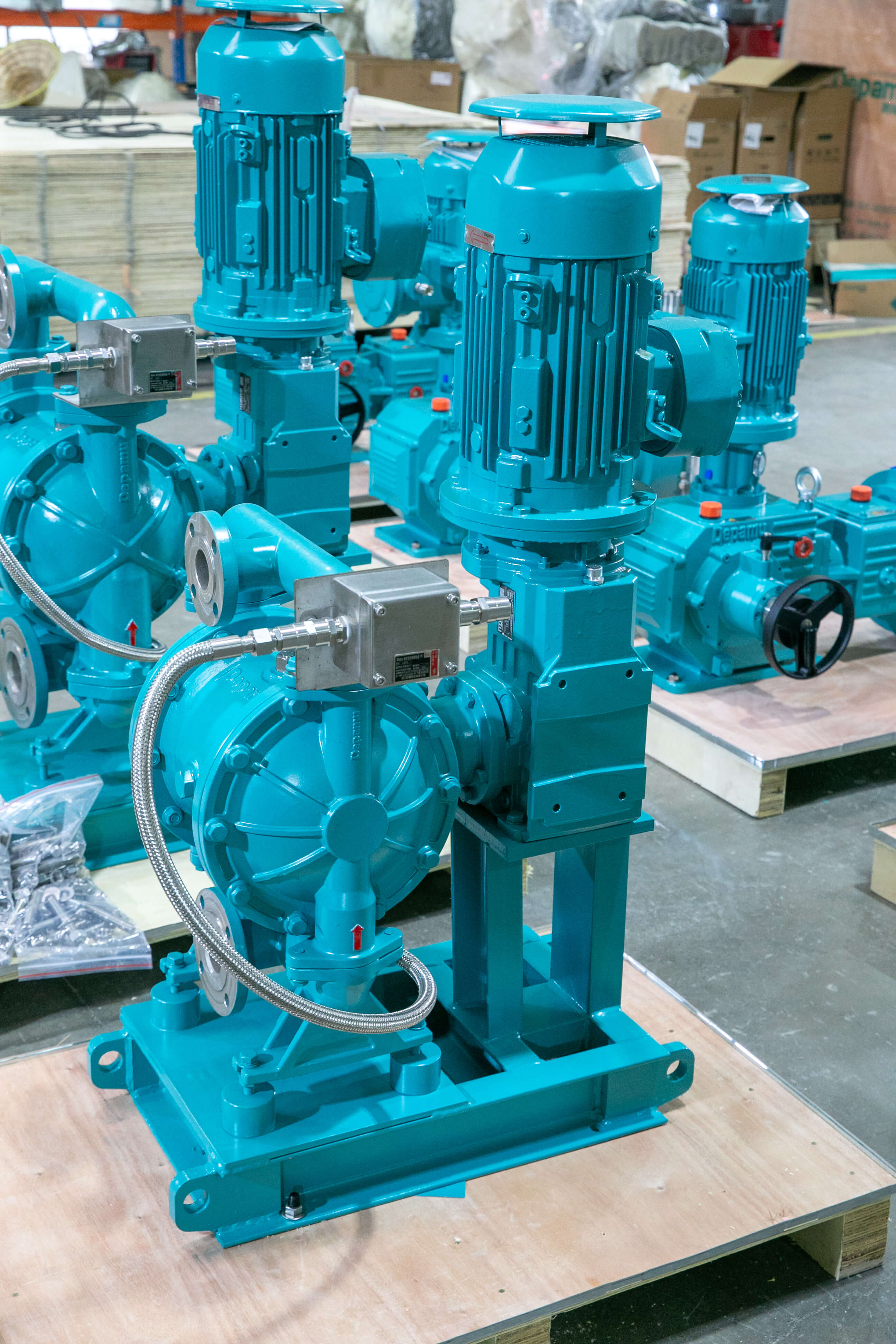
Standard catalogues rarely cover every process. A custom electric double diaphragm pump typically involves changes to wetted materials (for example PTFE-lined or stainless steel liquid ends), diaphragm elastomer selection, valve and seat materials, motor voltage and frequency for different markets, control panels, baseplates, and connections for dosing skids or sampling systems. A manufacturer with in-house design and fabrication can engineer these changes without outsourcing the critical components, which shortens lead time and keeps accountability in one place.
OEM and private-label cooperation is also common in B2B procurement. An OEM electric double diaphragm pump arrangement usually covers nameplate and documentation customization, specific packaging for export, agreed testing protocols and inspection reports, and a defined spare parts package shipped with the first order. When evaluating this option, ask precisely which documents accompany each unit — dimensional drawings, material certificates for wetted parts, test records and an operation and maintenance manual — because these determine how quickly your own maintenance team can respond on site.
Installation and Commissioning Checklist
Most diaphragm pump problems reported in the first weeks of operation trace back to installation rather than the pump itself. The following practical checks prevent the majority of them:
- Mount the pump on a rigid base with sufficient access to the liquid end, valves and diaphragm housings for inspection.
- Keep suction piping short, adequately sized and free of high points that can trap air; confirm that NPSH conditions are satisfied.
- Fit a suction strainer where solids may be present, and protect the suction line from air ingress through poorly sealed joints.
- Install flexible connections to isolate piping vibration and compensate for any thermal movement.
- Provide pressure relief protection on the discharge side if the line can be blocked by a closed valve.
- Verify motor rotation direction before first start-up, and confirm the drive is filled and lubricated as specified.
- Flush and leak-test the system with water where the process permits, then introduce the actual medium gradually.
- Record initial flow, pressure and stroke settings so future deviations can be diagnosed against a baseline.
Maintenance and Troubleshooting Essentials
Diaphragms, valves and seats are the primary wear parts of any double diaphragm pump, and their service life depends heavily on medium compatibility, temperature and the number of strokes per minute. A simple preventive maintenance programme — periodic inspection of diaphragm condition, checking valve sealing, verifying motor current, and confirming that suction pressure has not drifted — prevents most unplanned shutdowns.
Common symptoms and their usual causes include: reduced or fluctuating flow (worn valves, air ingress on suction, partially blocked strainer), loss of discharge pressure (diaphragm rupture, internal leakage, relief valve bypassing), excessive noise or vibration (loose baseplate, cavitation, incorrect motor alignment) and motor overload (medium viscosity higher than specified, excessive discharge pressure, or solids binding the valve). Because a ruptured diaphragm in a double diaphragm design can be detected before the process medium reaches the drive, specifying a diaphragm monitoring or leak-detection option is strongly recommended for aggressive or hazardous media. Replacing wear parts with the original manufacturer’s components — rather than locally sourced substitutes — preserves the hydraulic performance the pump was selected for.
How to Evaluate an Electric Double Diaphragm Pump Supplier
Price comparisons are only meaningful when the scope behind each quotation is equivalent. Use the following criteria when shortlisting an electric double diaphragm pump supplier:
- Engineering depth: Does the manufacturer design and machine its own liquid ends and drives, or simply assemble purchased components?
- Product breadth: Can the supplier offer an alternative pump type — screw, rotor, gear or reciprocating — if the diaphragm pump is not the right answer for a viscous or high-pressure duty?
- Application experience: Ask which industries the supplier serves and in what proportion; experience in your specific process is a genuine advantage.
- Testing: Confirm which performance and leak tests are performed on every unit before shipment, and whether test records are provided.
- Documentation and spare parts: Check the availability of drawings, material certificates, manuals and a recommended spare parts list.
- Customization capability: Verify that non-standard materials, voltages, control interfaces and skid integration can be handled in-house.
- Commercial transparency: A clear electric double diaphragm pump price breakdown — pump, motor, control, spares and freight — makes later change orders predictable.
A supplier that answers these questions with specifics rather than generalities is usually the one that will still be reachable two years after commissioning. Companies with long operating histories, stable production capacity and an established export process tend to be lower-risk partners for long-term projects. Depamu, for example, has manufactured pumps since 2003, operates three brands serving different market segments, and delivers both standard products and engineered fluid packages built to a customer’s medium, flow, pressure, temperature and site conditions.
FAQ
What is an electric double diaphragm pump used for?
It is used for chemical dosing, additive injection, transfer of corrosive or volatile liquids, water treatment chemical feeding, oilfield chemical injection and general process transfer. The double diaphragm design creates a sealed barrier between the process medium and the mechanical drive, so it is preferred where leakage, emissions or contamination must be avoided.
How is an electric double diaphragm pump different from an air-operated one?
An electric unit uses a motor and mechanical drive instead of compressed air. This gives more stable and repeatable flow, easier integration with PLC and 4-20 mA control systems, and lower operating cost where compressed air is expensive. Air-operated pumps remain preferable in some hazardous or remote locations where power is unavailable.
Can a manufacturer customize the pump for my medium and site conditions?
Yes. A capable factory can select wetted materials, diaphragm elastomers, valves and motor voltages to match the medium, and can supply non-standard baseplates, control panels and skid integration. Providing the medium composition, flow range, pressure, temperature and area classification at the enquiry stage is the fastest route to an accurate proposal.
How do I get an accurate electric double diaphragm pump quotation?
Submit a process data sheet covering medium, concentration, flow range, suction and discharge pressure, temperature, viscosity, solids content, duty cycle and power supply. Ask the supplier to state the pump model, materials, motor rating, control scope, spare parts package, testing protocol and delivery terms so that competing offers can be compared on equal scope.
What maintenance does an electric double diaphragm pump require?
Regular inspection and replacement of diaphragms, valves and seats, verification of motor current and lubrication, checking suction conditions and confirming that flow and pressure remain at the commissioned baseline. Keeping genuine spare diaphragms and valves in stock shortens downtime considerably.
Summary
Selecting an electric double diaphragm pump manufacturer is ultimately a decision about engineering support, material competence and long-term spare parts availability, not simply the lowest unit price. Define your medium, flow, pressure, temperature and duty cycle precisely; compare electric and air-driven options honestly; and request a quotation with a clear scope, testing protocol and documentation package. Manufacturers with in-house design and manufacturing capability — such as Depamu, with more than two decades of positive displacement pump experience, a 35,000 square meter facility and a product range spanning metering pumps, high-pressure reciprocating pumps, dosing systems and other fluid equipment — can support standard, non-standard and fully customized requirements across petrochemical, oil & gas, power, water treatment and new material applications. Approached this way, the pump you install becomes a predictable, maintainable part of the process rather than an ongoing troubleshooting project.