
A high pressure plunger reciprocating pump is one of the most demanding pieces of equipment in any process line. It has to hold pressure continuously, deliver a stable flow rate, and survive media that are abrasive, viscous, hot, or chemically aggressive. For plant owners and EPC contractors, the difference between a well-engineered pump and a marginal one usually shows up months later — as unplanned downtime, seal failures, or unstable injection rates. This is why the choice of a high pressure plunger reciprocating pump manufacturer matters as much as the pump specification itself.
Depamu (Hangzhou) Pump Industry Technology Co., Ltd. has focused on high-end volumetric pumps and fluid equipment since 2003. With more than 400 employees, a plant area of roughly 35,000 m², registered capital of RMB 54 million and an annual output value of around RMB 500 million, the company designs, manufactures and packages reciprocating pumps, metering pumps and complete chemical dosing systems for process industries worldwide. This guide explains what a high pressure plunger reciprocating pump does, how to evaluate a high pressure plunger reciprocating pump factory, and what to check before you issue a purchase order.
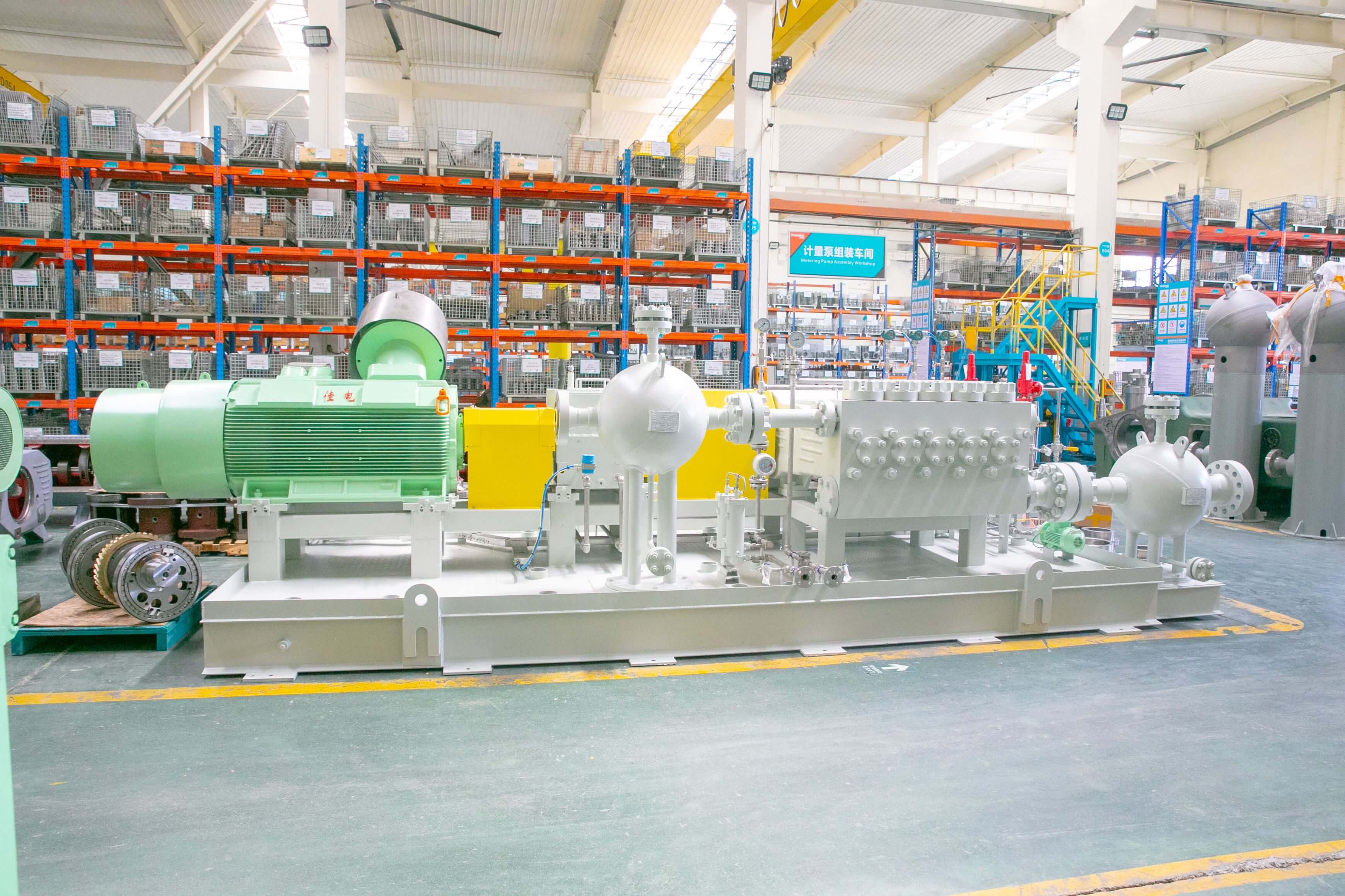
What Is a High Pressure Plunger Reciprocating Pump?
A plunger reciprocating pump moves liquid by the back-and-forth stroke of a plunger inside a cylinder. Each stroke displaces a fixed volume, so the pump is a positive displacement machine: the flow rate is determined by plunger diameter, stroke length and running speed rather than by downstream pressure. That characteristic makes it a natural choice for high pressure duty, because the pump can keep pushing until it reaches the set pressure of the system, limited only by its mechanical and hydraulic design.
In practical terms, a high pressure plunger pump behaves like a booster station inside the pipeline. It takes liquid at a low inlet pressure, raises it to a much higher discharge pressure, and delivers it to a reactor, a wellhead, an injection header, or a long-distance transfer line. In the Depamu product range, high pressure process reciprocating pumps can reach discharge pressures above 35 MPa, with stable flow and the ability to run continuously for long periods.
Compared with diaphragm metering pumps, plunger pumps generally handle higher pressures, higher temperatures and media containing solid particles more comfortably. Compared with centrifugal pumps, they maintain flow almost independently of pressure and are far better suited to high viscosity liquids. The trade-off is that the pumped medium contacts the plunger packing, so packing selection, flushing arrangements and material compatibility become central engineering decisions — which is exactly where the experience of the manufacturer shows.
Why Work With an Experienced High Pressure Plunger Reciprocating Pump Manufacturer
Buying a high pressure pump is not a catalogue transaction. The same nominal flow and pressure can be delivered by very different hydraulic end designs, valve types, packing systems and drive arrangements. A manufacturer that has already solved similar duties will usually propose a configuration that avoids the classic failure modes: cavitation at the inlet, packing wash-out from abrasive solids, thermal distortion at high temperature, or vibration from an undersized baseplate.
Depamu’s engineering team works from the actual process data — medium composition, flow rate, discharge pressure, temperature, viscosity, solids content and site conditions — and then matches the pump model, materials and accessories to that duty. The company also has the in-house capability to supply standard products, non-standard products and fully engineered fluid packages, so a project does not have to be split between several vendors.
Manufacturing Depth and Delivery Capability
Since 2003 the company has built a manufacturing base in Hangzhou covering machining, assembly, testing and packaging. Operating three brands — Depamu, Knirova and Dailupu — the company supports both OEM requirements and end-user projects. Sales have grown steadily from approximately RMB 450 million in 2023 to RMB 510 million in 2024 and RMB 560 million in 2025, which reflects repeat business from process industries rather than one-off equipment sales.
For buyers comparing a high pressure plunger reciprocating pump supplier, delivery reliability is often as important as the technical offer. A factory that controls its own machining and assembly can commit to realistic lead times and can respond quickly when a spare part is needed during commissioning.
Custom Engineering Instead of Catalogue Matching
Many high pressure duties cannot be satisfied by a standard model. A custom high pressure plunger reciprocating pump may require a modified hydraulic end, special valve materials, a different packing arrangement, a jacketed cylinder for hot media, or an integrated control and protection system. Depamu’s engineers handle these variations as a normal part of the design process, rather than as exceptions.
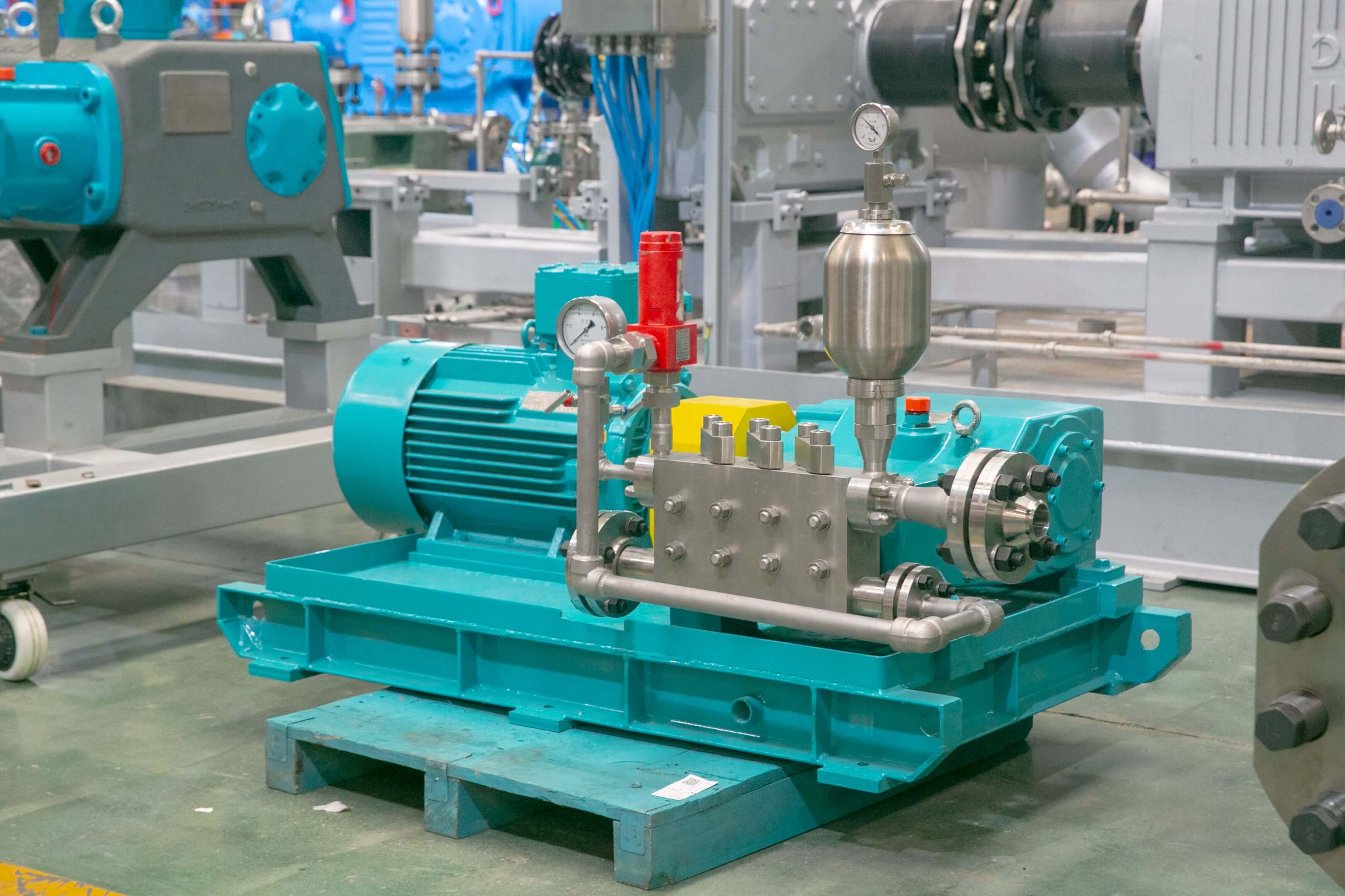
Typical Applications of High Pressure Plunger Reciprocating Pumps
Depamu’s product portfolio serves several process industries, and the sales mix gives a clear picture of where reciprocating and metering pump technology creates the most value. Petrochemical and chemical processing account for roughly 41% of business, oil and gas fields around 23%, nuclear power, electric power, metallurgy and new energy around 15%, environmental water treatment around 13%, new materials and food around 3%, and other industries the remaining 5%.
In oil and gas fields, high pressure plunger pumps are widely used for water injection and pressure maintenance, where a steady injection rate directly affects reservoir performance. In petrochemical and chemical plants, they handle process transfer, high pressure injection into reactors and pipeline boosting. In power generation, they support auxiliary high pressure services and water-steam sampling systems. In environmental water treatment, they feed chemicals and move sludge or high-solids streams.
Because the pump is positive displacement, it also performs well where a centrifugal machine would struggle: high viscosity liquids, high temperature liquids, and media with entrained solids. This makes the same basic platform useful across very different industries, provided the hydraulic end is configured correctly for each duty.
Selection Guide: Matching a Pump to Your Duty
Before requesting a quotation from any high pressure plunger reciprocating pump company, gather the data below. A manufacturer that receives complete information can usually return a precise configuration and a firm price; a manufacturer working from partial data has to make assumptions that later become change orders.
| Selection Input | Why It Matters |
|---|---|
| Medium and concentration | Determines wetted material selection, packing type and seal strategy |
| Flow rate and required accuracy | Sets plunger diameter, stroke length and running speed |
| Discharge pressure and inlet pressure | Defines hydraulic end strength, valve loading and motor rating |
| Temperature and viscosity | Affects clearances, cooling or jacketing requirements and NPSH margin |
| Solids content and particle size | Influences valve design and whether flushing is required |
| Duty cycle and environment | Determines drive selection, baseplate design and protection level |
| Control and integration needs | Confirms whether a skid, control panel or dosing system is included |
The most common specification error is sizing the pump exactly at the required duty point with no margin. Plunger pumps are typically selected with a modest flow margin so the pump can run slightly below maximum speed, which improves packing life and reduces valve impact. On the inlet side, adequate NPSH margin should be confirmed early, because a high pressure pump with a starved suction will cavitate and damage itself quickly.
Standard, Non-Standard or Complete Package
Depending on the project scope, Depamu can supply a bare pump, a pump with motor and baseplate, or a complete packaged unit combining pump, motor, piping, instrumentation and control. For chemical dosing duties, the company’s automatic chemical dosing systems integrate dosing tanks, agitators, metering pumps and automatic control into a single skid that is assembled and tested before shipment, so site work is limited to connecting piping and power.
Installation and Commissioning Considerations
Good installation protects the investment. The baseplate should be grouted flat and rigid to prevent vibration, and the suction line should be short, straight and generously sized. Pulsation dampeners on both discharge and suction reduce pressure fluctuations in the piping and improve measurement accuracy downstream. For high pressure systems, the discharge line must be rated for the maximum pressure the pump can generate, not just the normal operating pressure.
Commissioning should include a check of packing adjustment, lubrication, valve seating, relief valve setting and instrumentation wiring. Running the pump for a short period at reduced pressure allows the packing to bed in and confirms that flow and pressure behave as predicted. Recording baseline flow, pressure, vibration and motor current at start-up gives maintenance teams a reference point for future condition monitoring.
Maintenance Tips for Long Service Life
Plunger pumps reward routine attention. Packing is a wear item; gradual leakage increase is normal, and over-tightening to stop it completely usually shortens plunger life. Valve seats and balls or discs should be inspected at planned intervals, especially with abrasive or crystallising media. Lubrication levels, coupling alignment and foundation bolt tightness should be part of a monthly walk-down.
For media that crystallise or polymerise, a flush line on the packing area is often worth the small additional cost, because it prevents build-up that would otherwise score the plunger. Keeping a modest stock of packing, valves, gaskets and plungers on site avoids extended downtime, and a manufacturer that can supply spares quickly adds real value over the life of the asset.
FAQ
What pressure can a high pressure plunger reciprocating pump reach?
Depamu’s high pressure process reciprocating pumps are designed for discharge pressures above 35 MPa, depending on flow rate, medium and configuration. The exact pressure rating is confirmed during selection, because flow, plunger diameter and motor power are interdependent. Buyers should always state both the normal operating pressure and the maximum possible system pressure when requesting a quotation.
Can the pump handle high viscosity or high temperature media?
Yes. Plunger reciprocating pumps are positive displacement machines and handle viscous, high temperature and solids-containing media more comfortably than centrifugal pumps. For these duties the hydraulic end may need modified valve design, jacketing, special packing or a flushing arrangement. Providing accurate temperature, viscosity and solids data at the enquiry stage allows the manufacturer to propose the right configuration.
How do I evaluate a high pressure plunger reciprocating pump factory?
Look at engineering depth rather than brochure claims. Ask whether the factory designs the hydraulic end in-house, how it selects materials, whether assembly and testing happen on site, and whether it can supply standard, non-standard and packaged units. Ask for the recommended spare parts list and typical lead times for wear parts. A factory that answers these questions specifically is usually a safer partner than one that only quotes a price.
What is the difference between a plunger pump and a diaphragm metering pump?
Both are positive displacement pumps and both can meter accurately. A diaphragm metering pump separates the medium from the drive by a diaphragm, giving completely leak-free operation and excellent suitability for aggressive or toxic chemicals at moderate pressures. A plunger pump uses direct plunger displacement and generally reaches higher pressures and handles higher temperatures and solids better. Many plants use both technologies side by side, and Depamu manufactures both types.
Can you supply a complete pumping skid rather than just the pump?
Yes. Depamu provides complete fluid equipment packages including pumps, motors, baseplates, piping, instrumentation and control systems. Automatic chemical dosing systems are assembled and tested before delivery so that site work is limited to connecting utilities. For larger projects, custom skids can be engineered around the process requirements.
How long are typical lead times and how are spare parts handled?
Lead times depend on whether the unit is a standard model or a custom configuration, and on the materials required. Because the company controls its own machining and assembly, delivery schedules are set against actual production capacity. Spare parts such as packing, valves, gaskets and plungers are supplied against the pump’s configuration record, which is why keeping the original selection data is important.
Summary
Choosing a high pressure plunger reciprocating pump manufacturer is a decision about long-term process reliability, not just capital cost. The right partner understands the duty, sizes the pump with sensible margins, selects materials that suit the medium, and supports the installation through commissioning and beyond. Depamu (Hangzhou) Pump Industry Technology Co., Ltd. brings more than two decades of experience in volumetric pump design and manufacturing, a 35,000 m² production base, a workforce of over 400 people and a product range that covers high pressure reciprocating pumps, metering pumps, chemical dosing systems and complete fluid packages.
Whether the requirement is oilfield water injection, petrochemical process transfer, pipeline boosting or a custom high pressure package, the most efficient path is to share the process data early and let the manufacturer engineer the configuration around it. A pump built for the actual duty will always outperform a pump adapted to it after the fact.