
Selecting the right high pressure process diaphragm pump manufacturer is one of the most consequential decisions in process plant design. A diaphragm pump sits at the heart of chemical dosing, high-pressure injection, and complex media transfer, and a poorly specified unit can cause dosing inaccuracies, diaphragm fatigue, unplanned downtime, and even safety incidents. For buyers in petrochemical, oil and gas, power generation, nuclear, new energy, and water treatment industries, the difference between an average supplier and a genuinely capable high pressure diaphragm pump supplier shows up years after commissioning.
This guide explains what high-pressure process diaphragm pumps actually do, what separates a strong manufacturer from a trading intermediary, how to compare configurations, and how to prepare a specification that gets you an accurate high pressure diaphragm pump quotation the first time. It draws on the engineering practice of Depamu (Hangzhou) Pump Industry Technology Co., Ltd., a manufacturer that has focused on high-end positive displacement pumps and fluid equipment since 2003.
What Is a High-Pressure Process Diaphragm Pump and Where Is It Used?
A high-pressure process diaphragm pump is a positive displacement pump in which a flexible diaphragm separates the pumped medium from the hydraulic or mechanical drive. Because the medium never contacts the plunger or the hydraulic oil, the pump delivers two things process engineers care about most: zero leakage to atmosphere and high metering accuracy. In hydraulic diaphragm metering pumps, a hydraulic system actuates the diaphragm, and the flow rate is adjusted by changing stroke length and running frequency, allowing precise control of injected volume.
These characteristics make diaphragm pumps the default choice for aggressive, toxic, volatile, expensive, or environmentally sensitive fluids. Typical duties include chemical additive injection in refineries, inhibitor and scale-control dosing in oil and gas fields, pH adjustment and disinfection in water treatment, reagent dosing in new energy material production, and high-pressure transfer of viscous or particle-laden slurries in chemical processing.
Where a process also requires very high discharge pressure — often above 35 MPa — a high pressure process reciprocating pump with a plunger design is frequently used instead of, or alongside, a diaphragm pump. Capable manufacturers offer both technologies, because the correct answer depends on pressure, flow, medium abrasiveness, and whether absolute containment is required.
Why the Manufacturer Behind the Pump Matters More Than the Datasheet
Most diaphragm pump datasheets look similar on paper: flow range, discharge pressure, stroke rate, wetted materials. What they cannot show is the manufacturing discipline behind the numbers — diaphragm life under continuous duty, repeatability after thousands of stroke cycles, hydraulic end design, valve seat tolerances, and the quality of the test bench used before shipment. These are determined by the factory, not the catalogue.
A capable high pressure process diaphragm pump manufacturer should control the full chain: research and development, design, machining, assembly, pressure testing, and packaged system integration. When a supplier outsources machining or assembles from purchased kits, customization becomes slow and consistency becomes unpredictable.
Buyers should also consider the supplier’s ability to deliver complete fluid solutions rather than isolated hardware. A dosing skid, for example, needs a metering pump, a dissolution tank, an agitator, piping, instrumentation, and a control system that work together. Choosing a custom high pressure diaphragm pump factory with in-house skid integration capability removes the coordination risk that otherwise falls on the plant’s engineering team.
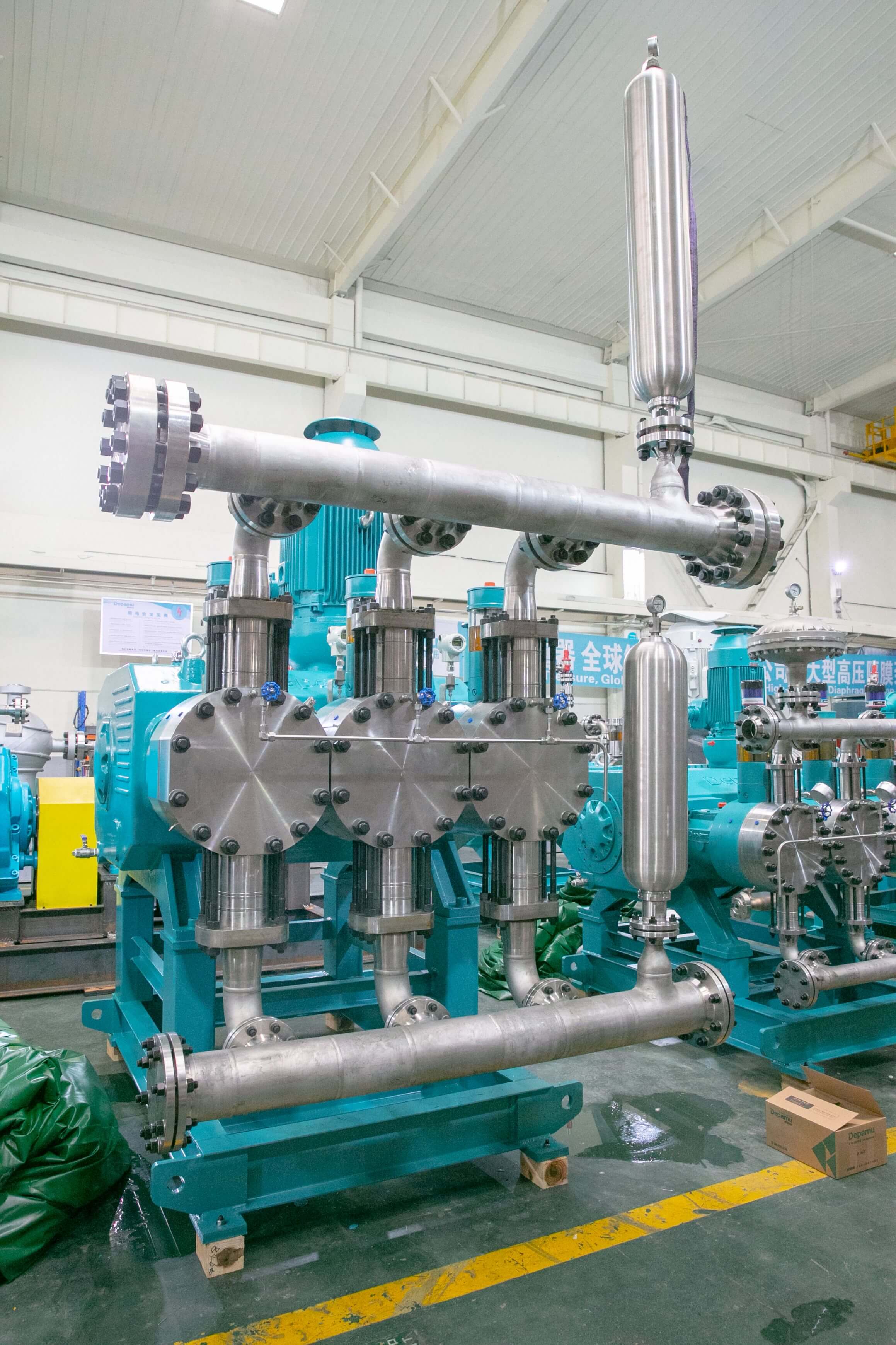
Inside the Manufacturing Capability of a Qualified Supplier
Depamu was founded in 2003 and has spent more than two decades concentrating on high-end positive displacement pumps. The company employs more than 400 people and operates a factory area of approximately 35,000 square meters, with registered capital of RMB 54 million and annual output value of roughly RMB 500 million. Sales have grown steadily — approximately RMB 450 million in 2023, RMB 510 million in 2024, and RMB 560 million in 2025 — which is a useful signal of production stability and repeat business rather than one-off project sales.
The company operates three brands — Depamu, Kenirova, and Dailupu — and introduced German engineering technology that has been continuously developed and localized over the years. Its portfolio covers metering pumps, high-pressure process reciprocating pumps, pneumatic and electric pumps, automatic chemical dosing systems, water and steam sampling devices, water treatment equipment, screw pumps, rotary lobe pumps, and gear pumps.
Just as importantly, the company delivers standard products, non-standard products, and fully customized fluid packages based on a customer’s medium characteristics, flow rate, pressure, temperature, and site process requirements. That combination — broad catalogue plus genuine customization — is what separates a high pressure process diaphragm pump manufacturer from a catalogue reseller.
Core Product Lines and What Each One Is Best At
1. Hydraulic Diaphragm Metering Pumps for Precision Dosing
The hydraulic diaphragm metering pump functions as a precision dosing device for industrial processes: it injects a chemical agent into a production system at a defined, stable rate. Stroke length and running frequency are adjusted to achieve high metering accuracy, and the hydraulic diaphragm structure eliminates leakage entirely. This makes the design suitable for strongly corrosive, volatile, and high-pressure media, and it is widely used in petrochemical, water treatment, pharmaceutical, food, and new energy applications where accurate reagent dosing is critical.
2. High-Pressure Process Reciprocating Pumps for Demanding Duty
The reciprocating plunger pump works like a pressure booster station on a process line, moving liquid from a low-pressure source to a high-pressure destination or along long-distance pipelines. Discharge pressure can exceed 35 MPa, flow is stable, and the unit is built for continuous operation. It handles high-viscosity, high-temperature, and solids-containing media, and is typically deployed for oil and gas field water injection, petrochemical process transfer, pipeline boosting, and high-pressure injection duty.
3. Fully Automatic Chemical Dosing Packages
The automatic chemical dosing system integrates chemical storage, dissolution, agitation, metered injection, and automatic control into a single skid — effectively a self-contained dosing station. Built around a metering pump and supplied with a dissolution tank, agitator, and intelligent control system, it supports dry powder or liquid dosing, multi-point injection, and automatic interlocking control. Each unit is assembled and tested before delivery, so on-site work is limited to piping and power connection. Typical applications include boiler water treatment, circulating water treatment, wastewater treatment, and petrochemical processes.
| Product Line | Working Principle | Typical Duty | Best Suited To |
|---|---|---|---|
| Hydraulic diaphragm metering pump | Hydraulically driven diaphragm, stroke and frequency adjustable | Precise chemical injection | Corrosive, volatile, toxic, high-pressure media requiring zero leakage |
| High-pressure process reciprocating pump | Plunger reciprocation, pressure up to 35 MPa and above | High-pressure transfer and injection | High viscosity, high temperature, solids-laden media, continuous duty |
| Automatic chemical dosing system | Skid-mounted integration with metering pump and control system | Automated preparation and dosing | Boiler water, circulating water, wastewater, petrochemical dosing points |
| Screw, rotary lobe, gear, pneumatic and electric pumps | Rotary or alternative positive displacement principles | Transfer of viscous or shear-sensitive media | Food, new materials, general chemical transfer |
Industry Applications: Where These Pumps Are Deployed
Actual deployment data is often more informative than marketing language. Within this manufacturer’s order book, petroleum refining and chemical processing account for roughly 41% of sales, oil and gas fields around 23%, nuclear power, power generation, metallurgy, and new energy approximately 15%, environmental water treatment about 13%, and new materials and food around 3%, with other industries making up the remainder.
That distribution reflects the real technical demands of each sector. Refineries and chemical plants need accurate, leak-free reagent injection into reactors and process streams, plus reliable transfer of aggressive intermediates. Oil and gas fields require high-pressure water injection and chemical injection for enhanced recovery, where continuous duty and pressure stability are non-negotiable. Power plants and nuclear facilities demand high reliability and precise control for water and steam sampling and boiler water conditioning. Water treatment plants need stable, automatically controlled dosing of coagulants, disinfectants, and pH adjusters.
Because the same pump platform serves all of these duty profiles, buyers benefit from a supplier whose engineering team has already solved similar problems across industries — a practical advantage when specifying a diaphragm pump for petrochemical industry service or a high-pressure unit for remote oilfield locations.
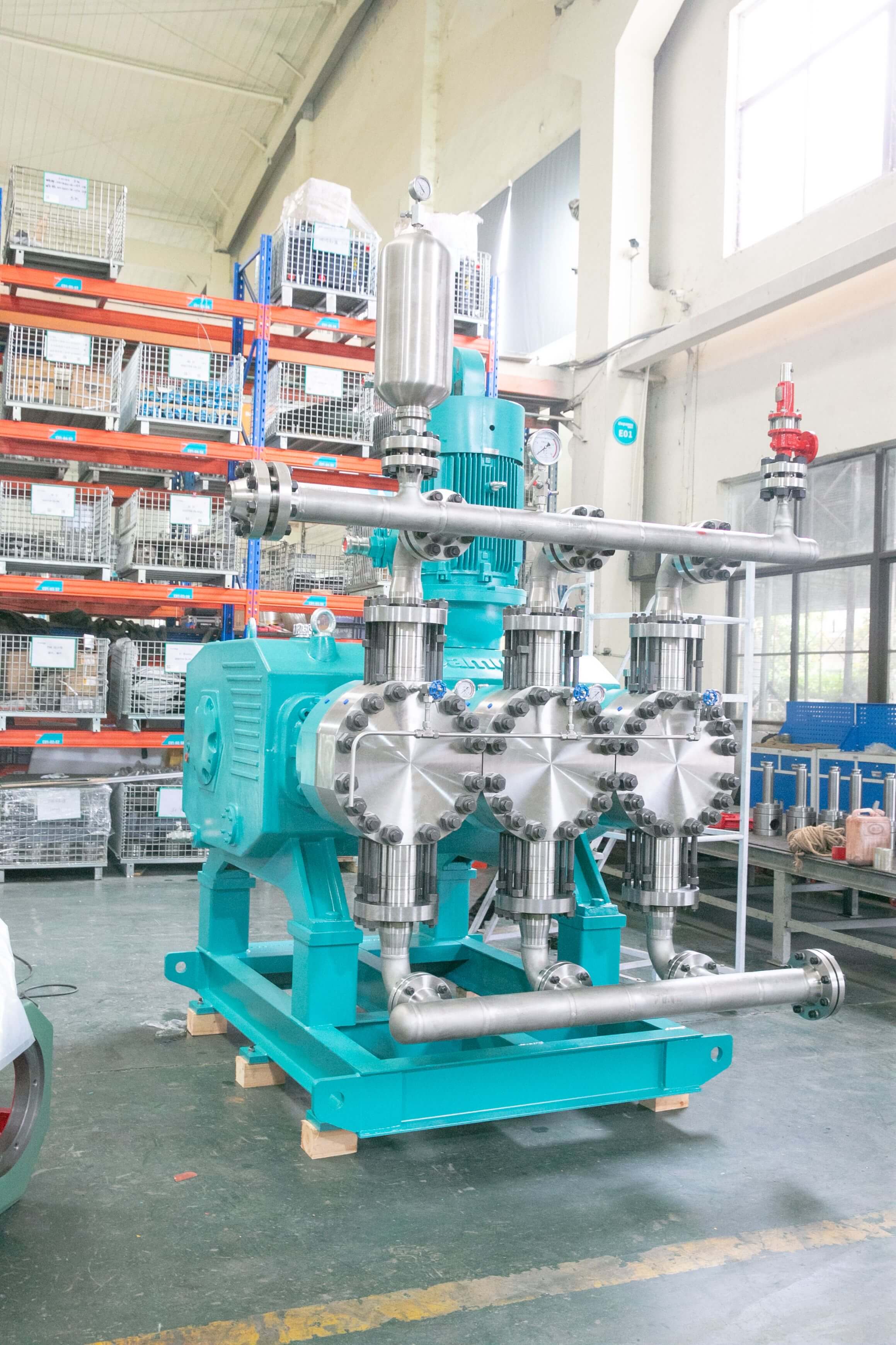
How to Specify a Custom High-Pressure Diaphragm Pump Correctly
Customization is where most purchasing delays originate. When a buyer sends a vague request to a custom high pressure diaphragm pump factory, the reply is usually a generic datasheet, followed by weeks of clarification. Providing complete process data up front accelerates the quotation and reduces the risk of a mismatch after delivery.
At minimum, a specification should define the medium and its concentration, operating temperature, viscosity, solids content, required flow rate and turndown ratio, suction and discharge pressure, available NPSH, continuous or intermittent duty, materials of construction for wetted parts, diaphragm and valve material, motor and electrical standard, control signal type, and the applicable area classification and certification requirements for the destination site.
| Parameter | Why the Manufacturer Needs It |
|---|---|
| Medium, concentration, and impurity content | Determines wetted materials, diaphragm elastomer, and valve type |
| Flow rate and turndown range | Sets pump size, stroke rate, and whether frequency control is required |
| Discharge pressure and pipeline layout | Defines hydraulic end design, motor power, and relief valve setting |
| Temperature and viscosity | Affects clearance, heating needs, and suction conditions |
| Duty cycle and site environment | Influences cooling, enclosure rating, and area classification |
| Control and integration requirements | Determines instrumentation, PLC scope, and skid automation level |
Evaluating a High-Pressure Diaphragm Pump Supplier: A Practical Checklist
Price comparisons are meaningless unless the technical scope is identical. When shortlisting a high pressure process diaphragm pump supplier, compare suppliers against the same checklist so the commercial comparison is fair.
- Manufacturing depth: Does the factory perform its own machining, assembly, and pressure testing, or assemble from purchased components?
- Product breadth: Can the supplier offer both diaphragm metering pumps and high-pressure reciprocating pumps, so the recommendation is driven by duty rather than by what is in stock?
- Customization evidence: Are non-standard materials, custom flows, and packaged skids genuinely available, or limited to catalogue variants?
- Testing documentation: Are performance and pressure test records supplied with each unit, including accuracy verification at rated conditions?
- Industry track record: Has the supplier delivered into comparable sectors — refining and chemical, oil and gas, power, nuclear, water treatment?
- After-sales structure: Are spare diaphragms, valve assemblies, and hydraulic parts available with predictable lead times?
- Delivery and documentation: Can the supplier provide drawings, O&M manuals, material certificates, and export packaging suitable for overseas shipment?
Installation, Commissioning, and Maintenance Best Practices
Correct installation extends diaphragm life significantly. Mount the pump on a rigid base, keep suction lines short and generously sized, and avoid unnecessary elbows that create trapped air. Install a pulsation dampener on the discharge side where flow stability matters, and always protect the pump with a relief valve set below the system’s design pressure.
During commissioning, verify that the suction line is fully primed, check stroke adjustment against the required dose rate, and confirm that the hydraulic oil level is correct. For skid-mounted dosing systems, complete the factory-tested interconnection checks and confirm that control signals from the plant DCS or PLC are recognized before introducing chemical.
Routine maintenance is straightforward but should not be skipped: inspect diaphragms and check valves on a schedule matched to duty severity, monitor hydraulic oil condition, verify dosing accuracy with a calibration cylinder periodically, and keep spare diaphragms in stock. In aggressive media service, diaphragm inspection intervals should be shortened during the first months of operation to establish a realistic replacement cycle.
FAQ
What media can a high-pressure process diaphragm pump handle?
Hydraulic diaphragm metering pumps are designed for corrosive, volatile, toxic, and high-pressure media because the diaphragm isolates the medium from the drive and hydraulic oil, achieving zero leakage. Material selection for the diaphragm, valve seats, and wetted parts is matched to the specific medium, concentration, and temperature, so always provide full fluid data when requesting a quotation.
When should I choose a diaphragm metering pump instead of a high-pressure reciprocating plunger pump?
Choose a diaphragm metering pump when accurate dosing and absolute containment of the medium are the priorities, particularly for aggressive or hazardous chemicals. Choose a plunger-type high-pressure process reciprocating pump when very high discharge pressure, continuous duty, or media with high viscosity, high temperature, or solid particles must be moved. Many plants use both technologies on the same site for different duties.
Can the manufacturer supply a complete automatic chemical dosing system rather than just a pump?
Yes. A fully automatic chemical dosing system integrates chemical storage, dissolution, agitation, metered injection, and automatic control on a single skid, with the metering pump as the core component. Units are assembled and tested before shipment, so on-site work is limited to connecting piping and power, which shortens commissioning time and reduces installation errors.
What information is needed to obtain an accurate quotation?
Provide the medium and its concentration, flow rate and required turndown, suction and discharge pressure, temperature, viscosity, solids content, duty cycle, required materials, control signal type, electrical standard, and the certification requirements of the destination site. With complete data, the supplier can recommend a configuration and issue a firm technical-commercial quotation without repeated clarification rounds.
How long can these pumps run continuously, and what affects service life?
High-pressure process reciprocating pumps are built for long uninterrupted operation, and diaphragm metering pumps are suitable for continuous dosing duty. Actual service life depends on medium aggressiveness, temperature, suction conditions, cleanliness of the hydraulic oil, and adherence to the maintenance schedule. Avoiding dry running and cavitation has the largest single effect on diaphragm and valve life.
Do you support non-standard and fully customized designs?
Yes. The manufacturer supplies standard products, non-standard products, and customized fluid packages engineered around the customer’s medium characteristics, flow, pressure, temperature, and site process requirements. Customization covers materials, flow and pressure ranges, control philosophy, skid layout, and integration with existing plant systems.
Summary
Choosing a high pressure process diaphragm pump manufacturer is a technical decision, not a purely commercial one. The right partner combines in-house design and machining, a portfolio broad enough to cover both diaphragm metering and high-pressure reciprocating technologies, proven experience across refining, oil and gas, power, nuclear, new energy, and water treatment, and the ability to deliver fully assembled, factory-tested dosing skids. Depamu, active in high-end positive displacement pumps since 2003 with a 35,000 square meter facility and more than 400 employees, is structured around exactly that model — standard products, non-standard products, and customized fluid solutions built from real process data.
To move forward efficiently, prepare a complete specification covering medium, flow, pressure, temperature, duty, materials, and control requirements, then compare shortlisted suppliers against the same technical checklist. A well-specified, well-sourced diaphragm pump will deliver accurate dosing and reliable high-pressure transfer for many years, while a poorly specified one will keep demanding attention. Investing time in the specification stage is the most reliable way to reduce total cost of ownership.