
A chemical injection skid source manufacturer designs, builds and tests the complete dosing package, including pump, tank, piping and controls, before it ships. Sourcing directly from the builder shortens the communication chain, keeps component choices consistent, and makes it easier to match the skid to your medium, flow and pressure requirements.
What a Chemical Injection Skid Source Manufacturer Supplies
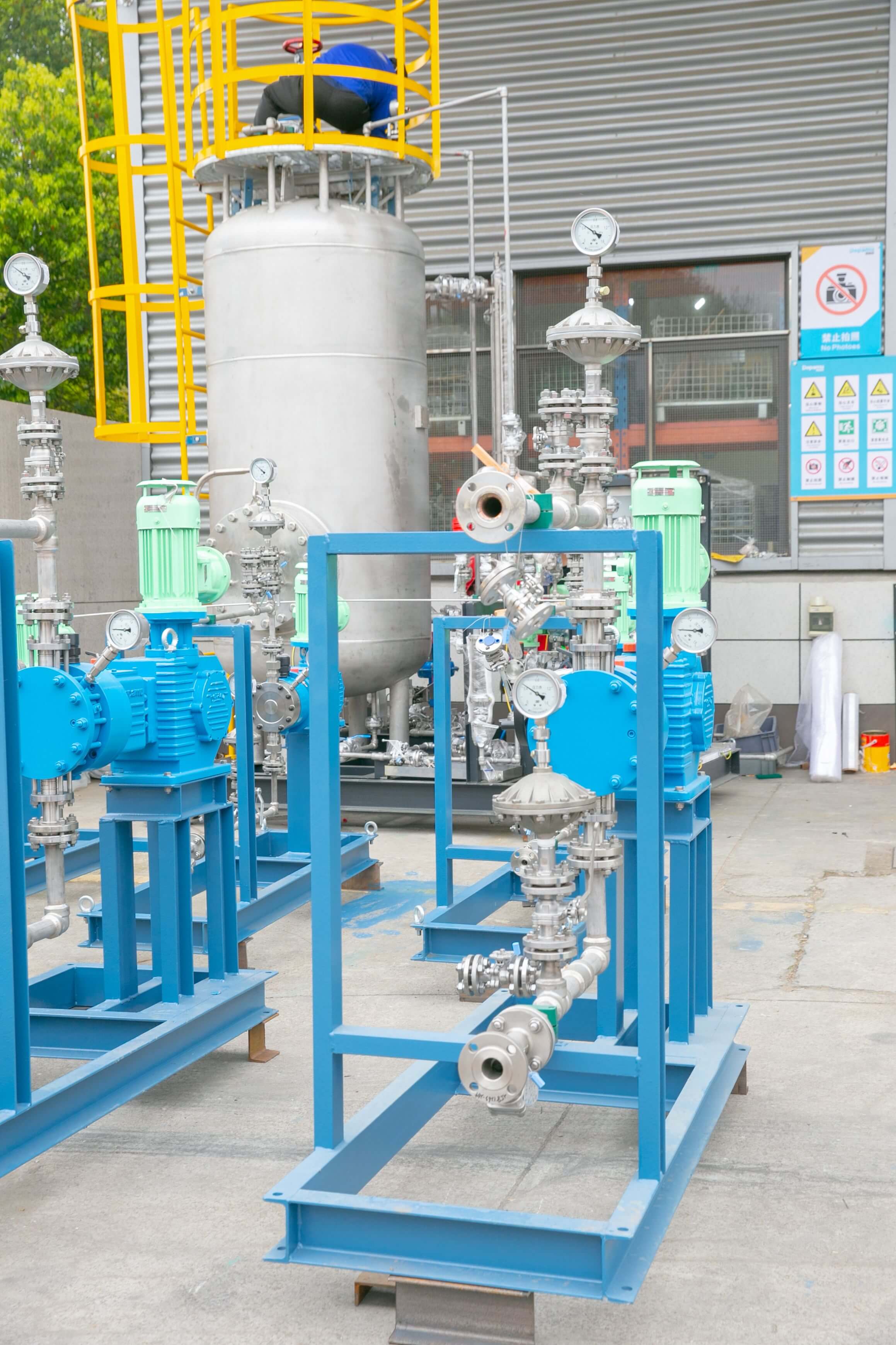
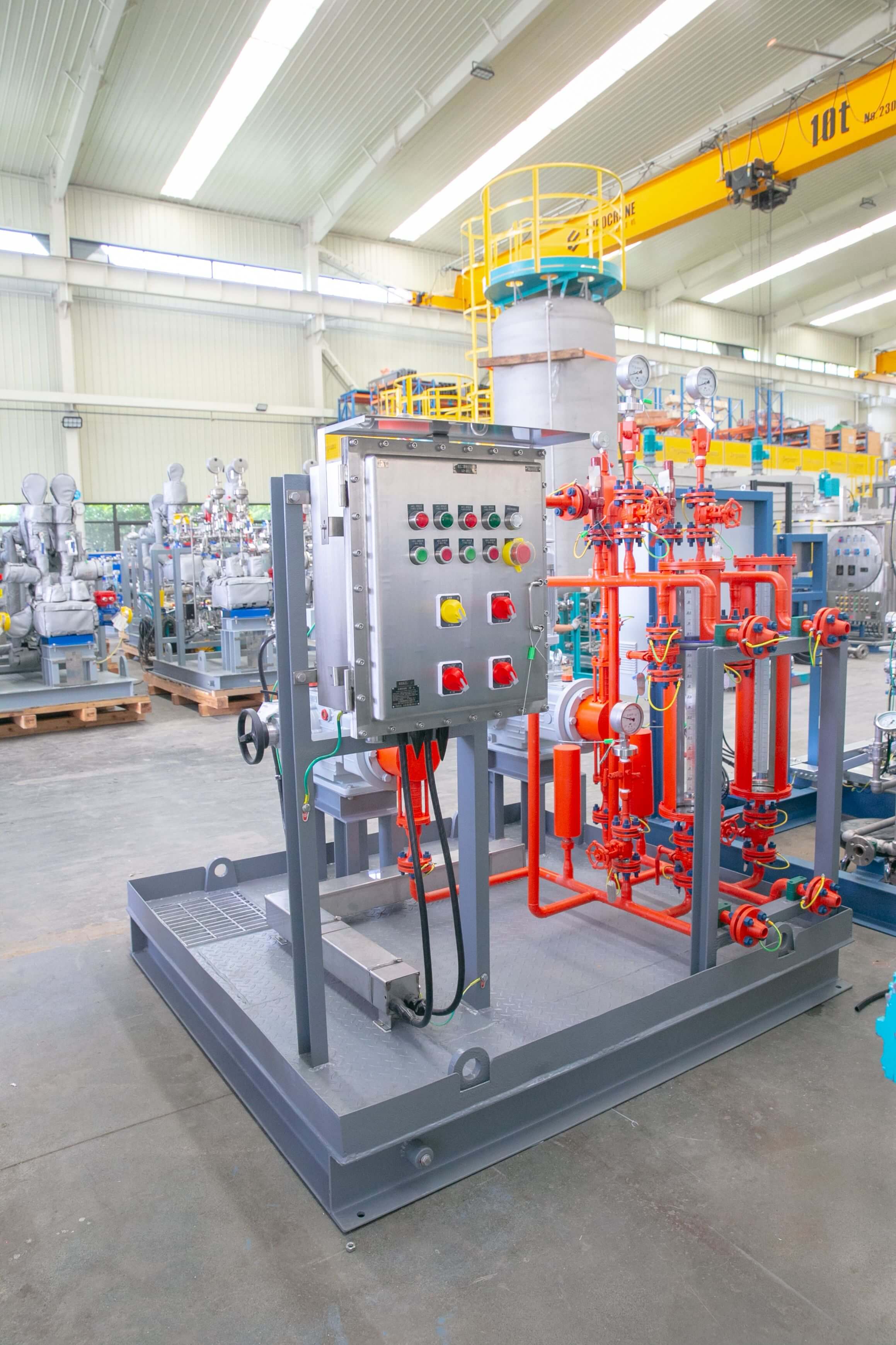
A source manufacturer supplies the injection skid as a single integrated unit: a metering pump as the core, a dissolving tank, an agitator, connecting piping and a control system, all mounted on one frame. The package is assembled and tested at the factory, so on site it only needs piping and power connections before commissioning begins.
The practical difference between buying a skid and buying parts is who owns the interface. When one source manufacturer designs the frame, the piping runs, the tank arrangement and the control logic together, the dosing pump is selected against the actual duty rather than adapted to a frame that already exists. That reduces the number of parties who can point at each other when a dose drifts or a diaphragm wears early.
Because the unit arrives as a tested package, site work is limited to placing the skid, connecting process piping, wiring power and signal cables, and commissioning the control loop. For revamps and skid-mounted projects where floor space is tight, that shorter site sequence is often as valuable as the equipment itself.
Core Components Integrated Into a Skid-Mounted Dosing System
Most skid-mounted dosing systems follow the same architecture, with the metering pump as the heart of the package and the surrounding equipment sized to support it.
- A metering pump that sets the dose by stroke length and running frequency
- A dissolving tank that holds the prepared chemical solution
- An agitator that keeps the solution uniform before dosing
- Piping, valves and fittings that route the chemical to the injection point
- A control system that links the pump to level, flow or process signals
How to Evaluate a Chemical Injection Skid Source Manufacturer
Evaluate a source manufacturer on four things: how well it reads your process data, what it builds in house, how it tests before shipment, and how it supports the unit after commissioning. Price matters, but a skid that fits the duty and can be maintained locally costs less over its service life.
Engineering fit comes first. A manufacturer that asks for medium characteristics, flow, pressure and temperature before quoting is doing the work that determines whether the pump can hold a stable dose. If a quotation arrives with a pump model and a price but no questions about the chemical being handled, the specification is probably being guessed rather than calculated.
Build scope is the second checkpoint. Ask which parts of the skid come from the manufacturer’s own production and which are bought in. A manufacturer with its own pump production and packaged equipment capability can hold tolerances across the whole assembly, while a trading intermediary can only pass requirements down a chain of suppliers.
Testing and support are the third and fourth checkpoints. Factory assembly and pre-delivery testing are what turn a parts list into a working system, and a clear answer on commissioning, spare parts and response time tells you how the unit will be looked after in year five rather than week one.
Process Data the Manufacturer Needs From You
Accurate input data is what separates a skid that works from one that needs rework after installation. Prepare these details before the first technical conversation.
- Medium characteristics, including corrosiveness, volatility and solids content
- Required flow rate and the dosing range you expect to operate in
- Discharge pressure at the injection point
- Operating temperature of the chemical and of the process line
- Site process requirements, including control signals and available space
Questions Worth Asking Before You Order
Comparable quotations often hide different scopes. These questions bring the differences into the open.
- Which pump model is proposed, and why does its wetted material suit this medium?
- Which components are made in house and which are sourced from third parties?
- How is the assembled skid tested before delivery?
- What documentation, spare parts and wear items are included?
- Who handles commissioning and after-sales support, and through which channel?
Manufacturing Capability Behind the Skid
A skid is only as reliable as the factory that builds it. Engineering depth, production area and a broad pump portfolio decide whether the dosing pump is matched to the duty, and whether the unit leaves the plant as a complete, tested package rather than a collection of bought-in parts.
DEPAMU (Hangzhou) Pump Technology Co., Ltd. was founded in 2003 and has more than 400 employees working across a plant of roughly 35,000 square meters, with registered capital of 54 million RMB and an annual output value of about 500 million RMB. The company concentrates on high-end volumetric pumps and fluid equipment, from research and design through manufacturing to packaged delivery.
Its product range covers metering pumps, high-pressure reciprocating process pumps, pneumatic pumps, electric pumps, chemical dosing devices, water and steam sampling devices and water treatment equipment, together with screw pumps, rotary lobe pumps and gear pumps. That breadth matters when a skid needs a pump matched to a difficult medium rather than the other way round.
Sales are spread across several industries: petrochemical and chemical processing account for roughly 41 percent of business, oil and gas fields around 23 percent, nuclear power, power generation, metallurgy and new energy about 15 percent, environmental water treatment about 13 percent, new materials and food around 3 percent, and other sectors the remaining 5 percent. Reported sales were approximately 450 million RMB in 2023, 510 million RMB in 2024 and 560 million RMB in 2025.
Standard, Non-Standard and Made-to-Order Skid Options
A supplier usually offers three routes: a standard skid built from proven configurations, a non-standard unit adapted to an existing interface, and a fully made-to-order system designed around the medium, flow, pressure and site conditions. The right route depends on how far your duty departs from a repeatable, well-understood application.
A standard configuration is the fastest and most predictable route when the chemical and the process are already familiar. A non-standard unit keeps a proven platform but changes connections, materials or controls so the skid fits equipment that is already installed. A made-to-order system starts from the process data and works outward, which is the sensible choice for complex media, tight footprints or multi-point dosing.
| Supply route | What it involves | Where it fits |
|---|---|---|
| Standard product | A proven configuration built to a fixed specification | Repeatable duties where the medium and the process are well understood |
| Non-standard product | A standard platform adapted in connections, materials or controls | Retrofits and interfaces that must match equipment already on site |
| Customized solution | A system designed around medium, flow, pressure, temperature and site requirements | Complex media, constrained footprints and multi-point dosing |
Where Skid-Mounted Dosing Systems Are Used
Skid-mounted dosing systems are specified wherever a liquid chemical must be added at a controlled rate. Boiler water treatment, circulating water treatment, wastewater treatment and petrochemical processing are among the most common duties, and the same package architecture scales from a single injection point to several dosing lines.
In water treatment duties, the metering pump holds a steady dose against a changing process load, while the control system follows level and flow signals. In petrochemical and chemical processing, the same package handles chemical agents that are corrosive, volatile or delivered at elevated pressure, which is why the pump’s wetted materials and diaphragm arrangement carry most of the technical risk.
Higher-pressure duties are handled differently. A reciprocating process pump drives the liquid through a plunger stroke, reaching pressures of up to 35 MPa and above, with a stable flow that supports long continuous runs. These units are used for oil and gas field water injection, process transport in petrochemical plants, pipeline boosting and high-pressure injection, and they are built to cope with viscous, hot or solids-bearing media.
For multi-point dosing, the skid approach keeps the dissolving, agitation, metering and control functions in one footprint, so a single package can feed several injection points with automatic coordination between them.
FAQ
What does a chemical injection skid source manufacturer deliver?
It delivers a complete, factory-tested dosing package rather than loose components. The skid normally includes a metering pump as the core, a dissolving tank, an agitator, connecting piping and a control system, all mounted on one frame. Because assembly and testing happen before shipment, site work is limited to piping, wiring and commissioning.
How do I choose a chemical injection skid source manufacturer?
Choose on engineering fit first and price second. Confirm that the manufacturer asks for medium characteristics, flow, pressure and temperature, that it controls the production of the main components, that it tests the assembled skid before delivery, and that it can support the unit after commissioning.
Can a skid be built to order for a specific dosing duty?
Yes. A made-to-order skid is designed around the medium, flow, pressure, temperature and site process requirements instead of being adapted from a fixed catalogue item. This route suits complex media, tight installation space and multi-point dosing, where a standard configuration would need extensive modification.
Which pumps are used inside a chemical injection skid?
Metering pumps are the usual choice, with hydraulic diaphragm designs preferred for corrosive, volatile or high-pressure media because the diaphragm keeps the chemical away from the drive. Where the duty calls for higher pressure, a reciprocating process pump can handle injection, boosting and transfer.
How is a skid tested before delivery?
Assembly and testing are completed at the factory before shipment, so the pump, piping and controls are proven together as a package. After delivery the skid only needs process piping and power connections on site before commissioning, which keeps installation time short.
Which applications use skid-mounted dosing systems?
Boiler water treatment, circulating water treatment, wastewater treatment and petrochemical processing are common applications. The same architecture also serves duties where chemicals must be injected at a controlled rate into process lines, while high-pressure reciprocating pumps cover oil and gas field injection and pipeline boosting.
Summary
A chemical injection skid source manufacturer should be judged on engineering fit, build scope, factory testing and post-delivery support, not on unit price alone. Prepare your medium, flow, pressure, temperature and site data before the first technical discussion, ask which components are built in house, and confirm how the assembled skid is tested. Then choose between a standard, non-standard or made-to-order route based on how far your duty departs from a repeatable application.