
A hydraulic diaphragm metering pump manufacturer combines pump design, machining, assembly and testing so that a dosing system can hold a set flow against changing line pressure. Diaphragm isolation keeps the process medium away from the hydraulic circuit, which is why this pump type suits corrosive, volatile and high-pressure dosing duty.
What a Hydraulic Diaphragm Metering Pump Manufacturer Does
A hydraulic diaphragm metering pump manufacturer designs, machines, assembles and tests dosing pumps, then supports them through delivery and operation. The starting point is the duty itself: medium corrosivity, volatility, viscosity and temperature, together with the required flow, pressure and site process conditions.
In this pump type a hydraulic circuit drives a diaphragm, and the diaphragm in turn displaces the process liquid. Dosing accuracy comes from controlling two variables — how far the diaphragm travels on each stroke and how often it strokes — so an operator can trim the injected volume without changing the piping or the reagent. Because the diaphragm sits between the hydraulic fluid and the medium, aggressive, volatile or high-pressure liquids are handled on the process side of the pump head.
Diaphragm Isolation and Dosing Control
The separation between hydraulic fluid and process medium defines the working envelope of the pump. It also sets the maintenance agenda: the diaphragm is the wear part that determines how long the pump holds its calibration, while the hydraulic circuit is what transmits force to it.
- Stroke length adjustment sets the volume displaced per stroke.
- Operating frequency sets how many strokes occur over a given period.
- The hydraulic circuit transmits drive force to the diaphragm.
- The diaphragm separates the dosing medium from the hydraulic fluid.
Inside the Manufacturing Base
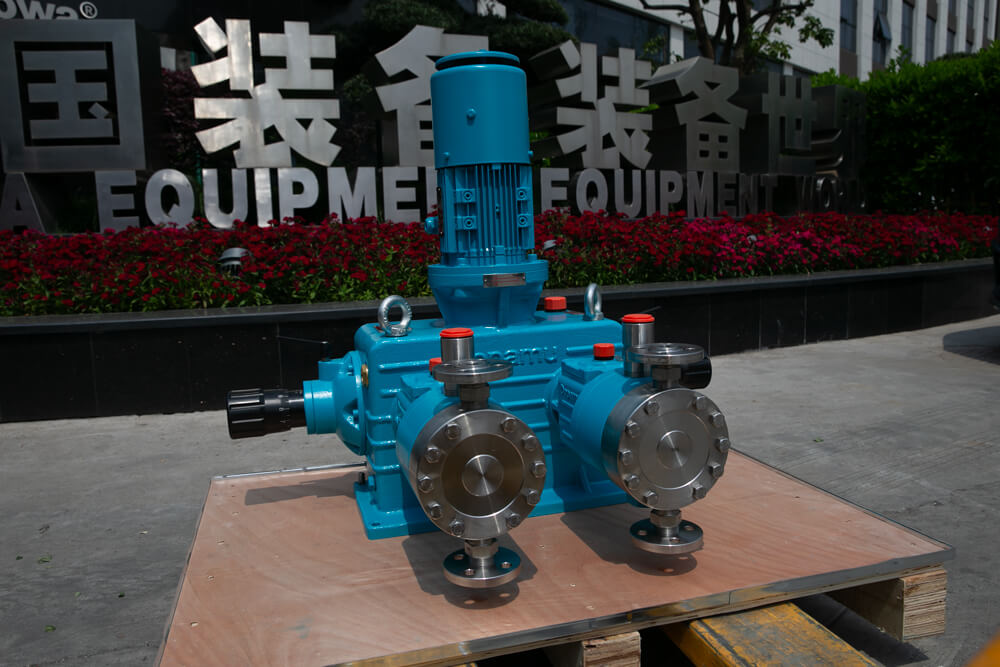
Manufacturing depth decides what a manufacturer can commit to on delivery, documentation and after-sales support. Depamu (Hangzhou) Pump Industry Technology Co., Ltd. was founded in 2003 and employs more than 400 people across a plant of about 35,000 square meters, with registered capital of RMB 54 million and annual output value of about RMB 500 million.
The company works across the full chain, from product research and design through manufacturing to complete-set delivery, and it operates three brands. Technology introduced from Germany has been developed further in-house. Sales have grown from about RMB 450 million in 2023 to about RMB 510 million in 2024 and about RMB 560 million in 2025.
That combination — engineering staff, floor space and a long production record — is what allows a single source to move between repeat standard builds and one-off configurations without handing the dosing duty to a third party for assembly or testing.
The Product Range Built Around Metering Pumps
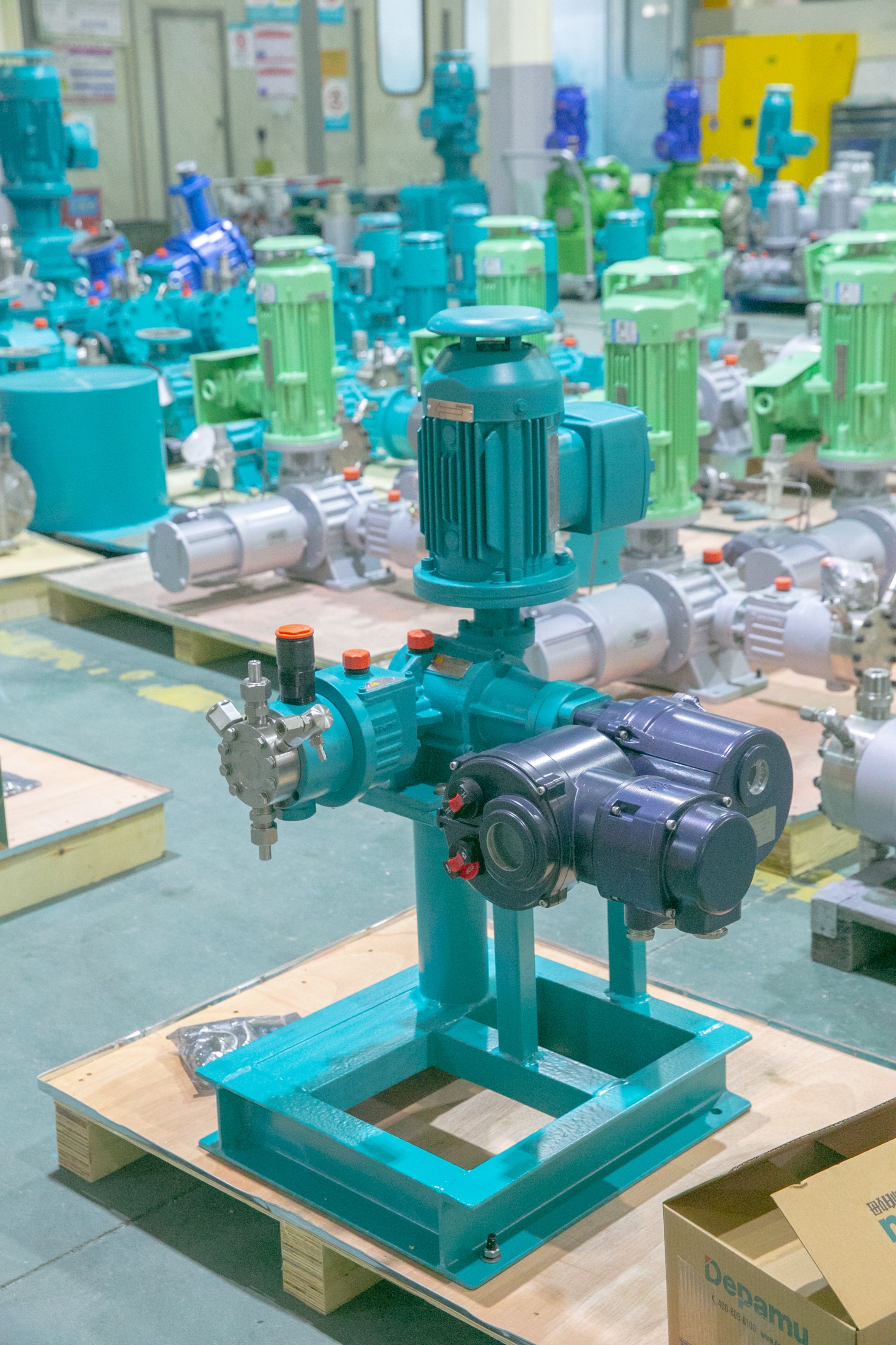
Metering pumps are the core of the range, and the hydraulic diaphragm type is the representative product. Around it sit the pumps and packages that turn a dosing requirement into a working system: high-pressure process pumps, transfer pumps and complete dosing skids supplied as one engineered set.
High-pressure process reciprocating pumps use a plunger to push liquid from a low-pressure side towards a high-pressure header or a distant pipeline, with pressure capability reaching 35 MPa and above, stable flow and the ability to run continuously. They are built for viscous, hot and particle-laden media and for duties such as oilfield water injection, process transport, pipeline boosting and high-pressure injection.
Automatic chemical dosing systems package storage, dissolving, mixing, metering and automatic control onto one skid. With a metering pump at the centre, plus a dissolving tank, an agitator and a control system, the skid prepares reagent and doses it, supports powder or liquid feed, multi-point injection and interlocked control, is assembled and tested before shipment, and needs only piping and power connections on site. Typical use covers boiler water treatment, circulating water treatment, wastewater treatment and petrochemical service.
The wider portfolio covers pneumatic pumps, electric pumps, water treatment equipment, water-steam sampling devices, screw pumps, rotary lobe pumps, gear pumps, emulsifying pumps, special centrifugal pumps and supercritical extraction devices, so a process line can be equipped from a single engineering source.
Applications and the Industry Mix
Applications follow the medium: wherever a process needs precise reagent injection, high-pressure transfer or handling of difficult fluids, a diaphragm metering pump is a routine choice. Petroleum refining and chemical processing account for about 41% of sales, and oil and gas fields for about 23%.
The remaining balance is spread across nuclear, power, metallurgy and new energy at about 15%, environmental water treatment at about 13%, new materials and food at about 3%, and other industries at about 5%. Metering pump duty appears in petrochemical, environmental water treatment, pharmaceutical, food and new energy settings, where a defined dose has to be repeated stroke after stroke.
Standard, Non-Standard and Customized Supply
Selection starts with four inputs — medium properties, flow, pressure and temperature — plus the process layout on site. From those inputs a supplier can propose a standard unit, a non-standard configuration or a customized fluid solution, and can extend it into a complete set with the tanks, mixing and control needed around the pump.
Customization matters most where the medium is the constraint: corrosive liquids, volatile reagents, high line pressures and viscous or particle-bearing fluids each pull the design in a different direction. Because pump, skid and control system can be engineered together, the dosing point is specified as one package rather than as separate items matched later on site.
For buyers comparing offers, the practical checks are consistent. Confirm the duty data behind the quotation, confirm what is assembled and tested before shipment, confirm which documentation travels with the unit, and confirm how replacement diaphragms and service support will be handled over the working life of the pump.
FAQ
What does a hydraulic diaphragm metering pump manufacturer deliver?
It delivers a dosing pump that injects a repeatable volume against line pressure, together with the selection work, assembly, testing and support behind it. The unit is specified from the medium, flow, pressure and temperature of the duty and can be supplied as a standard pump, a non-standard build or part of a complete dosing package.
How is dosing accuracy controlled on a hydraulic diaphragm metering pump?
Accuracy is controlled by adjusting stroke length and operating frequency. Stroke length sets how much liquid each stroke displaces, and frequency sets how many strokes occur, so the two together define the injected volume without changing the piping.
Which media can this pump type handle?
It is built for corrosive, volatile and high-pressure media. The hydraulic drive and diaphragm structure keep the process liquid separated from the hydraulic circuit, so aggressive reagents stay contained on the process side of the pump head.
What should buyers check when comparing a metering pump brand?
Buyers should check the duty data behind the offer, the scope of assembly and testing completed before shipment, the documentation supplied with the unit, and the availability of diaphragms and service support. These points decide whether the pump holds its dosage over time, not just whether it starts correctly.
Can a metering pump be supplied as part of a complete dosing system?
Yes. Automatic chemical dosing systems integrate reagent storage, dissolving, mixing, metering and automatic control on one skid, with the metering pump as the core. They are assembled and tested before shipment and need only piping and power connections on site.
Summary
A hydraulic diaphragm metering pump manufacturer earns its place in a process by getting the duty data right, building the pump around the medium, and testing the assembly before it ships. Diaphragm isolation, stroke and frequency control, and the option of a complete dosing package determine whether a dosing point holds its accuracy over its service life. Start the comparison from medium, flow, pressure and temperature, then confirm assembly, testing and service support.