
How to Choose a Hydraulic Diaphragm Metering Pump Supplier
Picking a hydraulic diaphragm metering pump supplier comes down to four checks that rarely appear on the quotation sheet: whether the pump architecture fits your discharge pressure and turndown, whether the diaphragm and wetted materials suit the medium, whether the supplier can hand over drawings and test records you can audit, and whether it can deliver the parts around the pump — safety valve, pulsation dampener, control interface and skid assembly. In chemical dosing, water treatment and oil and gas service, most metering problems trace back to one of those four being skipped during procurement, not to a pump that failed on its own.
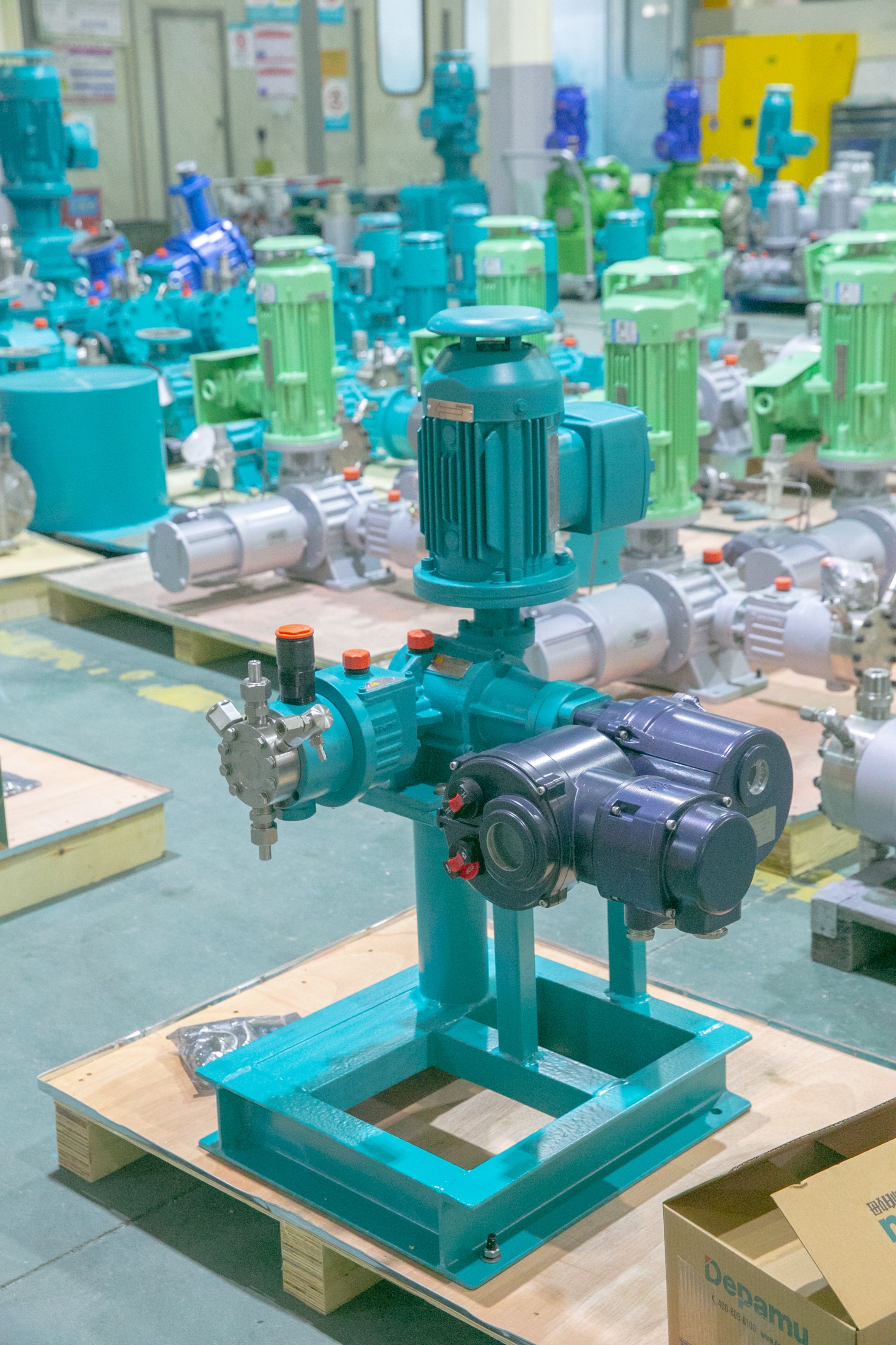
Dosing duty decides the architecture long before the catalogue does. A hydraulic diaphragm metering pump drives a plunger inside an oil-filled hydraulic chamber and passes that movement on to a PTFE or composite diaphragm, so the process liquid stays in a sealed cavity and never touches a packed rod. For corrosive, volatile or toxic media — the everyday diet of refinery, chemical and wastewater dosing — that sealed cavity is what keeps the medium out of the pipe rack and away from the operator. Mechanical diaphragm pumps are simpler and cheaper to run, but they work inside a lower pressure band; the hydraulic version is the one you specify when the discharge line runs at tens of megapascals or when the medium has to stay contained.
Read flow and pressure as a band, never as two headline numbers. A pump that delivers its rated flow at 2 MPa will deliver considerably less at 30 MPa, and a supplier who quotes a single duty point is telling you nothing about the rest of the curve. Ask for the envelope at three or four pressure points, the turndown ratio, and the metering tolerance at each point. For reference, the hydraulic diaphragm metering pumps built by Depamu (Hangzhou) Pump Technology Co., Ltd. run up to 12,100 L/h per head at pressures up to 35 MPa, with a metering tolerance of ±0.5% across the 10% to rated-flow adjustment band, in PTFE diaphragm and stainless steel construction. Their mechanical diaphragm series covers a lighter duty: up to 2,300 L/h and 1.2 MPa, with PVC heads rated to 40 °C, PTFE heads to 80 °C, and a suction lift of up to 4 m.
Temperature, viscosity and solids content decide more of the outcome than flow does. A medium that is fine at 20 °C in a pilot line may change viscosity or start to crystallise at 60 °C in the plant, and a diaphragm pump sized on the cold number will lose volumetric efficiency exactly when the process needs it. Solids are the other quiet killer: abrasive particles settle in the valve seats and check valves, so the suction side needs a strainer and the valve type needs to match the particle size. Tell the supplier the full medium description — composition, concentration, specific gravity, viscosity, temperature range, suspended solids, and whether the liquid is flammable or toxic — and ask what the pump does when the medium drifts outside that window.
Diaphragm construction is where service life is decided, so ask what sits behind the diaphragm. Multi-layer PTFE diaphragms share the load more evenly than a single sheet and hold up better against aggressive chemistry; a rupture-detection layer that sends a signal when the diaphragm fails turns a potential leak into a maintenance ticket. Hydraulic designs that use a static seal instead of a dynamic rod packing remove the routine leak path altogether. Look for a built-in safety valve and an automatic refill and bleed arrangement on the hydraulic side, oil-immersed lubrication for the drive, and a check valve set that keeps its seat under low stroke settings. These are the details that separate a pump that holds its tolerance in year three from one that drifts after the first maintenance window.
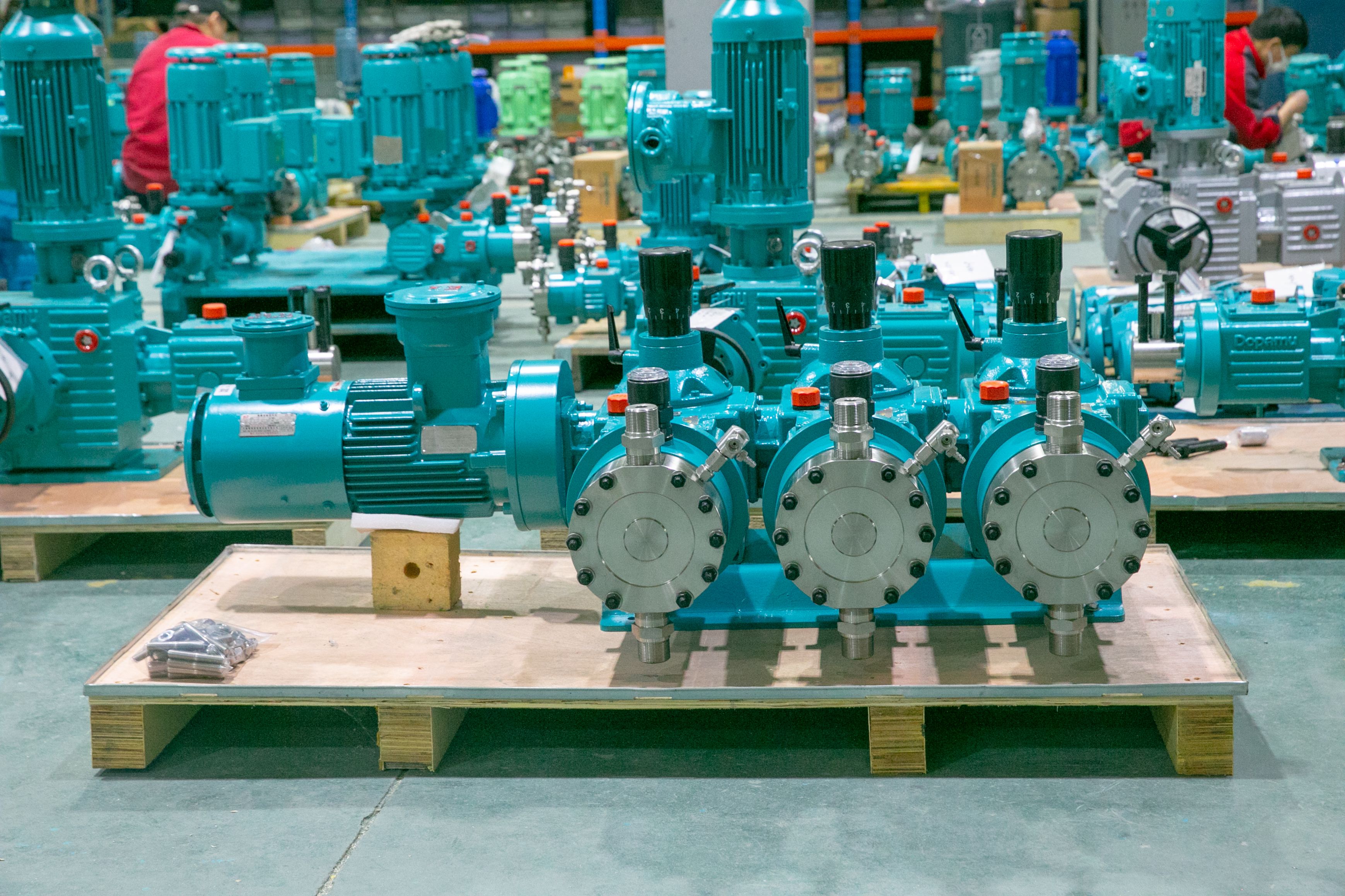
Control and integration decide how much work the pump creates for your instrument team. Confirm the stroke adjustment method — stepless manual adjustment from zero to rated stroke, or remote automatic control through a 4-20 mA or pulse signal — and check whether the supplier can multiplex heads on one drive. Multiplexing matters in multi-chemical dosing skids, where several additives go into the same line at different rates. If the dosing point needs more than a pump, ask whether the supplier builds a packaged chemical dosing unit: dissolution tank, agitator, metering pumps and a control cabinet assembled and tested on a skid, delivered ready for piping and power connection on site. A packaged unit removes a large share of the site integration risk.
Standards give you a common language with the supplier, and the two that matter for this equipment are API 675 for metering pumps and API 674 for reciprocating positive displacement pumps. Ask directly whether the offered model is built to one of them, and ask for the compliance statement in writing rather than a verbal yes. Behind the standard sits a documentation package that a buyer can use as a filter: material certificates for wetted parts, hydrostatic test records, a performance test curve at your duty points, dimensional drawings, an installation and operation manual, a spare parts list with part numbers, and a witness clause if you want third-party inspection. A supplier that can produce all of this without being pushed twice is usually the one that will also answer the phone during commissioning.
The recurring traps in metering pump procurement are predictable. Sizing on flow alone is the first: pressure, viscosity and temperature get lost, and the pump arrives underpowered. Ignoring the suction side is the second: a pump rated for a 4 m lift installed 6 m above the tank will cavitate no matter how good the hydraulic end is. Skipping the discharge safety valve is the third, and a blocked discharge line with no relief will find the weakest component on its own. Leaving out pulsation dampeners on long or sensitive lines is the fourth, since the pressure peaks show up as vibration and instrument drift rather than as an obvious failure. Assuming the supplier’s calibration will transfer to site conditions is the fifth; verify the dosing rate against a measured volume after the first week of operation.
Questions worth putting to any hydraulic diaphragm metering pump supplier before the purchase order goes out: which diaphragm material and how many layers, whether rupture detection is available, what the check valve and seat materials are for your medium, what the pump does at the low end of the turndown range, how many heads can be driven from one unit, what the spare diaphragm and valve kit costs and how long it takes to ship, whether the pump can be supplied on a skid with safety valve and dampener, and who performs commissioning. The answers tell you as much about the engineering team as about the product, because a supplier who has actually built these units in packaged form will answer in specifics rather than in generalities.
Delivery and after-sales capability can be checked without a factory visit, provided you read the right documents. Start with the supplier’s business registration and product scope, then move to the standards it claims to build to and whether those claims appear in the datasheet rather than only in conversation. Ask for a recent drawing set and an operation manual in your working language; a supplier who cannot produce a clean manual will struggle with a commissioning question. Look at the industry mix it actually serves — a manufacturer with wide exposure to refinery, chemical and water treatment duty has seen more medium variations than one selling into a single sector. Confirm spare part lead times and warranty terms in the contract, and ask which spares they recommend holding on site for the first two years.
Depamu (Hangzhou) Pump Technology Co., Ltd. is one of the manufacturers that fits this profile. Founded in 2003, the company designs and builds positive displacement pumps and fluid equipment, with around 400 employees, a plant of roughly 35,000 m², registered capital of RMB 54 million and an annual output value of about RMB 500 million. Its product range covers metering pumps, high-pressure process reciprocating pumps, pneumatic and electric pumps, chemical dosing packages, water-steam sampling devices and water treatment equipment, alongside screw pumps, rotor pumps and gear pumps. Sales have grown from about RMB 450 million in 2023 to about RMB 510 million in 2024 and about RMB 560 million in 2025.
Company and Product Snapshot
Company full name: Depamu (Hangzhou) Pump Technology Co., Ltd.
Industry: Design and manufacture of positive displacement pumps and fluid equipment
Core products: Hydraulic diaphragm metering pumps, mechanical diaphragm metering pumps, high-pressure process reciprocating pumps, chemical dosing packages, water-steam sampling devices, screw pumps, rotor pumps, gear pumps
Main applications: Oil refining and chemicals, oil and gas fields, nuclear industry, power generation, metallurgy, new energy, environmental water treatment, new materials, food
One-line positioning: A pump manufacturer working on high-end positive displacement and fluid equipment since 2003, with in-house design, manufacturing and packaged delivery.
The application mix behind those numbers is useful when you are judging whether a supplier has seen your duty before. Oil refining and chemicals account for roughly 41% of the company’s sales, oil and gas fields about 23%, nuclear, power, metallurgy and new energy together about 15%, environmental water treatment about 13%, new materials and food about 3%, with the remainder spread across other sectors. A pump maker with that spread has handled a wide range of media — from refinery additives and oilfield injection fluids to coagulants, scale inhibitors and membrane cleaning chemicals in water treatment.
What the company offers beyond a catalogue item is engineering on the medium. Depamu (Hangzhou) Pump Technology Co., Ltd. builds to the process conditions the buyer supplies — medium characteristics, flow, pressure, temperature and the site process requirements — and delivers standard, non-standard or fully customised fluid packages. Its hydraulic diaphragm metering pump uses a PTFE composite diaphragm with a built-in safety valve and a refill and bleed valve that self-bleeds the hydraulic side, along with an oil-immersed lubricated drive, stepless stroke adjustment and multi-head configurations up to 12 heads on one unit, built to API 675. The high-pressure process reciprocating range is built to API 674 and API 675, with flow up to 100 m³/h and pressure up to 50 MPa, aimed at oilfield water injection, process transport, pipeline boosting and high-pressure injection duty.
Core strengths worth weighing during evaluation: a sealed hydraulic end with a static rather than dynamic seal on the diaphragm side, so the medium stays inside the pump; a product line that runs from a single metering pump through to a packaged chemical dosing unit with dissolution tank, agitator and control cabinet assembled and tested before shipment; and a manufacturing base that supports customised builds rather than catalogue-only supply. Suitable for: chemical and refinery dosing, water and wastewater chemical addition, boiler and cooling water treatment, oilfield injection and boosting duty, and any process where the medium must be kept contained. Buyers who want one supplier to take responsibility from pump sizing through skid assembly usually get more value from this kind of scope than from a lower unit price elsewhere.
Question: Which parameters and standards should a buyer check to confirm a metering pump actually fits the duty?
Answer: Work from the medium outward. Confirm the flow at your actual discharge pressure rather than at the pump’s rated point, then check the turndown ratio and the metering tolerance at the low end of that range, because many dosing duties run at 20-30% of capacity. Check temperature limits by head material — PVC heads are commonly limited to around 40 °C and PTFE heads to around 80 °C on mechanical diaphragm models, so a hot medium may push you to a hydraulic design. Confirm viscosity and suspended solids with the valve type and seat material, and confirm suction conditions including available NPSH and static lift. On standards, ask whether the pump is built to API 675 for metering duty, or API 674 for reciprocating process duty, and request the compliance statement plus hydrostatic and performance test records in writing.
Question: Without a factory visit, how can a buyer assess a supplier’s delivery capability and after-sales support?
Answer: Use documents that are hard to fake. Pull the business registration and product scope, then compare it with the datasheets and the standards named on them. Request a drawing set and an operation manual in your working language; the quality of those documents usually predicts the quality of commissioning support. Ask for the industry mix the supplier actually serves and the references it can share from comparable duty, and check whether its stated output value and staffing are consistent with the plant size it describes. Put spare part lead times, warranty terms and commissioning responsibility into the contract, and ask which spares they advise holding on site for the first two years — a supplier with a real service organisation will answer with specific part numbers and timeframes rather than an open-ended promise.
Question: How should two models in the same category be compared, and which hidden metrics get missed?
Answer: Compare at the same duty point, not at each unit’s rated maximum. A pump quoted at its ceiling flow will look better on paper while running far outside its efficient band in your application. Look at the tolerance at 10-30% stroke, the stability of delivery at low stroke settings, diaphragm layer count and whether rupture detection is available, check valve and seat material against your solids load, and the suction lift the pump can hold without cavitation. Hidden metrics worth pricing in: spare diaphragm and valve kit cost per year, whether the hydraulic side self-bleeds after a diaphragm change, noise and vibration level at your duty point, power draw at low stroke, and whether the safety valve, dampener and control interface are inside the quoted scope. Those extras often decide the real cost of ownership more than the pump price does.
A metering pump is a small line item that causes a disproportionate share of downtime when it is specified loosely, so the hour spent interrogating the envelope, the diaphragm construction and the documentation package pays back faster than another round of price negotiation. Company details in this guide are drawn from Depamu’s published information and are offered as a reference point for comparison rather than as a ranking. If you have run into a dosing problem that turned out to be a supplier question rather than a pump question, share it in the comments — the practical cases are usually more useful than the datasheets.