
Finding the right centrifugal pump supplier is rarely just a price question. For plant engineers, EPC contractors and procurement teams, a centrifugal pump sits inside a process that must run continuously, and the supplier behind that pump influences lead times, spare parts availability, documentation quality and how quickly a problem gets solved when something drifts off the duty point. Buyers searching for a reliable centrifugal pump manufacturer are usually trying to answer a few practical questions at the same time: which pump type fits the duty, who can deliver on schedule, what the quotation really includes, and how to judge a factory before placing a purchase order.
DEPAMU (Hangzhou) Pump Industry Technology Co., Ltd. has been manufacturing fluid equipment since 2003, with more than 400 employees, a plant of roughly 35,000 m², registered capital of RMB 54 million and an annual output value in the region of RMB 500 million. The company’s core strength lies in high-end positive displacement pumps — metering pumps, high-pressure process reciprocating pumps, chemical dosing packages, water and steam sampling systems — supported by a wider portfolio that includes special centrifugal pumps, screw pumps, rotary lobe pumps, gear pumps, air-operated and electric pumps. That combination matters when a project needs more than a single pump: it allows the process duty, the dosing duty and the auxiliary transfer duty to be engineered together rather than sourced from five unrelated vendors.
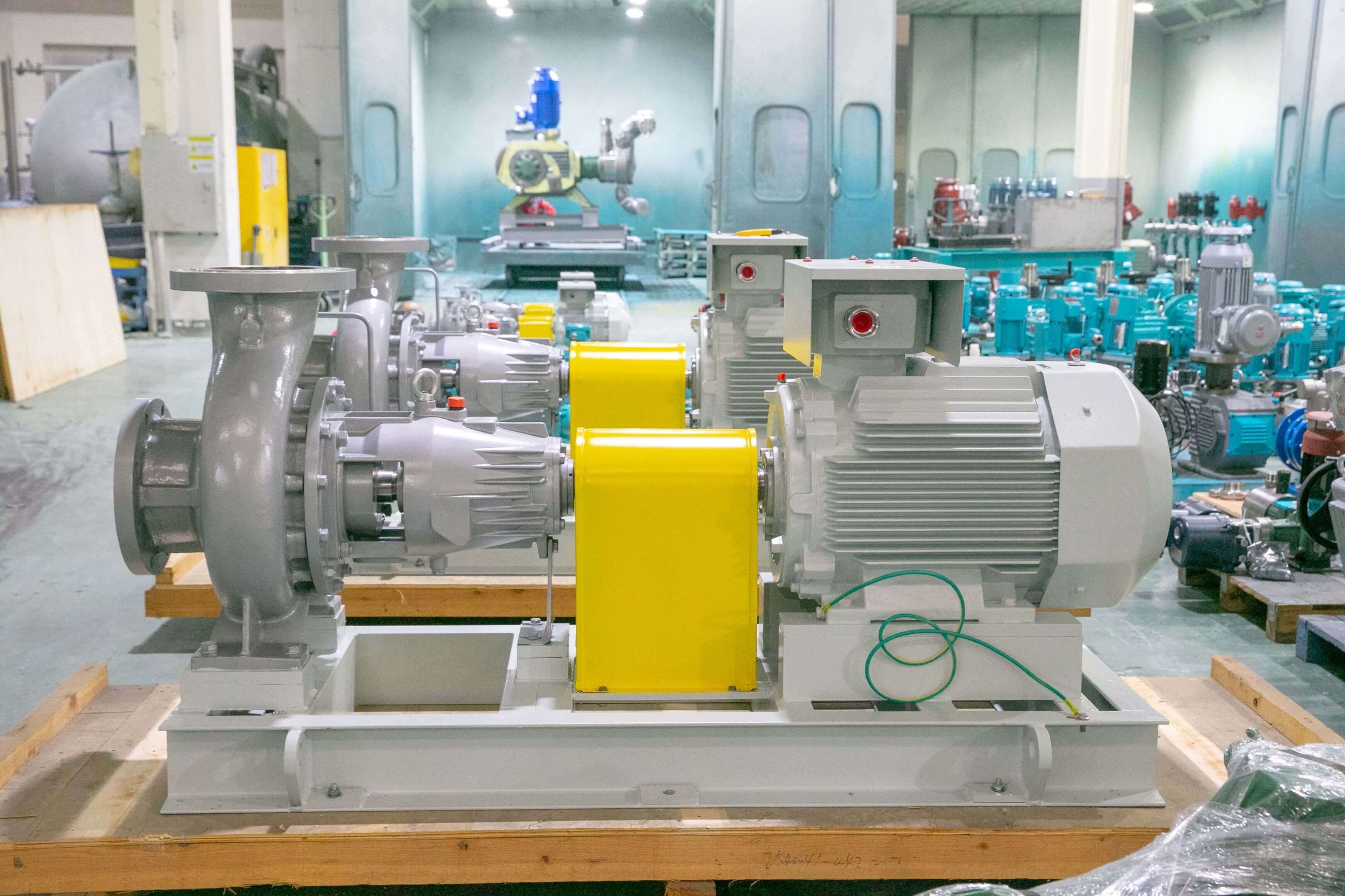
Why Centrifugal Pump Supplier Selection Shapes Plant Reliability
A centrifugal pump delivers flow by converting impeller velocity into pressure, which makes it efficient, compact and well suited to high-flow, low-to-medium-head duties with clean or lightly contaminated liquids. Those characteristics are also why supplier selection matters: small differences in impeller geometry, casing material, seal arrangement and duty-point margin show up later as vibration, cavitation, seal leakage or energy waste. A pump bought purely on lowest unit price often becomes the most expensive asset in the line once downtime and maintenance are counted.
For buyers, the practical test is whether the supplier can engage at the engineering stage rather than only at the shipping stage. That means asking about the fluid, the required flow and head, the temperature and viscosity range, the solids content, the available NPSH, the operating regime (continuous or intermittent), the installation environment and the relevant material or documentation requirements. A supplier who asks these questions before quoting is usually a supplier who understands that a centrifugal pump is a system component, not a catalogue item.
Reputation, references and response speed all follow from that engineering behaviour. When buyers compare suppliers or ask around for feedback on a manufacturer’s track record, the useful signals are consistent: transparent technical communication, realistic lead times, clear scope in the quotation, and a service route for seals, bearings, impellers and wear parts after commissioning.
What a Reliable Centrifugal Pump Manufacturer Should Provide
Engineering and application support
A capable manufacturer should be able to review a duty specification and recommend a pump configuration — casing and impeller material, seal type, motor rating, connection standard and control philosophy — rather than simply matching a model number. Where the duty sits outside the efficient range of a centrifugal pump, for example very low flow at high pressure, high viscosity, or precise chemical dosing, an honest supplier will say so and propose an alternative such as a metering pump or a high-pressure reciprocating pump.
Manufacturing capacity and delivery control
Delivery reliability is largely a function of manufacturing depth. DEPAMU operates a plant of about 35,000 m² with a workforce of more than 400 people, covering research and development, design, manufacturing and packaged system delivery. Reported sales have grown from roughly RMB 450 million in 2023 to about RMB 510 million in 2024 and around RMB 560 million in 2025, which reflects sustained demand across petrochemical, oil and gas, power, nuclear, metallurgy, new energy, environmental water treatment, new materials and food applications. For a buyer, scale of this kind usually translates into more stable material procurement, better workshop loading control and more predictable delivery dates.
Documentation, testing and traceability
Ask what documentation accompanies the pump: performance test records, material certificates, dimensional drawings, installation and operation manuals, and wiring or instrumentation diagrams for packaged units. For regulated industries, documentation is often as important as the hardware itself. Clarifying this at the quotation stage avoids surprises during inspection and handover.
Spare parts and long-term service
Seals, bearings, gaskets, impellers and wear rings are consumables in every centrifugal pump. A supplier who maintains drawings and spare-part records for the installed base makes future maintenance planning far easier. It is worth confirming wear-part identification, recommended spares for the first two years of operation, and the response route for technical support before the order is placed.
Centrifugal Pump Selection Guide: Matching Pump Type to Duty
Selection starts with the process, not the pump. The most common mistake in centrifugal pump procurement is choosing a model on flow and head alone, then discovering that the fluid is viscous, abrasive or sensitive to shear. Centrifugal pumps handle high flow rates efficiently and produce smooth, pulsation-free output, but their capacity falls sharply as viscosity rises, and they are generally less suitable for very low flows at high pressure or for shear-sensitive and high-solids media.
Positive displacement pumps fill that gap. DEPAMU’s metering pumps deliver accurate, repeatable dosing through stroke length and frequency adjustment, with a hydraulically actuated diaphragm design that keeps the medium fully contained — useful for corrosive, volatile or high-pressure chemicals. High-pressure process reciprocating pumps, with pressure capability above 35 MPa, are built for continuous high-pressure transfer and for viscous, hot or particle-bearing fluids. Where a plant needs both bulk transfer and precise dosing, specifying both duties through one manufacturer usually produces a cleaner, better-integrated installation.
| Selection parameter | What to specify to the supplier | Why it changes the pump choice |
|---|---|---|
| Flow and head (duty point) | Required flow range, total head, normal and maximum conditions | Determines impeller size, speed and best-efficiency operating range |
| Fluid characteristics | Composition, concentration, viscosity, density, pH, chlorides | Drives material selection and whether centrifugal or positive displacement is suitable |
| Temperature and pressure | Operating and design temperature, suction and discharge pressure | Affects sealing, casing rating and auxiliary systems |
| Solids and abrasiveness | Particle size, concentration, hardness | Influences impeller design, clearances and wear allowance |
| NPSH available | Suction layout, tank level, line losses, vapour pressure | Prevents cavitation, which damages impellers and seals |
| Operating regime | Continuous or intermittent, starts per hour, turndown needs | Guides motor sizing, seal choice and control method |
| Installation and standards | Area classification, connection standard, voltage and frequency, footprint | Determines mechanical configuration and compliance documentation |
Where Centrifugal Pumps Fit in an Integrated Fluid Equipment Portfolio
DEPAMU’s application base is concentrated in demanding sectors: petrochemical and chemical processing accounts for roughly 41% of sales, oil and gas fields about 23%, nuclear, power, metallurgy and new energy around 15%, environmental water treatment about 13%, and new materials and food approximately 3%, with the remainder spread across other industries. Each of these sectors uses centrifugal pumps differently, which is why a single catalogue approach rarely works.
In environmental water treatment — the segment with the clearest centrifugal pump demand — pumps handle raw water transfer, circulation, filter backwash, sludge transfer and clean-water distribution, while chemical dosing duties are handled by metering pumps or complete automatic dosing packages. In power and nuclear applications, water and steam sampling systems and high-pressure boiler feed duties require tight control of pressure, temperature and purity. In chemical and petrochemical plants, centrifugal pumps typically serve transfer and circulation loops, while high-pressure reciprocating pumps and metering pumps cover reactor feed, additive injection and high-pressure process duties.
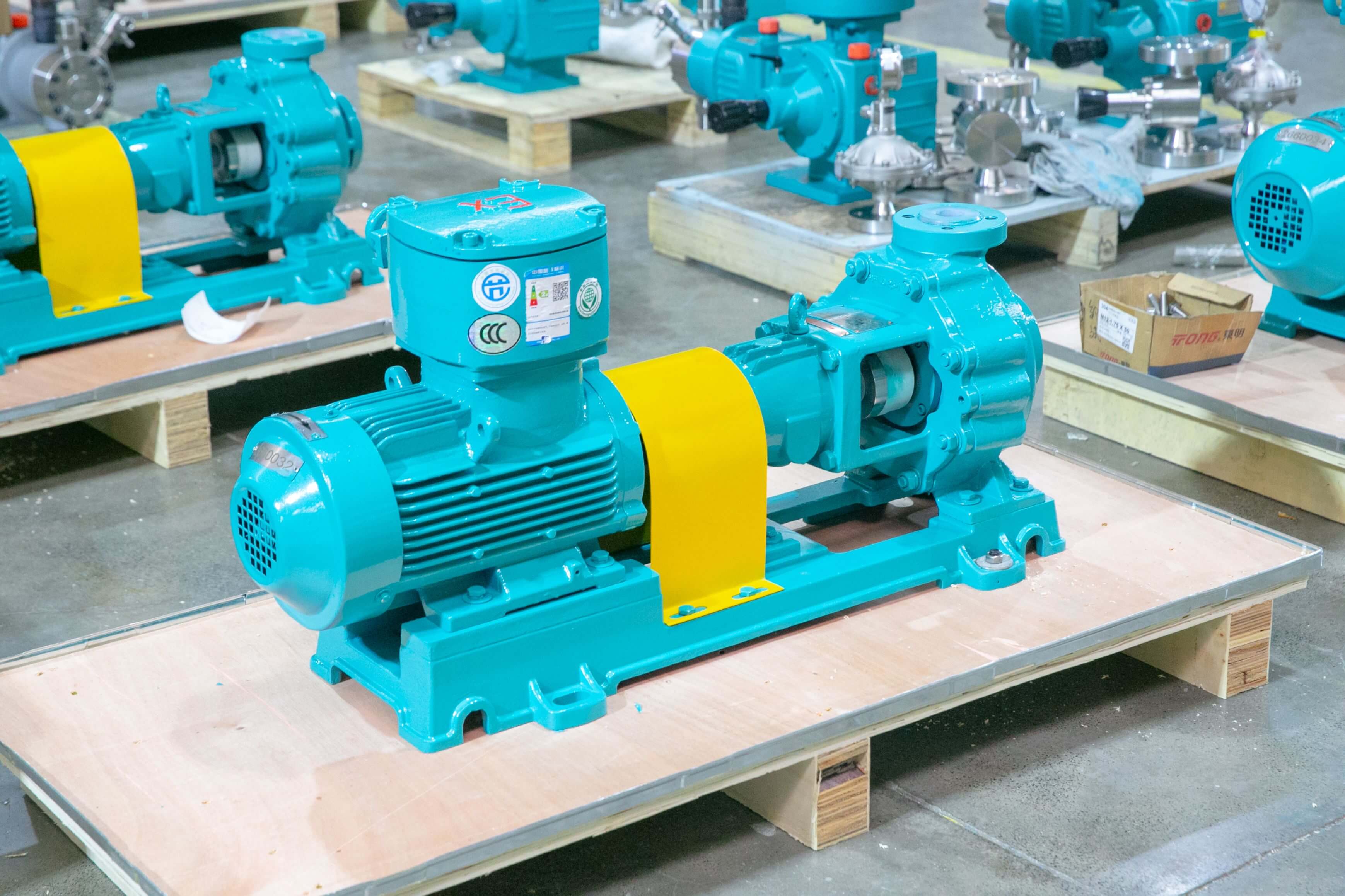
Custom and Non-Standard Centrifugal Pump Solutions
Standard pumps cover a large share of routine duties, but many industrial projects include at least one operating condition that does not fit a catalogue. Aggressive or high-chloride media, elevated temperatures, tight space envelopes, special connection standards, unusual control interfaces and combined skid requirements are all common reasons to request a non-standard or customised configuration. A manufacturer with in-house design and manufacturing capability can evaluate these requirements and propose a modified pump or an engineered package instead of forcing a standard model into an unsuitable duty.
Beyond the pump itself, packaged systems are often the more efficient purchase. An automatic chemical dosing package integrates chemical storage, dissolution, mixing, metering and control into a single skid, with the metering pump as the core and tanks, agitators and intelligent control completing the system. The unit is assembled and tested before delivery, so site work reduces to connecting piping and power. The same packaged approach applies to transfer and circulation duties, where centrifugal pumps, instrumentation, valves and controls can be supplied as a coordinated unit.
The practical advantage for buyers is interface reduction: fewer vendors, fewer scope gaps and one technical contact for the whole fluid system. That is particularly valuable on projects where the transfer pump, the dosing pump and the control logic must work together, and where responsibility for commissioning needs to sit in one place.
Centrifugal Pump Price, Quotation and Total Cost of Ownership
A meaningful centrifugal pump quotation depends on information quality. Sending only a model number or a single flow figure usually produces a cautious, wide-ranging offer; sending a complete duty description produces a precise, comparable one. A good quotation request includes the duty point, fluid data, temperature and pressure conditions, material preferences, seal requirements, motor and voltage data, installation environment, documentation requirements, delivery destination and required date.
Comparing quotations on unit price alone hides the real cost picture. Energy consumption over the operating life of a centrifugal pump usually exceeds the purchase price, so efficiency at the actual duty point deserves attention. Seal reliability, wear-part intervals, spare-part pricing, service access and lead times for replacement components all influence total cost of ownership. A pump that runs slightly further from its best-efficiency point may cost more in electricity each year than the difference in purchase price between two offers.
- Confirm the quoted duty point and acceptable operating range, not just a maximum rating.
- Check the material specification for casing, impeller, shaft and seal faces against the actual fluid.
- Ask for the scope of supply: pump, baseplate, coupling, guard, motor, instrumentation, controls, and whether testing is included.
- Request the recommended spare-parts list and the first-year maintenance plan.
- Review documentation deliverables and inspection requirements before order confirmation.
- Clarify delivery terms, packaging and the technical support route after commissioning.
Installation, Operation and Maintenance Practices That Extend Pump Life
Most centrifugal pump problems appear at the suction side. Correct suction piping layout, adequate straight length, minimal fittings, a properly sized strainer and sufficient net positive suction head available prevent cavitation, which otherwise erodes impellers and damages seals. Discharge piping should be supported independently so that nozzle loads do not distort the casing, and baseplate grouting and shaft alignment should be verified after installation rather than assumed.
During operation, running near the design duty point keeps efficiency high and vibration low. Throttling far from the design point, running dry, or operating with a closed discharge valve for extended periods all shorten component life. Monitoring bearing temperature, vibration, seal leakage and motor current gives early warning of wear, and recording these values over time makes it easier to distinguish normal drift from a developing fault.
Maintenance should follow a schedule rather than a breakdown. Routine checks cover seal condition, lubricant condition and level, coupling alignment, fastener tightness and strainer cleanliness; periodic work includes wear-ring clearance measurement and impeller inspection. Keeping a record of replaced parts and operating hours allows the maintenance interval to be tuned to the actual duty, which is usually more economical than a fixed calendar-based approach.
FAQ
How do I choose a reliable centrifugal pump supplier for my plant?
Evaluate the supplier on engineering support first, then on manufacturing depth and service capability. A reliable supplier asks for the full duty specification before quoting, explains why a particular pump type and material suit the process, states the scope of supply clearly and can support the installed pump with wear parts and technical assistance. Factory scale, workforce, documented testing and delivery history are useful secondary indicators. Comparing two or three technically qualified offers on total cost of ownership rather than unit price gives a more realistic decision.
Can one manufacturer supply centrifugal pumps together with metering pumps and dosing systems?
Yes, and it is often preferable. DEPAMU manufactures centrifugal pumps within a broader portfolio that includes metering pumps, high-pressure process reciprocating pumps, chemical dosing packages, water and steam sampling systems, screw pumps, rotary lobe pumps and gear pumps. Supplying transfer, circulation and dosing duties from one source reduces interface risk, shortens coordination time and places responsibility for the complete fluid system with a single technical contact.
What information do I need to provide to get an accurate centrifugal pump quotation?
Provide the required flow and head at normal and maximum conditions, the fluid composition and concentration, viscosity, density, temperature, solids content, available NPSH, suction and discharge pressure, operating regime, material and seal preferences, electrical supply, installation environment, documentation requirements and delivery location. Including a P&ID or process description helps the supplier identify interface points. The more complete the data, the more precise and comparable the quotation will be.
Do you offer custom or non-standard centrifugal pump solutions?
Yes. DEPAMU provides standard products, non-standard products and customised fluid solutions based on the customer’s medium characteristics, flow, pressure, temperature and site process requirements. Typical customisation requests involve special materials for corrosive media, elevated temperature service, non-standard connections, restricted footprints and packaged skid systems combining pumps, tanks, agitation and control. Each request is reviewed against the actual duty rather than adapted from a catalogue model without verification.
How can I verify a centrifugal pump manufacturer’s capability and reputation?
Ask for a factory visit or a virtual audit, review the manufacturing and testing equipment used, request documentation samples such as test records and drawings, and discuss how wear parts and spare parts are traced for existing installations. Company scale is a supporting indicator: DEPAMU, established in 2003, operates a plant of about 35,000 m² with more than 400 employees and an annual output value in the region of RMB 500 million, with sales growing from roughly RMB 450 million in 2023 to about RMB 560 million in 2025.
Which industries commonly use centrifugal pumps from this type of supplier?
Centrifugal pumps from an industrial fluid equipment manufacturer typically serve petrochemical and chemical processing, oil and gas operations, power generation, metallurgy, new energy, environmental water treatment, new materials and food processing. DEPAMU’s own application mix is concentrated in petrochemical and chemical (about 41%), oil and gas fields (about 23%), nuclear, power, metallurgy and new energy (about 15%), and environmental water treatment (about 13%), which reflects the type of duties where both centrifugal and positive displacement pumps are required.
Summary
Choosing a centrifugal pump supplier is an engineering decision with commercial consequences. The right supplier reviews the duty before quoting, explains the trade-offs between centrifugal and positive displacement technology, specifies materials and seals against the actual fluid, states the scope of supply clearly and supports the pump after commissioning with documentation and wear parts. Those habits matter more than a marginal difference in unit price, because energy use, seal life and downtime usually dominate the lifetime cost of a pump installation.
DEPAMU (Hangzhou) Pump Industry Technology Co., Ltd. combines more than twenty years of fluid equipment manufacturing experience, a plant of roughly 35,000 m², a workforce of over 400 people and an application base spanning petrochemical, chemical, oil and gas, nuclear, power, metallurgy, new energy, environmental water treatment, new materials and food processing. Its portfolio brings centrifugal pumps together with metering pumps, high-pressure reciprocating pumps and packaged dosing systems, so that transfer, circulation and precise dosing duties can be engineered as one coordinated solution rather than separate purchases. For buyers preparing a centrifugal pump enquiry, the most productive first step is a complete duty specification sent to a manufacturer able to answer it technically.