
An electric diaphragm pump is often the quiet workhorse behind accurate chemical dosing, reliable water treatment, and stable process injection. For buyers comparing suppliers, the real challenge is not simply finding a pump that moves liquid. It is finding an electric diaphragm pump manufacturer that understands medium compatibility, discharge pressure, control requirements, and long-term serviceability. Depamu (Hangzhou) Pump Industry Technology Co., Ltd. has focused on high-end positive displacement pumps and fluid equipment since 2003, and its electric-driven diaphragm metering technology is used across oil refining, petrochemical, water treatment, power, new energy, and food processing applications.
This guide explains how electric diaphragm pumps work, where they fit best, how to select the correct model, and how to evaluate an electric diaphragm pump supplier before placing an order. It also covers practical installation and maintenance advice, along with the differences between diaphragm and plunger pump designs.
What Is an Electric Diaphragm Pump and How Does It Work?
An electric diaphragm pump is a positive displacement pump in which an electric motor drives a flexible diaphragm. The diaphragm moves back and forth, changing the volume of the pump chamber and creating suction and discharge. Because the diaphragm separates the process liquid from the drive mechanism, the pumped medium does not contact the internal lubricated parts. This design is particularly valuable when the liquid is corrosive, volatile, toxic, abrasive, or expensive.
In a hydraulic diaphragm metering pump, the motor drives a hydraulic system that moves the diaphragm. The hydraulic oil acts as a buffer, distributing force evenly across the diaphragm and supporting stable operation at higher pressures. Metering accuracy is achieved by adjusting stroke length, stroke frequency, or both. This makes the pump suitable for applications where the injected volume must remain repeatable over long production runs.
The electric drive also makes automation straightforward. A variable-frequency drive, servo control, or external control signal can adjust flow without changing mechanical parts. For chemical dosing packages, the pump can be integrated with flow meters, pH sensors, conductivity meters, and PLC systems to maintain the required dose automatically.
Compared with pneumatic diaphragm pumps, electric diaphragm pumps are generally preferred when stable metering, lower pulsation, higher discharge pressure, or precise electronic control is required. Pneumatic pumps remain useful for simple transfer duties and hazardous areas where compressed air is the preferred power source, but they are not normally the first choice for accurate chemical injection.
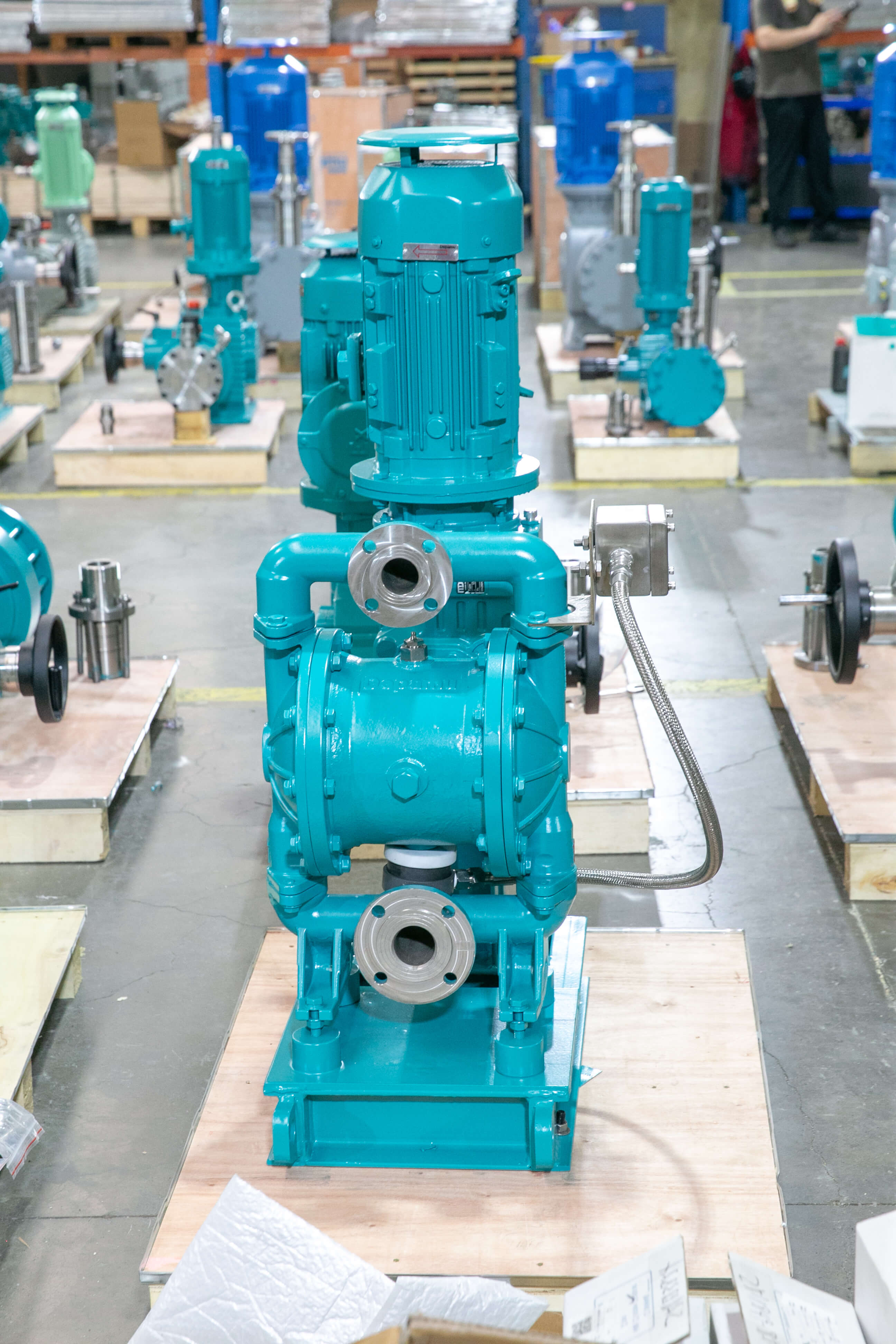
Why Depamu Is a Trusted Electric Diaphragm Pump Manufacturer
Depamu was founded in 2003 and has grown into a high-tech enterprise integrating research, production, sales, and packaged fluid solutions. The company employs more than 400 people and operates a factory site of approximately 35,000 square meters. With registered capital of RMB 54 million and an annual output value of approximately RMB 500 million, Depamu has the scale to support both standard product orders and customized engineering projects.
The company introduced advanced German pump technology and has continued to develop its own design and manufacturing capabilities. Its product development process starts with the customer’s medium characteristics, flow rate, pressure, temperature, and site process requirements. Engineers then determine whether a standard model, a non-standard configuration, or a fully customized fluid solution is the most appropriate choice. This approach is important for electric diaphragm pump projects because two applications with the same flow rate can require very different materials, control methods, and safety features.
Depamu’s sales performance reflects steady market acceptance. Sales were approximately RMB 450 million in 2023, RMB 510 million in 2024, and RMB 560 million in 2025. The business is diversified across oil refining and petrochemicals at about 41 percent, oil and gas fields at about 23 percent, nuclear power, power generation, metallurgy, and new energy at about 15 percent, environmental water treatment at about 13 percent, new materials and food at about 3 percent, and other industries at about 5 percent. This broad application base gives the company practical experience with many different fluids and operating conditions.
For international buyers, the key advantage is integrated capability. Depamu can handle product research and development, mechanical design, manufacturing, assembly, testing, and skid-mounted system delivery. Instead of coordinating several separate suppliers for a pump, control panel, dosing tank, and piping, buyers can work with one electric diaphragm pump manufacturer from specification through commissioning support.
Product Portfolio: Electric Diaphragm Pumps and Related Fluid Equipment
Depamu’s portfolio covers metering pumps, high-pressure process reciprocating pumps, pneumatic and electric pumps, automatic chemical dosing systems, water and steam sampling equipment, water treatment equipment, screw pumps, rotor pumps, and gear pumps. Within this range, the hydraulic diaphragm metering pump is a core product and a representative example of electric diaphragm pump technology.
The high-pressure process reciprocating pump is another major product line. It uses a plunger to generate high discharge pressure, with models capable of pressures above 35 MPa. These pumps are designed for stable flow, continuous operation, and difficult media such as high-viscosity fluids, high-temperature liquids, and liquids containing solid particles. Typical duties include oilfield water injection, petrochemical process transfer, pipeline boosting, and high-pressure injection.
The automatic chemical dosing system combines chemical storage, dissolution, mixing, metering, and automatic control in a skid-mounted package. Built around a metering pump, the system includes a solution tank, agitator, piping, valves, instruments, and a control system. It supports dry powder or liquid chemical preparation, multi-point dosing, and automatic interlocking. Factory assembly and testing reduce site work to connection of utilities and piping.
| Product Family | Typical Role | Key Characteristics |
|---|---|---|
| Hydraulic diaphragm metering pump | Precise chemical injection and dosing | Electric drive, adjustable stroke, leak-free diaphragm separation, suitable for corrosive and high-pressure media |
| High-pressure process reciprocating pump | High-pressure transfer, injection, and pipeline boosting | Plunger design, pressures above 35 MPa, stable flow, continuous duty, handles viscous and particle-laden media |
| Automatic chemical dosing skid | Integrated preparation and dosing | Tank, agitator, metering pump, piping, and control system assembled and tested before delivery |
| Screw, rotor, and gear pumps | Transfer of viscous or shear-sensitive fluids | Smooth flow, low shear, selected according to viscosity and solids content |
| Water treatment and sampling equipment | Boiler water, circulating water, wastewater, and steam sampling | Packaged systems for continuous plant operation and analytical monitoring |
Key Applications of Electric Diaphragm Pumps Across Industries
Electric diaphragm pumps are chosen when the process requires controlled injection rather than simple transfer. In oil refining and petrochemical plants, they inject additives, inhibitors, catalysts, and neutralizing chemicals into process streams. Because the diaphragm isolates the liquid from the drive, aggressive chemicals can be handled with appropriate wetted materials while the hydraulic system remains protected.
In electric diaphragm pump for water treatment applications, the pump doses coagulants, flocculants, disinfectants, pH adjustment chemicals, and anti-scalants. Boiler water treatment and circulating cooling water treatment require continuous, repeatable dosing, and the pump must respond reliably to changes in water quality. Automatic dosing skids are often used here because they combine chemical preparation, metering, and control in one package.
Oil and gas field operations use high-pressure reciprocating pumps for water injection and process duties, while metering pumps handle chemical injection at wellheads and gathering systems. Power generation, nuclear, metallurgy, and new energy applications require careful material selection and stable performance under continuous operation. Food and new material processes may require hygienic construction, accurate additive dosing, or gentle handling of sensitive fluids.
The application mix at Depamu reflects this diversity: oil refining and petrochemicals account for about 41 percent of sales, oil and gas fields about 23 percent, nuclear power, power, metallurgy, and new energy about 15 percent, environmental water treatment about 13 percent, new materials and food about 3 percent, and other industries about 5 percent. This means buyers can discuss real process conditions with a manufacturer that has seen similar duties across multiple sectors.
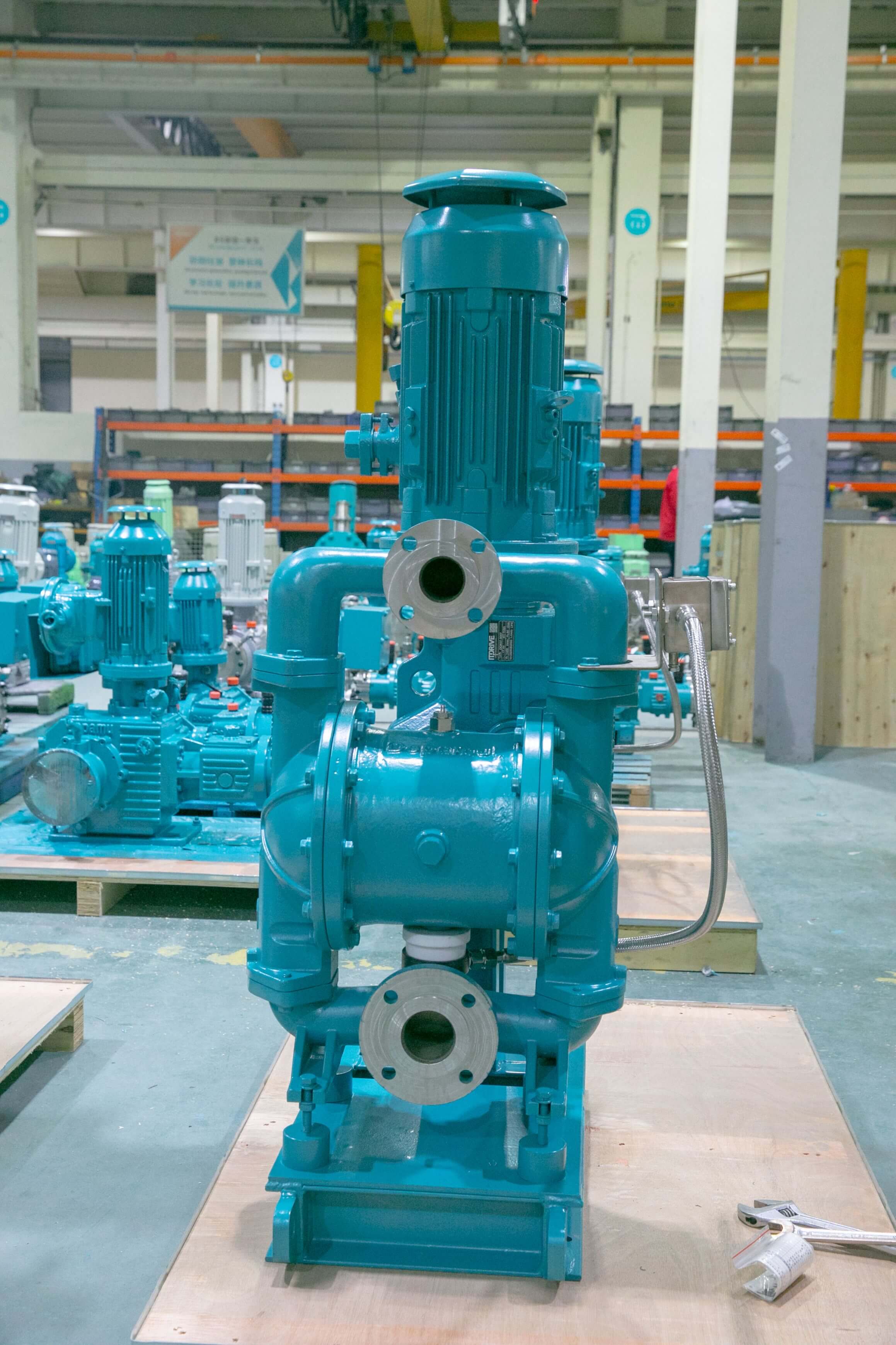
Electric Diaphragm Pump Selection Guide: How to Choose the Right Model
Selecting an electric diaphragm pump starts with the process data, not the pump catalog. The first step is to define the medium: chemical name, concentration, viscosity, temperature, solids content, vapor pressure, and whether the liquid is corrosive, toxic, flammable, or prone to crystallization. These properties determine the wetted materials, diaphragm material, seal arrangement, and whether a hydraulic diaphragm design is necessary.
The second step is to confirm flow rate and discharge pressure. Buyers should provide normal flow, minimum flow, maximum flow, suction pressure, discharge pressure, and any pressure fluctuations in the system. A pump that is oversized for the duty may lose metering stability, while an undersized pump may run at its upper limit and wear faster. The third step is to define the control strategy: manual stroke adjustment, variable-speed drive, 4–20 mA signal, pulse control, or integration with a PLC or SCADA system.
For chemical dosing projects, it is also important to confirm whether the pump will operate continuously or intermittently, whether more than one injection point is required, and whether the system needs automatic flushing, calibration columns, pressure relief valves, or back-pressure valves. These details affect the final configuration and the electric diaphragm pump price.
| Selection Parameter | What to Confirm | Why It Matters |
|---|---|---|
| Medium compatibility | Chemical composition, concentration, corrosion data | Determines pump head, valve, diaphragm, and piping materials |
| Flow rate | Normal, minimum, and maximum duty flow | Prevents oversizing and supports stable metering |
| Discharge pressure | System pressure, line losses, back pressure | Ensures sufficient pressure margin and safe operation |
| Temperature | Minimum and maximum liquid temperature | Affects diaphragm life, material choice, and hydraulic performance |
| Viscosity and solids | Viscosity range, particle size and concentration | Influences valve design, suction conditions, and pump type selection |
| Control mode | Manual, automatic, remote signal, PLC integration | Determines drive, instrumentation, and dosing accuracy in operation |
Electric Diaphragm Pump vs. Plunger Pump: Which Design Fits Your Process?
Both electric diaphragm pumps and plunger pumps are positive displacement designs, but they serve different priorities. A plunger pump uses a reciprocating piston or plunger to pressurize the liquid directly. It is well suited to very high pressures and can handle high-viscosity or particle-laden media when correctly configured. However, the plunger packing requires attention, and any leakage path must be managed according to the medium.
A diaphragm pump separates the process liquid from the drive by a flexible diaphragm. In a hydraulic diaphragm metering pump, the hydraulic system supports the diaphragm and enables high-pressure operation with no packing leakage. This design is often preferred for corrosive, toxic, volatile, or expensive chemicals where leakage is unacceptable. It is also well suited to precise chemical dosing because stroke adjustment provides repeatable flow control.
In practice, the choice depends on pressure, medium, and metering requirement. For very high pressure with abrasive slurries, a plunger pump may be the better mechanical fit. For accurate injection of aggressive chemicals at moderate to high pressure, a hydraulic diaphragm metering pump is often the safer and more controllable option. Buyers should discuss both designs with the manufacturer rather than assuming that one type fits every duty.
| Comparison Point | Electric Diaphragm Pump | Plunger Pump |
|---|---|---|
| Leakage control | Diaphragm isolates process liquid; no packing leakage | Packing or seal arrangement requires monitoring |
| Corrosive media | Suitable with compatible wetted materials | Possible, but seal and packing selection is critical |
| Very high pressure | Hydraulic diaphragm design supports high pressure | Naturally suited to very high pressure duties |
| Metering stability | Adjustable stroke and frequency for repeatable dosing | Good, but packing wear can affect performance over time |
| Maintenance focus | Diaphragm, valves, hydraulic oil, and seals | Plunger, packing, valves, and seals |
Installation, Operation, and Maintenance Best Practices
Correct installation has a direct effect on metering stability and pump life. The pump should be mounted on a rigid base with sufficient access for maintenance. Suction piping should be short, adequately sized, and free of unnecessary bends. A pulsation dampener may be required on the discharge side to protect piping and instruments, especially when several pumps feed a common header.
Before startup, verify that the suction line is filled and that the valves are in the correct position. Run the pump at a low stroke setting and check for abnormal noise, vibration, or leakage. Confirm that the discharge pressure is within the design range and that the relief valve is properly set. For automatic dosing systems, test the control loop with a calibration cylinder or flow verification method before introducing the chemical into the process.
Routine maintenance should include checking diaphragm condition, valve seats, hydraulic oil level, and control response. The frequency depends on chemical compatibility, operating pressure, temperature, and duty cycle. Keeping a maintenance log with stroke setting, discharge pressure, and dose volume helps identify drift before it affects product quality or treatment performance.
- Keep suction piping short and properly sized to avoid cavitation.
- Install a pressure relief valve on the discharge side to protect the pump and piping.
- Use compatible diaphragm and valve materials based on the chemical data sheet.
- Check hydraulic oil level and condition at recommended intervals.
- Recalibrate the dosing system after changing stroke settings or pump components.
- Record operating data to detect gradual changes in flow or pressure.
How to Evaluate an Electric Diaphragm Pump Supplier
Supplier evaluation should go beyond the quotation price. Start with technical capability: can the supplier review your medium data, calculate the required flow and pressure, and recommend the correct pump type and materials. A manufacturer that simply quotes a model number without asking about the process may leave you with a pump that fits the catalog but not the duty.
Next, confirm manufacturing depth. Depamu operates a 35,000 square meter facility with more than 400 employees and provides product development, design, manufacturing, and packaged system delivery. Buyers should ask whether the supplier builds the pump and the dosing skid in-house, how testing is performed before shipment, and what documentation is available for installation and operation.
After-sales support is equally important. Ask about spare parts availability, diaphragm and valve replacement guidance, response time for technical questions, and whether remote support is available for control and commissioning issues. For international projects, clarify the shipping terms, packaging, and documentation language. When comparing an electric diaphragm pump price, include the cost of spare parts, calibration, and potential downtime, not only the initial purchase cost.
A reliable electric diaphragm pump supplier should also be able to explain the difference between standard and custom configurations. If your process requires special materials, a non-standard control signal, multi-point dosing, or a skid-mounted package, the supplier should be able to describe how the system will be engineered and tested.
FAQ
What is the difference between an electric diaphragm pump and a pneumatic diaphragm pump?
An electric diaphragm pump uses an electric motor to drive the diaphragm through a mechanical or hydraulic linkage. This allows stable stroke control, adjustable flow, and integration with automated dosing systems. A pneumatic diaphragm pump uses compressed air and is often used for transfer duties where air supply is available. For precise chemical injection and continuous metering, an electric diaphragm or hydraulic diaphragm metering pump is usually the better choice.
Can hydraulic diaphragm metering pumps handle corrosive chemicals?
Yes, provided the wetted materials are selected correctly. The diaphragm separates the process liquid from the hydraulic drive, which reduces the risk of leakage and protects internal components. The pump head, valves, diaphragm, and piping should be matched to the chemical composition, concentration, and temperature. Depamu reviews the medium data before recommending a configuration.
How do I choose the right electric diaphragm pump for my flow and pressure requirements?
Provide the normal, minimum, and maximum flow rates, suction and discharge pressures, liquid temperature, viscosity, solids content, and chemical properties. Also describe the control method and whether the pump will operate continuously. The manufacturer can then select the pump size, stroke control, motor, and materials. Oversizing should be avoided because it can reduce metering stability.
How do I request an electric diaphragm pump quotation?
Prepare a process data sheet that includes medium, concentration, flow rate, discharge pressure, temperature, viscosity, control requirements, and site conditions. If a dosing skid is required, include tank size, injection points, and instrument signals. A clear data sheet allows the supplier to provide a meaningful quotation and reduces the risk of later changes.
Are custom or OEM electric diaphragm pump solutions available?
Depamu provides standard products, non-standard products, and customized fluid solutions based on medium characteristics, flow, pressure, temperature, and site process requirements. Customization can include special materials, control integration, multi-pump skids, and packaged chemical dosing systems. Buyers should discuss the application early so that the engineering scope is clearly defined.
What maintenance does an electric diaphragm metering pump require?
Typical maintenance includes checking diaphragm condition, valve seats, hydraulic oil level, seals, and control response. The maintenance interval depends on the chemical, pressure, temperature, and operating hours. Regular calibration checks and operating records help detect flow drift. Spare diaphragms and valve components should be kept available for critical duties.
Summary
Choosing an electric diaphragm pump is a process of matching the pump design to the medium, flow, pressure, and control requirements. Electric diaphragm and hydraulic diaphragm metering pumps are strong choices for precise chemical dosing, corrosive liquids, and applications where leakage must be avoided. High-pressure process reciprocating pumps serve different duties where very high pressure and difficult media are involved.
Depamu (Hangzhou) Pump Industry Technology Co., Ltd. combines more than two decades of positive displacement pump experience with in-house design, manufacturing, and packaged system delivery. Its product range covers metering pumps, high-pressure reciprocating pumps, automatic chemical dosing skids, screw and rotor pumps, and water treatment equipment, supported by a 35,000 square meter factory and a team of more than 400 employees. For buyers seeking an electric diaphragm pump manufacturer that can support both standard and customized projects, a detailed technical discussion is the most practical next step.