
An electric diaphragm pump is one of the most practical answers to a common industrial problem: moving aggressive, viscous, shear-sensitive or contaminated liquids without leakage and without dependence on a compressed air network. For plant engineers, EPC contractors and procurement teams, the real challenge is rarely whether a diaphragm pump works — it is how to choose one that matches the actual medium, duty cycle and site conditions, and how to find an electric double diaphragm pump manufacturer that can support the project from quotation through commissioning.
This guide walks through the working principle, the selection criteria that matter most, installation and maintenance practice, and the questions buyers should ask before placing an order. It is written from the perspective of a manufacturer that has been building high-end positive displacement pumps and fluid systems since 2003 — DEPAM (Hangzhou) Pump Industry Technology Co., Ltd. — and that supplies metering pumps, electric and pneumatic pumps, high-pressure process reciprocating pumps and complete chemical dosing systems to oil refining, petrochemical, oil and gas field, nuclear power, power generation, metallurgy, new energy, environmental water treatment, new materials and food applications.
What Is an Electric Diaphragm Pump and How Does It Work?
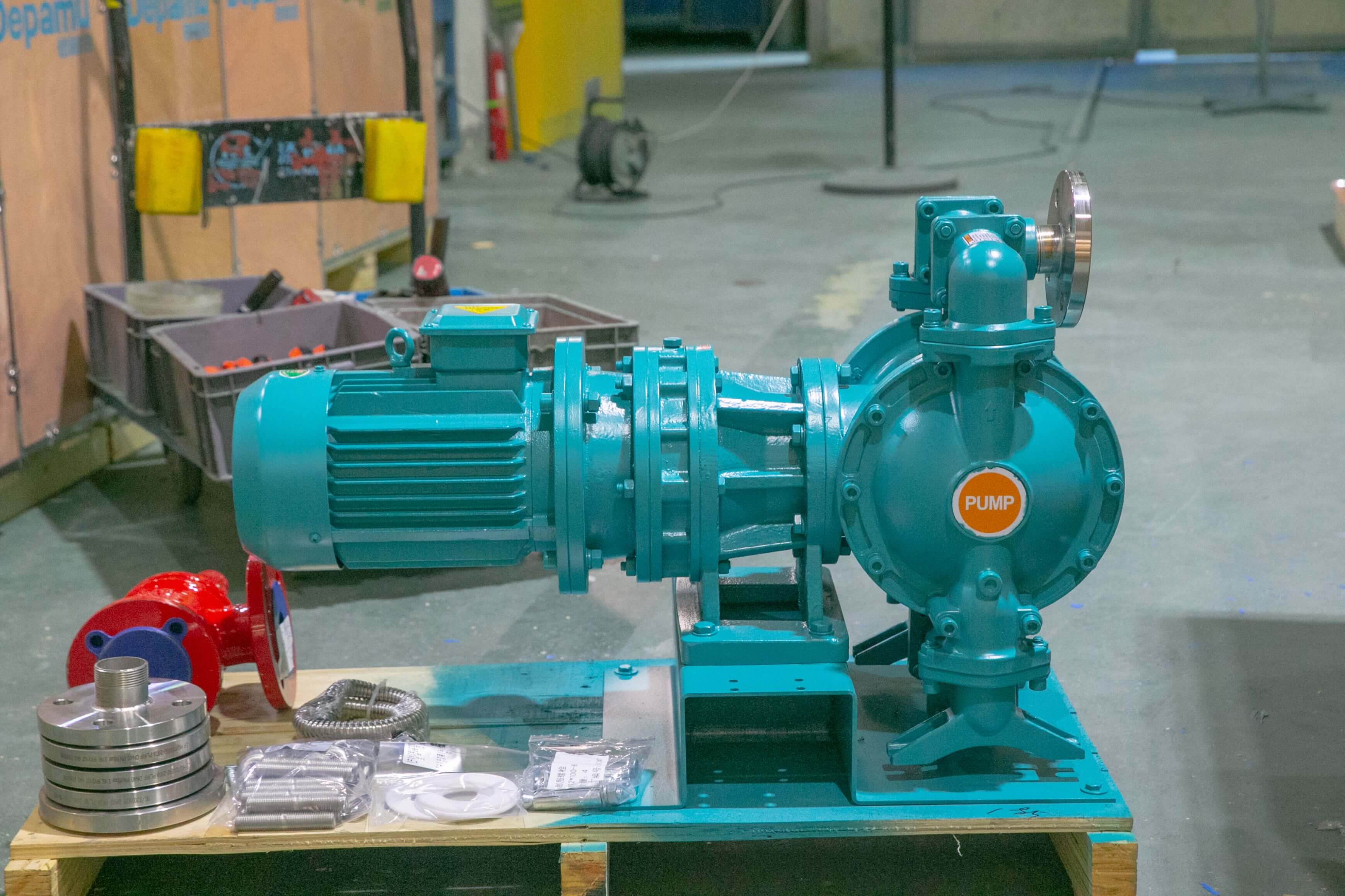
An electric diaphragm pump is a positive displacement pump in which a flexible diaphragm reciprocates inside a pump head, alternately drawing liquid in through a suction check valve and pushing it out through a discharge check valve. Because the diaphragm physically separates the process liquid from the driving mechanism, the medium never contacts the motor, the gearbox or the atmosphere. That separation is why diaphragm pumps are so widely used for corrosive chemicals, slurries, abrasive suspensions and liquids that must not leak to the environment.
In a motor-driven diaphragm pump, an electric motor drives the reciprocating mechanism — either through a cam, eccentric or crank arrangement, or through a hydraulic system in higher-pressure designs. Flow is regulated by changing the motor speed (with a variable frequency drive), by adjusting stroke length, or by a combination of both. This is a key advantage over air-operated pumps: output is repeatable and can be tied directly into a plant control system, so dosing and transfer can be automated and recorded.
DEPAM’s diaphragm technology is developed within the company’s broader positive displacement portfolio, which includes hydraulic diaphragm metering pumps, high-pressure process reciprocating pumps, pneumatic pumps, electric pumps, screw pumps, rotor pumps, gear pumps and complete dosing skids. That combination matters during selection: a diaphragm pump is often only one element of a system that also needs a dosing tank, a mixer, pulsation damping, instrumentation and a control philosophy — and a supplier that builds all of these can deliver the pump as a tested system rather than as a loose component.
Electric Diaphragm Pump vs Air-Operated Double Diaphragm Pump
The most common comparison buyers make is between an electric diaphragm pump and an air-operated double diaphragm (AODD) pump. Both use diaphragms and check valves, but they behave very differently in operation. An AODD pump is self-priming, tolerant of dry running and simple to control with a valve, which makes it excellent for intermittent transfer, drum unloading and hazardous areas where compressed air is the preferred power source. An electric unit, however, gives stable and repeatable flow that does not fluctuate with air pressure, consumes less energy in continuous duty, runs quieter, and is far easier to integrate with PLC or DCS-based dosing recipes.
| Selection factor | Electric diaphragm pump | Air-operated double diaphragm pump |
|---|---|---|
| Flow stability | Repeatable, set by motor speed or stroke; suitable for dosing | Varies with air pressure and air supply quality |
| Energy source and cost | Electric motor; lower energy consumption in continuous duty | Compressed air; compressor losses add to operating cost |
| Automation and control | VFD, 4–20 mA or pulse signals, easy PLC/DCS integration | Limited; usually throttled by air valve or solenoid |
| Noise level | Low, dominated by the motor and gearbox | Higher, from exhaust pulsation |
| Dry running tolerance | Depends on design; protection recommended for unattended duty | Generally tolerant of dry running |
| Best fit | Continuous duty, dosing, metering, remote or automatic plants | Intermittent transfer, hazardous areas, sites with reliable air supply |
In practice, many plants use both technologies side by side: air-operated units for flexible drum and sump transfer, and electric units wherever a fixed, measurable flow rate is needed. If your site already has a stable power supply and a control system, the motor-driven option usually delivers a lower total cost of ownership over a multi-year duty cycle.
How to Choose an Electric Diaphragm Pump: Seven Criteria That Decide Performance
Choosing an electric diaphragm pump is a matching exercise between the process and the hardware. A pump that is oversized wastes energy and can suffer from short-stroking; a pump that is undersized runs at its limit and fails early. The following criteria should be defined before any quotation is requested.
1. Medium properties: chemistry, solids and viscosity
The wetted materials must be selected for the specific liquid, not for a general category such as “acid” or “slurry.” Concentration, temperature, the presence of chlorides or solvents, and the percentage and particle size of solids all influence the choice of diaphragm elastomer, valve type and pump body material. DEPAM’s engineering team reviews the medium data sheet with the customer and recommends materials accordingly, including options for aggressive and mixed media.
2. Flow rate and turndown
Define both the design flow and the minimum flow the process actually needs. A wide turndown is valuable where dosing rates change between summer and winter, or between production recipes. With a variable frequency drive, an electric diaphragm pump can cover a broad range from a single unit, which reduces spare-part variety and simplifies maintenance training.
3. Discharge pressure and system resistance
Required pressure must be calculated from static head, line losses, control valve losses and the pressure of any receiving vessel or header — not taken from the pump’s maximum rating. Because diaphragm pumps are positive displacement machines, a discharge blockage can cause rapid overpressure, so relief protection and a correctly rated motor are essential parts of the specification.
4. Suction conditions and net positive suction head
Diaphragm pumps handle suction lift better than many centrifugal pumps, but they are not immune to cavitation. Long suction lines, high liquid temperature and elevation differences all reduce available NPSH. Where suction conditions are marginal, a flooded suction arrangement or a larger line size is usually a cheaper fix than a larger pump.
5. Control and instrumentation requirements
Decide early whether the pump will run manually, follow a 4–20 mA signal, accept pulse inputs from a flow meter, or be controlled by a SCADA layer. Specifying the control interface at the enquiry stage avoids retrofitting afterwards, and it is one of the areas where an experienced electric double diaphragm pump manufacturer can add most value.
6. Duty cycle, environment and safety
Continuous 24/7 duty, outdoor installation, ambient temperature, humidity, corrosive atmosphere and area classification all affect motor selection, enclosure rating and materials. For plants where leakage of the process liquid is unacceptable — a common requirement in chemical, petrochemical and nuclear-related facilities — diaphragm sealing and secondary containment should be discussed explicitly.
7. Serviceability and spare parts
Ask how the diaphragm and check valves are accessed, what the expected replacement interval is under your duty, and how quickly spares can be supplied. A pump that can be serviced in place by the plant’s own maintenance team is usually worth more than a marginally cheaper unit that requires specialist intervention.
Where Electric Diaphragm Pumps Are Used: Application Scenarios
Because the diaphragm isolates the medium and the electric drive delivers a controllable flow, motor-driven diaphragm pumps appear across almost every process industry. The table below summarizes typical duties by sector, based on the industries DEPAM serves and the ways its customers use positive displacement equipment.
| Industry | Typical duty | Why an electric diaphragm pump fits |
|---|---|---|
| Oil refining and petrochemical | Chemical additive injection, sample transfer, sump and waste liquid transfer | Leak-free containment of aggressive media, repeatable dosing |
| Oil and gas field | Methanol and inhibitor dosing, produced-water transfer | Reliable output at remote sites without an air network |
| Environmental water treatment | Coagulant, disinfectant, acid and alkali dosing; sludge transfer | Accurate, adjustable dosing that follows plant load |
| Power generation and nuclear-related plants | Water and steam sampling systems, boiler water chemical treatment | Stable low flows, tight sealing, system-level integration |
| New materials, metallurgy and new energy | Precursor and electrolyte transfer, reagent dosing in hydrometallurgy | Handling of high-purity or particle-bearing liquids |
| Food and other industries | Additive transfer, gentle handling of shear-sensitive liquids | Low shear pumping action, easy cleaning and material control |
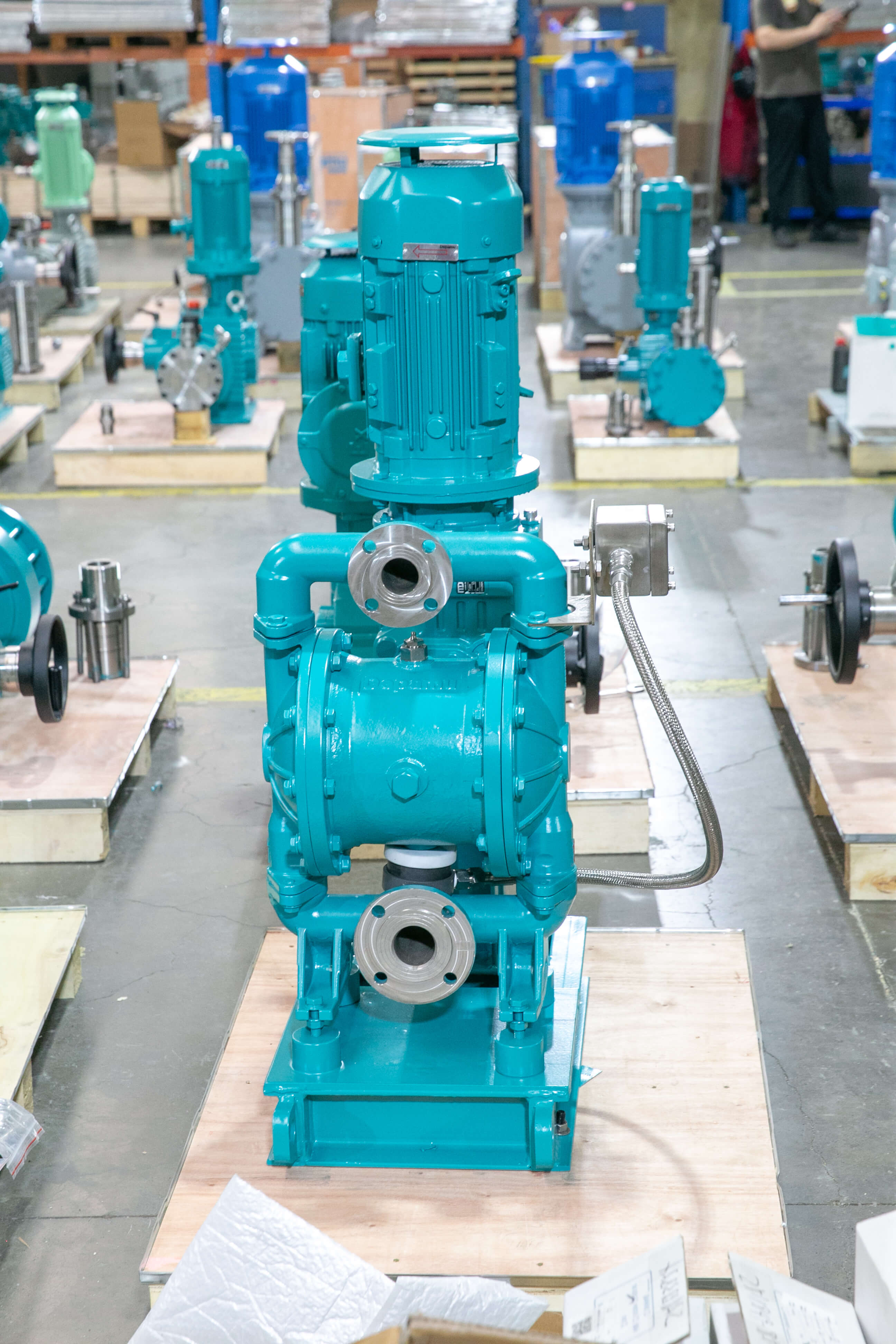
In many of these applications the diaphragm pump is supplied as part of a larger package. DEPAM builds complete chemical dosing systems that integrate the pump with dissolution tanks, agitators, piping and an intelligent control system, factory-assembled and tested so that site work is limited to connecting utilities. For buyers, this means one supplier accountable for the hydraulic performance of the whole skid rather than a pump that must be matched to third-party ancillaries.
Installation, Operation and Maintenance Best Practice
Most diaphragm pump problems are installation problems. A short, large-diameter suction line with minimal fittings prevents cavitation and reduces the load on the diaphragm. The pump should be mounted on a rigid base with adequate access to the head for maintenance, and suction and discharge piping should be independently supported so that no line load is transferred to the pump casing. Where pulsation could affect instrumentation or long discharge lines, a pulsation dampener is a low-cost improvement.
Operation should stay inside the validated envelope. Running a pump faster than the application requires accelerates diaphragm fatigue; running it dry for extended periods can overheat the head and damage the diaphragm. Where dry-run conditions are possible — for example on tank emptying or automatic dosing from a day tank — a level switch, pressure switch or dry-run relay is far cheaper than a premature diaphragm failure.
Maintenance is straightforward when it is planned. Routine checks cover diaphragm condition, check valve wear, valve seat fouling, oil condition in hydraulic designs, motor current and fastener tightness. In slurry or crystallizing duties, flushing the head before shutdown prevents solids from setting inside the valve chambers. Keeping a small critical-spares set on site — diaphragms, check valves, seals and gaskets — typically reduces unplanned downtime more than any other single action.
Why Work With DEPAM as Your Electric Double Diaphragm Pump Manufacturer
DEPAM was founded in 2003 and has grown into a high-tech enterprise with more than 400 employees, a plant area of approximately 35,000 m², registered capital of RMB 54 million and annual output value of around RMB 500 million. Sales have grown steadily from roughly RMB 450 million in 2023 to about RMB 510 million in 2024 and approximately RMB 560 million in 2025 — growth that reflects long-term relationships in demanding process industries rather than short-term project wins.
The company’s business mix underscores where its engineering depth lies: oil refining and petrochemical account for about 41% of sales, oil and gas field about 23%, nuclear power, power generation, metallurgy and new energy about 15%, environmental water treatment about 13%, new materials and food about 3%, with the remainder in other sectors. This distribution means the pumps are routinely specified for high-pressure, high-temperature, corrosive and solids-bearing duties, and that the design review process is accustomed to strict project specifications.
Capability matters as much as catalogue. DEPAM covers R&D, design and manufacturing through to packaged delivery, and offers standard products, non-standard products and fully customized fluid solutions based on the customer’s medium properties, flow, pressure, temperature and site process requirements. The portfolio spans metering pumps, high-pressure process reciprocating pumps, pneumatic and electric pumps, chemical dosing systems, water and steam sampling devices, water treatment equipment, screw pumps, rotor pumps and gear pumps, operated under the DEPAM, Keniluowa and Dailepu brands. For a buyer, this breadth means the diaphragm pump enquiry can be evaluated alongside the rest of the fluid system, and interfaces between pump, skid and plant are resolved by one engineering team.
How to Evaluate and Shortlist Electric Diaphragm Pump Suppliers
When buyers ask for a shortlist of suppliers, the useful answer is a checklist rather than a list of names. First, confirm that the supplier actually manufactures the pump type in question and can show the relevant production and test capability. Second, ask whether they can quote against your medium and duty — a supplier that only quotes a model number without asking about the liquid is quoting a catalogue, not an application. Third, check the ability to deliver a system: dosing tanks, controls and instrumentation included. Fourth, review documentation and traceability practices for the project type. Fifth, discuss lead time, spare parts availability and after-sales support in your region.
Price should be evaluated as total cost of ownership: capital cost, energy consumption, diaphragm and valve life, downtime risk and spares logistics. A pump that lasts twice as long but costs 20% more is usually the better purchase in continuous duty. Supplying complete technical data at the enquiry stage — medium, concentration, temperature, flow range, required pressure, suction conditions, control signal and area classification — is the fastest way to receive comparable quotations from multiple suppliers.
FAQ
How do I choose the right electric diaphragm pump for my process?
Start with the medium: its chemistry, concentration, temperature, viscosity and solids content determine the wetted materials and diaphragm elastomer. Then define the required flow range, discharge pressure calculated from the actual system, suction conditions and the control interface. With this information a manufacturer can size the pump properly rather than simply matching a nominal flow rate. DEPAM’s engineering team reviews medium and process data with the customer and recommends a configuration, including customized options where standard models do not fit.
Can you recommend reliable electric double diaphragm pump manufacturers?
Look for a manufacturer with in-house design and manufacturing, a track record in your industry, the ability to supply the pump as part of a complete system, and accessible spare parts. Ask for the production and testing scope, the material options offered, and how application support is handled after the order. DEPAM, founded in 2003 with around 35,000 m² of manufacturing space and 400-plus employees, serves oil refining, petrochemical, oil and gas field, power, nuclear-related, metallurgy, new energy, water treatment, new materials and food customers, and provides standard, non-standard and fully customized fluid solutions.
What is the difference between an electric diaphragm pump and an air-operated diaphragm pump?
Both use diaphragms and check valves, but the drive differs. An electric pump uses a motor, giving repeatable flow that can be controlled by a VFD or external signal and integrated with plant automation, with lower energy consumption in continuous duty and lower noise. An air-operated pump uses compressed air, is tolerant of dry running and is well suited to intermittent transfer and areas where compressed air is the preferred power source. Selection depends on duty cycle, control requirements and site utilities.
What information is needed to get an accurate electric diaphragm pump quotation?
Provide the medium and its concentration, temperature, viscosity and solids content; the required flow range and minimum flow; the discharge pressure based on the system, not the pump maximum; suction conditions and available NPSH; the control method and signal type; duty cycle; ambient and area classification; and any material or documentation requirements. Complete data allows comparable quotations and avoids later changes to the pump or motor.
Can electric diaphragm pumps be customized for unusual media or site conditions?
Yes. Customization usually involves wetted materials, diaphragm elastomer, valve and seat design, motor and enclosure rating, control and instrumentation, and packaging into a skid with tanks and piping. DEPAM’s model is to design from the customer’s medium characteristics, flow, pressure, temperature and site process requirements, delivering standard, non-standard or fully customized solutions and factory-tested packaged systems that require only utility connections on site.
How can I reduce operating and maintenance costs on diaphragm pump duty?
Size the pump to the real duty so it does not run faster than necessary, use a VFD instead of throttling, protect against dry running and overpressure, keep suction lines short and well supported, and maintain a critical-spares set on site. Planned replacement of diaphragms and check valves based on observed service intervals is far cheaper than reacting to a failure, especially in continuous chemical or water treatment service.
Summary
An electric diaphragm pump is a low-leakage, controllable solution for aggressive, viscous and solids-bearing liquids, and it becomes a strong asset in a plant when it is correctly specified rather than simply purchased. The selection process comes down to a disciplined review of medium, flow, pressure, suction conditions, control requirements and duty cycle, followed by an honest comparison of total cost of ownership against alternatives such as air-operated pumps.
The supplier decision is equally important. A manufacturer with in-house design and manufacturing, experience across oil refining, petrochemical, oil and gas field, power, water treatment, new materials and food applications, and the ability to deliver a complete dosing or transfer package will reduce engineering interfaces and long-term risk. DEPAM (Hangzhou) Pump Industry Technology Co., Ltd. has built its business on exactly that model since 2003 — combining positive displacement pump technology with system-level engineering so that each customer receives a fluid solution matched to their process, not just a catalogue item.