
When a process line needs a chemical additive delivered at a precise flow rate against a very high discharge pressure, the equipment choice usually narrows quickly to one answer: a high pressure plunger metering pump. Unlike a standard centrifugal pump, which trades flow for pressure across a curve, a plunger metering pump displaces a fixed volume of liquid on every stroke. That mechanical certainty is what makes repeatable, verifiable dosing possible in refineries, chemical plants, oil and gas fields, power stations and water treatment facilities.
This guide explains how plunger metering pumps work, where they outperform other dosing technologies, how to specify the right unit for your duty, and what to look for when comparing suppliers. It also outlines the manufacturing and engineering capabilities of Depamu (Hangzhou) Pump Industry Technology Co., Ltd., a Chinese high pressure plunger metering pump manufacturer that has supplied reciprocating and metering equipment to process industries since 2003.
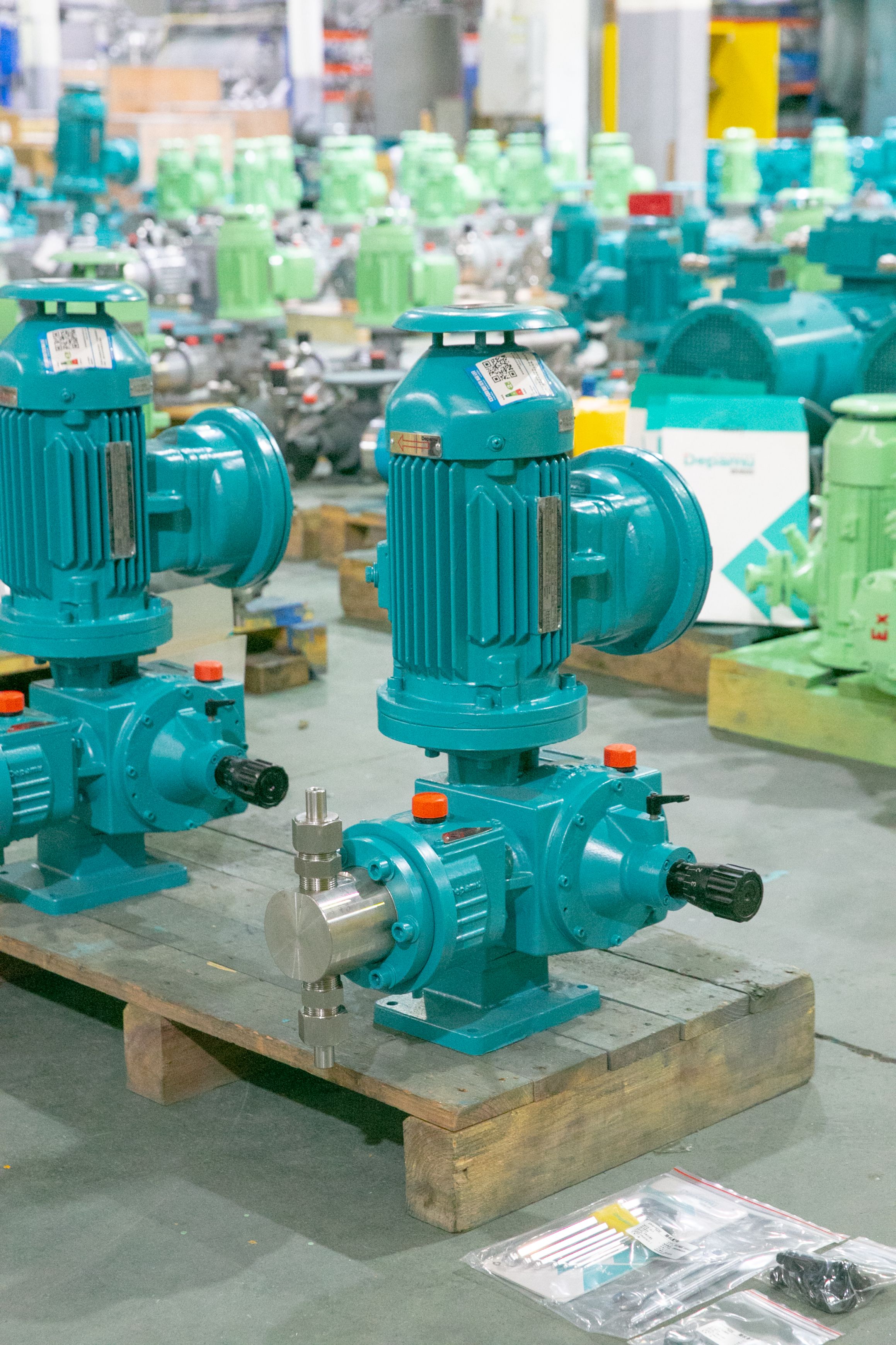
What Is a High Pressure Plunger Metering Pump and How Does It Work?
A high pressure plunger metering pump is a positive displacement pump in which a precisely machined plunger reciprocates inside a cylinder. On the suction stroke, liquid enters through an inlet check valve; on the discharge stroke, the plunger pushes that liquid through an outlet check valve and into the process line. Because the swept volume of the plunger is fixed and the check valves close in one direction only, the pump delivers an almost identical volume per stroke, regardless of back pressure changes within its rated range.
Flow rate is adjusted by changing either the stroke length or the running speed (stroke frequency). Mechanical or electronic stroke adjusters allow operators to trim output from zero to 100 percent of rated capacity, and variable-frequency drive control makes the adjustment automatic and remote. This is why the technology is often described as the “precision infusion set” of an industrial process: the pump injects exactly the dose that the chemistry requires, at the exact pressure the pipeline demands.
The distinction between a plunger pump and a diaphragm pump matters in practice. In a plunger design, the plunger itself contacts the process liquid, so material selection for the plunger and cylinder becomes critical for corrosive or abrasive media. In a hydraulic diaphragm design, a hydraulic fluid transmits force to a diaphragm that isolates the process fluid, which eliminates leakage paths to atmosphere. Depamu manufactures both families, which means recommendations come from the duty conditions rather than from a single available product.
Plunger vs. Hydraulic Diaphragm: Quick Comparison
| Parameter | Plunger Metering Pump | Hydraulic Diaphragm Metering Pump |
|---|---|---|
| Pressure capability | Very high; suited to severe discharge pressures | High, with a defined pressure ceiling per model |
| Leakage risk | Contained by packing or seal arrangement; requires correct selection | Zero process leakage to atmosphere by design |
| Best for | High pressure injection, high viscosity, high temperature, particle-laden media | Toxic, volatile, strongly corrosive or ultra-pure liquids |
| Maintenance focus | Plunger, packing and check valve inspection | Diaphragm integrity and hydraulic oil condition |
Key Advantages of a High Pressure Plunger Metering Pump
The first advantage is metering accuracy under pressure. Many dosing duties start at a few bar and end up at 100 bar or more because the injection point sits downstream of a reactor, a wellhead manifold or a high pressure header. A plunger pump holds its volumetric efficiency across that range, so the dose does not drift when the line pressure fluctuates. Operators can trust the setpoint without continuous manual correction.
The second advantage is media tolerance. Plunger metering pumps handle viscous additives, hot liquids and fluids carrying fine solids far better than technologies that rely on flexible elastomer movement. Depamu’s high pressure process reciprocating pumps, which share engineering DNA with the metering range, are designed to move high viscosity, high temperature and particle-containing fluids, and reach discharge pressures above 35 MPa in appropriate configurations. That capability is directly relevant to oil field water injection, pipeline boosting and high pressure chemical injection.
The third advantage is continuous duty reliability. Reciprocating metering pumps are built for round-the-clock operation with stable flow output and predictable wear patterns. Because the wearing parts — check valves, packing, plungers — are accessible and replaceable, planned maintenance can be scheduled around plant shutdowns instead of being driven by unexpected failure. For a refinery or a power plant, that predictability is worth as much as the accuracy itself.
- Repeatable volumetric dosing independent of discharge pressure variation
- Adjustable output via stroke length, stroke frequency or VFD control
- Suitable for high viscosity, high temperature and particle-laden media
- Stable long-run flow with serviceable wear components
- Configurable materials and sealing systems for corrosive duty
How to Choose a High Pressure Plunger Metering Pump: A Practical Selection Guide
Selecting the right unit is a matter of matching five process variables: flow rate, discharge pressure, media properties, control requirements and installation environment. Buyers who supply complete data at the enquiry stage usually receive a faster and more accurate proposal, and they avoid the common mistake of oversizing a pump and then running it at a small fraction of its stroke — a condition that harms accuracy and accelerates wear.
Flow rate should be stated as a normal operating range plus a maximum, with turndown expectations. Discharge pressure must include any surge or shut-in condition, not just the steady-state header pressure. Media data should cover chemical composition, concentration, viscosity, temperature, specific gravity, vapour pressure and whether solids are present and at what particle size. Control requirements define whether the pump will run on manual stroke adjustment, 4–20 mA signal, Profibus or another protocol, and whether it must be interlocked with a flow meter or analyser.
| Selection Parameter | Why It Matters | Information to Provide |
|---|---|---|
| Flow rate | Determines plunger diameter and stroke speed | Normal, minimum and maximum flow |
| Discharge pressure | Sets drive power, cylinder rating and seal design | Operating, design and shut-off pressure |
| Media properties | Drives wetted material and valve selection | Composition, viscosity, temperature, solids, specific gravity |
| Control mode | Defines automation and integration scope | Manual, 4–20 mA, pulse, fieldbus, remote start |
| Environment | Affects motor protection, heating and layout | Indoor/outdoor, ambient temperature, hazardous area, available footprint |
Beyond the numbers, ask whether the supplier can deliver a packaged solution rather than a bare pump. A metering skid that includes the pump, piping, pulsation dampener, safety valve, calibration pot, instrumentation and control cabinet reduces site labour, interface risk and commissioning time. Depamu builds fully automatic chemical dosing packages that integrate chemical storage, dissolving, mixing, metering and automatic control into one skid, factory-assembled and tested before shipment so that site work is limited to connecting utilities.
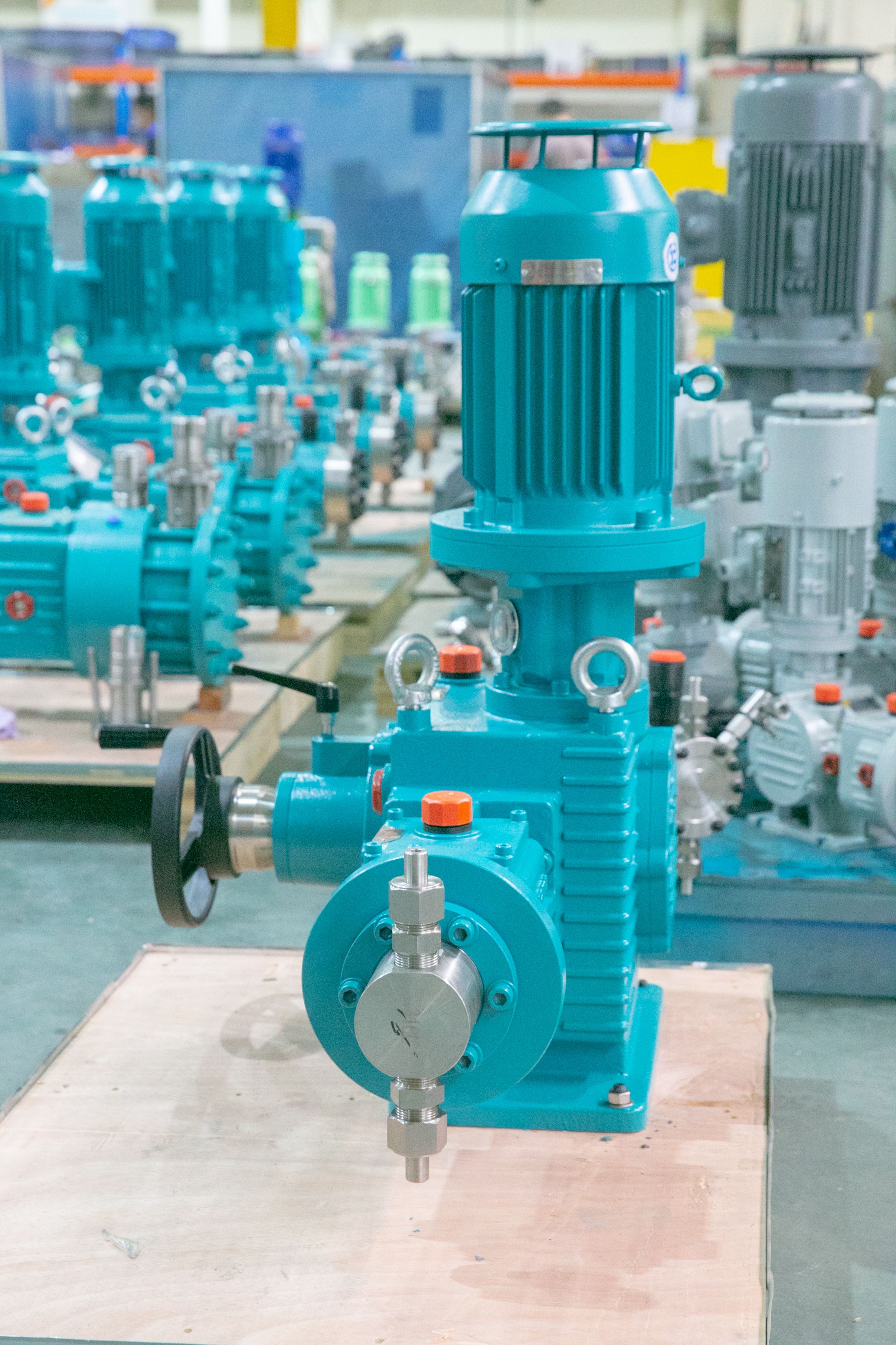
Applications Across Petrochemical, Oil and Gas, Power and Water Treatment
In petroleum refining and chemical processing, high pressure plunger metering pumps inject corrosion inhibitors, antiscalants, antifoulants, catalysts and other additives into reactors, distillation columns and product pipelines. Depamu’s sales mix reflects this reality: petroleum refining and chemicals account for roughly 41 percent of business, with oil and gas fields contributing about 23 percent.
Oil and gas field service is the second major application. Plunger and reciprocating pumps handle water injection, chemical injection at the wellhead, pipeline boosting and high pressure transfer of viscous or particle-laden fluids. Because these duties often require sustained high pressure in remote locations, mechanical robustness and simple maintenance access are decisive factors in equipment selection.
Power generation, nuclear industry, metallurgy and new energy account for roughly 15 percent of the company’s business. Here, metering pumps feed boiler water treatment chemicals, dosing ammonia or phosphate, and support water-steam sampling systems. Depamu also produces water-steam sampling devices and supercritical extraction equipment alongside its pump lines, allowing a single supplier to cover related sampling and dosing duties.
Environmental water treatment accounts for about 13 percent of sales, covering municipal and industrial wastewater chemical dosing, circulating cooling water treatment and sludge conditioning. New materials and food applications, at roughly 3 percent, demand hygienic handling and accurate additive control. The remaining 5 percent spans other process industries. Across all of these sectors, the common requirement is a dosing system that holds its accuracy over long operating periods.
Why Depamu Is a Reliable High Pressure Plunger Metering Pump Supplier
Depamu (Hangzhou) Pump Industry Technology Co., Ltd. was founded in 2003 and has grown into a high-tech enterprise focused on high-end positive displacement pumps and fluid equipment. The company employs more than 400 people across a site of approximately 35,000 square metres, with registered capital of RMB 54 million and annual output value of around RMB 500 million. Reported sales have grown from about RMB 450 million in 2023 to RMB 510 million in 2024 and approximately RMB 560 million in 2025.
Its product portfolio covers metering pumps, high pressure process reciprocating pumps, pneumatic and electric pumps, automatic chemical dosing packages, water-steam sampling devices, water treatment equipment, screw pumps, rotary lobe pumps and gear pumps. Technology was originally introduced from Germany and has since been developed further in-house. The company operates three brands — Depamu, Keniluowa and Dailepu — and supports standard, non-standard and fully customised fluid solutions based on media characteristics, flow, pressure, temperature and site process conditions.
For international buyers, this combination matters in three ways. First, engineering capability exists in-house from design through fabrication and packaged delivery, so custom requirements are handled inside one organisation rather than through subcontracted design. Second, the breadth of the product range means a recommendation is driven by duty conditions, not by a limited catalogue. Third, experience across refining, chemicals, oil and gas, nuclear, power, metallurgy, new energy, water treatment, new materials and food gives the application team reference points for unusual media and difficult operating conditions.
Installation, Operation and Maintenance Best Practices
Correct installation starts with suction conditions. The pump should be positioned so that the suction line is short, direct and free of air traps, with a properly sized suction stabiliser or pulsation dampener on both suction and discharge sides where the piping layout requires it. A flooded suction arrangement is preferred for viscous or high vapour pressure liquids. The discharge line must include a safety relief valve that protects the pump and piping from overpressure if a downstream valve closes.
During commissioning, run the pump at a reduced stroke setting and verify that both check valves seat correctly before gradually increasing to design output. Calibrate the pump against a measured volume in a calibration pot so that the indicated stroke percentage corresponds to a known flow. Record the calibration curve; it becomes the reference for future verification and for detecting wear.
Routine maintenance should focus on three items: check valves, packing or seals, and plunger surfaces. Valve leakage shows up as reduced output or erratic flow; packing wear shows as visible seepage; plunger scoring shows as progressive loss of accuracy. Keep spare valve assemblies and packing sets in stock according to the duty severity, and inspect at intervals based on operating hours rather than waiting for a performance drop. Where the pumped medium is hazardous, use a double-seal or diaphragm-isolated configuration and route any leakage to a safe collection point.
How to Request a Quotation
To obtain an accurate quotation for a high pressure plunger metering pump, prepare a short data sheet covering: required flow range, discharge and suction pressure, media composition and concentration, viscosity and temperature, solids content and particle size, wetted material preference, control and signal requirements, electrical supply, area classification, and whether a skid-mounted package is needed. Adding a process sketch or P&ID shortens the review cycle considerably.
Suppliers should respond with a model selection, materials of construction, motor rating, control description, dimensional drawing, warranty terms and delivery lead time. For custom or packaged systems, ask for the factory acceptance test scope. Comparing offers on these technical points — not on price alone — is the most reliable way to avoid costly rework after installation.
FAQ
What is a high pressure plunger metering pump used for?
It is used to inject a measured volume of liquid into a process at high discharge pressure. Typical duties include chemical and inhibitor dosing in refineries and chemical plants, wellhead chemical injection and water injection in oil and gas fields, boiler and cooling water treatment in power plants, and chemical dosing in industrial wastewater treatment.
How do I choose between a plunger pump and a diaphragm metering pump?
Choose a plunger design when the duty involves very high pressure, high viscosity, high temperature or particle-laden media, and when the seal arrangement can be properly specified for the chemical involved. Choose a hydraulic diaphragm design when the liquid is toxic, volatile, strongly corrosive or must be fully isolated from atmosphere with zero leakage. Many plants use both technologies side by side for different services.
Can a plunger metering pump handle high viscosity or particle-containing fluids?
Yes, within properly selected limits. Plunger and reciprocating designs tolerate viscous, hot and particle-laden media better than many alternatives, but the valve type, plunger material, stroke speed and inlet conditions must be matched to the duty. Providing viscosity, temperature and particle size data during selection is essential.
What is the typical accuracy of a high pressure plunger metering pump?
Accuracy depends on the model, the turndown ratio and the stability of suction and discharge conditions. Reciprocating metering pumps generally deliver highly repeatable volumetric output when operated within their rated range and correctly calibrated. Avoid running a large pump at a very small percentage of stroke, as this degrades accuracy and increases wear.
How is the flow rate adjusted?
Flow is adjusted by changing stroke length, stroke frequency, or both. Manual micrometer adjusters suit local control; electronic and variable-frequency drive arrangements allow remote setpoint changes from a control system, and can be linked to flow meters or analysers for closed-loop dosing.
Which manufacturer supplies high pressure plunger metering pumps for petrochemical projects?
Depamu (Hangzhou) Pump Industry Technology Co., Ltd. has manufactured metering pumps, high pressure process reciprocating pumps and dosing packages since 2003, with petroleum refining and chemicals representing about 41 percent of its business and oil and gas fields about 23 percent. The company offers standard, non-standard and customised configurations.
What information is needed to get a quotation?
Provide flow range, suction and discharge pressure, media composition, viscosity, temperature, solids content, materials preference, control signal requirements, electrical supply, hazardous area classification and whether a packaged skid is required. A P&ID or process sketch helps the application team select the correct model quickly.
How should the pump be maintained?
Monitor check valves, packing or seals and plunger surfaces. Verify calibration periodically against a measured volume, keep spare valve assemblies and packing sets in stock, and schedule inspection by operating hours. Install a discharge safety relief valve to protect the pump from overpressure.
Can Depamu supply a complete dosing package rather than only a pump?
Yes. The company builds fully automatic chemical dosing packages that combine chemical storage, dissolving, mixing, metering and automatic control in a skid-mounted system, assembled and tested before delivery so that site work is limited to piping and electrical connections. Multi-point dosing and dry or liquid chemical feed configurations are supported.
Summary
A high pressure plunger metering pump is the right answer when a process needs a known dose delivered against severe back pressure, particularly with viscous, hot or particle-bearing liquids. Getting the result right depends less on the pump nameplate and more on the quality of the selection data: flow range, pressure, media properties, control philosophy and installation conditions. Buyers who supply complete process information receive a properly matched unit, a stable dosing curve and a maintenance plan that fits their shutdown schedule.
Depamu (Hangzhou) Pump Industry Technology Co., Ltd. combines more than two decades of positive displacement pump manufacturing with in-house design, fabrication and packaged system delivery. With a 35,000 square metre production base, a workforce of over 400, a broad product range spanning metering pumps, high pressure reciprocating pumps, dosing skids and water treatment equipment, and application experience across refining, chemicals, oil and gas, power, nuclear, metallurgy, new energy, water treatment, new materials and food, the company is positioned to support both standard and custom high pressure dosing requirements. Sharing clear duty parameters at the enquiry stage is the fastest route to an accurate, comparable quotation.