
A high pressure reciprocating pump is one of the most dependable pieces of equipment in any process line where fluid must be moved at elevated pressure, at a precisely controlled flow rate, or against a long discharge pipeline. Unlike centrifugal pumps, which rely on rotating impellers and lose efficiency as pressure rises, reciprocating pumps use a positive displacement action: a plunger, piston or diaphragm moves back and forth inside a chamber, pushing a fixed volume of liquid on every stroke. That mechanical principle is what allows reciprocating pumps to deliver stable flow at very high discharge pressures, even when the medium is viscous, hot, abrasive or contains fine solids.
For buyers, however, the technical principle is only half of the story. The real challenge is choosing a pump that matches the process duty, a high pressure reciprocating pump manufacturer that can engineer the unit around the actual medium and site conditions, and a supplier that can support the equipment through installation, commissioning and years of continuous operation. This guide explains how high pressure reciprocating pumps work, where they are used, which parameters matter during selection, and how to evaluate a supplier before you place an order.
What Is a High Pressure Reciprocating Pump and How Does It Work?
A high pressure reciprocating pump converts the rotary motion of a motor into linear reciprocating motion through a crankshaft, connecting rod and crosshead assembly. The reciprocating element — a plunger, piston or diaphragm — draws liquid into the suction chamber through an inlet check valve and then forces it out through a discharge check valve. Because the volume displaced per stroke is geometrically fixed, flow rate is proportional to stroke speed and stroke length, while discharge pressure is determined by the system resistance and the mechanical strength of the pump components.
This positive displacement behaviour produces several characteristics that matter in industrial service. First, flow is essentially independent of discharge pressure, so the pump keeps delivering the same volume even as line pressure fluctuates. Second, the pump can be sized to generate very high heads, with process reciprocating pumps commonly reaching discharge pressures of 35 MPa and above depending on configuration. Third, because the pump is self-priming in most arrangements and handles entrained gas better than many centrifugal designs, it is well suited to dosing, injection and boosting duties.
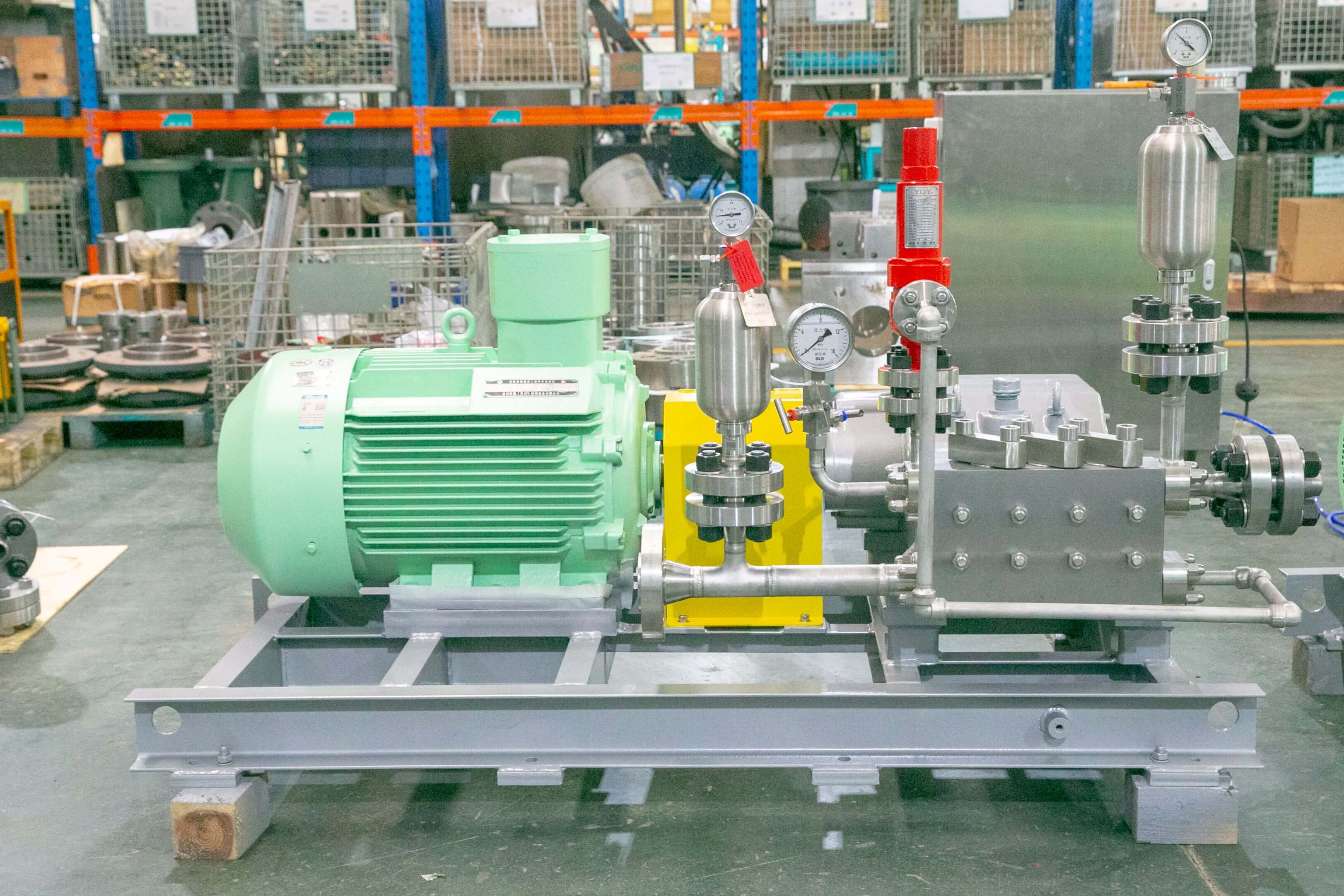
Depamu (Hangzhou) Pump Industry Technology Co., Ltd., founded in 2003 and operating a plant of roughly 35,000 square meters with more than 400 employees, has focused on this category of positive displacement equipment for over two decades. The company’s high pressure process reciprocating pump line — built around plunger reciprocating technology — is designed to move low-pressure liquid into high-pressure process lines or long-distance pipelines, and is engineered to handle high viscosity, high temperature and solids-containing media.
Core Performance Advantages of High Pressure Process Reciprocating Pumps
The value of a reciprocating design shows up most clearly in demanding duty. A high pressure pump for chemical process service must often run 24 hours a day, sometimes for months between planned shutdowns, while handling media that attack seals, corrode wetted parts or deposit solids on internal surfaces. Reciprocating pumps address these conditions through robust mechanical design, replaceable wear parts and material selection matched to the medium.
High discharge pressure with stable flow
Because the pressure capability of a reciprocating pump is limited mainly by structural design rather than hydraulics, these units can be built to deliver pressures of 35 MPa and above. Flow remains stable across the pressure range, which is critical in injection duties where a fluctuating flow rate would disturb the process balance. In oilfield water injection and chemical reactor feed applications, that stability directly protects downstream equipment.
Reliable handling of complex media
Viscous liquids, high-temperature fluids and slurries with fine suspended solids are difficult duties for many pump types. Reciprocating pumps handle them because the suction and discharge valves are designed to open and close under positive displacement pressure, and because flow velocity through the pump can be kept relatively low. For corrosive or hazardous fluids, a hydraulic diaphragm design provides an additional barrier: the medium never contacts the hydraulic system, so leakage risk is minimised even at high pressure.
Repeatable, adjustable metering accuracy
When the pump is used for chemical injection, accuracy becomes the primary requirement. A hydraulic diaphragm metering pump — a core product in the Depamu range — regulates output by adjusting stroke length and operating frequency, allowing operators to set a precise dose and repeat it consistently. This is the working principle behind the company’s metering pump family, which is used wherever chemicals must be added in controlled quantities rather than simply moved.
Long continuous operating cycles
Reciprocating pumps built for process service use heavy-duty bearings, hardened plungers, precision check valves and lubricated drive arrangements that support continuous operation. Maintenance intervals are driven by wear-part condition rather than by hydraulic instability, which makes planned maintenance easier to schedule and reduces the risk of unplanned process interruptions.
| Selection Parameter | Why It Matters When Specifying a Pump |
|---|---|
| Medium and concentration | Determines wetted material choice, diaphragm or plunger configuration and valve design. |
| Required flow rate | Defines stroke speed and pump size; also affects valve sizing and piping layout. |
| Discharge pressure | Sets structural class of the pump; process pumps can be configured for 35 MPa and above. |
| Temperature | Affects seal, diaphragm and material selection as well as cooling requirements. |
| Viscosity and solids content | Influences suction conditions, valve type and whether a flushing arrangement is needed. |
| Control and automation | Determines whether manual stroke adjustment, variable speed drive or PLC-linked dosing control is specified. |
| Site conditions | Ambient temperature, area classification, available footprint and utilities affect packaging and skid design. |
Application Scenarios for High Pressure Reciprocating Pumps
High pressure reciprocating pumps appear across a wide range of industries, and in most cases the reason is the same: the process needs pressure and flow control that other pump types cannot deliver reliably. Depamu’s product portfolio is distributed across oil refining and petrochemicals (about 41% of sales), oil and gas fields (about 23%), nuclear power, power generation, metallurgy and new energy (about 15%), environmental water treatment (about 13%), and new materials and food (about 3%), with the remainder spread across other sectors.
Oil refining and petrochemical processing
In refineries and chemical plants, reciprocating pumps handle chemical injection into reactors and columns, process boosting, and the transfer of high-pressure liquids between units. A high pressure pump for chemical process service must tolerate corrosive additives, high temperatures and continuous duty, which is why hydraulic diaphragm and plunger designs are commonly specified. Chemical dosing accuracy directly affects product quality and reagent consumption, making metering performance an economic issue rather than only a technical one.
Oil and gas field water injection
Water injection is one of the classic duties for a reciprocating plunger pump for oilfield water injection. Produced water, seawater or treated injection water must be pushed into the reservoir at high pressure through long strings and distribution headers. The pump must maintain a stable injection rate, resist corrosion and erosion from the injected water, and operate continuously in remote locations where maintenance access is limited. Flow stability matters because injection allocation between wells is usually balanced by pressure and rate control.
Pipeline boosting and long-distance transfer
Where liquid must be moved through long pipelines or from a low-pressure header into a high-pressure system, a high pressure pump for pipeline boosting provides the necessary pressure differential. Reciprocating units are well suited to this duty when the flow is moderate and the pressure ratio is high, and when the medium is viscous or contains solids that would damage a centrifugal impeller.
Environmental water treatment and boiler systems
In water treatment, reciprocating metering pumps and fully automatic chemical dosing skids are used to inject coagulants, scale inhibitors, disinfectants and pH correction chemicals. A skid package integrates chemical storage, dissolving, agitation, metering and automatic control in one pre-assembled system, so on site only piping and power connections are required. This reduces installation work and improves dosing consistency compared with manually assembled dosing stations.
How to Select the Right High Pressure Reciprocating Pump: A Practical Guide
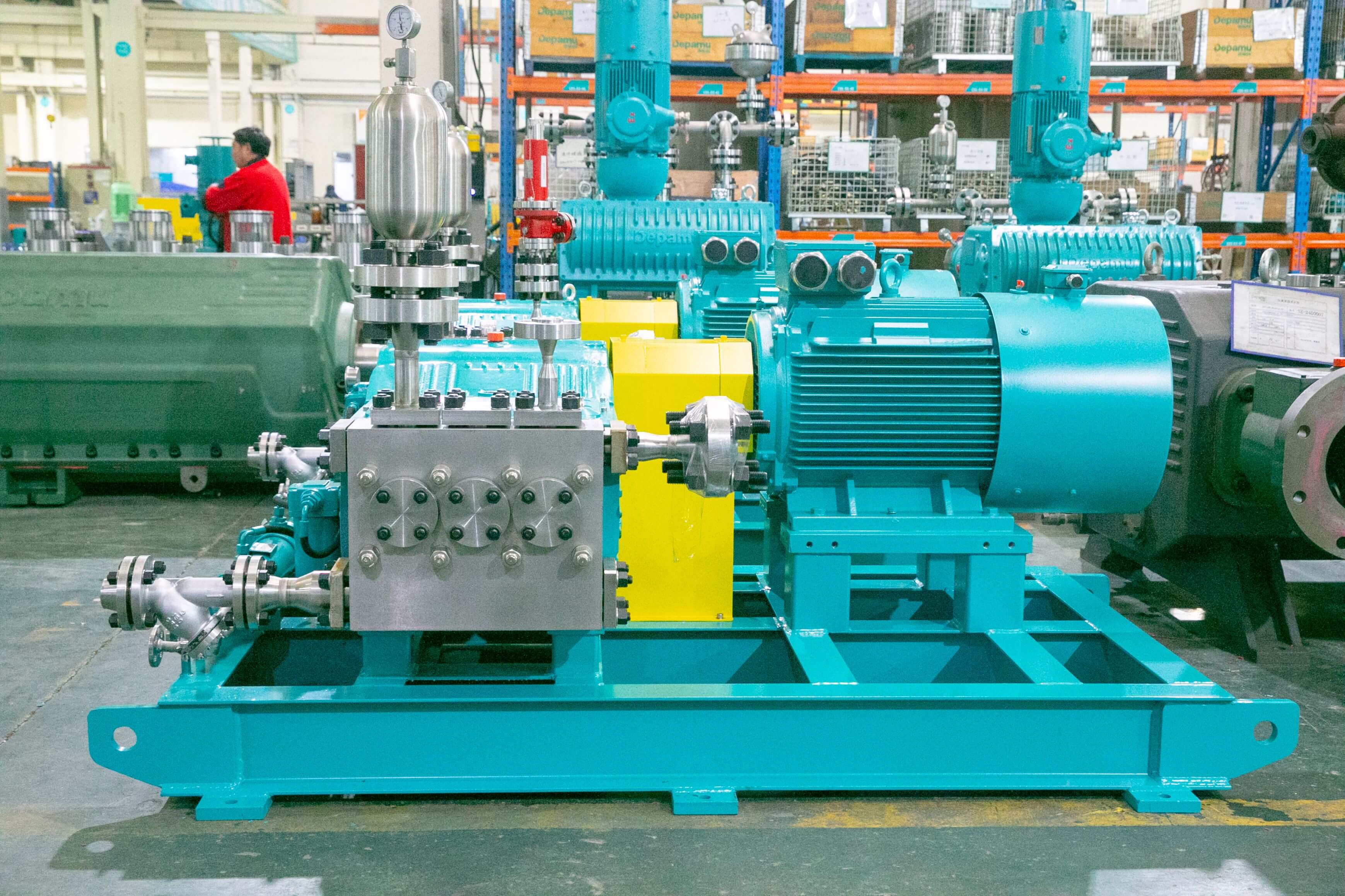
Selecting a high pressure reciprocating pump is not a catalogue exercise. Two pumps with the same flow and pressure rating can behave very differently depending on the medium, the duty cycle and the piping arrangement. A structured selection process avoids most of the problems that appear after commissioning.
Step 1: Define the duty in numbers
Start with the required flow rate, the suction pressure available, the minimum and maximum discharge pressure, the continuous or intermittent duty pattern, and the expected process turndown. Note whether the pump is expected to run at a fixed set point or to follow a variable demand signal. These figures determine the pump size, stroke speed and control strategy.
Step 2: Characterise the medium honestly
Record viscosity at operating temperature, specific gravity, temperature range, solids content and particle size, chemical composition, and whether the fluid is flammable, toxic or prone to crystallisation. A medium that crystallises on seal faces requires a different configuration from one that is simply corrosive. Providing a lab analysis or field sample to the manufacturer during quotation is the most reliable way to avoid material mismatch.
Step 3: Choose between plunger and diaphragm configurations
Plunger pumps generally suit high pressure, high flow and media that are compatible with packings and plunger materials. Hydraulic diaphragm metering pumps are preferred where zero leakage is essential — for hazardous, toxic, volatile or high-value chemicals — because the diaphragm isolates the process fluid from the hydraulic drive. In practice, the choice often comes down to the consequence of leakage and the accuracy requirement.
Step 4: Decide the level of automation
Manual stroke adjustment is adequate for stable processes. Variable speed drives, automatic stroke actuators and PLC-linked control become worthwhile where dosing must follow a flow signal, a pH or conductivity measurement, or a plant-wide control system. Skid-mounted packages that combine pumps, tanks, mixers and controls simplify this decision because the automation is engineered as one integrated system.
Step 5: Confirm the commercial and service picture
Finally, confirm delivery time, spare parts availability, documentation, testing before shipment, and the manufacturer’s ability to support commissioning and after-sales service in your region. A high pressure reciprocating pump price that looks attractive at quotation stage can become expensive if wear parts are hard to source or if technical support is unavailable during a shutdown.
Comparing Pump Options for High Pressure Duties
Buyers often compare reciprocating pumps with centrifugal and rotary positive displacement alternatives. The table below summarises how each type behaves in typical high pressure duties.
| Pump Type | Typical Strength | Practical Limitation |
|---|---|---|
| Reciprocating plunger pump | Very high pressure, stable flow, good for viscous and solids-containing media | Pulsation requires dampeners; packings and valves are wear parts |
| Hydraulic diaphragm metering pump | Leak-free operation, precise dosing, safe for hazardous chemicals | Diaphragm condition must be monitored; lower flow than large plunger units |
| Centrifugal pump | High flow, compact, low pulsation, simple maintenance | Pressure capability limited; flow varies with system resistance |
| Screw or rotary lobe pump | Gentle handling of viscous media, continuous flow | Pressure range generally below high pressure reciprocating designs |
How to Evaluate a High Pressure Reciprocating Pump Manufacturer and Supplier
When overseas buyers ask which supplier to work with for a high pressure reciprocating pump, the answer usually depends less on the brochure than on engineering depth and delivery capability. A manufacturer that designs, machines and assembles its own pumps can adjust dimensions, materials and controls to a project specification; a trading company that resells generic units cannot.
Depamu operates as a research, production and sales integrated enterprise with in-house capability spanning product development, design, manufacturing and packaged delivery. That structure allows the company to supply standard products as well as non-standard and customised fluid solutions based on a customer’s medium characteristics, flow rate, pressure, temperature and site process requirements. The company runs three brands — Depamu, Keniluowa and Dailepu — across metering pumps, high pressure process reciprocating pumps, pneumatic and electric pumps, chemical dosing packages, water and steam sampling equipment, water treatment equipment, and screw, rotor and gear pumps.
Questions worth asking before purchase
- Can the manufacturer show the hydraulic and mechanical calculations behind the offered model for your specific duty?
- Which wetted materials are proposed, and why are they appropriate for your medium and temperature?
- Is the pump tested before shipment, and what test records are provided?
- What is the recommended spare parts list for the first two years of operation?
- How quickly can wear parts such as diaphragms, check valves and packings be supplied?
- Is technical support available for commissioning, either remotely or on site?
Sales performance is another useful indicator of supplier stability. Depamu’s sales have grown from approximately RMB 450 million in 2023 to about RMB 510 million in 2024 and about RMB 560 million in 2025, which reflects sustained demand for its pump and package portfolio across refining, oilfield, power, nuclear, new energy and water treatment markets. For a buyer placing a multi-year order, that continuity reduces the risk of discontinued models and unavailable spares.
Installation, Operation and Maintenance Best Practices
Most reciprocating pump problems originate at installation rather than in the pump itself. Suction piping that is too long, too narrow or insufficiently supported causes cavitation and valve hammering. Discharge piping without pulsation damping transmits pressure spikes into the system and accelerates fatigue in valves and fittings. Correcting these issues at the design stage is far cheaper than correcting them after start-up.
During operation, monitor discharge pressure, flow rate, vibration, lubricant condition and packing leakage as routine parameters. Where a metering pump is used, verify dose accuracy periodically against a calibration cylinder rather than relying solely on the stroke setting. For diaphragm units, follow the manufacturer’s interval for diaphragm inspection, because a diaphragm failure in a hazardous chemical service is both a safety and an environmental event.
For maintenance planning, keep a critical spares inventory proportionate to the duty cycle. Continuous duty pumps running corrosive media typically consume check valves, plungers, packings or diaphragms faster than intermittent units. Documenting replacement intervals builds a reliable history that supports better planning and reduces unplanned downtime.
FAQ
What is a high pressure reciprocating pump used for?
A high pressure reciprocating pump is used where fluid must be delivered at high discharge pressure with a stable, predictable flow rate. Typical duties include oilfield water injection, chemical injection and process boosting in refineries and chemical plants, pipeline boosting, high pressure transfer of viscous or high temperature media, and chemical dosing in water treatment and boiler systems.
How do I choose the right high pressure reciprocating pump supplier?
Look for a supplier that manufactures rather than only resells, that can engineer a configuration around your medium, flow, pressure and temperature, and that provides test records, spare parts and after-sales support. Ask for the hydraulic and mechanical basis of the offered model, confirm material selection reasoning, and check whether non-standard or customised solutions are possible. Depamu, for example, offers standard, non-standard and customised fluid equipment based on site process requirements.
What information is needed to get a quotation for a high pressure reciprocating pump?
A usable quotation requires the medium and its concentration, viscosity, specific gravity, temperature, solids content, required flow rate, suction pressure, discharge pressure, duty pattern, control and automation requirements, and site conditions such as ambient temperature and available utilities. Providing a sample analysis or field data helps the manufacturer select materials and configuration accurately.
What is the difference between a hydraulic diaphragm metering pump and a reciprocating plunger pump?
A hydraulic diaphragm metering pump uses a hydraulically actuated diaphragm to isolate the process fluid, so there is no packing leakage and dosing accuracy is high — suitable for hazardous, toxic or high value chemicals. A reciprocating plunger pump uses a plunger with packings and is generally chosen for higher flow and very high pressure duties, including duties where the medium is viscous or contains solids.
Can a high pressure reciprocating pump handle high viscosity and high temperature media?
Yes. Reciprocating designs are specifically suited to high viscosity, high temperature and solids-containing media because positive displacement action provides strong suction and because flow velocities through the pump can be kept low. Material selection for wetted parts, seals and valves must be matched to the actual temperature and chemical composition, which is why medium data should be shared during quotation.
What is included in a fully automatic chemical dosing skid?
A fully automatic chemical dosing skid typically integrates chemical storage, dissolving, agitation, metering and automatic control in one packaged system, with the metering pump as the core component. It supports dry powder or liquid chemical addition, multi-point dosing and automatic interlocking control, and is assembled and tested before shipment so that on-site work is limited to piping and power connections.
Summary
Choosing a high pressure reciprocating pump is a decision that combines hydraulic engineering with supplier due diligence. The pump must match the medium, the flow and pressure envelope, the temperature and the duty cycle, and it must be supported by a manufacturer that can engineer, test and service the equipment over its operating life. Reciprocating pumps remain the preferred solution wherever stable flow at high pressure, accurate chemical dosing or reliable handling of difficult media is essential.
Depamu (Hangzhou) Pump Industry Technology Co., Ltd. brings more than two decades of focus to this category, with in-house development, manufacturing and packaged delivery capability, a portfolio spanning metering pumps, high pressure process reciprocating pumps, chemical dosing skids and other fluid equipment, and experience across refining, petrochemical, oilfield, power, nuclear, new energy, water treatment and food applications. Buyers who define their duty clearly, evaluate engineering depth rather than price alone, and plan spares and maintenance from the start will get far more value from a high pressure reciprocating pump installation.