
Selecting a high pressure reciprocating pump is rarely just a matter of matching a flow rate and a pressure number. The pump sits at the heart of a process line, and an undersized or poorly matched unit can limit output, damage downstream equipment, or create maintenance headaches that last for years. For buyers sourcing from overseas, the challenge is even greater: you need a high pressure reciprocating pump manufacturer who can interpret your process data, propose a realistic configuration, and support the unit after delivery.
This guide walks through the practical side of pump selection — the parameters that actually drive the decision, the difference between plunger and diaphragm designs, the industries where high pressure reciprocating pumps earn their place, and the questions worth asking before you send a request for quotation to several suppliers. It is written for process engineers, procurement teams and project contractors who need a clear, technical starting point rather than a sales brochure.
What Is a High Pressure Reciprocating Pump and Where Does It Fit?
A high pressure reciprocating pump uses a piston, plunger or diaphragm that moves back and forth inside a chamber. Each stroke displaces a fixed volume of liquid, and a set of suction and discharge check valves keeps the flow moving in one direction. Because the displacement is positive and mechanically defined, the pump delivers a nearly constant flow rate regardless of pressure fluctuations in the discharge line — a behaviour that centrifugal pumps cannot replicate at high heads.
This positive displacement principle makes reciprocating pumps the default choice for duties involving high discharge pressure, accurate dosing, viscous or abrasive media, and low flow rates at high head. In a refinery, a high pressure process pump may be used to inject chemicals into a reactor feed line; in an oil field, a plunger pump may push water into a reservoir at pressures well above 20 MPa; in a power plant, a small metering pump may dose hydrazine or phosphate with accuracy measured in fractions of a percent.
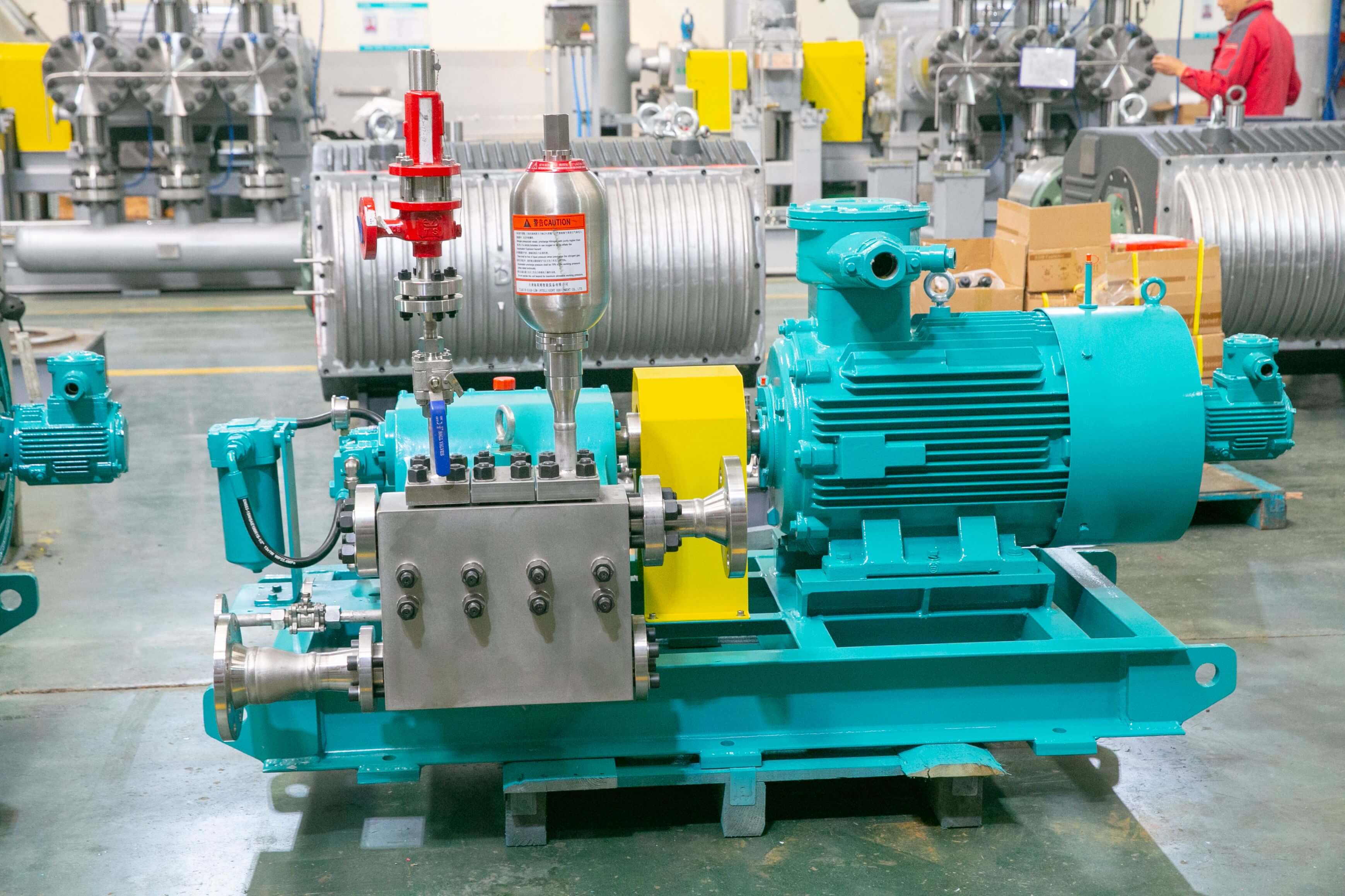
The key distinction is that reciprocating pumps are chosen for capability, not simply for capacity. A pump that handles clean water at 5 MPa may be entirely unsuitable for a slurry at 25 MPa, and the same nominal model can behave very differently depending on viscosity, temperature and the presence of solids. That is why the selection conversation almost always begins with the medium, not the model number.
Why the Manufacturer Behind the Pump Matters More Than the Datasheet
On paper, two pumps from different suppliers can look nearly identical: same flow, same pressure, same port size. In service, the differences appear in valve life, packing or diaphragm durability, hydraulic efficiency, and how easily the unit can be serviced in a plant where spare parts arrive by air freight. A high pressure reciprocating pump manufacturer with in-house design and machining capability can control these details; a trading company reselling third-party units usually cannot.
Vertical integration matters most in three areas. First, hydraulic design: the shape of the valve chambers and the volumetric efficiency of the pump determine how much of the theoretical displacement actually reaches the process. Second, materials: wetted parts must be matched to the medium, whether that is chloride-rich water, amine solutions, acids, or high-temperature heat transfer fluids. Third, testing: a unit should be pressure-tested and performance-tested before shipment, because correcting a defect after installation is far more expensive than catching it at the factory.
For international buyers, support capability is equally important. Ask whether the manufacturer can provide drawings, material certificates, operation manuals and commissioning guidance in a language your site team can use, and whether spare parts are standardised across models so that inventory can be kept minimal. These are the factors that separate a one-off purchase from a long-term supply relationship.
How to Choose a High Pressure Reciprocating Pump: A Step-by-Step Selection Guide
Choosing the right unit starts with a process data sheet rather than a product catalogue. The more precisely you can define the duty, the more accurate — and more comparable — the quotations you receive will be. The steps below reflect the sequence a pump engineer typically follows when sizing a reciprocating pump for an industrial application.
Step 1: Define the Medium in Detail
Record the fluid name, concentration, density, viscosity at operating temperature, vapour pressure, solids content and particle size, corrosivity, and whether the medium is toxic, flammable or prone to crystallisation. A high viscosity media reciprocating pump may need larger suction passages and slower stroke speeds, while a fluid containing abrasive particles may call for hardened plungers and specially designed valves.
Step 2: Fix the Flow Rate and Pressure Range
State the required capacity in cubic metres per hour or litres per hour, together with the minimum and maximum values the process will actually run at. Reciprocating pumps are often specified with a turndown requirement — for example, dosing from 10% to 100% of rated flow. Also confirm the rated discharge pressure, the suction pressure available, and the maximum pressure the discharge line can safely see. Note that a pump rated for 35 MPa is not automatically suitable for continuous operation at that pressure with a highly viscous medium.
Step 3: Check Temperature and Thermodynamic Limits
Operating temperature affects seal life, material strength and net positive suction head. For hot media, confirm the maximum allowable working temperature of the diaphragm, packing and valve components. For fluids near their boiling point, calculate the available NPSH carefully; reciprocating pumps have limited suction capability once the fluid begins to flash.
Step 4: Decide on the Pump Type and Control Method
Choose between plunger, packed piston and hydraulic diaphragm designs based on leakage tolerance, pressure level and medium characteristics. Then decide how the flow will be controlled — manually by stroke length, electrically by variable speed, or pneumatically — and whether the pump must interface with a plant DCS or PLC through 4–20 mA, pulse or Profibus signals.
Step 5: Confirm Materials, Sealing and Accessories
Wetted materials, check valve type, packing or diaphragm construction, lubrication method, and the need for pulsation dampeners, safety relief valves, back pressure valves and calibration columns all form part of the specification. For skid-based installations, include the piping, instruments and control panel in the scope so that responsibility for the complete package sits with one supplier.
| Selection Parameter | What to Provide | Why It Affects the Pump Choice |
|---|---|---|
| Flow rate | Normal, minimum and maximum capacity; required turndown | Determines plunger diameter, stroke length and drive speed |
| Discharge pressure | Rated pressure plus any surge or deadhead allowance | Drives wall thickness, valve design and motor rating |
| Viscosity | Value at pumping temperature, not at ambient | Affects suction conditions, valve sizing and volumetric efficiency |
| Temperature | Minimum and maximum operating temperature | Determines sealing material, clearances and cooling needs |
| Solids and abrasives | Content percentage, particle size and hardness | Guides valve type and wear-resistant wetted materials |
| Control requirement | Manual, variable speed or automated dosing with plant signals | Defines drive selection and instrumentation scope |
| Installation environment | Indoor/outdoor, hazardous area classification, available footprint | Influences motor protection, skid layout and enclosure design |
Plunger versus Diaphragm: Matching the Pump Type to the Duty
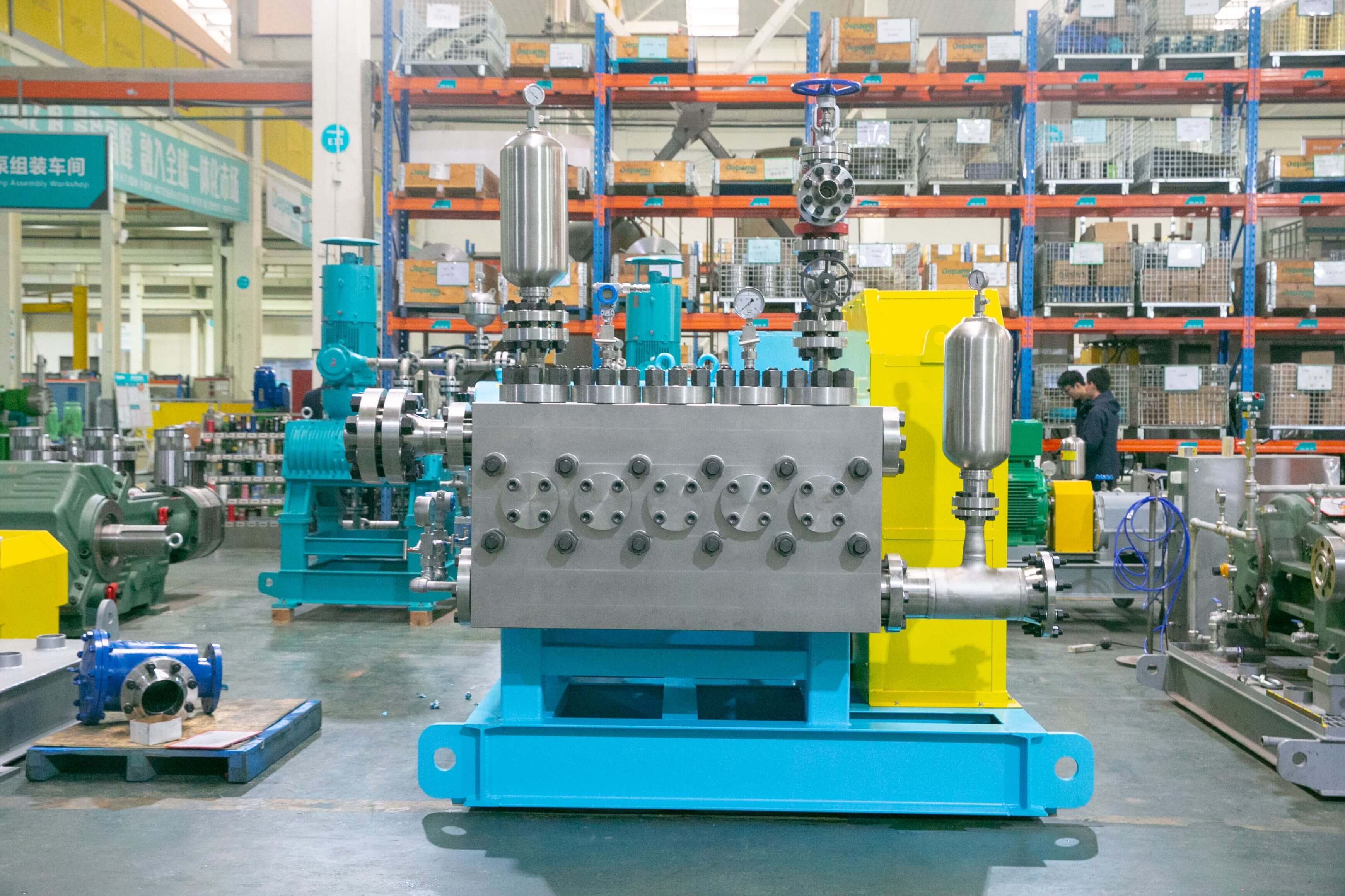
Two designs dominate high pressure service, and they are not interchangeable. A high pressure plunger reciprocating pump uses a hard plunger moving through a packing gland, which allows very high pressures and high temperatures but permits a small, controlled amount of leakage at the packing. A hydraulic diaphragm pump isolates the medium behind a flexible diaphragm, eliminating leakage entirely, which is essential for toxic, expensive or ultra-pure fluids.
In practice, many plants use both types side by side. A plunger unit handles bulk injection of produced water or process chemicals, while a hydraulic diaphragm metering pump doses a small, precise additive stream where even a few grams per hour of leakage would be unacceptable. Understanding this division early prevents over-specifying one design for a duty it does not suit.
| Comparison | High Pressure Plunger Pump | Hydraulic Diaphragm Metering Pump |
|---|---|---|
| Leakage behaviour | Small controlled packing leakage, routed to drain | Fully sealed, no contact between medium and atmosphere |
| Typical pressure level | Very high, suitable for pressures above 35 MPa in appropriate configurations | High, but generally limited by diaphragm fatigue life |
| Best suited media | Water, emulsions, viscous fluids, media with some solids | Corrosive, toxic, volatile, high-purity or expensive chemicals |
| Metering accuracy | Good, adjusted by stroke length and speed | High, repeatable at low capacities |
| Maintenance focus | Packing, plunger and check valves | Diaphragm, hydraulic oil and relief valve |
Typical Applications Across Industries
High pressure reciprocating pumps appear wherever a process needs a defined volume of liquid delivered against a significant resistance. In oil and gas fields, plunger pumps inject water into reservoirs to maintain pressure and improve recovery, often at pressures and flow rates that demand robust valves and wear-resistant plungers. In petrochemical and refinery service, they handle chemical injection, reactor feed, and the transfer of viscous or high-temperature process streams.
In the chemical industry, reciprocating pumps feed reagents into reactors and circulate heat transfer fluids, while diaphragm metering pumps dose additives with high repeatability. Power plants use them for boiler chemical dosing, condensate treatment and water sampling systems. Nuclear, metallurgical and new energy facilities rely on them for precise reagent addition and high pressure process duties. Water treatment plants use them for coagulant and disinfectant dosing, and the food and new material sectors use them where gentle handling and accurate proportioning are required.
Because these duties vary so widely, a pump that works well in one plant may need a different valve arrangement, material set or control philosophy in another. This is normal in reciprocating pump engineering, and it is the reason experienced buyers treat the selection process as a joint exercise between process owner and manufacturer rather than a catalogue lookup.
Standard, Non-Standard or Fully Customised: Working with an OEM Supplier
Not every duty can be met with a catalogue model. When the medium is unusually corrosive, the pressure is outside the standard range, the footprint is constrained, or the pump must be integrated into a skid with tanks, mixers and control panels, an OEM high pressure reciprocating pump supplier becomes essential. The practical question is how much of the package should be customised and how much should remain standard to keep spares and maintenance simple.
A sensible approach is to customise the wetted end — materials, valve type, plunger or diaphragm construction — while keeping the drive end, lubrication system and frame as standard as possible. This balances process fit with serviceability. For chemical dosing applications, a fully assembled package combining metering pumps, dissolution tanks, agitators and automatic control can be factory-assembled and tested, so that site work is limited to connecting utilities and piping.
What to Ask Before You Request a Quotation
When you contact several manufacturers for a high pressure reciprocating pump quotation, the quality of the answers depends heavily on the quality of the questions. Start by asking each supplier to confirm the calculated plunger or diaphragm diameter, the resulting volumetric efficiency, and the expected valve life for your medium. A supplier who simply quotes a model number without these details is unlikely to have reviewed your process data.
Ask also about testing: will the unit be hydrostatically tested and performance-tested before shipment, and will test reports be provided? What is the standard scope of supply — does it include a relief valve, pulsation dampener, baseplate and coupling guard, or are these extras? What is the lead time for the pump and for critical spares, and how are spare parts identified in the manual? For overseas projects, confirm documentation language, packing standards for sea freight, and the warranty terms in writing.
Finally, ask for references in similar duties — not customer names necessarily, but the type of application, pressure range and medium. A manufacturer with genuine experience in petrochemical, oil field or water treatment service will be able to describe comparable installations and the design choices made for them.
Installation, Operation and Maintenance Essentials
Correct installation protects both the pump and the process. Mount the unit on a rigid, level baseplate, align the coupling carefully, and ensure that suction piping is short, straight and generously sized. Reciprocating pumps have pulsating flow, so a pulsation dampener on the discharge side is often necessary to protect piping and instruments. A properly sized relief valve between the pump and the first isolation valve is not optional — it is the primary protection against a blocked discharge.
During operation, monitor discharge pressure, flow rate, motor current, lubricant level and vibration. A gradual rise in current or a drop in flow often signals worn valves or packing rather than a hydraulic fault. Keep a simple log of stroke length, speed and pressure so that drift can be spotted early. For plunger pumps, adjust packing only according to the manufacturer’s procedure; over-tightening accelerates wear on the plunger and shortens both component lives.
Plan maintenance around the wear parts. Check valves, packing, plungers and diaphragms are consumables and should be stocked according to operating hours and medium severity. Clean or replace suction strainers on schedule, verify relief valve set pressure periodically, and inspect the lubricant for contamination. A modest spare parts inventory and a documented maintenance routine will typically deliver far better availability than reactive repairs, especially in remote sites where delivery times are long.
About Depamu (Hangzhou) Pump Industry Technology Co., Ltd.
Depamu (Hangzhou) Pump Industry Technology Co., Ltd. was founded in 2003 and has specialised in high-end positive displacement pumps and fluid equipment for more than two decades. The company operates a plant of approximately 35,000 square metres with more than 400 employees, registered capital of RMB 54 million and an annual output value of around RMB 500 million. Sales have grown steadily in recent years, from about RMB 450 million in 2023 to approximately RMB 510 million in 2024 and RMB 560 million in 2025.
Its product range covers metering pumps, high pressure process reciprocating pumps, pneumatic and electric pumps, automatic chemical dosing packages, water and steam sampling systems, water treatment equipment, screw pumps, rotary lobe pumps and gear pumps. These products serve petroleum refining and chemicals (about 41% of sales), oil and gas fields (about 23%), nuclear power, electric power, metallurgy and new energy (about 15%), environmental water treatment (about 13%), and new materials and food (about 3%), with the remainder in other industries.
The company offers standard products, non-standard designs and customised fluid solutions based on medium characteristics, flow rate, pressure, temperature and site process requirements. Its capabilities span development, design, manufacturing and packaged delivery, with the aim of supporting high pressure transfer, accurate metering, chemical dosing, process boosting and the handling of complex media.
FAQ
How do I choose a high pressure reciprocating pump for my process?
Begin with a complete process data sheet: medium, concentration, density, viscosity at operating temperature, solids content, required flow range, discharge pressure, temperature and control method. Use these values to determine the pump type (plunger or hydraulic diaphragm), plunger or diaphragm size, stroke speed, valve design and wetted materials. Sharing this data with several manufacturers allows you to compare technically equivalent offers rather than catalogue numbers.
Can you recommend a reliable high pressure reciprocating pump manufacturer for export projects?
Look for a manufacturer with in-house design and manufacturing, experience in your specific industry, documented pressure and performance testing, English documentation and a clear spare parts policy. Depamu, based in Hangzhou, has supplied positive displacement pumps since 2003 across petrochemical, oil and gas, power, nuclear and water treatment applications, and can provide standard, non-standard and customised units with packaged delivery.
What is the difference between a high pressure plunger pump and a hydraulic diaphragm metering pump?
A plunger pump uses a hard plunger through a packing gland, allowing very high pressures and temperatures with a small controlled leakage at the packing. A hydraulic diaphragm pump seals the medium completely behind a diaphragm, which is preferred for corrosive, toxic, volatile or high-purity chemicals. Many plants use plunger pumps for bulk high pressure transfer and diaphragm pumps for precise, leak-free dosing.
What information is needed for an accurate high pressure reciprocating pump quotation?
Provide the medium and its properties, normal and maximum flow rate, required turndown, suction and discharge pressure, operating temperature, solids content, available utilities, control signal requirements, installation environment and any hazardous area classification. Also state whether the scope should include relief valves, pulsation dampeners, baseplates, control panels or a complete skid.
How often does a high pressure reciprocating pump need maintenance?
Maintenance intervals depend on the medium, pressure level and running hours. As a general guide, check valves, packing, plungers and diaphragms should be inspected at planned intervals and treated as consumables. Daily checks of pressure, flow, current, lubricant level and vibration help identify wear early, and keeping critical spares on site reduces downtime in remote installations.
Can reciprocating pumps handle high viscosity or particle-containing media?
Yes, with appropriate configuration. High viscosity media require larger suction passages, slower stroke speeds and correctly sized valves, while media containing solids call for hardened plungers and wear-resistant valve designs. Sharing viscosity values at pumping temperature and particle size data with the manufacturer is essential for a reliable selection.
Summary
Choosing a high pressure reciprocating pump is a process engineering decision before it is a purchasing one. Defining the medium, flow range, pressure, temperature and control requirements gives manufacturers the information they need to propose a workable configuration, and it gives you a fair basis for comparing quotations from several suppliers. Plunger and hydraulic diaphragm designs serve different duties, and understanding that distinction prevents both over-specification and premature failure.
A high pressure reciprocating pump manufacturer with in-house design, manufacturing, testing and packaged delivery capability can support the pump from selection through commissioning and spare parts supply. Depamu (Hangzhou) Pump Industry Technology Co., Ltd., with more than two decades of experience in positive displacement pumps and fluid equipment, offers standard, non-standard and customised solutions for petrochemical, oil and gas, power, nuclear, new energy and water treatment applications. Starting the conversation with a detailed duty specification remains the most reliable way to get the right pump for your process.