
A high pressure reciprocating pump is a critical piece of equipment in many demanding industrial processes. It is used to move liquids at high discharge pressure, deliver stable flow, and handle media that ordinary pumps may struggle to process. For buyers working in oil and gas, petrochemicals, chemical processing, power generation, metallurgy, new energy, or water treatment, choosing the right high pressure reciprocating pump supplier can directly affect process reliability, maintenance cost, and long-term operating efficiency.
This guide is written for engineering and procurement teams who are comparing high pressure reciprocating pump manufacturers, preparing a technical enquiry, or trying to understand what a realistic high pressure reciprocating pump price should include. It explains the working principle, common applications, selection criteria, quotation requirements, installation considerations, and maintenance best practices. It also introduces Depamu (Hangzhou) Pump Industry Technology Co., Ltd., an experienced manufacturer of high pressure process reciprocating pumps, metering pumps, chemical dosing systems, and related fluid equipment.
What Is a High Pressure Reciprocating Pump?
A high pressure reciprocating pump is a positive displacement pump that uses a piston or plunger moving back and forth inside a cylinder to pressurize and transfer liquid. During the suction stroke, liquid enters the pump chamber. During the discharge stroke, the piston or plunger pushes the liquid through a discharge valve into the process line. Because the pump displaces a fixed volume of liquid with each stroke, it can generate very high pressure while maintaining a relatively stable flow rate.
High pressure reciprocating pumps are often described as the “power booster” of an industrial process line. They are suitable for services where low-pressure centrifugal pumps cannot provide enough pressure, where accurate repeatable flow is important, or where the liquid is viscous, hot, abrasive, or contains solid particles. Depending on the configuration, a high pressure process reciprocating pump can reach discharge pressures of 35 MPa or higher and can be designed for continuous operation in severe working conditions.
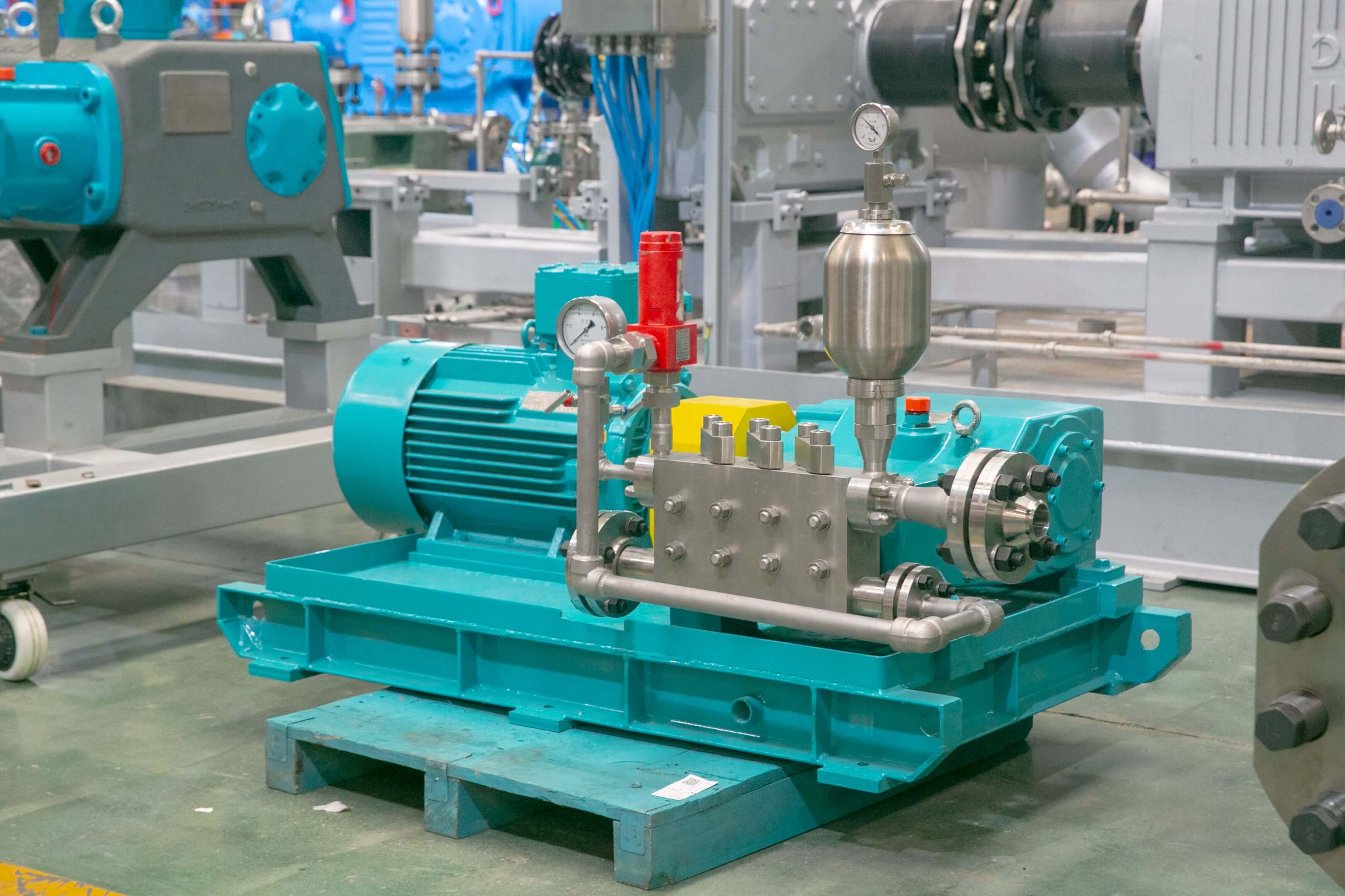
How a Reciprocating Process Pump Works
The core working cycle includes suction, compression, discharge, and return. Inlet and outlet check valves control the direction of flow, while the plunger or piston creates the pressure required to move the liquid. The pump is driven by an electric motor, gear reducer, or other drive system, and the flow rate is adjusted through speed control or stroke adjustment depending on the pump design.
For high pressure applications, the hydraulic and mechanical design must be carefully matched to the process. The liquid end material, sealing arrangement, valve type, plunger material, and packing or diaphragm system all influence performance. This is why a high pressure reciprocating pump manufacturer should review the complete process data before recommending a model, rather than offering a standard pump based only on flow and pressure.
Key Performance Characteristics
- High discharge pressure capability for demanding process services
- Stable flow output with low pulsation when equipped with suitable dampeners
- Suitable for high-viscosity, high-temperature, and some particle-containing media
- Available with different liquid end materials for corrosive or abrasive fluids
- Can be configured for continuous operation in petrochemical, oil and gas, and power plants
- Supports variable flow control through speed or stroke adjustment
High Pressure Reciprocating Pump Applications Across Industries
High pressure reciprocating pumps are used where pressure, reliability, and fluid compatibility are more important than simple transfer capacity. The same basic pump principle can be adapted to very different duties through material selection, valve design, sealing systems, drive configuration, and control integration. This flexibility is one reason high pressure reciprocating pump suppliers are often asked to provide customized solutions rather than catalogue products only.
Oil and Gas Water Injection and Pipeline Boosting
In oil and gas production, high pressure reciprocating pumps are commonly used for water injection, pipeline boosting, high pressure transfer, and process injection. Water injection helps maintain reservoir pressure, while pipeline boosting moves liquids over long distances or into high pressure process systems. These applications require reliable continuous operation, stable pressure, and resistance to corrosive or contaminated media. A high pressure pump for water injection must be selected with careful attention to pressure, flow, water quality, and maintenance access.
Depamu serves the oil and gas field sector with high pressure process reciprocating pumps designed for high pressure delivery and demanding operating conditions. The company’s product range and engineering capability allow the pump configuration to be matched to the actual medium, flow rate, pressure, temperature, and site process requirements.
Petrochemical and Chemical Processing
Petrochemical plants and chemical processing facilities use high pressure reciprocating pumps for process feed, high pressure reaction, transfer of viscous liquids, and injection of chemical streams. The pump may need to handle corrosive fluids, high temperature, volatile media, or liquids containing solids. Material selection is critical: wetted parts may be supplied in stainless steel, duplex steel, or other suitable materials depending on the fluid composition.
In chemical processing, a high pressure reciprocating pump for chemical processing must also be integrated with the plant’s control and safety philosophy. Flow control, pressure protection, relief systems, and instrument connections should be reviewed during the design stage. This is where an experienced high pressure reciprocating pump manufacturer can add value by combining pump design with system-level engineering.
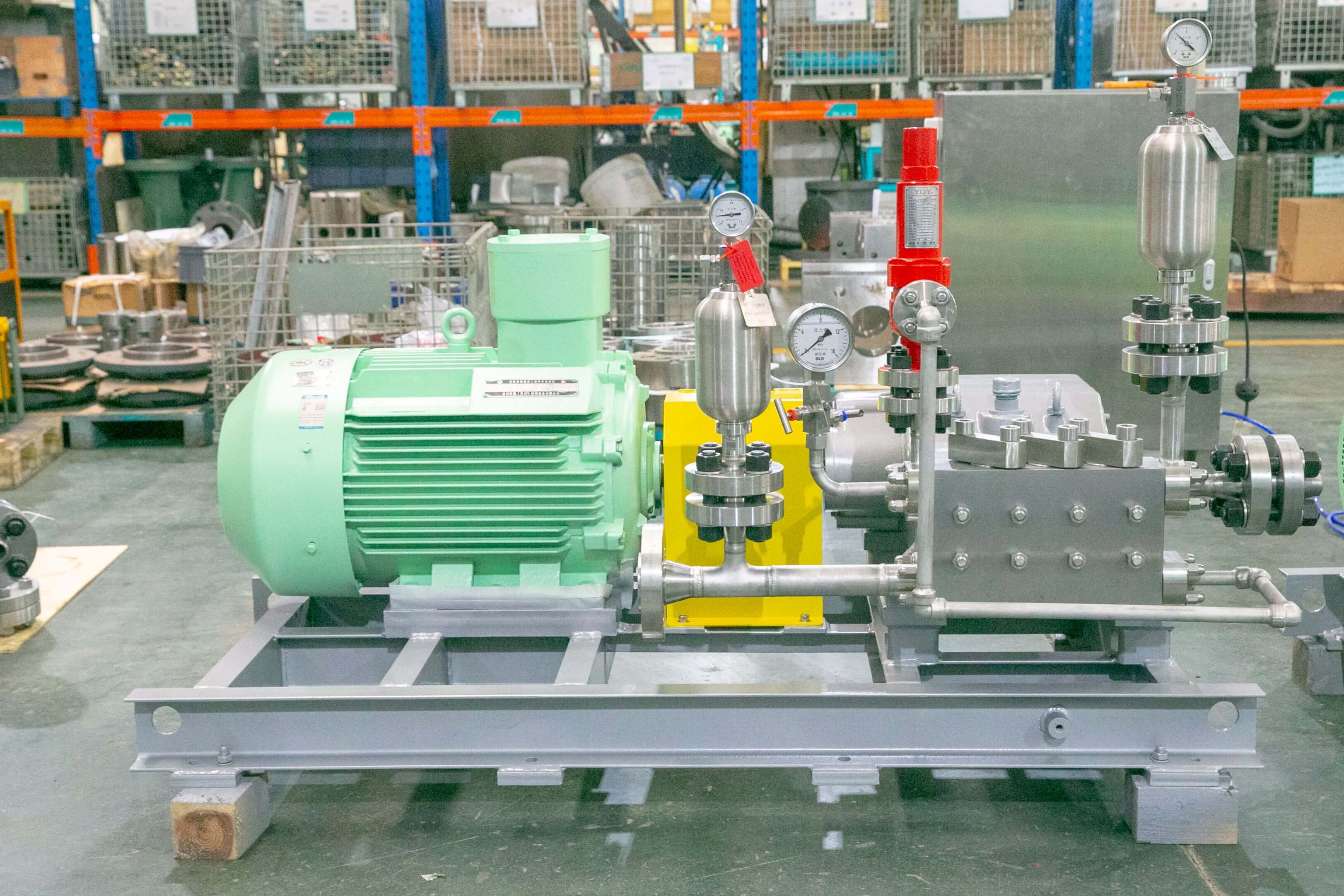
Power, Metallurgy, New Energy, and Water Treatment
High pressure reciprocating pumps also support power generation, metallurgy, new energy, and environmental water treatment. In power plants, related fluid equipment may include chemical dosing systems, water and steam sampling systems, and high pressure transfer equipment. In metallurgy and new energy, pumps may be used for process liquid transfer, pressure boosting, and special fluid handling. In water treatment, high pressure pumps and chemical dosing systems support filtration, membrane processes, circulation, and chemical addition.
Because these industries have different process priorities, the selection process should not rely on a single generic specification. A pump that works well for water injection may not be suitable for a viscous chemical stream or a high temperature process line. Buyers should share full operating data with the supplier and ask for a technical review before placing an order.
How to Select the Right High Pressure Reciprocating Pump
Selecting a high pressure reciprocating pump starts with a clear process data sheet. Flow rate and discharge pressure are only the beginning. The pump must also be compatible with the liquid, temperature, viscosity, solid content, corrosion risk, operating cycle, and site environment. A high pressure reciprocating pump selection guide should therefore cover both hydraulic performance and mechanical reliability.
| Selection Parameter | Why It Matters |
|---|---|
| Required flow rate | Determines plunger size, stroke speed, and drive power; should include minimum and maximum operating cases. |
| Discharge pressure | Defines pump strength, sealing design, valve loading, and motor sizing. |
| Fluid characteristics | Corrosiveness, viscosity, temperature, solid content, and volatility affect wetted materials and sealing choice. |
| Operating cycle | Continuous duty, intermittent dosing, or frequent start-stop operation changes the mechanical and control design. |
| Control requirement | Manual, local, remote, or PLC-integrated control affects the drive, instrumentation, and skid design. |
| Installation environment | Indoor or outdoor location, ambient temperature, hazardous area classification, and available space influence the final package. |
Data Needed for Accurate Sizing
To receive a reliable recommendation, buyers should provide the fluid name and composition, density, viscosity, temperature, vapor pressure, solid content and particle size, required flow range, suction pressure, discharge pressure, continuous or intermittent operation, available power supply, control method, and any site-specific requirements. A simple enquiry such as “high pressure reciprocating pump price” is not enough for accurate quotation because the pump configuration can vary significantly with the duty.
For high pressure reciprocating pump for pipeline boosting or water injection projects, it is also useful to provide a process sketch, line size, relief valve setting, and interface details. If the pump will be part of a packaged system, the buyer should clarify whether the scope includes baseplate, coupling guard, pulsation dampener, control panel, instrumentation, and spare parts.
Why Choose Depamu as Your High Pressure Reciprocating Pump Manufacturer
Depamu (Hangzhou) Pump Industry Technology Co., Ltd. was established in 2003 and has more than 20 years of experience in high-end positive displacement pumps and fluid equipment. The company has more than 400 employees, a factory area of approximately 35,000 square meters, registered capital of RMB 54 million, and an annual output value of approximately RMB 500 million. It is a high-tech enterprise engaged in research and development, production, sales, and integrated fluid solutions.
The company introduced advanced German pump technology and has continued to develop it through in-house engineering. Its product portfolio includes metering pumps, high pressure process reciprocating pumps, pneumatic pumps, electric pumps, chemical dosing skids, water and steam sampling systems, water treatment equipment, screw pumps, rotary lobe pumps, and gear pumps. This broad portfolio allows Depamu to support both single-equipment procurement and integrated fluid system projects.
Depamu’s products have been applied in petroleum refining and petrochemicals, chemical processing, oil and gas fields, nuclear industry, power generation, metallurgy, new energy, environmental water treatment, new materials, and food processing. Based on the company’s reported business distribution, petroleum refining and chemical processing account for approximately 41% of sales, oil and gas fields approximately 23%, nuclear industry, power, metallurgy, and new energy approximately 15%, environmental water treatment approximately 13%, new materials and food approximately 3%, and other industries approximately 5%. Sales have continued to grow, with reported figures of approximately RMB 450 million in 2023, RMB 510 million in 2024, and RMB 560 million in 2025.
Engineering and Customization Capability
A high pressure reciprocating pump supplier should be able to review the process conditions and recommend a suitable configuration, not simply quote a standard model. Depamu provides standard products, non-standard products, and customized fluid solutions based on medium characteristics, flow rate, pressure, temperature, and site process requirements. The company’s capabilities cover product development, design, manufacturing, and packaged delivery.
For complex projects, this integrated approach can reduce coordination risk between the pump, motor, baseplate, controls, valves, instruments, and piping. The pump can be supplied as part of a complete skid or process package when required, which is especially useful for chemical dosing, water treatment, and high pressure injection applications.
High Pressure Reciprocating Pump Price and Quotation: What Affects Cost?
High pressure reciprocating pump price depends on far more than flow rate and pressure. The final cost is influenced by the liquid end material, pressure rating, sealing system, valve design, drive arrangement, control package, instrumentation, testing requirements, documentation, spare parts, and packaging. A pump quoted for clean water service is not directly comparable with a pump designed for corrosive chemicals, high temperature, or abrasive particles.
Buyers often ask where to buy a high pressure reciprocating pump or which supplier offers the best price. The lowest initial offer is not always the lowest lifecycle cost. A well-matched pump with suitable materials and reliable sealing can reduce downtime, spare parts consumption, and maintenance labor. For critical process duty, it is better to compare technical compliance, manufacturing quality, service support, and spare parts availability than price alone.
To receive an accurate high pressure reciprocating pump quotation, prepare a data sheet and mark any mandatory requirements. Ask the supplier to state the scope of supply, performance guarantee, testing procedure, delivery time, warranty terms, recommended spare parts, and installation support. If you need a high pressure reciprocating pump contact phone number, use the official company contact channel and confirm that you are speaking with the sales or technical team responsible for your region. For international buyers, time zone differences and language support should also be considered when planning technical discussions.
Installation, Operation, and Maintenance Best Practices
Installation Considerations
Correct installation helps protect the pump and maintain stable performance. The pump should be mounted on a rigid foundation or baseplate, aligned with the drive, and connected to piping without excessive strain. Suction piping should be sized to avoid cavitation and unnecessary pressure loss. A pulsation dampener may be required to reduce pipe vibration and protect instrumentation. Pressure relief protection must be installed on the discharge side, and the relief valve should be set below the maximum allowable working pressure of the system.
Before commissioning, check that the pump is filled with liquid, valves are in the correct position, and all connections are tight. Run the pump at low load first and observe pressure, flow, vibration, noise, and leakage. Any abnormal condition should be investigated before continuous operation begins.
Maintenance Recommendations
- Inspect seals, packing, and diaphragms according to the maintenance schedule
- Check valve seats and balls for wear, erosion, or blockage
- Monitor lubricating oil condition and replace it at recommended intervals
- Verify relief valve function and instrument calibration
- Record discharge pressure, flow rate, power consumption, and vibration trends
- Keep recommended spare parts available for critical duty pumps
- Review performance trends to identify wear before a failure occurs
Maintenance requirements vary with the fluid and operating conditions. A pump handling clean water may require less frequent inspection than a pump handling abrasive slurry, corrosive chemical, or high temperature media. The supplier should provide an operation and maintenance manual with clear inspection points, torque values, clearances, and spare parts recommendations.
How to Evaluate a High Pressure Reciprocating Pump Supplier
When comparing high pressure reciprocating pump manufacturers, look beyond a product list. A capable supplier should understand the process, ask detailed technical questions, and explain the reasoning behind the proposed configuration. The following checklist can help procurement and engineering teams make a balanced decision:
- Relevant experience in your industry and fluid type
- Ability to design standard, non-standard, and customized pump packages
- Clear material selection and sealing recommendations
- Manufacturing capability and assembly testing process
- Documentation, drawings, and operation manuals
- Spare parts availability and response time
- References or project experience that can be discussed appropriately
- Transparent quotation scope and delivery schedule
For international buyers, it is also important to confirm export packaging, shipping terms, commissioning support, and after-sales communication. A supplier with strong engineering support can often help reduce project risk more effectively than a supplier that competes only on initial price.
FAQ
What is a high pressure reciprocating pump used for?
A high pressure reciprocating pump is used to transfer liquids at high discharge pressure with stable flow. Typical applications include oil and gas water injection, pipeline boosting, petrochemical process feed, chemical processing, high pressure transfer, power generation, metallurgy, new energy, and water treatment. It is particularly suitable for viscous, high temperature, or difficult media when the pump is correctly configured.
How do I choose between a high pressure reciprocating pump and a metering pump?
A high pressure reciprocating pump is generally selected for high pressure transfer, boosting, and process delivery. A metering pump is selected when accurate chemical dosing is the main requirement. Some applications use both types of equipment in one system. The choice depends on required flow accuracy, pressure, fluid properties, control method, and process purpose.
Can high pressure reciprocating pumps handle high-viscosity or abrasive media?
Yes, many high pressure reciprocating pumps can be configured for high-viscosity, high temperature, and particle-containing liquids. However, the pump must be designed with suitable valve type, plunger material, sealing arrangement, and speed. The buyer should provide viscosity, temperature, solid content, and particle size so the manufacturer can evaluate the duty and recommend the correct configuration.
What information is needed for a high pressure reciprocating pump quotation?
Provide the fluid name and composition, density, viscosity, temperature, solid content, required flow rate, suction pressure, discharge pressure, operating cycle, control requirements, power supply, installation environment, and any documentation or testing requirements. A complete data sheet allows the supplier to offer a technically suitable high pressure reciprocating pump quotation instead of a generic price estimate.
How can I find a high pressure reciprocating pump contact phone number?
The most reliable way is to use the official contact channel of the manufacturer or supplier. Confirm the sales region, ask for the technical contact responsible for your application, and prepare your process data before the call. For international projects, email or an online enquiry form can be used first to share drawings and specifications, followed by a scheduled technical discussion.
Which high pressure reciprocating pump manufacturer has a good reputation?
Reputation should be evaluated through technical capability, industry experience, manufacturing facilities, application references, response quality, and after-sales support. Depamu (Hangzhou) Pump Industry Technology Co., Ltd. has served high pressure pump applications since 2003 and provides high pressure process reciprocating pumps, metering pumps, chemical dosing systems, and customized fluid solutions for industries including petrochemicals, oil and gas, power, metallurgy, new energy, and water treatment.
Summary
Choosing a high pressure reciprocating pump is a technical decision that affects process safety, production continuity, and operating cost. Buyers should define the full duty conditions, compare suppliers on engineering capability rather than price alone, and request a detailed quotation with a clear scope of supply. A reliable high pressure reciprocating pump manufacturer should be able to review the fluid, flow, pressure, temperature, and site requirements and recommend a configuration that fits the application.
Depamu (Hangzhou) Pump Industry Technology Co., Ltd. combines more than two decades of pump experience, a broad positive displacement pump portfolio, integrated manufacturing, and customized fluid solutions. For projects involving oil and gas, petrochemicals, chemical processing, power, metallurgy, new energy, or water treatment, working with an experienced high pressure reciprocating pump supplier can help reduce technical risk and support stable long-term operation.