
Handling slurry with a high solid content is one of the most demanding duties in any process plant. Abrasive particles, fast-settling solids, high viscosity and fluctuating back pressure all combine to punish pumps that were never designed for the job. A high solids slurry pump is not simply a heavier version of a standard process pump — it is a piece of equipment whose hydraulic design, materials and drive train must all be matched to the specific slurry being moved. This guide explains the available pump technologies, the criteria that matter most during selection, typical applications, and how to evaluate a high solids slurry pump manufacturer before placing an order.
Depamu (Hangzhou) Pump Industry Technology Co., Ltd. has focused on high-end positive displacement pumps and fluid equipment since 2003. With more than 400 employees, a plant covering roughly 35,000 square meters and an annual output value of around RMB 500 million, the company designs and builds metering pumps, high-pressure reciprocating process pumps, screw pumps, rotary lobe pumps, gear pumps, pneumatic and electric pumps, chemical dosing skids and water treatment equipment. That portfolio is directly relevant to slurry duty, because the most reliable way to move high solid content media is usually through positive displacement technology rather than a conventional centrifugal pump.
What Makes High Solids Slurry So Difficult to Pump?
Slurry is a mixture of liquid and suspended solids. When the solids fraction rises — whether measured by weight or by volume — the behavior of the fluid changes dramatically. Settling velocity increases, apparent viscosity rises, and the mixture may stop behaving like a liquid at all in low-flow sections of the line. In practical terms, this means a pump that performs well on clean water or a dilute effluent can fail within weeks on a high solids duty.
The first challenge is abrasion. Sand, ore particles, ash, lime and mineral tailings act like a grinding medium on impellers, casings, seals and valves. The second challenge is clogging: narrow passages, check valves and small clearances are all potential blockage points. The third challenge is flow stability. High solids slurries often need a steady, low-shear, non-pulsating flow to avoid settling in the pipeline and to protect downstream equipment.
This is why positive displacement pumps dominate high solid content slurry service. A centrifugal pump transfers energy through velocity, and its head falls sharply as viscosity and solids concentration increase. A positive displacement pump moves a fixed volume of material per cycle, so its flow stays largely independent of discharge pressure. For viscous, abrasive or shear-sensitive slurries, that characteristic is decisive. It is also why experienced buyers look for a positive displacement pump for abrasive slurry rather than simply specifying a larger centrifugal unit.
High Solids Slurry Pump Types and How to Match the Pump to the Duty
There is no single pump design that suits every slurry. The right choice depends on particle size and shape, solids concentration, viscosity, required discharge pressure, temperature and how sensitive the product is to shear. The three families below cover the majority of industrial high solids applications, and all three are part of Depamu’s positive displacement range.
Screw Pumps for Viscous, High Solid Content Slurries
A screw pump (progressing cavity pump) uses a helical rotor turning inside a matching stator to form sealed cavities that travel continuously from suction to discharge. The result is a smooth, almost pulsation-free flow that copes well with viscous media, fibrous material and moderate solids loading. Because the flow path is wide and the internal velocities are low, screw pumps are a strong choice for sludge, lime slurry, pulp, starch and other thick mixtures. The trade-off is that the stator is a wear part, so elastomer selection and operating speed must be matched to the abrasiveness of the solids.
Rotary Lobe Pumps for Gentle, Low-Shear Transfer
Rotary lobe pumps use two counter-rotating lobes inside a casing. They are valued for gentle handling, high suction lift capability and easy cleaning, and they perform well on slurries with entrained solids that must not be damaged or emulsified. They are also compact for the flow rates they deliver, which makes them useful in skid-mounted and packaged systems. Lobe geometry and clearance must be chosen carefully in abrasive duty, since excessive slip accelerates wear and reduces volumetric efficiency.
High-Pressure Reciprocating Process Pumps for Demanding Injection Duty
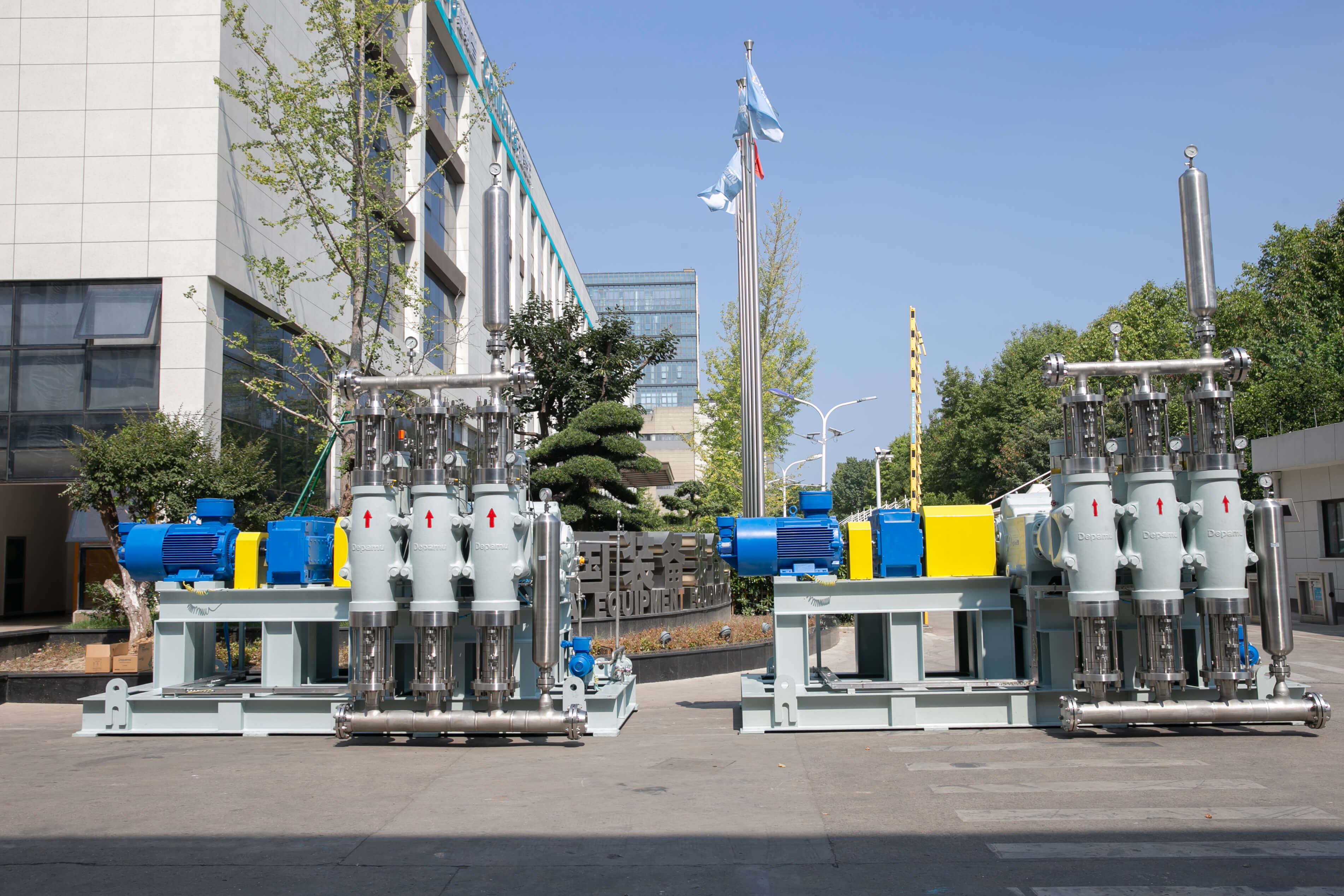
When the slurry must be injected into a pressurized line, a wellhead or a long-distance pipeline, a reciprocating plunger or piston pump is often the only practical option. Depamu’s high-pressure process reciprocating pumps are designed to deliver stable flow at discharge pressures up to and beyond 35 MPa, and they are built to handle viscous, high-temperature media and fluids containing solid particles. In oil and gas field water injection, chemical process feed, pipeline boosting and high-pressure injection, this pump type provides the pressure capability that other designs cannot reach.
| Pump Type | Solids & Viscosity Handling | Typical Discharge Pressure | Best Suited To |
|---|---|---|---|
| Screw pump (progressing cavity) | High viscosity, moderate to high solids, fibrous content | Medium | Sludge, lime slurry, pulp, thick chemical slurry, dosing and transfer |
| Rotary lobe pump | Gentle handling, moderate solids, shear-sensitive media | Medium | Transfer duty, skid-mounted systems, food and new material slurries |
| High-pressure reciprocating pump | High pressure, viscous and high-temperature media, particles present | High (up to 35 MPa and above) | Oil and gas field injection, pipeline boosting, high-pressure process feed |
| Gear pump | High viscosity, fine solids, lubricating media preferred | Medium to high | Thick chemical and oil-based media with limited particle size |
High Solids Slurry Pump Selection Guide: The Eight Factors That Decide the Result
A high solids slurry pump selection guide is only useful if it reflects the data a manufacturer actually needs. Vague enquiries such as “we need a slurry pump” almost always lead to oversized, undersized or wrongly configured equipment. The list below covers the information that should be on the table before a quotation is issued.
- Solids concentration. State the percentage by weight and, if possible, by volume, plus the normal and maximum values expected in operation.
- Particle size and shape. Maximum particle diameter matters as much as average size, because a single oversized particle can block a narrow passage. Sharp, angular particles accelerate wear far more than rounded ones.
- Viscosity and rheology. Many high solids slurries are non-Newtonian. Apparent viscosity at the actual operating temperature and shear rate is far more useful than a single laboratory figure.
- Flow rate and turndown. Give the design flow, the minimum continuous flow and whether the duty requires accurate dosing or simple transfer.
- Discharge pressure and line losses. Include static head, friction losses, control valve pressure drop and any back pressure from the receiving system.
- Temperature and chemistry. Temperature affects elastomer life and material strength. pH, chloride content and the presence of solvents determine which wetted materials are acceptable.
- Duty cycle. Continuous 24/7 operation demands different bearings, seals and lubrication than intermittent batch transfer.
- Installation constraints. Available footprint, suction conditions, NPSH margin, noise limits and whether the unit must be supplied as a packaged skid all influence the final configuration.
| Parameter to Specify | Why It Matters | What to Send to the Supplier |
|---|---|---|
| Solids content | Determines pump type, speed limit and wear allowance | % by weight and by volume, normal and maximum |
| Particle size | Sets minimum passage size and valve design | D50 and maximum particle diameter, particle shape |
| Flow rate | Sizes the displacement volume and drive power | Design, minimum and maximum flow in m³/h or L/h |
| Pressure | Defines pump stage count, strength and seal rating | Discharge pressure, suction pressure, line losses |
| Temperature | Limits elastomer and material selection | Operating and maximum temperature |
| Corrosivity | Drives wetted material and seal flush decisions | pH, chlorides, solvents, gas content |
Where High Solids Slurry Pumps Are Used in Industry
High solid content slurry appears across almost every heavy process industry, and each sector stresses the pump in a different way. In oil refining and chemical processing, slurries include catalyst suspensions, lime and calcium carbonate slurry, and thick process intermediates; here the priority is flow stability, containment and compatibility with aggressive chemistry. In oil and gas fields, the combination of produced sand, high pressure and remote locations makes high-pressure reciprocating injection pumps the standard solution for water injection, pipeline boosting and high-pressure transfer.
In metallurgy and mineral processing, abrasive ore and tailings slurries demand generous wear allowances and conservative operating speeds. In power generation, limestone and gypsum slurries in flue gas desulfurization, ash handling and boiler water treatment circuits require dependable continuous operation. In environmental water treatment, thickened sludge, digested sludge and chemical slurries are moved by screw pumps and rotary lobe pumps, often as part of a packaged dosing or transfer system. New materials and food processing add a further constraint: the pump must handle solids gently and be easy to clean.
Because of this diversity, a pump that is correct for one plant may be wrong for another even when both are described as “high solids slurry”. Depamu’s engineering approach is to work from the medium itself — its solids content, viscosity, temperature, pressure and site process requirements — and then select a standard model, a modified unit or a fully customized fluid solution. Roughly 41% of the company’s sales come from oil refining and chemical applications, 23% from oil and gas fields, 15% from nuclear, power, metallurgy and new energy, 13% from environmental water treatment, and the remainder from new materials, food and other industries.
How to Choose a Reliable High Solids Slurry Pump Manufacturer
Price comparisons between quotations are only meaningful when the technical scope is identical. Before deciding where to buy a high solids slurry pump, it is worth evaluating the supplier on five practical points. First, does the manufacturer ask detailed questions about the medium, or does it simply quote a model number? Second, can it supply both the pump and the surrounding system — baseplate, motor, control panel, piping and skid — so that interface responsibility is not split between vendors? Third, is customization genuinely available, including non-standard materials, special seals and modified hydraulics?
Fourth, what happens after delivery? A high solids duty consumes wear parts, and the availability of stators, rotors, plungers, valves, diaphragms and seals over a ten-year horizon matters more than a small difference in initial cost. Fifth, can the supplier demonstrate experience in comparable industries? Depamu has been manufacturing fluid equipment since 2003 and has grown steadily, with sales of approximately RMB 450 million in 2023, RMB 510 million in 2024 and RMB 560 million in 2025 — growth that reflects a large installed base and a repeat customer pattern rather than a single project.
Buyers comparing high solids slurry pump options should also request documentation: dimensional drawings, material certificates, performance curves, spare part lists and operating manuals. A supplier that provides these as standard is usually a supplier that expects its equipment to be maintained properly in the field.
Maintenance and Operating Practices That Extend Slurry Pump Life
Most slurry pump failures are not sudden. They are the result of running the pump outside its intended envelope for long enough that wear becomes catastrophic. The following practices consistently extend service life in high solid content duty.
- Never run dry or starve the suction. Positive displacement pumps rely on the medium for lubrication and cooling in many designs; a dry run can destroy a stator or seal within minutes.
- Keep velocity above the settling threshold. Design suction and discharge lines so that the slurry stays in suspension. Settled solids create blockages that put abnormal loads on the pump.
- Control the operating speed. Reducing speed is the single most effective way to reduce abrasive wear; slight oversizing with speed reduction is often cheaper over the life cycle than a smaller pump running flat out.
- Inspect wear parts on a schedule. Track stator, rotor, plunger, valve and seal condition at fixed intervals rather than waiting for a loss of flow or pressure.
- Check the seal support system. Flush, quench or barrier systems must be working correctly, especially in abrasive or crystallizing service.
- Log performance data. A gradual fall in flow at constant speed, or a rise in power draw, is an early warning of internal wear or partial blockage.
Why Depamu Is a Practical Partner for High Solids Slurry Projects
Depamu (Hangzhou) Pump Industry Technology Co., Ltd. combines a broad positive displacement portfolio with in-house design, manufacturing and packaged system delivery. The company operates three brands, employs more than 400 people and occupies a plant of about 35,000 square meters, with capabilities spanning research and development, design, fabrication, assembly, testing and delivery of complete skids. That combination matters in slurry service, where the pump is only one part of a solution that may also need a dosing skid, a control system, a receiver tank and site-specific piping.
For slurry applications, the relevant product families include screw pumps and rotary lobe pumps for transfer and dosing duty, high-pressure reciprocating process pumps for injection and boosting, gear pumps for viscous media, and pneumatic and electric pumps for specialized installations. Chemical dosing skids and water treatment equipment complete the picture for plants that need to prepare and inject slurries or chemical suspensions automatically. All of this is supported by the ability to build standard, non-standard or fully customized units based on the customer’s medium characteristics, flow, pressure, temperature and process requirements.
If you are evaluating options and want to discuss a specific duty, the most efficient first step is to send the medium data sheet together with flow, pressure and temperature requirements. That information is enough for the engineering team to propose a suitable configuration and a realistic quotation, rather than a generic model number.
FAQ
What is a high solids slurry pump used for?
A high solids slurry pump is used to move mixtures that contain a large proportion of suspended solids, such as mineral slurry, tailings, thickened sludge, lime slurry, ash slurry and catalyst suspensions. The pump must maintain stable flow despite high viscosity and abrasiveness, and it must resist clogging. In most industrial plants, positive displacement designs — screw pumps, rotary lobe pumps and high-pressure reciprocating pumps — are selected for these duties because their flow is largely independent of discharge pressure.
Which pump type is best for a high solid content slurry?
There is no universal answer; the correct type depends on particle size, solids concentration, viscosity and required pressure. Screw pumps are well suited to viscous slurries and sludge with moderate solids. Rotary lobe pumps are preferred when the medium is shear-sensitive or when gentle handling is important. High-pressure reciprocating pumps are used when the slurry must be injected into a pressurized line or wellhead at pressures up to 35 MPa and above. A manufacturer should confirm the selection against the actual medium data rather than a generic category.
How do I get a quotation for a high solids slurry pump?
Prepare a short technical brief covering solids content by weight and volume, maximum particle size, viscosity at operating temperature, required flow range, suction and discharge pressure, temperature, pH and chloride level, duty cycle and any installation constraints. With these details, a manufacturer can propose a pump type, materials, seal arrangement and drive configuration, and then issue a quotation that is comparable with other offers. Requests that include only a flow rate usually result in assumptions that later have to be corrected.
Can Depamu customize a pump for a specific slurry?
Yes. Depamu’s engineering process starts from the medium characteristics — solids content, viscosity, temperature, pressure and site process requirements — and results in a standard product, a non-standard product or a customized fluid solution. Customization can cover wetted materials, seal systems, drive and control arrangements, and complete packaged systems combining the pump with tanks, mixers, piping and automatic control. Since the company also builds chemical dosing skids and water treatment equipment, interface responsibility can stay with one supplier.
Why do high solids slurry pumps wear out quickly?
Wear is driven by abrasion, speed, particle shape and operating conditions. Running the pump above its intended speed, starving the suction, allowing solids to settle in the line, or operating with a failed seal support system will all shorten service life dramatically. In many cases the pump is not the problem — the installation or operating envelope is. Reviewing line velocities, suction conditions and speed setting usually delivers more life extension than simply buying a heavier pump.
How can I evaluate a high solids slurry pump supplier?
Look beyond the quotation price. Check whether the supplier asks detailed technical questions, whether it can deliver the pump and the surrounding system, whether customization is genuinely possible, and whether spare parts will be available over the long term. Ask for drawings, material certificates, performance data and manuals, and ask which industries the supplier serves. Depamu, for example, serves oil refining and chemical processing, oil and gas fields, nuclear, power, metallurgy, new energy, environmental water treatment, new materials and food, with a manufacturing history dating back to 2003.
Summary
High solids slurry is unforgiving, and the pump selected for the duty determines whether a plant enjoys stable throughput or spends its maintenance budget on repeated rebuilds. The safest path is to match the pump type to the medium — screw pumps and rotary lobe pumps for viscous transfer and gentle handling, high-pressure reciprocating pumps for injection and boosting — and then to specify materials, seals, speed and drive based on real operating data rather than assumptions. Equally important is choosing a manufacturer that asks the right questions, can supply a complete system, and will still be able to provide wear parts years after commissioning.
Depamu (Hangzhou) Pump Industry Technology Co., Ltd. brings more than two decades of positive displacement engineering, a broad product range, in-house manufacturing and packaged system capability to high solids slurry projects. Whether the requirement is a single pump or a customized fluid solution, the productive first move is to share the medium data sheet and let the engineering team build a configuration around the actual duty.