
Moving slurry with a high solids content is one of the most demanding duties in any process plant. The fluid is heavy, abrasive, often corrosive, and sometimes hot. A pump that performs well on clean water can fail within weeks when the same duty involves sand, ore tailings, lime slurry, paper pulp, sludge, or catalyst-laden process streams. That is why the question of how to choose a high-solids slurry pump deserves a structured answer rather than a quick catalogue lookup.
This guide explains what a high-solids slurry pump actually needs to do, which pump technologies are suitable, which parameters must be defined before requesting a quotation, and how to evaluate a high-solids slurry pump manufacturer. It is written for plant engineers, EPC contractors, maintenance managers and procurement teams who need a pump that keeps running rather than a pump that merely matches a pipe diameter.
What Is a High-Solids Slurry Pump and Why Selection Matters
A high-solids slurry pump is a pump designed to convey a liquid carrying a significant concentration of solid particles — typically above 10–15% by weight, and in many industrial cases far higher. The solids may be fine powders, crystalline particles, fibrous material, sand, mineral fines, or a mixture of several fractions. The carrier liquid may be water, an acid, a caustic solution, an oil, or a process stream with dissolved chemicals.
The difficulty is not simply viscosity. High-solids slurry combines abrasion, settling behaviour, and often high specific gravity. Centrifugal pumps can handle some of these duties, but as solids concentration and pressure rise, positive displacement designs usually become the more reliable choice because they deliver a nearly constant flow independent of discharge pressure and generate lower shear on the solids.
Getting the selection wrong has direct cost consequences. An undersized pump runs at maximum speed and wears out prematurely. An oversized pump runs inefficiently and may cause settling in the suction line. A pump with the wrong internal clearances may clog on fibrous solids or lose volumetric efficiency on fine abrasive particles. In all three cases, the real cost is not the pump price but the unplanned shutdown.
How to Choose a High-Solids Slurry Pump: Key Selection Criteria
Choosing a high-solids slurry pump starts with a process data sheet, not with a product list. Before any supplier can recommend a model, the following parameters should be defined as precisely as possible. If the data is uncertain, state the expected range and identify the worst case, because slurry duties are usually governed by the worst case rather than the average.
| Selection Parameter | Why It Matters | Information to Provide |
|---|---|---|
| Solids concentration | Drives pump type, speed and wear allowance | % by weight and % by volume, plus typical and maximum values |
| Particle size and shape | Determines passage clearance and abrasion rate | Maximum particle size, d50, angular or rounded particles |
| Flow rate | Sets displacement volume and operating speed | Required duty flow, minimum and maximum, with turndown ratio |
| Discharge pressure | Defines pump stage count, shaft and bearing design | Normal and maximum pressure, pipe length and static head |
| Temperature | Affects elastomer choice and clearances | Operating and design temperature, heating or cooling cycles |
| Chemical composition | Determines wetted material and seal strategy | pH, chlorides, solvents, presence of gases or vapours |
| Duty cycle | Continuous duty needs different bearings and cooling than intermittent duty | Hours per day, starts per hour, batch or continuous operation |
Solids concentration and particle size
Solids concentration defines the basic hydraulic and mechanical load. At moderate concentrations, a robust centrifugal or rotary lobe pump may be adequate. As concentration rises, the mixture behaves less like a liquid and more like a plastic mass, and the pump must be selected for volumetric displacement rather than for head alone. Particle size matters just as much: a pump with generous passage clearance will pass larger particles without bridging, while a tight-clearance pump may achieve high efficiency on fine slurry but suffer rapid wear or blockage on coarse material.
Flow rate, pressure and operating point
Flow and pressure together define the operating point, and the operating point must sit inside the pump’s safe continuous range. For high-solids duty, it is good practice to size the pump so that it runs at a moderate speed at the design flow, leaving room to increase speed as wear occurs. A positive displacement pump can often be speed-adjusted to compensate for gradual wear-related slip, which extends the interval between overhauls.
Abrasion, corrosion and material selection
Slurry wear is not uniform. It concentrates at the casing, rotor tips, valve seats, liners and seal faces. Material selection should therefore be based on the dominant wear mechanism: abrasion from hard particles, corrosion from the liquid phase, or erosion-corrosion from the combination of both. Elastomer-coated wetted parts, hardened metal components and suitable shaft sealing arrangements are typical options, and the final choice should come from a supplier who has reviewed the actual medium rather than a generic recommendation.
Which Pump Types Suit High-Solids Slurry Duties?
Several pump technologies can be applied to high-solids slurry, and the right choice depends on the combination of concentration, particle size, pressure and available space. In practice, the following options are most often considered.
Screw pumps and progressive cavity designs
Screw pumps are widely used for high-solids and high-viscosity media because they move the product through a sequence of sealed cavities with low shear and a steady, pulsation-free flow. They handle fibrous and pasty materials well and tolerate moderate particle content, making them a common choice for sludge, pulp, polymer solutions and oily slurries. The trade-off is that the stator elastomer is a wear part, so the selection must account for abrasiveness and the expected service interval.
Rotary lobe pumps
Rotary lobe pumps offer large, unobstructed passages and gentle product handling. They are well suited to slurries containing soft solids, granules or fibrous material where damage to the product or clogging is a concern. Because the lobes do not contact each other, the pump can run dry for short periods and can be cleaned in place, which is an advantage in food, pharmaceutical and fine chemical duties.
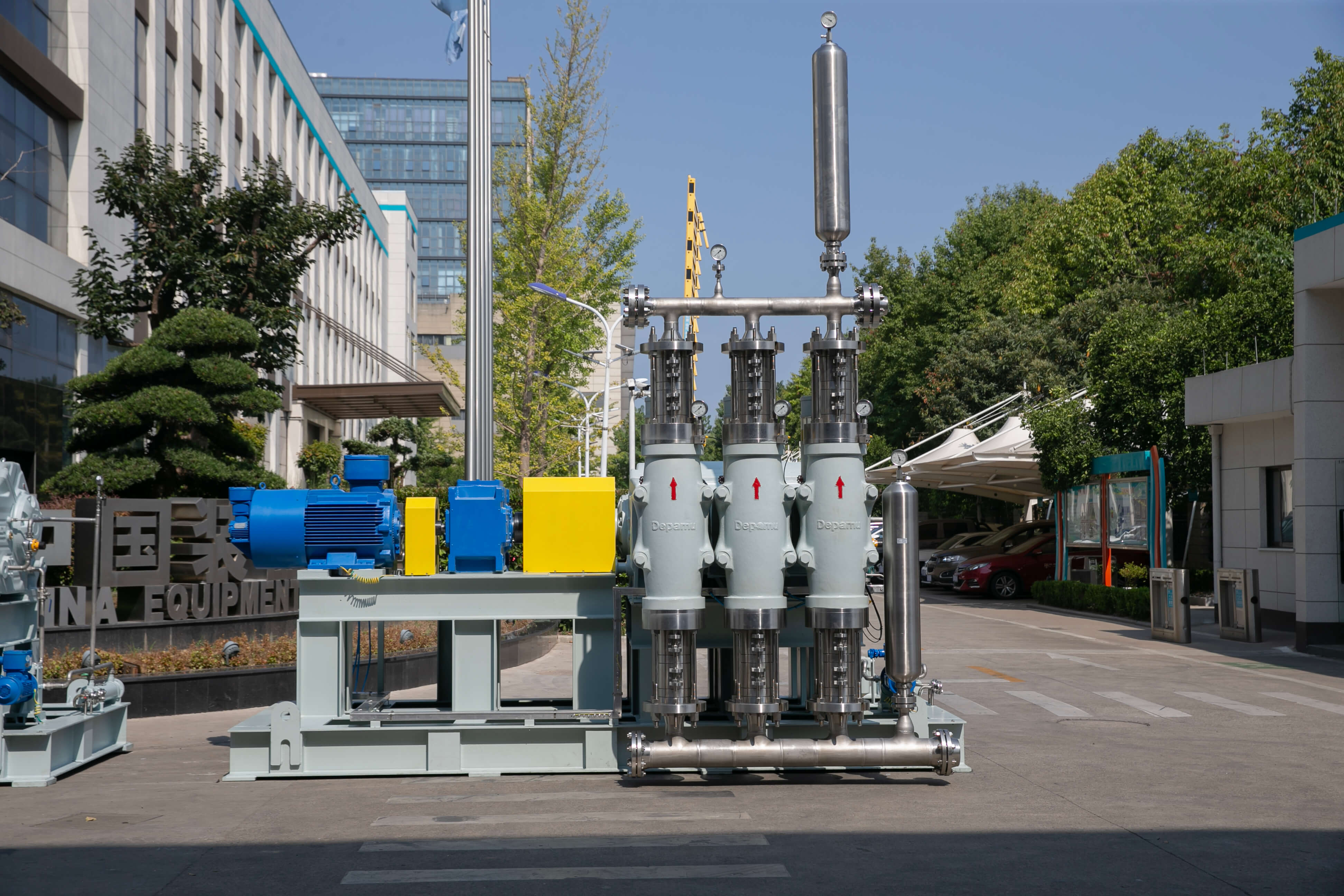
High-pressure reciprocating process pumps
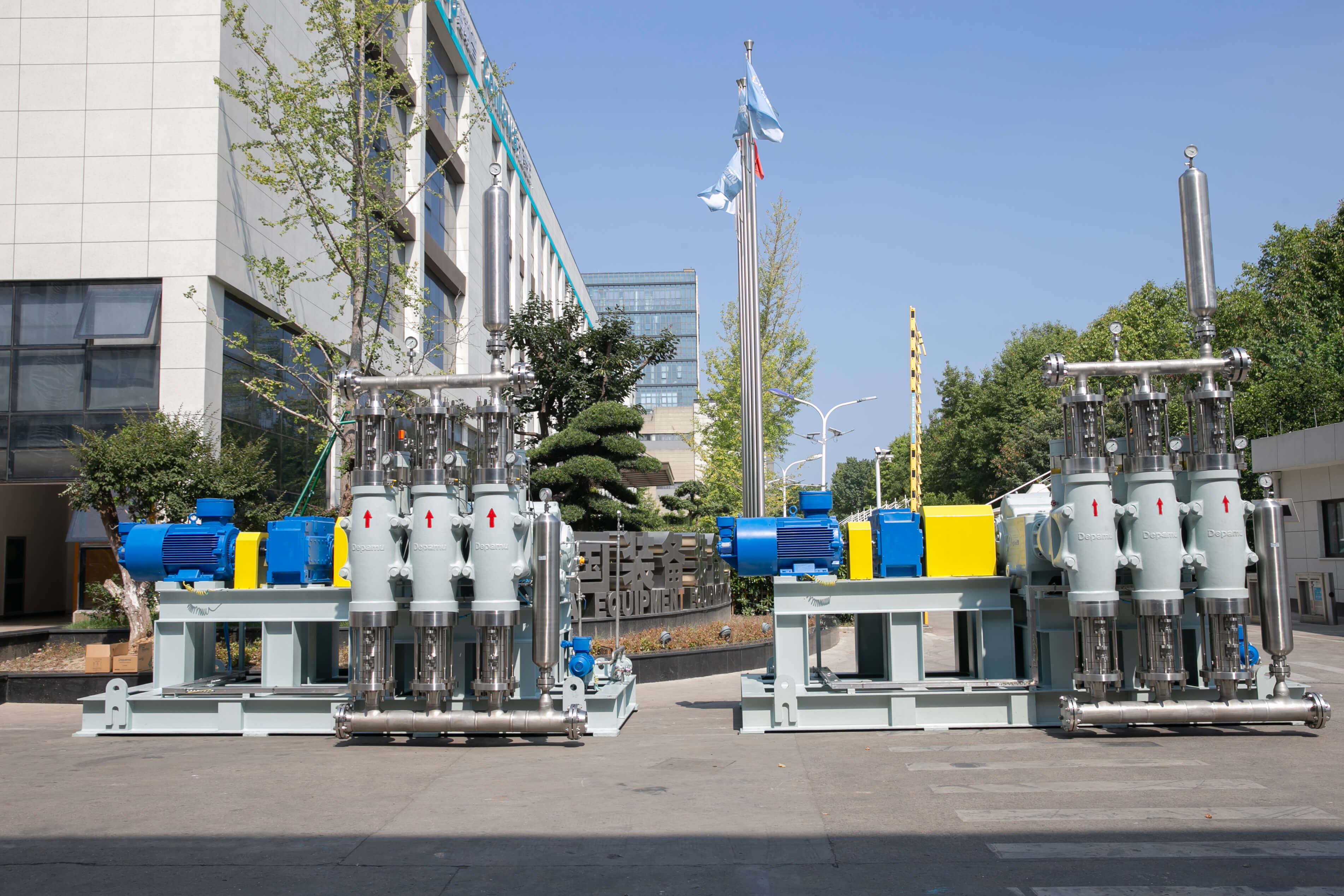
When the duty combines high solids with high pressure — for example long-distance pipeline transfer, high-pressure injection, or process streams requiring a defined pressure at the reactor inlet — a reciprocating process pump is often the only practical solution. Plunger and hydraulic diaphragm designs generate high pressure with a stable flow, and the wetted end can be configured for abrasive or corrosive media. This is the same engineering territory as high-pressure process tubular pump applications, where the pump must deliver a specified pressure into a pipeline or tubular process system without flow instability.
Working With a High-Pressure Process Tubular Pump Manufacturer
Buyers searching for a high-pressure process tubular pump manufacturer are usually looking for more than a catalogue item. They need a supplier who can review the process data, propose a hydraulic and mechanical configuration, confirm materials, and support the installation through commissioning. The same expectation applies to high-solids slurry pump projects, where the pump is only one part of the solution and the suction arrangement, flushing plan and control philosophy all affect reliability.
DEPAMU (Hangzhou) Pump Industry Technology Co., Ltd. is a manufacturer established in 2003 that focuses on high-end positive displacement pumps and fluid equipment. The company employs more than 400 people, operates a plant of approximately 35,000 m², and has annual output value of around RMB 500 million. Its product range includes metering pumps, high-pressure process reciprocating pumps, pneumatic and electric pumps, chemical dosing skids, water and steam sampling devices, water treatment equipment, screw pumps, rotary lobe pumps and gear pumps.
For high-solids and abrasive slurry duties, this range allows the pump type to be selected from the process requirement rather than forced from a single product family. Screw and rotary lobe pumps cover the low-to-medium pressure transfer duties, while high-pressure process reciprocating pumps cover injection and pipeline boosting duties where pressure is the dominant constraint. Because the company also builds complete dosing and water treatment packages, it can supply a pump alone or an integrated skid with control instrumentation.
Typical Applications of High-Solids Slurry Pumps
High-solids slurry pumps appear across a wide range of industries, and each sector places a different emphasis on the pump specification. In oil refining and petrochemical plants, slurry duties include catalyst handling, sludge transfer and process streams with suspended solids, where leak-free operation and material compatibility are critical. In oil and gas fields, produced sand, drilling waste and injection streams require pumps that tolerate abrasive particles at high pressure.
In wastewater treatment, primary and secondary sludge, lime slurry and filter backwash streams call for pumps that resist clogging and deliver a predictable flow for dosing and dewatering. In mining and metallurgy, tailings, concentrate and backfill slurry are among the most abrasive duties, and wear life is usually the dominant selection criterion. Power plants use slurry pumps for ash handling, limestone slurry in flue gas desulphurisation and boiler water treatment chemicals. New materials and food processing introduce additional constraints such as product integrity, cleanability and low shear.
Across these applications, the common requirement is a pump that maintains flow at the specified pressure while tolerating the solids, without frequent intervention. A supplier with experience in several of these sectors can usually anticipate the failure modes that a single-sector supplier might miss.
Installation, Operation and Maintenance Practices That Extend Service Life
Correct installation matters as much as correct selection. Suction piping should be short, generously sized and free of high points where solids can settle. A positive displacement pump must never be started against a closed discharge valve without a relief path, and a properly sized relief valve or bypass is essential protection. Where the slurry tends to settle, flushing connections and a suitable drain arrangement make maintenance faster and safer.
During operation, the most useful habit is to record flow, pressure, power draw and vibration at a defined interval. A gradual loss of flow at constant speed usually indicates internal wear, while a rise in vibration points toward bearing or alignment issues. Early detection allows planned intervention instead of emergency repair.
- Keep a written operating envelope for each pump, including maximum pressure and minimum flow.
- Inspect replaceable wear parts on a schedule based on measured performance, not only on calendar time.
- Maintain a stock of critical spares — elastomers, liners, seals and valve components — selected at the time of purchase.
- Verify suction conditions after any process change, because a change in solids content can alter the net positive suction head requirement.
- Train operators to recognise the difference between a normal high-pressure reading and a blocked line.
How to Shortlist a Reliable High-Solids Slurry Pump Manufacturer
When comparing suppliers, look beyond the unit price. A credible high-solids slurry pump manufacturer should be able to review the medium, ask detailed questions about particle size and duty cycle, and explain the material selection rationale. Ask for a dimensional drawing, a performance curve at the actual slurry properties, a spare parts list with recommended stock levels, and a maintenance procedure. If the supplier cannot provide these documents before the order, the after-sales support is likely to be equally thin.
It is also worth checking whether the supplier can offer more than one pump technology. Slurry duties often sit between two technologies, and a supplier with screw, rotary lobe, gear, metering and high-pressure reciprocating options can recommend the most economical fit instead of steering the project toward whatever happens to be in stock. Factory capability matters too: in-house machining, assembly and testing allow tighter control of clearances and quicker resolution of non-standard requirements.
Finally, confirm how the pump will be tested before shipment and what documentation will accompany it. A performance test with recorded flow, pressure and power, together with material certificates and an as-built drawing, gives the maintenance team a baseline for future condition monitoring. For customised or skid-mounted systems, a factory acceptance test before dispatch reduces site work and shortens commissioning time.
FAQ
How do I choose a high-solids slurry pump for an abrasive duty?
Start with the medium: solids concentration, maximum particle size, temperature and chemical composition. Then define flow and pressure at the worst case, not the average. With those data, a supplier can compare screw, rotary lobe and reciprocating options on wear life, efficiency and maintenance effort. Abrasive duties usually justify hardened or elastomer-protected wetted parts and a generous passage clearance, even at some cost in efficiency.
Can a screw pump handle high-solids slurry without clogging?
Yes, in many cases. Screw pumps move medium through sealed cavities with low shear, which suits sludge, pulp and viscous slurries. Clogging risk depends mainly on the largest particle size relative to the pump’s passage geometry and on whether fibrous material can bridge at the inlet. Providing the full particle size distribution and a representative sample allows the supplier to confirm whether a screw pump or a rotary lobe pump is the better fit.
What is the difference between a high-solids slurry pump and a high-pressure process pump?
A high-solids slurry pump is defined by the medium it handles, while a high-pressure process pump is defined by the pressure it develops. The categories overlap: a pipeline injection duty may require both high solids tolerance and pressures of several megapascals. In that case, a reciprocating process pump with an abrasion-resistant wetted end is usually selected, and the material and seal design must address both wear and pressure.
What information should I give a manufacturer before requesting a quotation?
Provide the fluid composition, solids concentration by weight and volume, particle size range, temperature, pH and chloride content, required flow with minimum and maximum values, suction and discharge pressure, pipe layout, duty cycle and the available space. Photos or a sample of the slurry are also valuable. Complete data reduces the risk of an oversized or undersized proposal and shortens the technical review.
How often should wear parts be replaced on an abrasive slurry pump?
There is no universal interval, because wear depends on particle hardness, velocity and operating hours. The practical method is to establish a baseline performance record at commissioning and monitor flow at constant speed. When flow has dropped by a defined percentage, inspect the internal parts and replace them as a set. This condition-based approach usually costs less than fixed-interval replacement.
Can DEPAMU supply a complete slurry dosing or transfer package rather than a single pump?
Yes. DEPAMU manufactures pumps and also builds integrated packages such as automatic chemical dosing systems, which combine tanks, agitators, metering pumps and control systems on a skid. For slurry and chemical transfer duties, the company can supply a pump, a skid or a complete fluid system, depending on the project scope, and can customise the configuration to the medium and site requirements.
Summary
Selecting a high-solids slurry pump is a process of matching the medium to the machine, not simply matching a flow rate to a pipe size. Define the solids concentration, particle size, temperature, chemistry, flow and pressure before contacting suppliers, and treat the worst case as the design case. Compare pump technologies on wear life, maintenance access and efficiency rather than unit price alone, and involve the manufacturer early enough that material selection and sealing strategy can be reviewed properly.
A supplier with a broad positive displacement portfolio, in-house manufacturing and experience across oil and gas, chemical, power, water treatment and mining applications can usually identify the most economical configuration faster. DEPAMU, with more than two decades in high-end positive displacement pumps and fluid equipment, offers screw pumps, rotary lobe pumps, gear pumps, metering pumps and high-pressure process reciprocating pumps, and can deliver standard, non-standard or fully customised fluid solutions based on the customer’s medium, flow, pressure, temperature and site process requirements.