
Selecting the right pump for chemical injection is not simply a matter of matching a flow rate to a pipe size. In continuous industrial processes, the dosing pump becomes part of the control loop: it must deliver the required volume accurately, resist the chemical being handled, operate safely at the specified pressure, and remain reliable over thousands of operating hours. For buyers comparing suppliers, the challenge is to separate a standard catalogue pump from a properly engineered dosing solution. This guide explains how hydraulic diaphragm metering pumps work, how to approach chemical dosing pump selection, and what to evaluate when choosing a hydraulic diaphragm metering pump manufacturer for projects in water treatment, oil and gas, chemical processing, power generation, and other demanding industries.
Depamu (Hangzhou) Pump Industry Technology Co., Ltd. has focused on high-end positive displacement pumps and fluid equipment since 2003. The company employs more than 400 people, operates a factory site of approximately 35,000 square meters, and has developed integrated capabilities covering research and development, design, manufacturing, assembly, testing, and complete system delivery. Its product range includes metering pumps, high-pressure process reciprocating pumps, pneumatic and electric pumps, chemical dosing systems, water and steam sampling equipment, water treatment equipment, screw pumps, rotor pumps, and gear pumps. This background provides useful context for understanding how a hydraulic diaphragm metering pump manufacturer approaches real project requirements rather than only selling individual pump models.
What Is a Hydraulic Diaphragm Metering Pump and Why It Matters
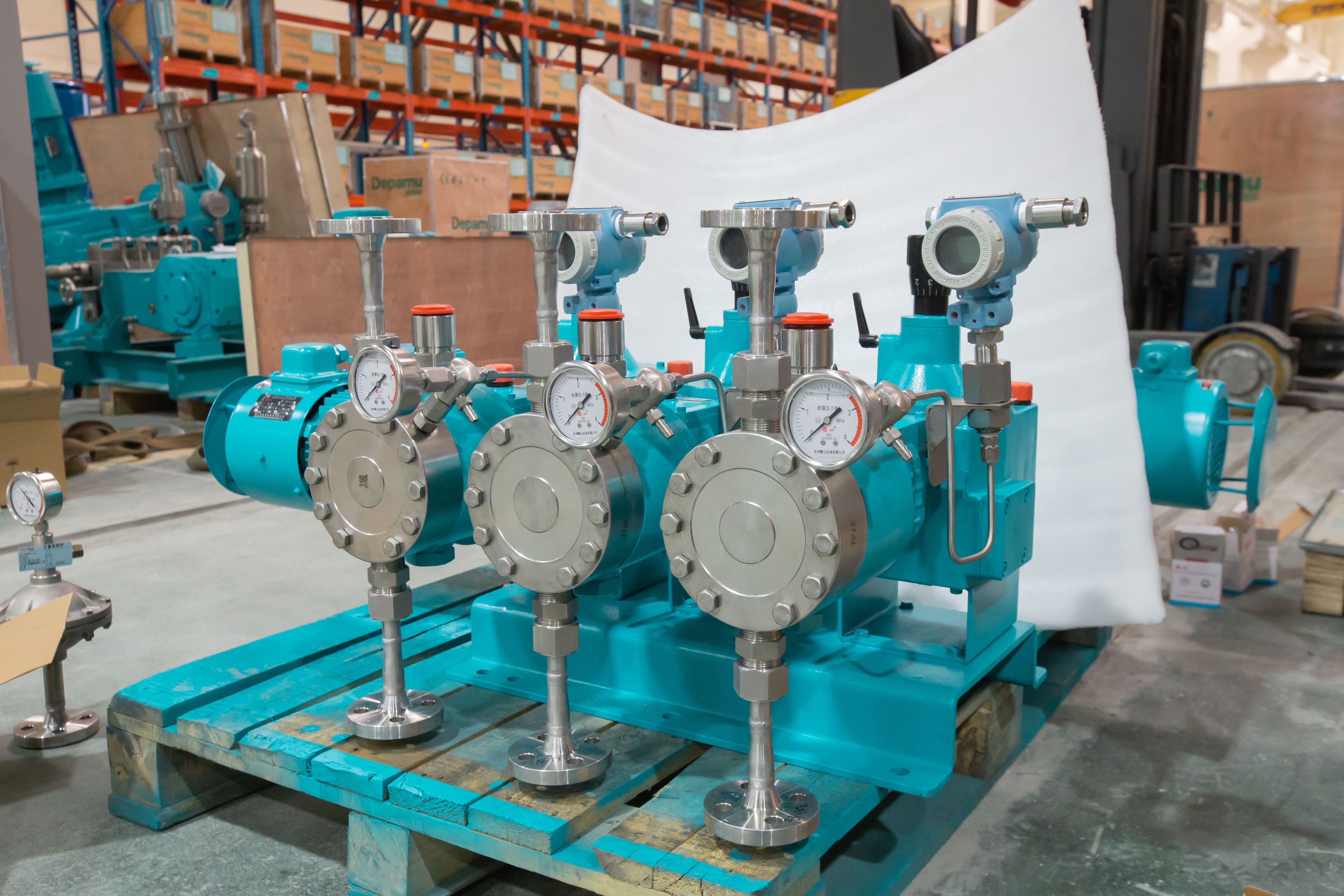
A hydraulic diaphragm metering pump uses a hydraulic system to move a flexible diaphragm, which in turn displaces the chemical being dosed. Because the diaphragm separates the hydraulic oil from the process liquid, the pump can handle aggressive, toxic, volatile, or high-purity media without a conventional stuffing box or exposed sliding seal. The stroke length and operating frequency can be adjusted to change the dosing rate, allowing accurate control across a wide turndown range. In practical terms, the pump acts as a precise injection device: it delivers a repeatable volume against the system pressure and can be integrated with flow measurement, pH/ORP control, or PLC-based dosing logic.
The hydraulic diaphragm design is particularly relevant where leakage cannot be tolerated. Acids, caustics, biocides, scale inhibitors, corrosion inhibitors, and other treatment chemicals are often hazardous or expensive. A diaphragm metering pump provides a sealed pumping chamber and a clear boundary between the drive end and the process fluid. This is one reason hydraulic diaphragm metering pumps are widely used in chemical dosing pump for water treatment applications, where reliability and containment are more important than initial purchase price alone.
Hydraulic Diaphragm vs. Plunger Metering Pumps
A plunger metering pump uses a reciprocating piston or plunger inside a sealed packing arrangement. It can achieve very high pressures and is suitable for certain viscous or high-temperature duties, but the packing requires attention and may allow a small amount of leakage over time. A hydraulic diaphragm pump avoids packing leakage by using a diaphragm as the primary barrier. The trade-off is that the diaphragm material, hydraulic circuit, and valve design must be matched to the process conditions. For corrosive chemicals, high-pressure injection, and applications where environmental containment is critical, the hydraulic diaphragm design is often the preferred starting point.
The choice is not always absolute. Some projects use hydraulic diaphragm metering pumps for accurate chemical injection and high-pressure process reciprocating pumps for bulk transfer or pressure boosting. A competent hydraulic diaphragm metering pump supplier should be able to explain the boundary between these technologies and recommend the appropriate configuration based on flow, pressure, viscosity, temperature, solids content, and control philosophy.
Chemical Dosing Pump Selection Guide: How to Choose a Dosing Pump
Effective dosing pump selection starts with a clear process datasheet. The buyer should define the chemical name and concentration, required dosing range, normal and maximum discharge pressure, temperature, viscosity, specific gravity, presence of solids or gas, suction conditions, and the control signal available at the injection point. It is also important to state whether the pump will operate continuously or intermittently, whether multiple chemicals will be dosed at one location, and whether redundancy or standby capacity is required. Without these details, a supplier can only offer a generic pump, which often leads to oversizing, poor turndown, or premature maintenance.
The next step is to select the pump size so that normal operation falls within a controllable part of its range. A pump that is always run at its minimum stroke may lose accuracy, while a pump that is always at maximum output has no reserve for process changes. The turndown ratio, repeatability, and linearity of the metering pump should be reviewed together with the turndown required by the process. For example, a water treatment plant may need a wide dosing range because demand changes seasonally, whereas a chemical reactor may need a narrow but highly repeatable flow.
| Selection Factor | What to Verify | Why It Matters |
|---|---|---|
| Dosing flow range | Minimum, normal, and maximum flow; required turndown ratio | Prevents oversizing and preserves accuracy at normal operation |
| Discharge pressure | Normal and maximum pressure at the injection point; pressure fluctuations | Determines pump rating, motor selection, and hydraulic design |
| Chemical compatibility | Wetted materials for pump head, diaphragm, valves, and seals | Protects pump life and maintains chemical purity |
| Viscosity and temperature | Operating viscosity, temperature range, need for heating or insulation | Affects valve performance, suction conditions, and diaphragm life |
| Control mode | Manual stroke adjustment, 4–20 mA, pulse input, Profibus, or PLC integration | Matches the plant automation and dosing control philosophy |
| Installation and redundancy | Available space, suction layout, standby pump, skid configuration | Reduces installation risk and improves process availability |
Match the Pump to the Chemical and the Process
Material selection is a central part of the selection process. The pump head, diaphragm, check valves, and piping connections must be compatible with the chemical at the operating concentration and temperature. Sodium hypochlorite, sulfuric acid, caustic soda, ammonia, and various polymer solutions behave differently with respect to corrosion, crystallization, gas formation, and viscosity. A hydraulic diaphragm metering pump manufacturer should ask for the safety data sheet or a detailed chemical description and then propose suitable wetted materials rather than relying on a single standard configuration.
Suction conditions deserve equal attention. A dosing pump is a positive displacement machine, and it cannot reliably draw chemical from a remote or poorly vented tank if the suction line is undersized or the net positive suction head is inadequate. Pulsation dampeners, calibration columns, back-pressure valves, pressure relief valves, and injection quills are not accessories to be added at the end of the project; they are part of the dosing system design. This is especially true for skid-mounted chemical dosing systems, where all components should be arranged for safe access, proper venting, and straightforward maintenance.
Define the Control and Automation Requirements Early
Modern dosing systems are often expected to follow a process signal automatically. A pump may receive a 4–20 mA signal from a flow meter, a pulse signal from a water meter, or a command from a plant PLC. In more advanced systems, the dosing rate is calculated from flow and chemical concentration, and the pump speed or stroke is adjusted continuously. The buyer should specify the signal type, fail-safe position, alarm contacts, and whether remote monitoring is required. Defining these points early prevents costly modifications after the skid has been assembled.
For projects involving multiple chemicals, the automation architecture should also consider segregation, labeling, and independent control loops. A chemical dosing system supplier with experience in complete skid design can integrate metering pumps, tanks, agitators, level instruments, and control panels into a coordinated package. This reduces interface risk between the pump supplier and the EPC contractor or plant integrator.
Choosing a Hydraulic Diaphragm Metering Pump Manufacturer
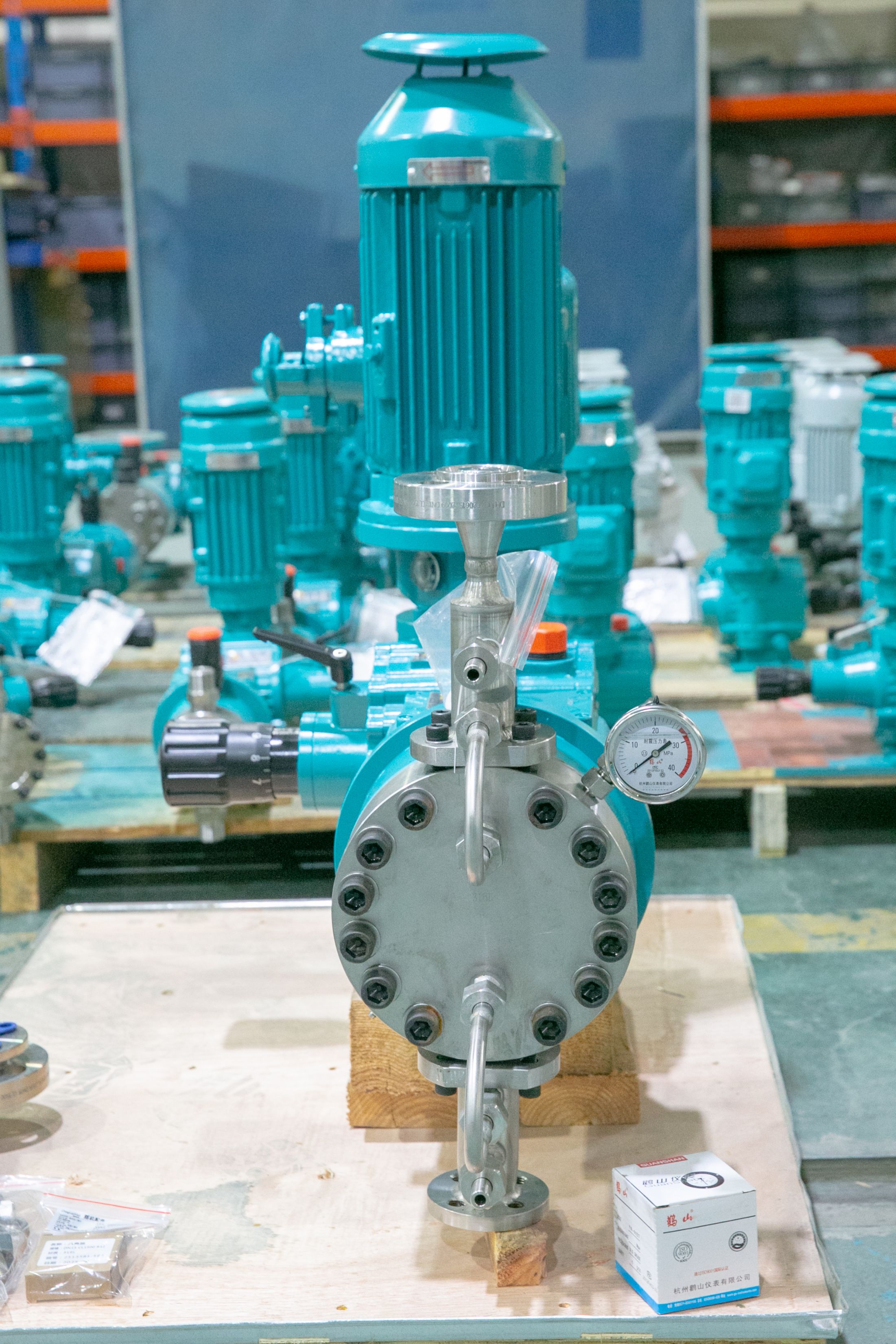
When comparing suppliers, price is only one part of the decision. A hydraulic diaphragm metering pump manufacturer should be able to demonstrate engineering capability, manufacturing control, testing discipline, and after-sales support. The evaluation should cover the pump itself, the motor and drive arrangement, the control system, the auxiliary components, and the documentation package. For overseas projects, the supplier should also be able to communicate clearly in technical English and provide drawings, manuals, and inspection records in a format that the buyer and contractor can use.
Depamu operates as a high-tech enterprise with more than two decades of experience in positive displacement pumps and fluid equipment. Its manufacturing base includes design, machining, assembly, and testing resources, and its product portfolio extends beyond individual metering pumps to complete chemical dosing systems, water and steam sampling devices, and other process equipment. The company serves petroleum refining and chemical processing, oil and gas fields, nuclear power, power generation, metallurgy, new energy, environmental water treatment, new materials, and food-related industries. This breadth of application experience is useful when a project requires a non-standard configuration rather than a catalogue item.
Questions to Ask a Metering Pump Supplier
- Can you provide a calculated pump selection based on my process datasheet, including flow, pressure, chemical compatibility, and control signal?
- Which wetted materials do you recommend for the chemical and operating temperature, and what is the expected diaphragm life?
- How is the pump tested before shipment, and what documentation is included in the inspection record?
- Can you supply the pump as part of a skid-mounted chemical dosing system with tanks, valves, instruments, and controls?
- What is the recommended spare parts list, and how quickly can replacement diaphragms and valves be delivered?
- Do you provide installation and commissioning support, and what information is needed for a quotation?
A supplier that answers these questions with specific technical information is usually better prepared to support the project than one that responds only with a price and a model number. The buyer should also confirm the scope of supply: is the offer for the pump only, or does it include the motor, baseplate, control panel, pulsation dampener, relief valve, calibration column, and interconnecting piping? Clarifying the battery limits early avoids gaps during installation.
Applications Across Water Treatment, Oil and Gas, Chemical, and Power Industries
Hydraulic diaphragm metering pumps are used wherever a controlled volume of liquid must be injected into a process. In environmental water treatment, they dose coagulants, flocculants, disinfectants, pH adjustment chemicals, scale inhibitors, and antifoaming agents. In boiler water treatment and cooling water systems, they inject oxygen scavengers, corrosion inhibitors, and scale control chemicals. In petroleum refining and chemical processing, they add catalysts, inhibitors, and additives to reactors, pipelines, and storage systems. In oil and gas fields, they support chemical injection for flow assurance, corrosion control, and wellsite operations.
Depamu’s sales distribution illustrates this application breadth. Petroleum refining and chemical processing account for approximately 41 percent of sales, oil and gas fields approximately 23 percent, nuclear power, power generation, metallurgy, and new energy approximately 15 percent, environmental water treatment approximately 13 percent, new materials and food approximately 3 percent, and other industries approximately 5 percent. These proportions reflect long-term experience in industries where dosing accuracy, containment, and equipment reliability are essential.
Typical Dosing Duties
In a water treatment plant, a chemical dosing pump may operate continuously with flow-paced control. The pump must respond smoothly to changes in water flow and maintain the residual chemical concentration within the target range. In a boiler water system, the dosing rate is often small but critical, and the pump must be able to handle high pressure and high temperature conditions at the injection point. In a refinery or petrochemical plant, the pump may dose a corrosion inhibitor into a hydrocarbon stream or a chemical additive into a high-pressure reactor feed. Each duty requires a different combination of pump size, materials, control mode, and auxiliary equipment.
High-pressure process reciprocating pumps complement the metering pump range in duties that require pressure boosting or bulk transfer. These pumps can handle high-viscosity, high-temperature, and solids-containing media in applications such as oilfield water injection, pipeline pressure boosting, and process transfer. A supplier with both metering and high-pressure reciprocating pump capability can help the buyer select the right technology instead of forcing one product type into every application.
Factory Capability, Customization, and Skid-Mounted Dosing Systems
For projects that require more than a standalone pump, a hydraulic diaphragm metering pump factory should be able to deliver an engineered package. A skid-mounted chemical dosing system typically includes one or more metering pumps, a solution tank, a mixer, level instruments, piping, valves, a control panel, and a structural frame. The system is assembled and tested before shipment, which reduces site work and improves quality control. On arrival, the contractor only needs to connect utilities and process lines, commission the system, and verify the dosing response.
Customization can cover the pump head materials, diaphragm type, motor voltage and protection class, control interface, painting system, enclosure rating, and documentation language. It can also cover the physical layout of the skid, the number of dosing points, the arrangement of standby pumps, and the integration of flow meters or analytical instruments. The key is to define the process requirements and the interface conditions clearly so that the factory can design a system that fits the site rather than requiring the site to fit a standard package.
Depamu’s product scope includes chemical dosing systems, water and steam sampling devices, water treatment equipment, and a range of positive displacement pumps. The company can provide standard products, non-standard products, and customized fluid solutions based on medium characteristics, flow, pressure, temperature, and site process requirements. This is particularly useful for projects in which the chemical is corrosive, the discharge pressure is high, the installation space is limited, or the control system must interface with an existing plant DCS.
Installation, Operation, and Maintenance Best Practices
Correct installation extends the life of a hydraulic diaphragm metering pump and protects the accuracy of the dosing system. The pump should be mounted on a rigid base with adequate access for maintenance. Suction piping should be short, properly sized, and arranged to avoid air pockets. A strainer, if used, must be selected so that it does not create excessive suction loss. A pressure relief valve should protect the pump and piping from overpressure, and the discharge line should include a means of calibration and isolation. For hazardous chemicals, secondary containment and proper ventilation should be provided around the tank and dosing area.
During operation, the pump stroke and frequency should be adjusted according to the commissioning procedure, and the actual dosing rate should be verified by calibration. Operators should record suction and discharge pressure, stroke setting, motor current, and any alarm conditions. If the dosing rate drifts, the cause may be a worn diaphragm, a partially blocked valve, gas in the suction line, or a change in chemical viscosity. Troubleshooting should follow a logical sequence rather than simply increasing the stroke setting.
Preventive Maintenance Checklist
- Inspect the diaphragm and hydraulic oil condition at the recommended interval, and replace worn parts with genuine spares.
- Check suction and discharge valves for fouling, crystallization, or damage, especially when handling scaling or crystallizing chemicals.
- Verify calibration against a calibration column or a measured drawdown test after any maintenance or process change.
- Inspect the relief valve, pulsation dampener precharge, and piping supports for vibration or leakage.
- Keep the control panel and signal wiring clean and dry, and confirm that alarm and fail-safe functions operate correctly.
- Maintain a spare parts inventory for diaphragms, valves, seals, and other wear items based on the supplier’s recommendation.
Procurement and Total Cost of Ownership
Procurement decisions for dosing pumps should consider total cost of ownership rather than the lowest initial quotation. The purchase price is only the beginning; energy consumption, spare parts, downtime, calibration effort, and the cost of chemical losses all affect the lifecycle cost. A pump that is correctly sized and constructed for the duty may cost more initially but can reduce maintenance interventions and production risk over time. Buyers should ask for a spare parts recommendation, expected maintenance intervals, and the lead time for critical components.
For international projects, the commercial evaluation should also consider documentation, testing, packing, shipping, and commissioning support. A hydraulic diaphragm metering pump supplier that can provide a complete documentation package, including general arrangement drawings, P&ID for skid systems, operation and maintenance manuals, and inspection reports, reduces the risk of delays at site. It is also useful to confirm the warranty terms, the response time for technical support, and the availability of remote assistance for commissioning and troubleshooting.
Depamu’s sales performance has grown steadily, with sales of approximately RMB 450 million in 2023, RMB 510 million in 2024, and RMB 560 million in 2025. This growth reflects the company’s continued investment in product development, manufacturing capability, and customer service. For buyers seeking a long-term supplier rather than a one-time vendor, this kind of sustained business development is a useful indicator of stability and market confidence.
FAQ
How do I choose a dosing pump for my chemical process?
Start with a process datasheet that defines the chemical, concentration, required dosing range, normal and maximum discharge pressure, temperature, viscosity, and control signal. Then select a pump size that keeps normal operation within a controllable part of its range and confirm the wetted materials with the chemical supplier. The selection should also include the suction arrangement, relief valve, calibration method, and control interface. A hydraulic diaphragm metering pump manufacturer can calculate the pump duty and recommend a configuration, but the buyer must provide accurate process data for the calculation to be reliable.
What is the difference between a hydraulic diaphragm metering pump and a plunger metering pump?
A hydraulic diaphragm metering pump uses hydraulic oil to move a diaphragm that separates the drive end from the process fluid. This design provides containment and is well suited to corrosive, toxic, or high-pressure chemicals. A plunger metering pump uses a reciprocating plunger with packing, which can achieve high pressures but may require packing maintenance and may allow a small amount of leakage. The final choice depends on the chemical, pressure, temperature, maintenance philosophy, and environmental requirements of the project.
Can you customize a skid-mounted chemical dosing system for my plant?
Yes. A skid-mounted chemical dosing system can be configured with one or more metering pumps, solution tanks, mixers, level instruments, piping, valves, and a control panel. The system can support dry powder or liquid chemical preparation, single-point or multi-point dosing, and automatic control linked to plant flow or analytical signals. The factory assembles and tests the skid before shipment, and the site work is generally limited to connecting utilities and process lines, followed by commissioning and calibration.
How can I find a reliable hydraulic diaphragm metering pump manufacturer?
Look for a manufacturer with demonstrable experience in your industry, a clear engineering process, and the ability to provide references or technical documentation. Ask how the pump is selected, what materials are recommended, how the unit is tested before shipment, and what spare parts and service support are available. A factory visit or a detailed technical discussion can reveal whether the supplier is simply assembling catalogue components or actually engineering the dosing solution. For overseas projects, confirm the availability of English documentation and commissioning support.
What maintenance does a hydraulic diaphragm metering pump require?
Routine maintenance typically includes checking the diaphragm and hydraulic oil, inspecting suction and discharge valves, verifying calibration, and confirming that the relief valve and pulsation dampener are functioning correctly. The maintenance interval depends on the chemical, operating pressure, temperature, and running hours. Keeping a recommended spare parts inventory and recording operating data help identify wear before it causes an unplanned shutdown. Always use genuine spare parts and follow the manufacturer’s instructions for reassembly and testing.
Summary
Choosing a chemical dosing pump requires a structured review of the process, the chemical, the pressure and flow range, the control philosophy, and the installation environment. Hydraulic diaphragm metering pumps are a strong choice for accurate, contained dosing in water treatment, chemical processing, oil and gas, power generation, and other demanding applications. The supplier matters as much as the pump: a hydraulic diaphragm metering pump manufacturer with engineering capability, factory testing, customization experience, and responsive support can help turn a pump selection into a reliable dosing system.
Depamu (Hangzhou) Pump Industry Technology Co., Ltd. combines more than two decades of positive displacement pump experience with the ability to deliver metering pumps, high-pressure process reciprocating pumps, chemical dosing systems, and related fluid equipment. Its product range and application experience make it a practical partner for buyers who need standard pumps, non-standard configurations, or complete skid-mounted dosing solutions. By defining the duty clearly and evaluating suppliers on technical capability rather than price alone, procurement teams can reduce operating risk and improve the long-term performance of their chemical dosing systems.