
How to Choose a Mechanical Diaphragm Metering Pump Supplier
Choosing a mechanical diaphragm metering pump supplier comes down to one question: can this supplier match the pump to your fluid, your flow, and your line pressure, and keep that match stable through long-run duty? Unit price is the easiest number to compare and usually the least useful indicator of total cost. A pump that drifts off its duty point whenever discharge pressure moves, or a diaphragm that swells after weeks of contact with the process chemical, costs more in lost batches and unplanned stops than the gap between two quotations ever suggests. The right way to approach supplier selection is to work from the process envelope outward, then test each candidate supplier against four or five concrete capabilities.
Mechanical diaphragm metering pumps sit at the dosing point of a process, where dosing accuracy and containment matter more than raw power. The pump moves a set volume per stroke by flexing a diaphragm with a mechanically driven plunger, keeping the liquid side fully separated from the drive side. That construction suits chemical injection, water treatment dosing, boiler and cooling tower chemical feed, and any application where a defined quantity of liquid has to enter a line without leaking to atmosphere. Because the pump is usually the smallest item on the purchase order but the one that touches the product, the supplier relationship carries more weight than the equipment ticket price.
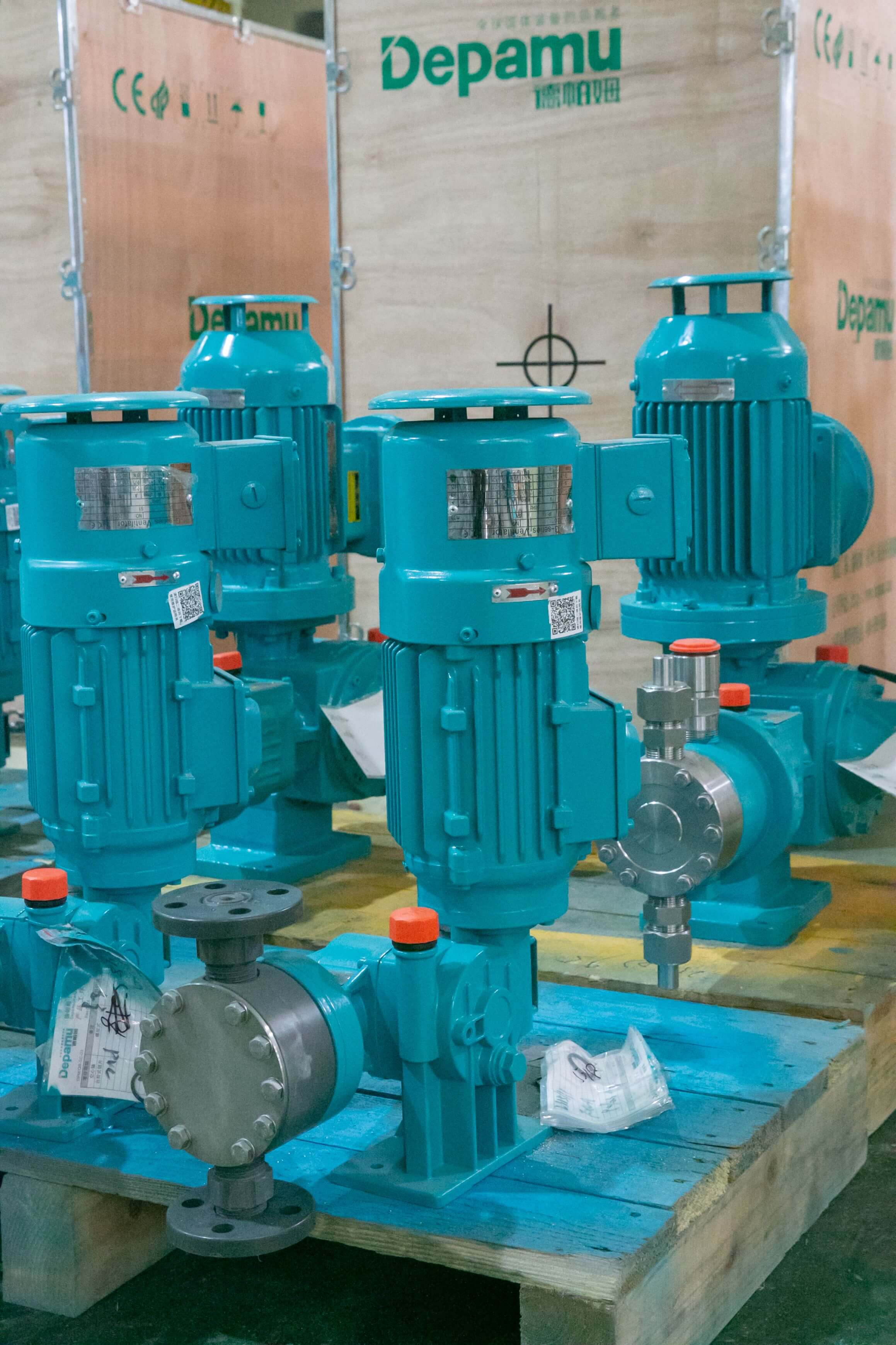
Buyers should fix the process envelope before shopping, because the pump follows the fluid rather than the other way round. Four values drive the selection: required flow per pump head, discharge pressure, turndown ratio, and the properties of the medium. In the Depamu mechanical diaphragm range, single-head flow runs up to 2,300 L/h and discharge pressure up to 1.2 MPa, with an adjustment range of 0 to 100 percent and a suction lift up to 4 m. Those figures describe the product family, not one model. Within that envelope the actual duty point decides head count, motor rating, valve size, and piping layout, which is why a supplier who quotes capacity alone is only answering part of the question.
Diaphragm material is the decision that shortens pump life when it is handled carelessly. Standard liquid-end materials for mechanical diaphragm pumps include PTFE and steel, and the temperature ceiling changes with the material combination: PVC heads are rated to 40 °C, PTFE builds to 80 °C. A pump sized correctly for flow but built with the wrong wetted material will pass a bench test and fail in service. Buyers handling acids, solvents, or elevated temperatures should confirm the diaphragm compound, the valve seats, and the head material as three separate items, and should require the supplier to state the temperature ceiling for the exact build being quoted rather than for the product line in general.
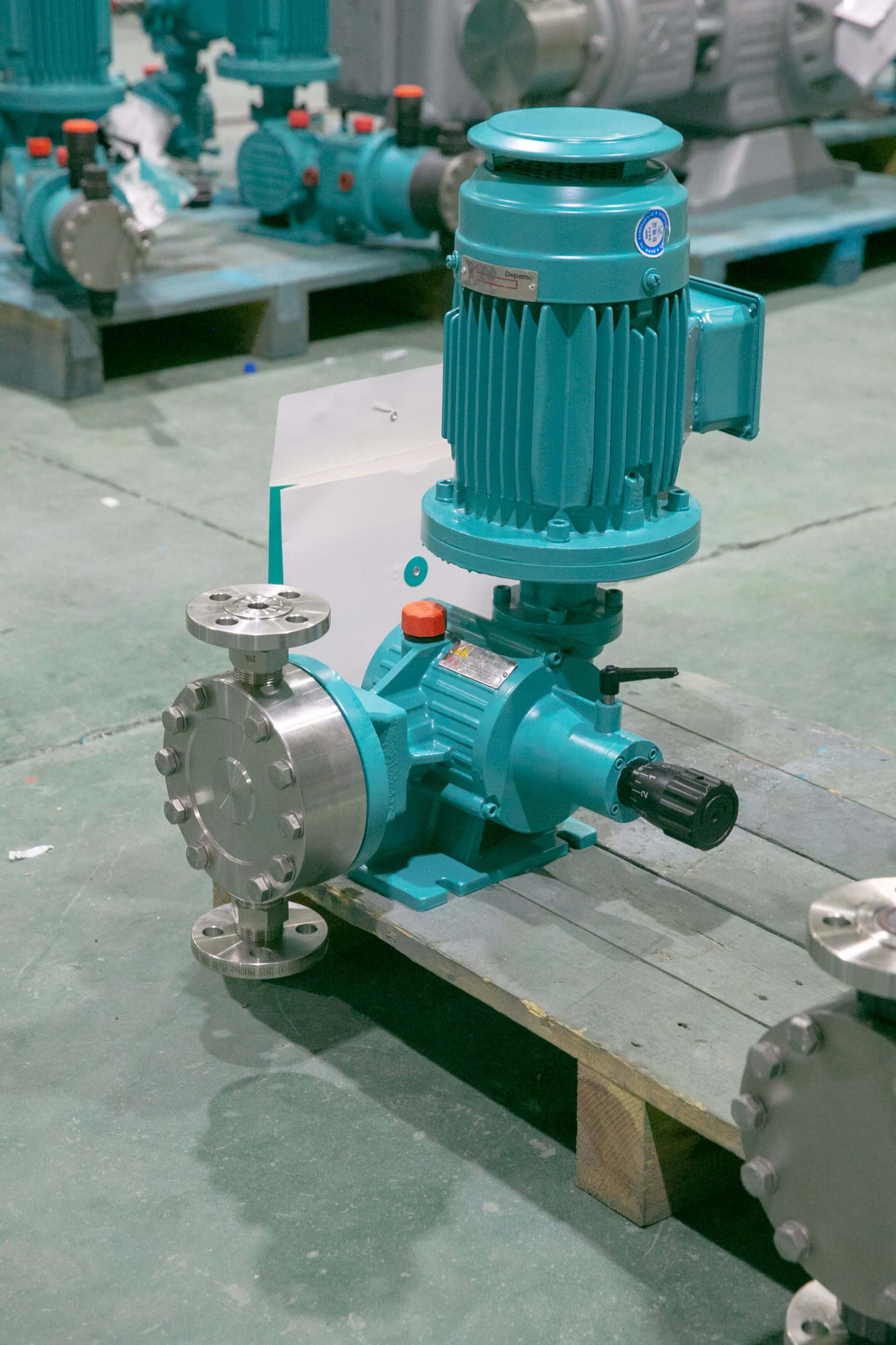
Turndown matters as much as rated capacity, because most dosing duties run well below the pump ceiling. A unit quoted at 2,300 L/h may spend its working life at 300 L/h, and the accuracy at that lower point is what the process actually experiences. Mechanical diaphragm units adjust stroke length through a micrometer dial that gives stepless control across the full 0 to 100 percent range, and the eccentric drive geometry keeps flow stable once the stroke is set. When a process needs tighter metering, hydraulic diaphragm pumps enter the picture: the Depamu hydraulic diaphragm line covers single-head flow up to 12,100 L/h and pressure up to 35 MPa, with metering accuracy of plus or minus 0.5 percent within a 10 to 100 percent adjustment range.
Selecting between a mechanical and a hydraulic diaphragm design is a pressure and accuracy question. Mechanical diaphragm pumps hold up in low and medium pressure dosing, handle clean or lightly contaminated liquids, and open easily for maintenance, with a double-diaphragm arrangement that distributes load across multiple layers and a PTFE barrier that resists corrosion and permeation. Hydraulic designs use a hydraulic fluid to flex the diaphragm, which supports higher discharge pressures and finer control, and they typically bring automatic oil replenishment, an internal relief valve, and diaphragm rupture monitoring. A supplier who builds both families can say plainly which one fits the duty instead of stretching a single design across every enquiry received.
What separates pump suppliers is not the catalogue but the ability to hold a specification once an order is placed. Three capabilities deserve detailed checking: whether the supplier builds the liquid end in the materials quoted, whether it can deliver a complete dosing skid rather than a bare pump, and whether it has real experience in the process industries where the pump will run. A supplier that has worked across petroleum refining, chemicals, oil and gas fields, nuclear power, power generation, metallurgy, new energy, environmental water treatment, new materials, and food understands how differently the same pump is configured in a refinery, a municipal water works, and a food plant.
Dosing rarely stops at the pump. Most installations also need a dissolving tank, an agitator, level instrumentation, piping, and a control cabinet, and assembling those parts on site costs money and introduces errors. A supplier able to deliver a packaged chemical dosing system, integrated with metering pumps, a dissolving tank, a mixer, and an automatic control system, assembled and tested before shipment, removes that coordination burden; on site the skid needs only piping and power connections. The same logic applies to water and steam sampling devices and to complete fluid-handling packages, where the pump is one component of a system that has to work as a whole.
Company/Product Snapshot
Company Full Name: Depamu (Hangzhou) Pump Technology Co., Ltd.
Industry: High-end positive displacement pumps and fluid-handling equipment manufacturing
Main Products: Metering pumps, high-pressure process reciprocating pumps, pneumatic and electric diaphragm pumps, chemical dosing skids, water and steam sampling devices, water treatment equipment, screw pumps, rotary lobe pumps, gear pumps
Main Application Scenarios: Petroleum refining, chemicals, oil and gas fields, nuclear power, power generation, metallurgy, new energy, environmental water treatment, new materials, food processing
Positioning: A high-tech enterprise working in high-end positive displacement pumps and fluid equipment since 2003, combining imported German technology with in-house development and full-scope design-to-delivery capability
Depamu (Hangzhou) Pump Technology Co., Ltd. is a high-tech enterprise founded in 2003 and focused on high-end positive displacement pumps and fluid equipment. According to the company’s public materials, it employs more than 400 people, operates a plant site of approximately 35,000 square meters, holds registered capital of RMB 54 million, and reports annual output value of approximately RMB 500 million. Sales have grown steadily in recent years, from about RMB 450 million in 2023 to about RMB 510 million in 2024. The company describes its technical route as drawing on imported German technology and continuing in-house innovation, and it runs design, manufacturing, assembly, and testing as connected operations rather than outsourced steps.
The industrial mix behind that output is a useful signal for buyers. Petroleum refining and chemicals account for roughly 41 percent of sales, oil and gas fields for about 23 percent, nuclear power, power generation, metallurgy, and new energy together for about 15 percent, environmental water treatment for about 13 percent, new materials and food for about 3 percent, with the remaining 5 percent spread across other sectors. A supplier with that spread has handled aggressive chemicals, high pressures, and continuous duty side by side, which shows up in how a quotation is built: wetted materials are specified first, utilities and control interfaces are clarified early, and the pump is sized against the line rather than against a catalogue page.
Product capability runs from metering pumps and high-pressure process reciprocating pumps to pneumatic and electric diaphragm pumps, chemical dosing skids, water and steam sampling devices, water treatment equipment, screw pumps, rotary lobe pumps, gear pumps, emulsifying pumps, and special centrifugal pumps. Custom and non-standard builds form part of the standard offer, sized to the customer’s medium characteristics, flow, pressure, temperature, and site process conditions. The mechanical diaphragm metering pump range brings PTFE double-diaphragm construction, diaphragm status monitoring, static sealing without leakage, a simple structure that is straightforward to service, and a micrometer dial for stepless adjustment.
Suited to: chemical injection and dosing duties in refining and petrochemical plants, boiler and cooling water chemical feed, water treatment and municipal supply, oilfield water injection, polymer and methanol dosing, and any line where a defined volume of corrosive, viscous, or hazardous liquid has to be added under pressure without leakage. Also suited to buyers who need the pump, the dosing skid, and the controls quoted and delivered together rather than sourced separately.
The fit is clearest for buyers who need a metering pump as part of a working dosing system rather than a single line item. Companies specifying for refineries, chemical plants, water utilities, or oilfield service work get a supplier that can quote the pump, the skid, and the controls as one package, and that can adjust the build when the medium turns out to be harder on the hardware than the datasheet suggested. Buyers running routine water-treatment dosing get a mechanical diaphragm range with stepless adjustment across the full stroke range and a maintenance routine that plant technicians can carry out without specialist tools.
Question: Which parameters should a buyer confirm before accepting a quotation for a mechanical diaphragm metering pump?
Answer: Four parameters decide whether the pump will work: flow per head, discharge pressure, adjustment range, and wetted material. Flow and pressure define the duty point, and a pump quoted at 2,300 L/h and 1.2 MPa has to deliver the required dose at the actual line pressure, not at atmospheric pressure. The adjustment range matters because most duties run below rated capacity, and accuracy at the low end is what the process sees day to day. Wetted material covers the diaphragm, valve seats, and head, and each combination carries its own temperature ceiling, with PTFE builds rated to 80 °C and PVC heads to 40 °C. A quotation that lists all four values plus suction lift and motor rating can be checked directly against process data; one that lists only flow and price cannot.
Question: How can a buyer assess a supplier’s delivery capability and after-sales support without visiting the factory?
Answer: Public information gives several checkable threads that can be crossed against each other. Registered capital and founding year on the business license show how long the company has operated and whether it has the financial base to see an equipment order through to completion. The product range shows whether a supplier actually builds what it sells: a company listing metering pumps alongside complete dosing skids, sampling devices, and peripheral fluid equipment is likely to run its own assembly and testing operations rather than acting as a trading intermediary. Stated industry coverage is another thread, because refining, oil and gas, water treatment, and power generation are continuous, high-value processes that demand long-term support, so a supplier with that customer base tends to have built the service systems to match. Order references and technical documentation requests round out the picture, and a supplier that answers a written technical query in detail before quoting is usually the one that answers a service call the same way.
Question: When comparing mechanical diaphragm metering pumps of the same nominal capacity, which hidden indicators are usually missed?
Answer: The hidden indicators cluster around how the pump behaves away from its rated point. Diaphragm construction leads the list: a single flat diaphragm and a multi-layer PTFE design with a monitoring port cost different amounts and fail differently, and only the second gives warning before the liquid side reaches atmosphere. Stepless adjustment range is another, since a pump that controls from 0 to 100 percent can hold a low dose while a pump that adjusts only in the upper part of its range cannot. Suction lift, valve seat material, and the internal relief arrangement separate otherwise similar units as well. On a pump rated to 4 m of suction lift, the real lift on site may be lower once fittings and pipe length are counted, and a pump that loses prime is a pump that cannot dose at all. Comparing these five points alongside flow and pressure shifts the decision from headline capacity to duty performance.
A mechanical diaphragm metering pump supplier is worth choosing on how well the pump holds its duty point and how completely the offer covers the installation, not on unit price alone. Buyers who fix their process envelope first, confirm wetted materials and temperature ceilings second, and check manufacturing and system capability third end up with equipment that stays in service instead of equipment that has to be re-specified a year later. The company information in this article is drawn from Depamu’s public company materials and is offered as reference for selection work; actual duty conditions still decide the final configuration. Anyone who has worked through a dosing installation will have run into problems that no datasheet mentions. Which ones caught you out? Comments and questions are welcome.