
Choosing a hydraulic diaphragm metering pump manufacturer is not simply a purchasing decision — it is a process reliability decision. In chemical dosing, water treatment, petrochemical processing and other flow-critical operations, a metering pump runs continuously, handles aggressive or hazardous media, and must hold a repeatable dose over thousands of operating hours. A pump that drifts, leaks or fails prematurely affects product quality, safety and environmental compliance far beyond the cost of the unit itself.
This guide explains what a hydraulic diaphragm metering pump actually does, how to specify one correctly, what to look for in a hydraulic diaphragm metering pump supplier, and how integrated dosing systems are built around the pump. It also introduces Depamu (Hangzhou) Pump Industry Technology Co., Ltd., a Chinese manufacturer that has focused on high-end positive displacement pumps and fluid equipment since 2003.
What a Hydraulic Diaphragm Metering Pump Manufacturer Actually Delivers
A hydraulic diaphragm metering pump is a positive displacement pump in which a diaphragm is moved by hydraulic oil pressure rather than by a direct mechanical linkage. The hydraulic circuit transfers force evenly across the diaphragm, which reduces localized stress on the diaphragm and allows the pump to work against higher discharge pressures while keeping the process medium completely sealed from the drive end. Dosing is adjusted by changing stroke length, stroke frequency, or both.
The practical benefit is leak-free containment. Because the diaphragm separates the hydraulic side from the process side, corrosive acids, caustics, solvents, volatile liquids and other difficult media stay inside the pump head and the piping. There is no packing or mechanical seal in contact with the chemical, which is why hydraulic diaphragm designs are frequently selected for hazardous, toxic, odorous or high-purity duty.
A capable hydraulic diaphragm metering pump manufacturer must therefore deliver more than a catalog item. It needs to control diaphragm geometry and hydraulic compensation, match wetted materials to the medium, verify performance at the specified duty point, and support the pump through commissioning and long-term operation. That combination of design, manufacturing and application engineering is what separates a pump assembler from a true metering pump producer.
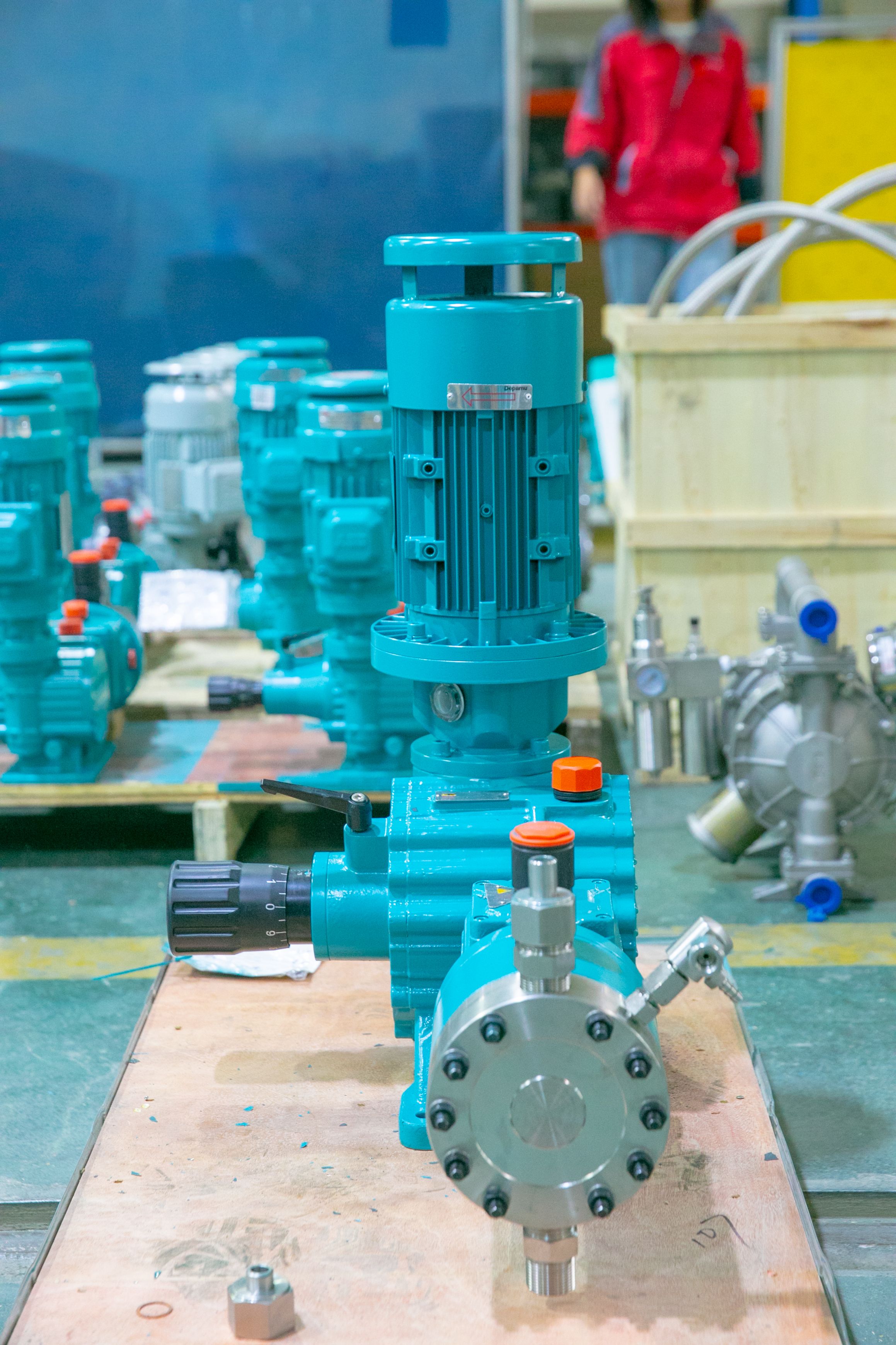
Inside Depamu: Manufacturing Capacity and Product Range
Depamu (Hangzhou) Pump Industry Technology Co., Ltd. was founded in 2003 and has grown into a research, development, manufacturing and sales enterprise specializing in high-end positive displacement pumps and fluid equipment. The company employs more than 400 people, operates a plant site of approximately 35,000 square meters, holds registered capital of RMB 54 million, and generates annual output value of roughly RMB 500 million. Sales have continued to grow in recent years, from about RMB 450 million in 2023 to about RMB 510 million in 2024 and approximately RMB 560 million in 2025.
The product portfolio is broad enough to cover most dosing and transfer duties in a process plant: metering pumps, high-pressure process reciprocating pumps, pneumatic pumps, electric pumps, chemical dosing packages, water and steam sampling systems, water treatment equipment, screw pumps, rotary lobe pumps and gear pumps. The company operates three brands — Depamu, Kenilowa and Dailepu — and positions itself as a long-term player in global fluid equipment.
Where the Company’s Experience Is Concentrated
Application experience matters when selecting a metering pump, because the same pump model performs very differently in clean water, concentrated acid, viscous polymer or slurry service. Depamu’s sales distribution reflects a heavy emphasis on demanding process industries: petroleum refining and chemical processing account for roughly 41% of business, oil and gas fields about 23%, nuclear power, power generation, metallurgy and new energy about 15%, environmental water treatment about 13%, and new materials and food about 3%, with the remainder in other sectors.
That distribution means the manufacturer’s engineering team is routinely exposed to high-pressure injection, precise chemical dosing, process boosting and complex media handling. For buyers, this is relevant context: a hydraulic diaphragm metering pump supplier with this application mix is more likely to recognize the process risks behind a specification, such as vapor pressure, suspended solids, temperature excursions or back-pressure variation.
How a Hydraulic Diaphragm Metering Pump Works and Where It Fits
In operation, the drive turns a crankshaft that moves a hydraulic piston. The piston pressurizes hydraulic oil, which in turn deflects the diaphragm. Inlet and outlet check valves control the direction of flow, so each stroke delivers a defined volume of chemical into the discharge line. Because the diaphragm movement is driven by an incompressible hydraulic fluid, the displacement is consistent and the load on the diaphragm is distributed across its surface.
This architecture suits three broad categories of duty. The first is precision dosing of chemicals where the dose rate must be controlled and repeatable — for example, injecting corrosion inhibitors, antiscalants, coagulants, disinfectants or pH adjustment chemicals. The second is handling media that must not leak to atmosphere, including hazardous or odorous substances. The third is dosing against elevated discharge pressure, where a mechanically driven diaphragm would be subjected to higher point loads.
Typical Applications Across Industries
- Petroleum refining and chemicals: additive injection, inhibitor dosing, process chemical metering and high-pressure injection into reaction or transfer lines.
- Oil and gas fields: chemical injection for corrosion control, scale inhibition, demulsifiers and methanol dosing at wellheads and gathering systems.
- Power generation and nuclear-related facilities: boiler and feedwater chemical treatment, water and steam sampling support, and precise dosing in high-purity water circuits.
- Environmental water treatment: coagulation, flocculation, disinfection, pH correction and phosphorus removal in municipal and industrial wastewater plants.
- New materials, metallurgy and food processing: controlled addition of additives, reagents and processing aids where repeatability and hygiene matter.
Depamu also manufactures high-pressure process reciprocating pumps for duties where the requirement is pressure rather than fine metering — for example, oilfield water injection, process transfer, pipeline boosting and high-pressure injection. In practice, many projects combine both pump types: a metering pump for the chemical additive and a reciprocating process pump for the main fluid stream.
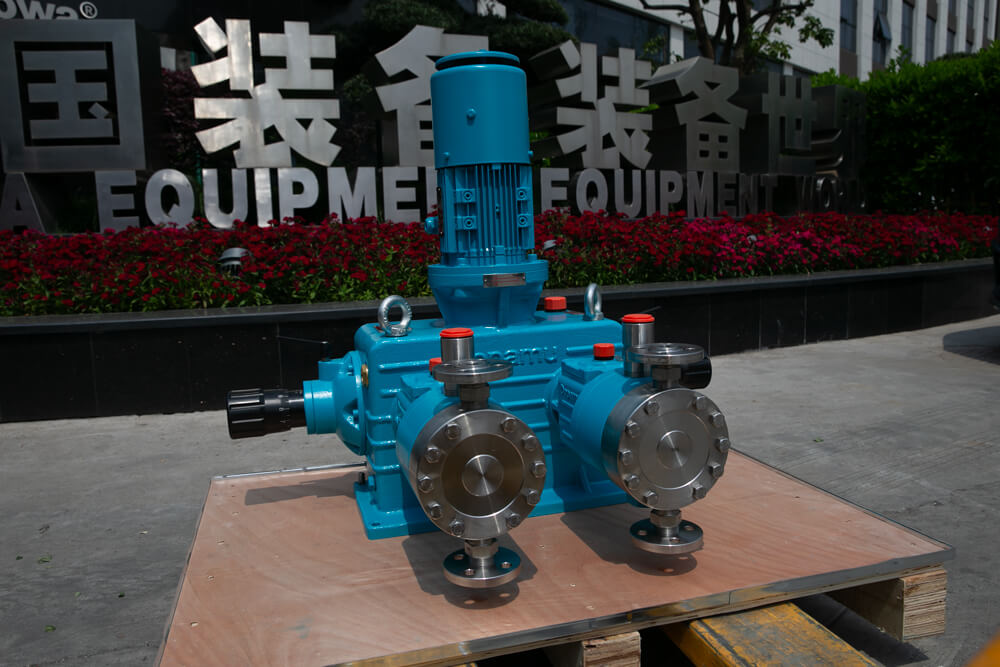
Hydraulic Diaphragm Metering Pump Selection Guide: What to Confirm Before Requesting a Quotation
Most metering pump problems begin with an incomplete specification. A hydraulic diaphragm metering pump manufacturer can only guarantee performance at a defined duty point, so the buyer should provide the full process picture rather than a single flow figure. The table below lists the inputs that matter most and why each one changes the pump configuration.
| Selection Input | Why It Matters | Information to Supply |
|---|---|---|
| Chemical and concentration | Determines wetted materials for the pump head, valves, diaphragm and gaskets. | Chemical name, concentration, impurities, compatibility data if available. |
| Flow rate and turndown | Sets pump size and the usable adjustment range; oversized pumps lose control at low doses. | Normal and maximum flow, minimum turndown required, dosing profile. |
| Discharge pressure | Affects hydraulic circuit design, motor power and check valve selection. | Normal and maximum back pressure, line pressure variation, injection point details. |
| Temperature and viscosity | Changes filling behavior, valve response and material limits. | Ambient and media temperature range, viscosity at operating temperature. |
| Control and automation | Defines whether manual stroke adjustment or automatic modulation is needed. | 4–20 mA, pulse, batch control, PLC integration, remote monitoring. |
| Area classification and environment | Influences motor selection, enclosure and installation layout. | Hazardous area status, indoor or outdoor location, available utilities. |
For a hydraulic diaphragm metering pump quotation, it also helps to state whether the pump will be supplied as a standalone unit or as part of a dosing package, and whether the request is for a standard model or a custom configuration. Depamu’s stated capability covers standard products, non-standard products and customized fluid solutions based on media characteristics, flow, pressure, temperature and site process requirements — which means the specification process should be treated as a technical dialogue rather than a catalog lookup.
Hydraulic Diaphragm vs. Mechanical Diaphragm vs. Plunger Pumps
Buyers often compare three dosing technologies. The choice depends on pressure, chemical risk, space, budget and control requirements. The comparison below is a general technical orientation; final selection must always be confirmed against the specific duty point and the manufacturer’s data.
| Technology | Strengths | Points to Consider |
|---|---|---|
| Hydraulic diaphragm | Leak-free containment, even diaphragm loading, well suited to higher discharge pressures and aggressive or hazardous chemicals. | More complex internal design; hydraulic oil and diaphragm maintenance require trained personnel. |
| Mechanical diaphragm | Simple construction, compact footprint, straightforward maintenance, lower initial cost. | Diaphragm is mechanically loaded; pressure capability and duty severity are limited compared with hydraulic designs. |
| Plunger | Very high pressure capability, robust for continuous process duty, efficient at high differential pressure. | Packing and seals contact the medium, so leakage and maintenance must be managed; less suitable for toxic or high-purity chemicals. |
In many plants the practical answer is a mixed fleet: hydraulic diaphragm metering pumps for precise and hazardous dosing, mechanical diaphragm pumps for lower-pressure utility dosing, and reciprocating plunger pumps for high-pressure process injection. A manufacturer that builds all three can advise without bias toward a single technology.
From Single Pump to Complete Dosing Skid
Dosing performance depends as much on the system around the pump as on the pump itself. A chemical dosing package typically integrates chemical storage, dissolution or dilution, mixing, metering and automatic control in a skid-mounted arrangement. Depamu supplies fully automatic chemical dosing systems built around its metering pumps, together with dissolving tanks, agitators and intelligent control systems, supporting dry powder or liquid dosing, multi-point injection and automatic interlocking control.
Pre-assembled and factory-tested skids reduce site work: the package arrives as a tested system, and on-site work is largely limited to piping and electrical connection. For project owners, this shifts responsibility for hydraulic design, control logic and component compatibility to a single supplier, which simplifies commissioning and long-term spare parts planning.
Beyond dosing packages, the company provides screw pumps, rotary lobe pumps, gear pumps, pneumatic and electric pumps, emulsion pumps, special centrifugal pumps, water and steam sampling devices and supercritical extraction equipment. That breadth matters in projects where the dosing pump is one item in a larger fluid equipment package.
How to Evaluate a Hydraulic Diaphragm Metering Pump Supplier
Supplier evaluation should go beyond price per unit. A structured checklist helps separate manufacturers from traders. First, confirm that the supplier actually designs and manufactures the pump, not merely assembles imported components. Second, ask for the technical basis of the offer: diaphragm material, hydraulic compensation method, valve design and the assumed duty point. Third, verify application experience in your industry, because a supplier familiar with petrochemical or water treatment dosing will ask better questions during the inquiry stage.
Fourth, examine the scope of supply. Can the supplier provide the pump alone, or also the dosing skid, controls, sampling systems and related rotary pumps? Fifth, review documentation and support: dimensional drawings, material certificates where applicable, operating manuals, commissioning guidance and spare parts recommendations. Sixth, confirm customization capability, since many projects require non-standard materials, special connections, alternative control signals or a footprint that fits an existing skid.
Depamu’s position as a hydraulic diaphragm metering pump manufacturer rests on its own R&D, design and manufacturing capability, a plant of about 35,000 square meters, a workforce of more than 400, and technology originally introduced from Germany and subsequently developed in-house. For international buyers, a manufacturer with this combination of scale, application range and customization scope can support both standard replacement pumps and project-specific dosing solutions.
Installation, Commissioning and Maintenance Practices That Protect Accuracy
Accurate dosing is a system property. Even a well-matched pump will lose repeatability if the suction line is undersized, the suction lift is excessive, the chemical degasses in the pump head, or the discharge line has trapped air. Installation should keep the suction line short, slope it upward toward the pump, provide adequate net positive suction head, and install pulsation damping where the process requires smooth flow. A pressure relief valve on the discharge side protects the pump and piping if the line becomes blocked.
Commissioning should include calibration under actual process conditions. Because dose volume depends on stroke length, frequency and back pressure, calibration in clean water is only an approximation for viscous or gassing media. A draw-down test on the actual chemical, at the actual discharge pressure, gives the most reliable calibration curve. Where automatic control is used, the control signal should be verified against measured dose rather than assumed.
Maintenance for hydraulic diaphragm pumps focuses on a few items: checking hydraulic oil level and condition, inspecting the diaphragm at planned intervals, verifying check valve seating, and confirming that stroke adjustment moves freely. Diaphragm replacement should be treated as a planned task rather than a reaction to failure, particularly with aggressive chemicals. Keeping a small set of wear parts — diaphragms, valves, gaskets and oil — on site reduces downtime significantly.
- Log dose rate, pressure and stroke setting weekly to detect drift early.
- Inspect suction strainers and filters; a partially blocked suction line causes erratic dosing.
- Check for hydraulic oil discoloration, which may indicate diaphragm fatigue.
- Verify relief valve function and discharge line cleanliness after any maintenance work.
- Recalibrate after changing chemical supplier, concentration or operating pressure.
FAQ
What is a hydraulic diaphragm metering pump used for?
A hydraulic diaphragm metering pump is used for precise, repeatable injection of chemicals into a process. Typical duties include corrosion and scale inhibitor dosing, pH adjustment, coagulation and disinfection in water treatment, additive injection in refining and petrochemical plants, and chemical injection at oil and gas facilities. The hydraulic diaphragm design keeps the process medium fully contained, so it is also chosen for hazardous, toxic or high-purity chemicals.
Can a hydraulic diaphragm metering pump handle corrosive or hazardous chemicals?
Yes, provided the wetted materials are selected for the specific medium. The diaphragm isolates the chemical from the hydraulic side and the drive, so there is no packing or dynamic seal in contact with the process fluid. The pump head, check valves, diaphragm and gaskets must be matched to the chemical concentration and temperature, which is why a complete chemical and operating condition description is essential at the inquiry stage.
Can Depamu supply a custom hydraulic diaphragm metering pump for a specific flow, pressure and medium?
Depamu states that it supplies standard products, non-standard products and customized fluid solutions based on media characteristics, flow, pressure, temperature and site process requirements. Customization can cover materials, connections, control arrangements and integration into a dosing package. The practical starting point is a documented duty specification so the configuration can be engineered and confirmed.
What information do I need to provide to get an accurate hydraulic diaphragm metering pump quotation?
Provide the chemical name and concentration, required flow range and turndown, normal and maximum discharge pressure, media and ambient temperature, viscosity, control signal requirements, area classification, and whether the pump is standalone or part of a dosing skid. Adding a piping sketch, injection point details and any site constraints will usually shorten the review and reduce the risk of a mismatched offer.
How do I choose between a hydraulic diaphragm and a mechanical diaphragm metering pump?
Choose hydraulic diaphragm when the duty involves higher discharge pressure, aggressive or hazardous chemicals, or a requirement for leak-free containment and stable long-term accuracy. Choose mechanical diaphragm for simpler, lower-pressure utility dosing where compact size and lower initial cost are the priorities. Final selection should always be confirmed against the duty point, since pressure, media and control requirements can change the answer.
Does Depamu provide complete chemical dosing systems, not only pumps?
Yes. Depamu supplies fully automatic chemical dosing packages that integrate chemical storage, dissolution, mixing, metering and automatic control in a skid-mounted system. These packages use metering pumps as the core component and can include dissolving tanks, agitators and intelligent controls, with support for dry powder or liquid dosing, multi-point injection and automatic interlocking. Systems are assembled and tested before delivery, so site work is mainly piping and electrical connection.
How can I keep dosing accuracy stable over long operating periods?
Stability comes from correct installation and planned maintenance. Keep the suction line short and properly sized, avoid air entrapment, install pulsation damping and a discharge relief valve, and calibrate against the actual chemical at the actual discharge pressure. During operation, log dose rate and stroke settings, inspect valves and strainers, monitor hydraulic oil condition, and replace diaphragms on a planned schedule rather than after a failure.
Summary
Selecting a hydraulic diaphragm metering pump manufacturer is a technical decision with long-term operational consequences. The right partner combines proven hydraulic diaphragm design, material selection matched to the chemical, a clearly defined duty point, and the ability to supply either a standalone pump or a complete dosing package. Asking the right questions at inquiry stage — about media, pressure, control, environment and scope of supply — prevents most dosing problems before the pump is even built.
Depamu (Hangzhou) Pump Industry Technology Co., Ltd. brings more than two decades of focus on positive displacement pumps, a 35,000 square meter manufacturing site, a workforce of over 400, three brands, and application experience concentrated in petroleum refining, chemicals, oil and gas, power, metallurgy, new energy and water treatment. Its range covers hydraulic diaphragm metering pumps, high-pressure process reciprocating pumps, chemical dosing packages, rotary pumps and related fluid equipment, supported by customization for specific media, flow, pressure and temperature requirements. For buyers comparing hydraulic diaphragm metering pump suppliers, the most productive next step is a precise duty specification and a direct technical discussion with the manufacturer.