
Choosing a PAC dosing pump looks simple on paper: pick a metering pump, set a flow rate, and start injecting polyaluminium chloride into the process line. In practice, PAC is one of the more demanding chemicals to dose. It is acidic, it carries suspended solids, it tends to crystallise when it dries, and it is almost always dosed in applications where accuracy directly affects water quality, chemical consumption and operating cost. A pump that is undersized, built from the wrong materials, or matched to the wrong control philosophy will lose accuracy quickly and create maintenance problems that persist for years.
This guide explains how PAC dosing pumps work, what parameters actually drive selection, how PAC and PAM dosing differ, and what to look for when you shortlist a PAC dosing pump manufacturer. It is written for plant engineers, EPC contractors, integrators and procurement teams evaluating a chemical dosing pump for wastewater treatment, drinking water plants or industrial process water systems.
What Is a PAC Dosing Pump and Why Accuracy Matters
Polyaluminium chloride (PAC) is a coagulant used to destabilise suspended particles, colloids and dissolved impurities so they can be agglomerated into larger flocs and removed by sedimentation, flotation or filtration. It is widely used in municipal drinking water treatment, industrial wastewater treatment, sludge conditioning, paper manufacturing and a range of process water applications. The dosing point is usually close to the rapid mix stage, and the dose has to be controlled within a fairly narrow band.
A PAC dosing pump is therefore a metering device rather than a transfer pump. Its task is not simply to move liquid from a storage tank to a process line; its task is to deliver a repeatable, adjustable and verifiable volume per unit of time. That distinction matters, because the hydraulic behaviour of a metering pump under varying discharge pressure is very different from that of a centrifugal pump.
Accuracy affects three things at once. Under-dosing leaves coagulation incomplete, which means higher turbidity in the treated water and more load on downstream filters. Over-dosing wastes chemical, increases sludge volume, shifts pH, and in some processes leaves residual aluminium in the treated water. Unstable dosing — even when the average dose is correct — creates erratic water quality that operators then try to correct by over-adjusting the set point, which makes the problem worse.
For these reasons, a PAC dosing pump should be selected around steady-state accuracy, turndown capability, and resistance to the specific chemical being handled, not around a single nameplate flow figure.
How to Choose a PAC Dosing Pump: The Core Selection Parameters
The selection process starts with the process data, not the pump catalogue. Before comparing models, gather the required dose rate in litres per hour, the maximum and normal discharge pressure at the injection point, the PAC concentration as supplied and as diluted on site, the minimum and maximum ambient and liquid temperatures, and the material of the downstream piping. Each of these influences the pump type, the wetted materials and the drive configuration.
The second step is to define the turndown ratio honestly. A plant designed for 1000 L/h peak dosing may run at 200 L/h overnight. If the pump can only control accurately between 60% and 100% of its rated flow, the low-flow condition will fall outside its controllable range and the dosing error will grow. Either select a pump with a wider adjustment range, or plan a two-pump configuration with a small trim pump for low-load periods.
The third step is to decide the control philosophy: manual stroke adjustment, analogue 4–20 mA control from a flow meter or turbidity analyser, pulse-based control from a water meter, or full closed-loop control through a dosing controller or plant DCS. This decision has a direct effect on the pump head selected and on how the dosing system is commissioned.
| Selection Parameter | What to Check | Typical Engineering Consideration |
|---|---|---|
| Dose rate | Normal and peak flow in L/h | Size above the peak, then confirm the pump still controls accurately at the minimum flow |
| Discharge pressure | Line pressure at the injection point plus injection valve and pipe losses | Add a safety margin; confirm the pump can dose at the highest credible line pressure |
| Chemical properties | PAC concentration, acidity, suspended solids, viscosity, temperature | Drives the choice of wetted materials and the internal design of the pump head |
| Turndown ratio | Ratio between maximum and minimum controllable flow | Match to real daily and seasonal load swings, not to the design peak alone |
| Control mode | Manual, 4–20 mA, pulse, or closed-loop with analyser feedback | Determines whether a simple pump or an integrated dosing controller is the better fit |
| Wetted materials | Diaphragm, valve seats, ball checks, pump head, piping | Must resist acidic attack and abrasive solids carried in the PAC solution |
| Accessories | Pulsation dampener, safety valve, back-pressure valve, calibration pot, strainer | Often determines whether the installed performance matches the pump’s rated performance |
Why Wetted Materials Deserve Extra Attention for PAC Duty
PAC solutions are acidic and frequently contain fine undissolved solids. That combination puts stress on valve seats and ball checks, which is where most metering pump accuracy problems begin. A pump that measured well in clean water in the factory may lose repeatability within weeks when handling a PAC solution that has been mixed on site without adequate settling time.
Practical engineering measures include selecting corrosion-resistant elastomers and seats for the diaphragms and check valves, keeping a strainer ahead of the suction valve, and confirming with the supplier that the chosen wetted material set has been validated for PAC rather than assuming that a general-purpose chemical pump will perform equally well across all coagulants.
PAC Dosing Pump Types Compared: Diaphragm, Plunger and Peristaltic
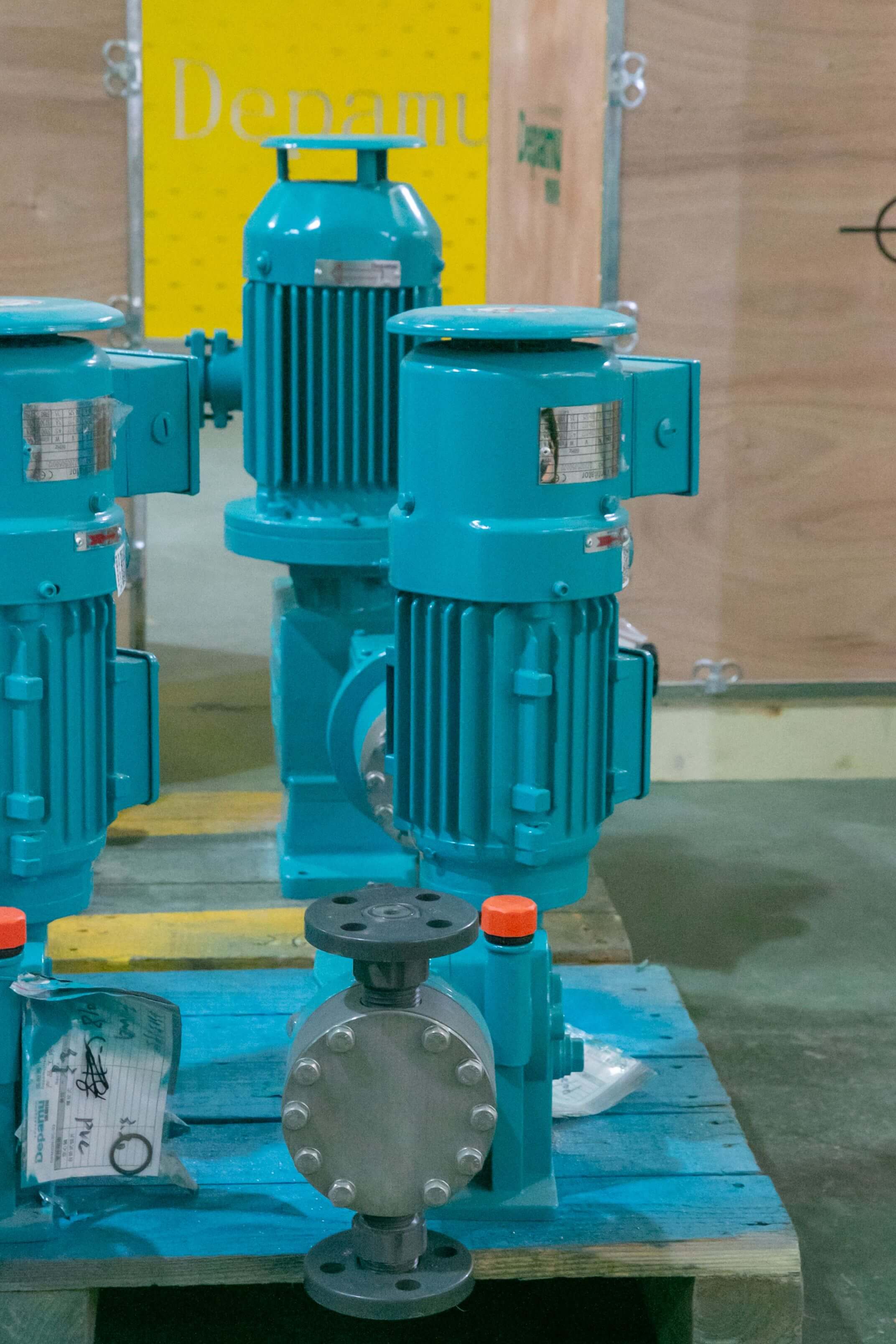
Most PAC dosing in water treatment is handled by mechanical or hydraulic diaphragm metering pumps. A hydraulic diaphragm metering pump uses hydraulic fluid to actuate a diaphragm, so the diaphragm is uniformly supported and the pump can operate at higher discharge pressures while keeping the process liquid fully contained. There is no dynamic seal between the process liquid and the atmosphere, which means no shaft packing to leak and no route for the chemical to escape. On PAC duty this containment matters as much as the accuracy itself, because leaks around a packing gland tend to be the first failure mode operators notice.
Plunger pumps are used in PAC and coagulant duty where very high pressure is required or where the process demands the mechanical robustness of a packed plunger design. They offer excellent repeatability and are well suited to high-pressure injection, but they require a sealing arrangement and need more attention to flushing and seal maintenance. For moderate pressures and a strong emphasis on zero leakage, the diaphragm option is usually the more practical choice.
Peristaltic and diaphragm-type dosing pumps with a flexible tube or hose element are common in small plants and in PAM duty, where the polymer solution can be viscous and shear-sensitive. Their simplicity is attractive, but tube life is finite and depends heavily on chemical compatibility, so they are best suited to lower pressures and lower duty cycles.
- Hydraulic diaphragm metering pump: high pressure capability, fully sealed process side, strong accuracy, suited to PAC and aggressive chemicals.
- Mechanical diaphragm metering pump: compact and economical, good for moderate pressures and clean or mildly abrasive solutions.
- Plunger metering pump: robust and precise at very high pressures, requires seal maintenance and flushing planning.
- Peristaltic hose pump: simple and gentle on viscous polymers such as PAM, but limited in pressure and tube life.
The practical conclusion is that pump type should follow from the duty: pressure band, chemical aggressiveness, solids content, turndown requirement and leakage tolerance. Selecting the family first and then fitting it to the process is how most dosing problems are created.
Working With a PAC Dosing Pump Manufacturer: What to Ask
Because PAC duty is unforgiving of small specification errors, the supplier’s engineering capability matters as much as the hardware. A manufacturer that can read the process data sheet, ask the right follow-up questions and propose a complete dosing arrangement will save far more time than a supplier that simply quotes a model number against a flow rate.
Look for a supplier that can provide a combined package of metering pump, dosing skid and control, so that the pump curve, the back-pressure valve setting, the calibration procedure and the control logic are consistent from the start. When these elements come from four different vendors, commissioning becomes a negotiation, and any accuracy shortfall becomes difficult to attribute.
It is also worth asking how the supplier handles material selection for PAC specifically — whether the proposed wetted material set has been used in comparable coagulant duty, what the recommended suction strainer arrangement is, and how the pump should be calibrated on site. A supplier that answers these questions in engineering detail is usually a safer long-term partner than one that answers only with price.
Manufacturing Capability and Custom Dosing Solutions
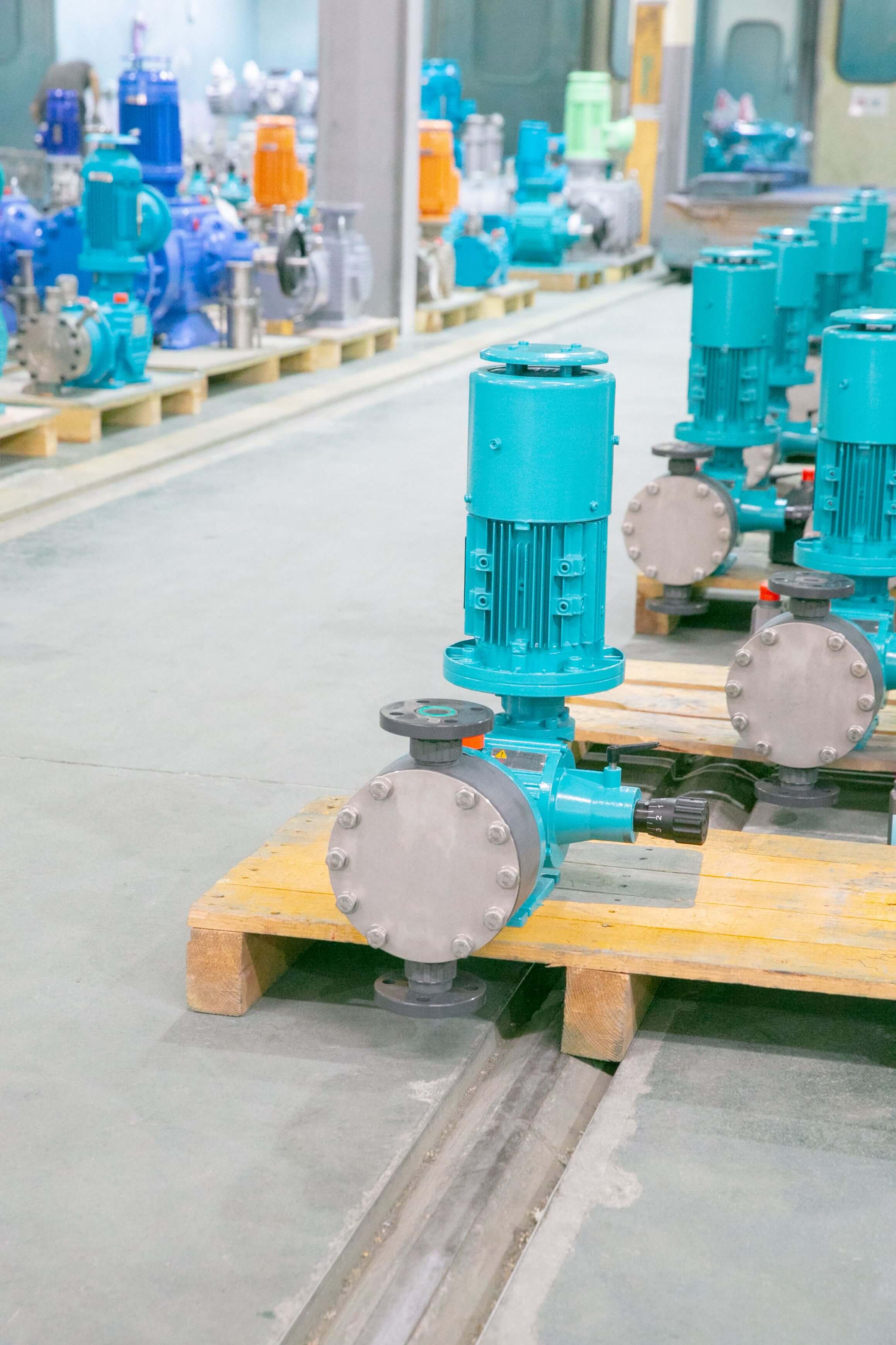
For projects with unusual process conditions, the ability to configure a non-standard solution is often decisive. A manufacturer with in-house design and production capability can modify the pump head, change the motor and drive arrangement, adapt the control cabinet or build a skid to fit a constrained plant room. The result is a dosing system matched to the site rather than a site redesigned around a catalogue pump.
Suppliers worth shortlisting should also be able to describe their own production base clearly: manufacturing floor area, engineering headcount, the range of pump families they build in-house, and their experience across water treatment, chemical, petrochemical and power applications. Concrete facts are more useful in an evaluation than marketing adjectives.
PAC Dosing versus PAM Dosing: Why the Same Pump Is Not Always the Answer
PAC is an inorganic coagulant, acidic, relatively low in viscosity and usually dosed at a fairly well-defined point in the process. PAM (polyacrylamide) is an organic flocculant, typically prepared as a dilute solution that can be viscous and shear-sensitive, and it is dosed later in the process at much lower volumes. The two duties therefore stress a pump in different ways.
A PAC dosing pump needs robust chemical resistance and reliable check valve behaviour in the presence of fine solids. A PAM dosing pump needs to handle a viscous solution without degrading the polymer chain, which usually pushes the selection toward a pump with gentle flow characteristics, adequate suction conditions and a carefully sized suction line. Low-speed operation and generous inlet piping are usually more important on PAM duty than maximum pressure capability.
When a water treatment plant is sourcing both coagulant and flocculant dosing equipment, working with one supplier that produces both metering pumps and complete dosing skids has real advantages. The two systems share utilities, control architecture and calibration procedures, and a single supplier can ensure the dosing points, mixing arrangements and control interlocks are consistent. This is why buyers often look for a PAC dosing pump manufacturer and a PAM dosing pump supplier who can cover the whole coagulation and flocculation stage rather than splitting it across vendors.
Installation, Calibration and Maintenance Best Practices
Most dosing accuracy complaints trace back to installation details rather than the pump itself. Suction piping that is too small in diameter, long suction lifts, air entrainment from a poorly positioned suction line, or an undersized pulsation dampener can all degrade performance even when the pump is correctly specified.
Good practice starts with a short, generously sized suction line from a tank outlet that stays submerged, with a strainer ahead of the pump and a calibration pot arranged so the pump can be verified against a measured volume. A pulsation dampener on the discharge smooths the flow and protects both the pump and the inline instruments. A back-pressure valve maintains a stable discharge head, which is particularly important when dosing into a line whose pressure fluctuates.
- Calibrate the pump on site with the actual PAC solution, at the actual operating pressure, not with clean water at atmospheric conditions.
- Record the calibration result and re-verify whenever the PAC source, concentration or dilution procedure changes.
- Check and clean suction and discharge check valves on a defined schedule; valve wear is the most common cause of gradual accuracy loss.
- Rinse the pump head before long shutdowns to prevent dried PAC solids from locking the check valves.
- Monitor diaphragm condition according to the manufacturer’s interval and replace it before failure rather than after.
- Log dose rate against treated water flow so that drift is identified from data rather than from water quality complaints.
Common PAC Dosing Problems and Their Causes
Loss of dosing accuracy with no visible leak usually points to worn check valves, a partially blocked suction strainer, or gas locking from dissolved air coming out of solution. A pump that doses correctly at high flow but not at low flow often has a control range problem rather than a mechanical fault. Visible leakage around a pump head, by contrast, points to diaphragm or seal ageing and should be treated as a maintenance priority.
Pulsation visible in the discharge line or audible water hammer suggests the pulsation dampener is undersized or has lost its precharge. Erratic dosing that follows no clear pattern frequently turns out to be suction air entrainment, often from a tank outlet that draws air as the level drops or from a suction line with a rising section that traps gas.
Cost Factors When Buying a PAC Dosing Pump
The purchase price of a PAC dosing pump is only one part of the total cost of ownership. The larger cost drivers over the life of the installation are chemical consumption, spare parts, downtime and the engineering time required to keep the dose correct. A modestly higher initial investment in a properly specified pump and a complete dosing package often pays back within the first year through reduced chemical waste and fewer interruptions.
When comparing quotations, check whether each offer covers the same scope. A low price for a bare pump can become expensive if it excludes the pulsation dampener, safety valve, back-pressure valve, calibration pot, control cabinet, skid fabrication and commissioning support. It is also worth clarifying the local availability of diaphragms, valve kits and other wear parts, since imported spares with long lead times can be more costly than a higher purchase price.
For buyers who are asking a PAC dosing pump manufacturer for a recommendation, the most productive approach is to send a complete process data sheet, the required control philosophy and the site conditions, and to ask for a proposal that includes the pump, accessories and skid engineering as one scope. That comparison is far more meaningful than comparing headline flow rates and prices across suppliers.
FAQ
How do I choose a PAC dosing pump for a wastewater treatment plant?
Start with the required dose rate at normal and peak conditions, the discharge pressure at the injection point, the PAC concentration and the achievable turndown ratio. Then select the pump type, usually a diaphragm metering pump, and confirm the wetted materials are suitable for an acidic solution carrying fine solids. Finally, define the control mode — manual, 4–20 mA, pulse or closed-loop with analyser feedback — and include the accessories needed for stable, verifiable dosing.
Can a PAC dosing pump also be used for PAM dosing?
Sometimes, but it is not the ideal approach. PAC and PAM place different demands on a pump: PAM solutions are typically viscous and shear-sensitive, while PAC is acidic and may carry abrasive solids. A pump optimised for PAC duty may not provide the gentle handling and suction conditions that PAM dosing requires. Where both chemicals are used, it is usually better to size each pump for its own duty rather than standardise on a single model.
Why does my PAC dosing pump lose accuracy over time?
The most common causes are worn or fouled check valves, a partially blocked suction strainer, air entrainment in the suction line, and a pulsation dampener that has lost precharge. Diaphragm ageing can also change the effective stroke volume. Checking the valves and strainer first, verifying suction conditions, and re-calibrating with the actual PAC solution usually resolves the issue.
What wetted materials are suitable for PAC dosing?
Because PAC solutions are acidic and may contain fine solids, the diaphragm, valve seats, balls and pump head should be selected for chemical resistance and abrasion tolerance. The exact material set depends on the PAC concentration, temperature and any impurities present, so it should be confirmed with the pump manufacturer against the actual process data rather than assumed from a general chemical compatibility chart.
Does a PAC dosing pump need a pulsation dampener and back-pressure valve?
In most installations, yes. A pulsation dampener smooths the discharge flow and protects downstream instrumentation, while a back-pressure valve maintains a stable discharge head so the pump’s output remains consistent. Both accessories also improve the repeatability of calibration, which directly supports stable coagulant dosing.
How often should a PAC dosing pump be calibrated?
Calibrate at commissioning, then re-verify at a defined interval based on duty severity — commonly every few months in continuous duty — and whenever the PAC source, concentration or dilution procedure changes. Calibration should always be performed with the actual solution at the actual operating pressure, using a measured volume rather than an assumed flow figure.
Summary
Selecting a PAC dosing pump is a process engineering decision before it is a purchasing decision. The four parameters that matter most are accurate dose rate across the real operating range, adequate discharge pressure with margin, wetted materials that suit an acidic solution carrying fine solids, and a control philosophy that matches how the plant actually operates. Get these right and the pump becomes a reliable, low-attention part of the treatment process; get them wrong and the same pump will generate calibration drift, chemical waste and water quality complaints for its entire service life.
It also pays to evaluate suppliers on engineering capability, not only on price. A manufacturer that can review the process data, recommend the right pump family, supply the associated accessories and skid, and support on-site calibration will reduce both commissioning risk and long-term operating cost. For plants dosing both coagulant and flocculant, a single supplier able to cover PAC metering pumps and PAM dosing pump requirements as one coordinated package usually delivers a cleaner, more maintainable installation.
For buyers comparing options, the most effective next step is to prepare a complete process data sheet covering flow range, pressure, chemical properties, control requirements and site conditions, and request a proposal that includes the pump, accessories, controls and commissioning support as a single scope. That approach gives a realistic basis for comparing a PAC dosing pump price against true total cost of ownership.