
Polyaluminium chloride (PAC) is one of the most widely used coagulants in drinking water, municipal wastewater and industrial water treatment. It works quickly, produces dense flocs and tolerates a broad pH range, which is why plant operators rely on it for clarification, phosphorus removal and sludge conditioning. But the performance of PAC is only as good as the equipment that delivers it. An undersized, poorly matched or badly maintained PAC dosing pump leads to fluctuating turbidity, wasted chemical, blocked injection lines and, in the worst cases, non-compliance with discharge limits.
This guide explains how a PAC chemical dosing pump actually works, what parameters decide the right model, how materials of construction affect service life, and how to evaluate a PAC dosing pump manufacturer before placing an order. It is written for plant engineers, EPC contractors, system integrators and procurement teams who need a reliable PAC dosing system for water treatment rather than a generic pump on a catalogue page.
What Is a PAC Dosing Pump and Why Accuracy Matters
A PAC dosing pump is a positive-displacement metering pump that injects a precisely controlled volume of polyaluminium chloride solution into a process stream. Unlike a transfer pump, which only needs to move liquid, a dosing pump must hold a repeatable flow rate against a fluctuating discharge pressure. In coagulation, the coagulant dose is usually expressed in milligrams per litre (mg/L) of treated water, and small deviations in delivered volume translate directly into either poor floc formation or unnecessary chemical spend.
Most PAC solutions used in plants are prepared at relatively low concentration, commonly in the range of 5–10% as delivered or diluted on site, and they are acidic and rich in chloride ions. That combination is aggressive toward many metals and elastomers. A metering pump built for clean water service will often fail early in PAC duty, so material selection and diaphragm design matter as much as headline flow rate.
How a metering pump delivers PAC accurately
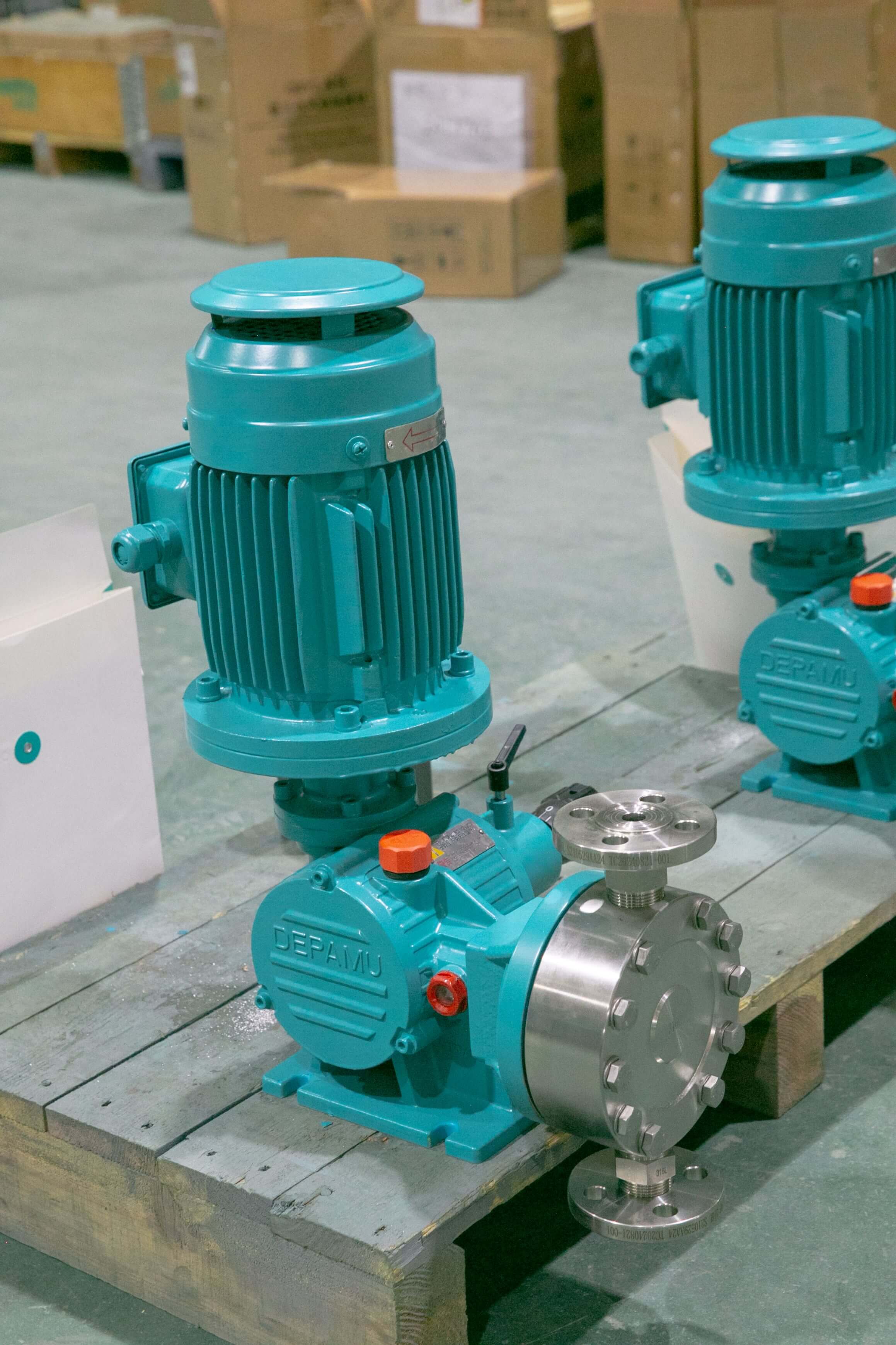
Metering pumps control output in two ways: by adjusting the stroke length of the displacing element and by changing the running speed (stroke frequency). Mechanical or hydraulic diaphragm designs separate the pumped liquid from the drive mechanism with a flexible diaphragm, so the chemical never contacts the gearbox or lubricant. Hydraulic diaphragm metering pumps add a hydraulic balancing system behind the diaphragm, which supports the diaphragm against high back pressure and extends its life in continuous duty.
For PAC service this architecture has two practical advantages. First, the sealed diaphragm means no leakage at the stuffing box, which is important for a corrosive coagulant and for housekeeping around the dosing station. Second, the hydraulic support allows the pump to hold accuracy at higher discharge pressures, such as when PAC is injected into a pressurised pipeline or a deep tank.
PAC Dosing Pump Selection: The Parameters That Decide the Model
Selection should always start from the process data sheet, not from a pump catalogue. The four values that shape the choice are the required dose, the PAC solution concentration, the discharge pressure at the injection point, and the turndown range the plant expects between minimum and maximum demand. Seasonal variation in raw water quality can easily double the required dose, so designing the pump only for average conditions usually leads to short-cycling and poor control later.
A common and practical approach is to size the pump so that normal operation falls at roughly 50–70% of maximum capacity, leaving headroom for peak turbidity events and for future plant expansion. Over-sizing to the extreme is also a mistake: a very large pump running at 5% of its capacity will struggle to hold accuracy and will pulse noticeably in the injection line.
| Selection parameter | What to check | Why it matters for PAC |
|---|---|---|
| Dosing flow rate | L/h at minimum, normal and peak dose; required turndown ratio | Prevents over-dosing at low demand and starvation during turbidity peaks |
| Discharge pressure | Line pressure at injection point plus pressure losses in the injection quill | Determines whether a mechanical or hydraulic diaphragm design is needed |
| Wetted materials | Pump head, valves, seals and diaphragm compatibility with acidic, chloride-rich PAC | Controls corrosion rate, diaphragm life and maintenance frequency |
| Control mode | Manual stroke adjustment, 4–20 mA, pulse input or flow-paced control | Enables dose pacing with raw water flow for stable treated-water turbidity |
| Suction conditions | Tank level, suction lift, solution viscosity and any settled solids | Avoids cavitation, lost suction and inaccurate delivery |
| Installation environment | Indoor/outdoor, ambient temperature, hazardous area classification | Affects motor, enclosure and control panel specification |
Material compatibility for polyaluminium chloride
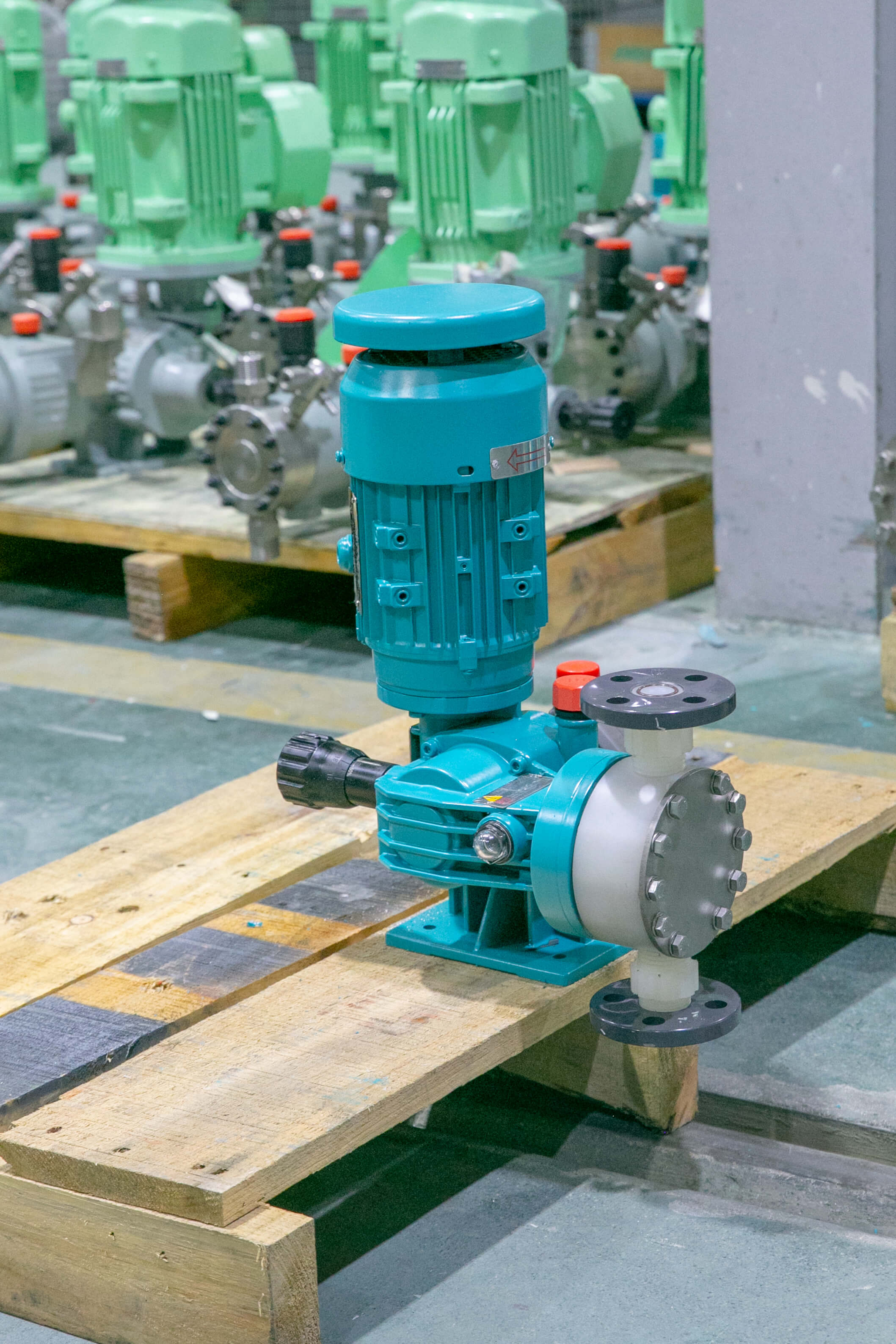
PAC solutions are typically acidic and contain high chloride levels, so stainless steel is not automatically the safe choice for every wetted part. Non-metallic pump heads, PTFE-faced diaphragms and corrosion-resistant valve seats are common in this service, while the final selection should always be confirmed against the actual concentration, temperature and any co-dosed chemicals such as sodium hypochlorite or sulphuric acid. Where PAC and other chemicals share a dosing room, each pump should be specified individually rather than standardised across the whole station.
Pulsation, injection point and accessories
All reciprocating metering pumps produce pulsating flow. In short injection lines this can be tolerated, but on longer runs a pulsation dampener helps protect piping and improves mixing. A proper PAC dosing installation usually includes a calibration pot or calibration column for verifying output, a back-pressure valve to keep the pump working against a stable head, a pressure relief line back to the storage tank, and a strainer on the suction side to protect the valves from undissolved PAC particles.
Diaphragm Metering Pump vs Other Pump Types for PAC Dosing
Not every pump that can move PAC is a good dosing pump. Centrifugal and similar rotodynamic pumps are excellent for bulk transfer but their flow varies strongly with system pressure, which makes them unsuitable for controlled coagulant addition. The comparison below reflects normal water-treatment practice.
| Pump type | Typical use in PAC service | Limitations |
|---|---|---|
| Diaphragm metering pump | Main coagulant dosing, enclosed design, wide turndown, high accuracy | Diaphragm is a wear part and must be replaced on schedule |
| Hydraulic diaphragm metering pump | Higher discharge pressures and continuous duty dosing | Higher initial cost than a mechanical diaphragm unit |
| Peristaltic pump | Small flows, easy tube change, lab or pilot plants | Tube fatigue limits pressure and continuous industrial duty |
| Centrifugal pump | Bulk transfer from delivery tank to day tank | Flow changes with back pressure, no precise dose control |
How to Choose a PAC Dosing Pump Supplier
Once the duty is clear, the next decision is who builds the equipment. Price alone is a poor guide in chemical dosing, because the cost of a failed pump is measured in downtime, off-spec water and emergency spares, not in the purchase order. A capable PAC dosing pump supplier should be able to read a process data sheet, question the assumptions behind it, and propose a configuration rather than simply quote a model number.
Depam (Hangzhou) Pump Industry Technology Co., Ltd. was founded in 2003 and has spent more than two decades in high-end positive displacement pumps and fluid equipment. The company employs over 400 people and operates a plant of approximately 35,000 m², with a registered capital of RMB 54 million and annual output value of around RMB 500 million. Sales have grown steadily from about RMB 450 million in 2023 to RMB 510 million in 2024 and approximately RMB 560 million in 2025, reflecting sustained demand across its core markets.
Its product range covers metering pumps including hydraulic diaphragm metering pumps, high-pressure process reciprocating pumps, pneumatic and electric pumps, automatic chemical dosing packages, water and steam sampling devices, water treatment equipment, screw pumps, rotary lobe pumps and gear pumps. Around 41% of sales come from oil refining and chemical processing, 23% from oil and gas fields, 15% from nuclear, power, metallurgy and new energy, 13% from environmental water treatment, 3% from new materials and food, and the remainder from other industries. That spread matters for buyers: a coagulant dosing problem in a municipal plant shares engineering logic with chemical injection in a refinery, and a supplier active in both tends to design for difficult media rather than ideal conditions.
The company has the capability to move from R&D and design through manufacturing to packaged delivery, and can supply standard products, non-standard products and customised fluid solutions based on the customer’s medium characteristics, flow, pressure, temperature and site process requirements. For buyers comparing a PAC dosing pump price across several vendors, the useful question is not only the cost of the pump but what is included: pulsation dampener, calibration column, relief valve, control interface and documentation.
Automatic PAC Dosing Skids for Water Treatment Plants
For many projects the right answer is not a pump on its own but a packaged dosing station. An automatic chemical dosing package integrates chemical storage, dissolving, agitation, metering and automatic control into one skid. Taking the metering pump as the core element, the package typically combines a dissolving tank, a mixer and an intelligent control system, and can perform automatic chemical preparation and accurate dosing, support dry powder or liquid feeding, multi-point injection and automatic interlocked control.
Such packages are assembled and tested before leaving the factory, so site work reduces to connecting piping and power. For a PAC application this shortens commissioning, keeps the dosing concentration consistent between batches, and puts the calibration point, relief line and control panel in one place instead of scattering them across a dosing room. It also makes responsibility clearer: one supplier accepts accountability for the whole dosing train rather than a pump that may or may not suit the tank and control system around it.
Where PAC dosing pumps are used
- Municipal drinking water plants, where PAC is dosed for coagulation and turbidity removal ahead of sedimentation or filtration
- Wastewater treatment plants, where PAC supports phosphorus removal and sludge dewatering performance
- Industrial water and circulating cooling water systems, where coagulants and other treatment chemicals are dosed together
- Oil refining, petrochemical and chemical plants, where process water and effluent streams require controlled coagulant addition
- Paper, textile, food processing and new material plants with their own effluent treatment stages
Installation, Commissioning and Maintenance Tips
Most dosing problems reported in the field are installation problems rather than pump failures. Keep the suction line short and generously sized, avoid unnecessary bends, and make sure the pump is not starved by a day tank that empties faster than it refills. Install a strainer on the suction side and clean it during commissioning, because undissolved PAC particles are the single most common cause of stuck valves and lost output.
After installation, verify the actual delivered flow with a calibration column across the working range, not only at maximum stroke. Record the values so that later checks can be compared against a baseline. Set the relief valve to protect the pump and piping, and route its discharge safely back to the storage tank.
For maintenance, keep a simple schedule: check valve seats and diaphragms at intervals matched to the duty, inspect the injection quill for scale or coagulant build-up, and confirm that the control signal still tracks the flow meter. Diaphragms are consumable parts; replacing them on a planned basis is far cheaper than repairing a pump that failed mid-stroke or cleaning coagulated PAC out of an injection line.
FAQ
What type of pump is best for dosing PAC?
A diaphragm metering pump is generally the best choice for polyaluminium chloride dosing. It gives a repeatable flow rate against varying line pressure and keeps the corrosive chemical sealed behind a diaphragm. Where the injection point is at higher pressure or the pump runs continuously, a hydraulic diaphragm metering pump is preferred because the hydraulic support protects the diaphragm and helps hold accuracy.
How do I size a PAC dosing pump correctly?
Start from the required dose in mg/L, the treated flow rate and the PAC solution concentration, then calculate the required dose in litres per hour. Add margin for peak turbidity or seasonal load, check the discharge pressure at the injection point, and define the turndown range. Sizing for normal operation at roughly 50–70% of maximum capacity usually gives both accuracy and headroom.
Which materials should I specify for a polyaluminium chloride dosing pump?
Because PAC solutions are acidic and chloride-rich, non-metallic wetted parts and corrosion-resistant diaphragms and valve components are commonly specified. The final choice depends on concentration, temperature and any other chemicals dosed nearby, so the wetted material list should be confirmed against the actual solution rather than assumed from a general water-treatment specification.
How can I find a reliable PAC dosing pump manufacturer?
Look for a manufacturer with genuine application engineering capability, in-house manufacturing and packaged system experience, not only a product catalogue. Ask for the proposed configuration, wetted materials, control interface, spare parts list and documentation package. A supplier that can read your process data, question the assumptions and take responsibility for the complete dosing train is a better partner than one quoting on price alone.
Why does my PAC dosing pump lose output over time?
Gradual loss of output usually comes from worn or fouled check valves, a stretched or damaged diaphragm, gas locking from poor suction conditions, or a blocked injection quill. Verify the output with a calibration column, inspect the suction strainer and valves, and check that the relief valve is not passing. Cleaning the injection point often restores performance with no pump repair at all.
Can one dosing skid handle PAC and other treatment chemicals?
Yes, provided each chemical is given its own pump, piping and injection point. PAC, alkali, polymer and disinfectant have different corrosion profiles and different dose requirements, so sharing a single pump is not appropriate. A packaged dosing skid with multiple independent metering lines and interlocked control is the standard approach for multi-chemical water treatment plants.
What information should I provide when requesting a quotation?
Supply the chemical and its concentration, required flow range in L/h, discharge pressure, temperature, suction conditions, control signal, installation environment and any hazardous area requirement. Include a sketch of the dosing room or tank arrangement where possible. Complete data allows the supplier to quote a workable configuration and a meaningful PAC dosing pump price instead of a placeholder figure.
Summary
Choosing a PAC dosing pump is an engineering decision, not a catalogue selection. The dose and treated flow define the required capacity, the injection point defines the pressure, the chemistry of the PAC solution defines the wetted materials, and the plant’s control philosophy defines the pump’s interface. Get those four right and the pump will hold turbidity stable, keep chemical consumption predictable and stay out of the maintenance backlog.
For buyers comparing suppliers, the strongest signal is application capability: a manufacturer that can propose a complete PAC dosing system for water treatment, from metering pump through dissolving tank and control panel, and can support it with documentation and spares after delivery. Depam (Hangzhou) Pump Industry Technology Co., Ltd., with more than twenty years in positive displacement pumps, a 35,000 m² manufacturing base and an installed base spanning water treatment, chemical processing, oil and gas, power and new energy, is positioned to support both standard and customised PAC dosing requirements. Share your process data first, then compare configurations and scope, and the final decision becomes considerably easier.