
A skid-mounted metering pump system is one of the most practical ways to bring accurate, repeatable chemical dosing into an industrial process. Instead of assembling tanks, agitators, pumps, piping and controls on site — where weather, space, labor skills and schedule pressure all work against quality — the entire dosing station is engineered, wired, piped, tested and delivered as a single packaged unit. The plant simply connects utilities and process lines, and the system is ready to run.
For plant owners, EPC contractors and procurement teams, the question is rarely whether to use a packaged dosing system. The real questions are: what should the package contain, which configuration fits a specific duty, and how do you identify a skid-mounted metering pump system manufacturer that can actually deliver repeatable quality? This guide answers those questions from an engineering and purchasing perspective, drawing on more than two decades of volumetric pump and fluid equipment experience at Depamu (Hangzhou) Pump Industry Technology Co., Ltd.
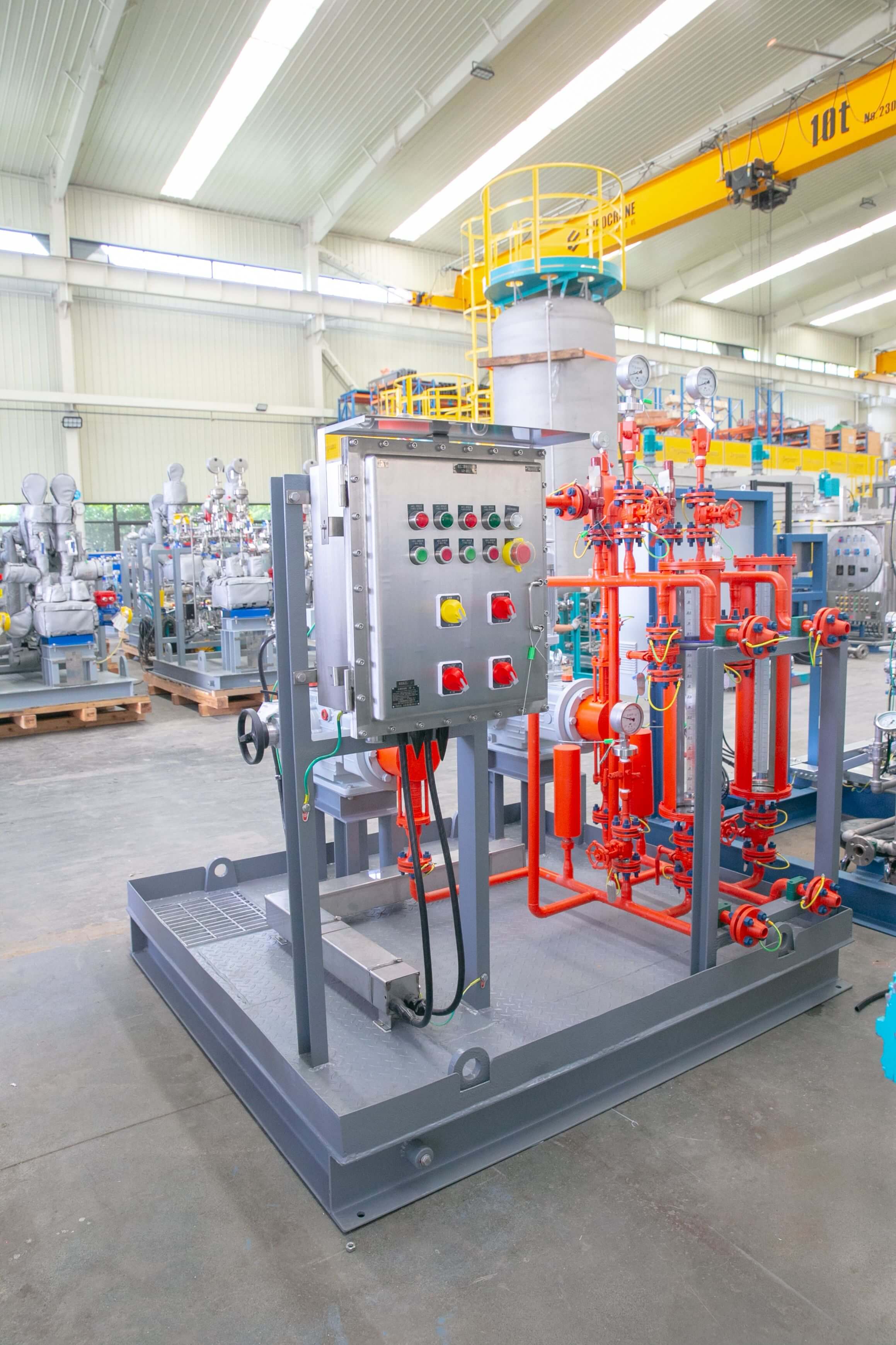
What Is a Skid-Mounted Metering Pump System and How Does It Work?
A skid-mounted metering pump system — also called a dosing skid, chemical dosing package or dosing station — is a complete, self-supporting assembly built on a structural steel frame. It combines chemical storage, preparation, transfer, precise dosing and automatic control into one compact footprint. The frame carries the load, provides lifting points, collects minor leaks and allows the whole unit to be transported, installed and relocated as a single item.
At the heart of the package sits the metering pump. In most demanding duties this is a hydraulic diaphragm metering pump, which uses hydraulic oil to drive a PTFE or composite diaphragm. Because the diaphragm physically separates the hydraulic end from the process liquid, the pump delivers leakage-free dosing even with corrosive, toxic, volatile or high-pressure media. Dosage is regulated by adjusting stroke length and running frequency, giving a wide, controllable turndown range and steady repeatability.
The operating principle is straightforward but demanding in execution. Chemical is drawn from the solution tank through suction piping, metered by the pump at a set flow and pressure, and discharged into the process at the injection point. Level instruments confirm the tank has sufficient inventory, a mixer keeps the solution homogeneous, and the control cabinet manages pump speed, stroke, alarms and interlocks. When the process demand changes — a rise in boiler load, a change in effluent pH, or a shift in produced water flow — the controller adjusts dosing automatically so the chemical-to-water ratio stays within target.
Because the entire unit is assembled and tested before shipment, commissioning time on site is measured in hours rather than weeks, and the dosing accuracy verified in the factory is the accuracy the plant receives.
What Components Are Typically Included in a Skid-Mounted Chemical Dosing Package?
Configuration varies by application, but a well-engineered skid-mounted chemical dosing package generally follows the same functional layout. The table below shows the typical scope of supply and the engineering purpose of each element.
| Component | Typical Configuration | Function |
|---|---|---|
| Metering pump | Hydraulic diaphragm or plunger type, single or duplex | Precise, leakage-free dosing at the required pressure |
| Solution tank | PE, PP, FRP or stainless steel, with level gauge | Storage and preparation of the dosing solution |
| Agitator | Top-entry or side-entry mixer, explosion-proof optional | Keeps powder or liquid chemicals fully dissolved |
| Instrumentation | Level switches, pressure gauges, flow meter, pH or ORP probes | Feedback signals for closed-loop dosing control |
| Piping and valves | PVC, PVDF, PP or 316L stainless steel, with pulsation damper | Suction, discharge, calibration and safety lines |
| Control cabinet | PLC or relay logic, touch screen, remote I/O, alarm contacts | Automatic proportioning, interlocks and data reporting |
| Skid frame | Carbon steel, hot-dip galvanized or stainless, with lifting lugs | Structural base, alignment and single-lift transport |
Beyond the standard scope, packages can be extended with dry powder dissolving systems, dilution water control, multiple injection points, second-language HMI, explosion-proof electricals for hazardous areas, or heat tracing for low-temperature climates. These options should be decided during the design phase, because retrofitting a skid after fabrication is far more expensive than specifying it correctly at the start.
A key engineering point that buyers often underestimate is pulsation control. Because a reciprocating metering pump discharges in pulses, a properly sized pulsation damper and correctly supported piping are essential to protect flow meters, sensors and the injection quill. Reputable suppliers address this during design, not after the first site complaint.
Where Are Skid-Mounted Metering Pump Systems Used?
The reason skid-mounted dosing stations are so widely adopted is that almost every process industry needs to add a small, precise quantity of a chemical into a much larger flow of water, oil or process fluid. The application defines the materials, control strategy and redundancy of the package.
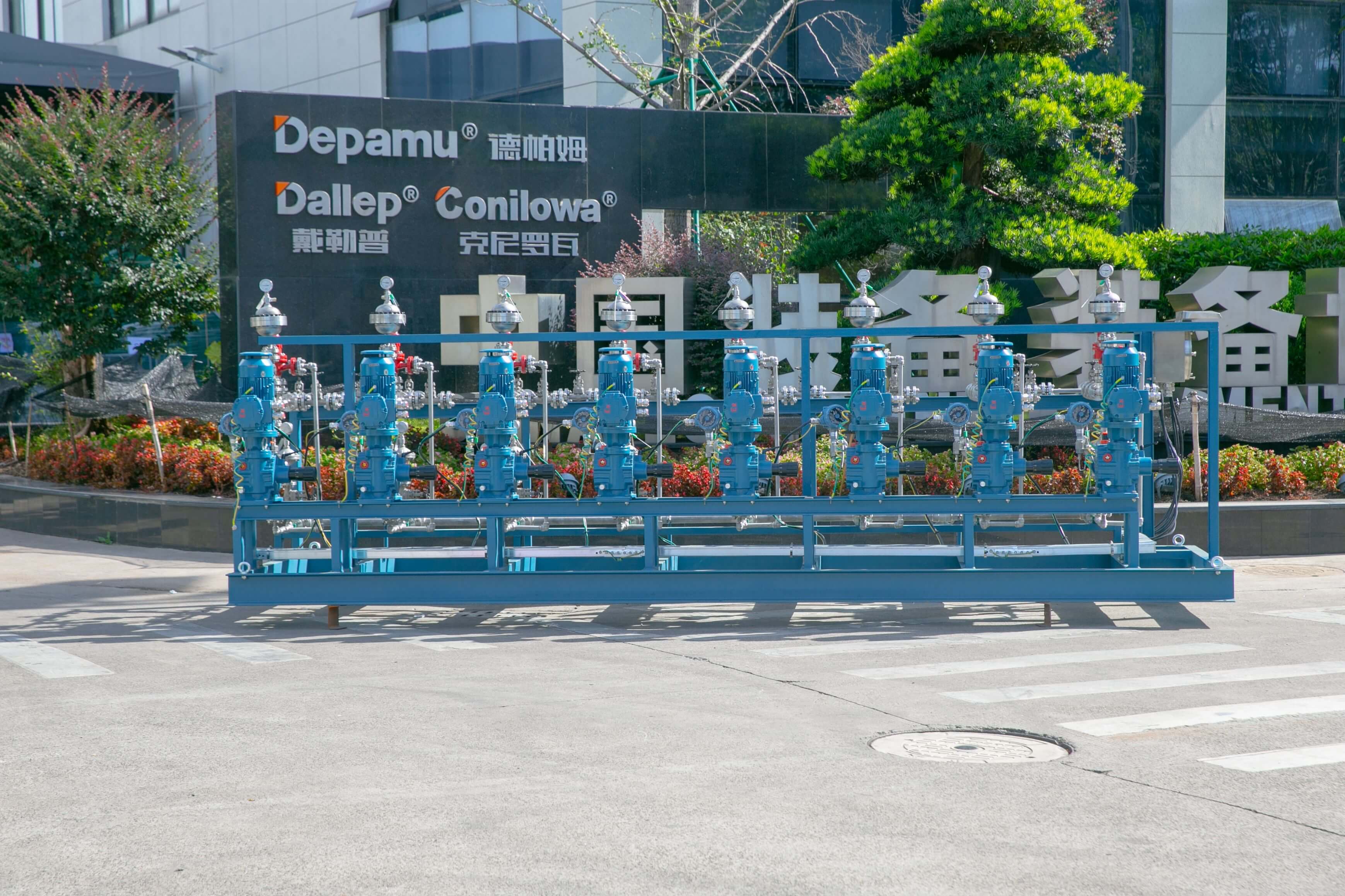
Boiler Water Treatment and Steam Cycle Chemistry
In power plants and industrial boiler houses, dosing skids feed chemicals such as oxygen scavengers, phosphates, ammonia or hydrazine into feedwater and steam circuits. Dosing accuracy directly affects corrosion rates and tube life, so the system must maintain a stable dose across a wide load range and handle the high discharge pressures of a closed boiler circuit.
Circulating Cooling Water and Wastewater Treatment
Cooling towers require scale and corrosion inhibitors, biocide and pH correction; wastewater plants require coagulants, flocculants, phosphorus precipitants and disinfectants. A skid-mounted dosing station for water treatment typically combines two to four dosing lines, each with its own pump, calibration column and control loop, so operators can adjust each chemical independently.
Oil and Gas Field Chemical Injection
Upstream and midstream operations inject corrosion inhibitors, scale inhibitors, demulsifiers, biocides and methanol into wellheads, flowlines and separation trains. A chemical injection skid for oil and gas has to cope with remote locations, wide ambient temperature ranges, unattended operation and high injection pressures, which makes hydraulic diaphragm metering pumps with robust hydraulic ends a natural choice.
Petrochemical, Refinery and Process Additive Dosing
Refineries and chemical plants use packaged dosing units for antistatic additives, antioxidants, neutralizers, catalysts and pH control chemicals. Here the medium may be flammable, viscous or aggressive, so sealing integrity, material compatibility and hazardous-area electrical compliance dominate the specification.
New Energy, New Materials and Food Processing
Battery materials, fine chemicals and food processing all rely on very accurate addition of additives, nutrients and pH adjusters. In food-related lines, hygienic materials and cleanable construction become the priority, while in new energy processes the challenge is often handling slurries and specialty liquids with strict contamination limits.
How to Select the Right Skid-Mounted Metering Pump System: A Practical Selection Guide
Selection should start with the process duty, not the catalog. Collect the following data before contacting any supplier — this single step shortens the technical clarification cycle by weeks and reduces the risk of a mis-sized package.
- Dosing flow rate: minimum and maximum, in L/h, plus the normal operating point and expected future range.
- Discharge pressure: the injection point pressure plus line losses and a sensible safety margin.
- Chemical properties: concentration, viscosity, density, temperature, pH, solids content and whether the liquid is toxic, flammable or volatile.
- Control intent: manual stroke adjustment, 4–20 mA proportional control, pulse-triggered dosing, or closed-loop control from a flow meter or pH/ORP analyzer.
- Environment: indoor or outdoor installation, ambient temperature range, corrosion class and hazardous-area classification.
- Footprint and logistics: available space, lifting capacity, access route and the maximum dimensions that can pass through site doors.
A common mistake is to specify the pump first and the system later. In practice, the pump, tank size, piping layout and control philosophy must be balanced together. For example, a 3,000 L tank may be necessary for a chemical with a one-week delivery cycle, but it also drives skid dimensions and structural loads. Likewise, choosing closed-loop pH control instead of proportional dosing changes the sensor scope, the controller logic and the operator interface.
Equally important is turndown. A pump with a 10:1 turndown may look adequate on paper, but if the plant actually runs between 40% and 100% of design flow, the real requirement is modest; if the seasonal swing is 5% to 100%, a hydraulic diaphragm pump with a high turndown plus a small-capacity backup pump may be the more reliable configuration. Discussing this openly with an experienced metering pump skid supplier prevents both over-specification and shortfall.
Skid-Mounted System vs. Field-Built Dosing Station: What Is the Real Difference?
Some projects still assemble dosing equipment on site from separate purchases. That approach can look cheaper on the initial quotation, but the total cost picture is usually different. The comparison below reflects what plant operators typically experience.
| Aspect | Skid-Mounted Package | Field-Built Station |
|---|---|---|
| Engineering responsibility | Single supplier covers pump, piping, tank and controls | Split across several vendors and the site team |
| Factory testing | Assembled, wired and performance-tested before shipment | First real test happens on site |
| Installation time | Days — position, anchor, connect utilities | Weeks — fabrication, piping and wiring on site |
| Dosing accuracy | Verified against design values before delivery | Depends on site assembly quality and alignment |
| Site labor and safety exposure | Minimal hot work and confined assembly | Extended work at height and in congested areas |
| Future relocation | Can be lifted and moved as one unit | Effectively fixed in place |
The conclusion for most B2B buyers is that a packaged system offers better cost predictability. The capital cost is known up front, the commissioning risk is transferred to the manufacturer, and production starts earlier. Those three factors usually outweigh the apparent savings of buying components separately.
Why Depamu Is a Reliable Partner for Skid-Mounted Metering Pump Systems
Depamu (Hangzhou) Pump Industry Technology Co., Ltd. was founded in 2003 and has spent more than twenty years focused on high-end volumetric pumps and fluid equipment. The company employs over 400 people across a plant site of approximately 35,000 m², with annual output value of around RMB 500 million and steadily growing sales — approximately RMB 450 million in 2023, RMB 510 million in 2024 and RMB 560 million in 2025. Three brands — Depamu, Keniluowa and Dailepu — support different product lines and market positions.
What matters most for a dosing package is the depth of the product range behind it. Depamu manufactures metering pumps (including hydraulic diaphragm metering pumps), high-pressure process reciprocating pumps rated above 35 MPa, pneumatic and electric pumps, automatic chemical dosing packages, water and steam sampling devices, water treatment equipment, screw pumps, rotary lobe pumps, gear pumps, emulsifying pumps and special centrifugal pumps. Because the core pump, the package and the controls come from the same engineering organization, the interface between pump performance and system performance is designed rather than negotiated.
Application experience is equally relevant. Petroleum refining and chemicals account for roughly 41% of the company’s business, oil and gas fields about 23%, nuclear power, power generation, metallurgy and new energy around 15%, environmental water treatment about 13%, and new materials and food approximately 3%, with other industries making up the remainder. That spread means a dosing skid for a refinery additive and a dosing skid for a municipal wastewater plant are both routine engineering exercises rather than first-time experiments.
Customization capability closes the loop. Depamu engineers select pump type, wetted materials, tank volume, control philosophy and skid layout according to the customer’s medium characteristics, flow rate, pressure, temperature and site process requirements. Standard products, non-standard products and fully customized fluid packages are all available — which is exactly the flexibility a custom metering pump skid supplier needs to offer when a plant has an unusual duty.
Installation, Commissioning and Maintenance Best Practices
A well-built skid still depends on correct installation and reasonable maintenance. The following practices consistently deliver the best long-term results.
Installation and Commissioning
- Set the skid on a level, load-bearing foundation and anchor it according to the general arrangement drawing; verify the frame is not twisted before tightening anchors.
- Check that suction piping is short, generously sized and free of air pockets, and that the suction lift is within the pump’s allowed NPSH margin.
- Fit a calibration column or a suitable calibration point so the dosing rate can be verified against actual volume, not just the pump setting.
- Confirm the injection point pressure before start-up, and set the safety relief valve below the pump and piping rating.
- Flush the system with clean water before introducing the chemical, and verify all interlocks — low level, high pressure, flow proof — operate correctly.
- Record baseline stroke length, frequency and measured output; this becomes the reference for future performance checks.
Routine Maintenance
- Inspect the diaphragm and hydraulic oil condition at the interval recommended for the duty; aggressive chemicals and high temperatures shorten the cycle.
- Check valve balls and seats for wear — loss of dosing accuracy is more often a check valve issue than a pump drive issue.
- Keep the solution tank clean and confirm the mixer runs as designed; undissolved chemical is a frequent cause of blocked suction lines.
- Verify level instrumentation and alarm setpoints, since a false level reading can empty a tank or overflow it.
- Recalibrate the dosing rate after any change in chemical concentration, and re-verify after replacing pump parts.
Most dosing problems trace back to one of four causes: air ingress on the suction side, worn check valves, incorrect calibration after a chemical change, or a control loop tuned to the wrong sensor. Each is straightforward to diagnose when the system was properly documented at commissioning — another reason to choose a supplier who delivers complete documentation with the skid.
How to Evaluate Skid-Mounted Metering Pump System Suppliers
When international buyers compare offers for a skid-mounted metering pump system, price alone is a poor guide. The following evaluation framework helps separate capable manufacturers from trading intermediaries.
- Manufacturing depth: does the supplier build the metering pump itself, or buy it in? In-house pump production means better control of accuracy, spare parts and lead time.
- Engineering documentation: P&ID, general arrangement drawings, electrical schematics, calibration records and operation manuals should be standard deliverables.
- Testing capability: ask how the package is pressure-tested, how dosing accuracy is verified, and whether a factory acceptance test can be witnessed.
- Material and component traceability: wetted materials, diaphragm compounds and instrument brands should be clearly specified, not left vague.
- After-sales structure: spare parts availability, response time, remote technical support and the availability of commissioning assistance.
- Reference scope: the industries a supplier has served indicate whether your application is familiar territory.
Reputation in this sector is built slowly through repeat orders, not through marketing claims. Buyers are therefore advised to ask directly for comparable project experience, to request drawings for review before the commercial stage, and to speak with the technical contact — not only the sales contact — before committing.
FAQ
What is a skid-mounted metering pump system used for?
It is used to dose a precise quantity of chemical into a process stream in a controlled, repeatable way. Typical uses include boiler water treatment, cooling water conditioning, wastewater coagulation and disinfection, refinery additive injection, oil and gas chemical injection, and pH correction in new energy, new materials and food processing. Because the whole station is factory-assembled on one frame, it is also used where site labor is limited or installation time is short.
What is included in a standard skid-mounted chemical dosing package?
A typical package includes one or more metering pumps, a solution tank, an agitator, level and pressure instrumentation, suction and discharge piping with valves and a pulsation damper, a control cabinet with PLC or relay logic, and a structural steel skid frame with lifting lugs. Optional items include dry powder dissolving systems, flow meters, pH or ORP analyzers, explosion-proof electricals, heat tracing and multiple injection points.
How do I choose between a hydraulic diaphragm and a plunger metering pump for my dosing skid?
Choose a hydraulic diaphragm metering pump when the chemical is corrosive, toxic, volatile or expensive, when leakage is unacceptable, or when discharge pressure is high. The diaphragm isolates the process liquid from the hydraulic system, so there is no packing to leak. Plunger pumps remain suitable for clean, non-hazardous media at very high pressure where a small amount of packing weepage is tolerable. For most packaged dosing systems handling treatment chemicals, the diaphragm design is the safer default.
How accurate is a skid-mounted metering pump system?
Accuracy depends mainly on the pump type, the turndown ratio and how well the system is calibrated. Hydraulic diaphragm metering pumps with adjustable stroke length and frequency typically deliver steady repeatability in the region of ±1% of setpoint under stable suction and discharge conditions. In practice, overall dosing accuracy also depends on correct calibration, adequate suction conditions, pulsation control and a properly tuned control loop — which is why factory testing and documented commissioning matter.
Can the dosing skid be customized for a specific medium, flow and pressure?
Yes. A capable manufacturer will select pump type, wetted materials, diaphragm compound, tank volume and material, control philosophy and skid dimensions based on the customer’s medium characteristics, required flow range, discharge pressure, temperature and site process conditions. Non-standard and fully customized fluid packages are a normal part of the scope for experienced suppliers, and customization is best defined at the design stage rather than retrofitted later.
How long does installation take on site?
Because the skid arrives assembled, wired, piped and tested, on-site work is mainly positioning, anchoring, connecting suction and discharge lines, connecting power and instrument air, and commissioning. This is typically measured in days rather than the weeks required to fabricate and assemble a dosing station from separate components on site.
What maintenance does a skid-mounted metering pump system require?
Routine maintenance includes checking diaphragm condition and hydraulic oil, inspecting check valve balls and seats, cleaning the solution tank and confirming mixer operation, verifying level and pressure instruments, and recalibrating the dosing rate after chemical changes or parts replacement. Maintenance intervals depend on chemical aggressiveness, temperature, running hours and whether the system operates continuously or intermittently.
How can I evaluate whether a supplier’s dosing skid reputation is reliable?
Ask for comparable project experience in your industry, request P&ID and general arrangement drawings for review, confirm whether the metering pump is manufactured in-house, ask how factory testing and accuracy verification are performed, and check spare parts and technical support arrangements. Speaking with the supplier’s technical engineers rather than only the sales team gives the clearest picture of actual capability.
Summary
A skid-mounted metering pump system converts a collection of separate components into one tested, documented and transportable dosing station. It shortens installation, removes site assembly risk, improves dosing repeatability and makes future relocation practical. The keys to a successful project are straightforward: define the process duty properly, decide the control philosophy early, specify materials that match the chemical, insist on factory testing, and choose a manufacturer with genuine in-house pump production and package engineering capability.
Depamu (Hangzhou) Pump Industry Technology Co., Ltd. has focused on high-end volumetric pumps and fluid equipment since 2003, with more than 400 employees, a plant site of approximately 35,000 m² and an annual output value of around RMB 500 million. With metering pumps, high-pressure process reciprocating pumps, automatic chemical dosing packages and a broad range of complementary fluid equipment manufactured under one roof, and with application experience spanning petroleum refining and chemicals, oil and gas fields, nuclear power, power generation, metallurgy, new energy, environmental water treatment, new materials and food, the company is positioned to engineer standard or fully customized skid-mounted dosing solutions around a specific medium, flow, pressure and temperature requirement.
For procurement teams comparing options, the practical next step is to prepare a duty specification and request a technical proposal with drawings, scope of supply, material list and factory test plan. That single comparison will usually reveal which suppliers are engineering the system and which are simply reselling components.