
Choosing a skid-mounted metering pump system is one of the most consequential decisions in any process plant that handles chemical dosing. A well-designed skid delivers accurate injection, protects operators from hazardous media, shortens on-site installation time and keeps a process line running year after year. A poorly specified skid does the opposite: it drifts out of calibration, corrodes at the seams and turns every dosing point into a maintenance headache.
This guide explains what a skid-mounted metering pump system actually contains, which parameters decide whether a package will work in your process, how to compare configurations, and what to look for when you shortlist a chemical injection skid manufacturer. The technical content reflects the engineering practice of DEPAM (Hangzhou) Pump Industry Technology Co., Ltd., a China-based manufacturer founded in 2003 that has specialised in high-end positive displacement pumps and packaged fluid systems for more than twenty years.
What Is a Skid-Mounted Metering Pump System?
A skid-mounted metering pump system — also called a metering pump skid package, chemical dosing skid or skid-mounted chemical dosing system — is a pre-assembled, pre-tested unit built on a single steel frame. Instead of shipping a pump, a tank, valves, piping and a control cabinet separately and assembling them on site, the manufacturer mounts all of them on one structural base, connects the piping, wires the instruments and runs a factory acceptance test before delivery.
The purpose is simple: turn a multi-discipline installation project into a single lifting and connection task. When the skid arrives, the site team lifts it into position, anchors the frame, connects the process inlet and outlet, connects power and signal cables, and commissions. Compared with stick-built dosing stations, packaged skids reduce field welding, cut installation time substantially, and shift quality responsibility to a single supplier.
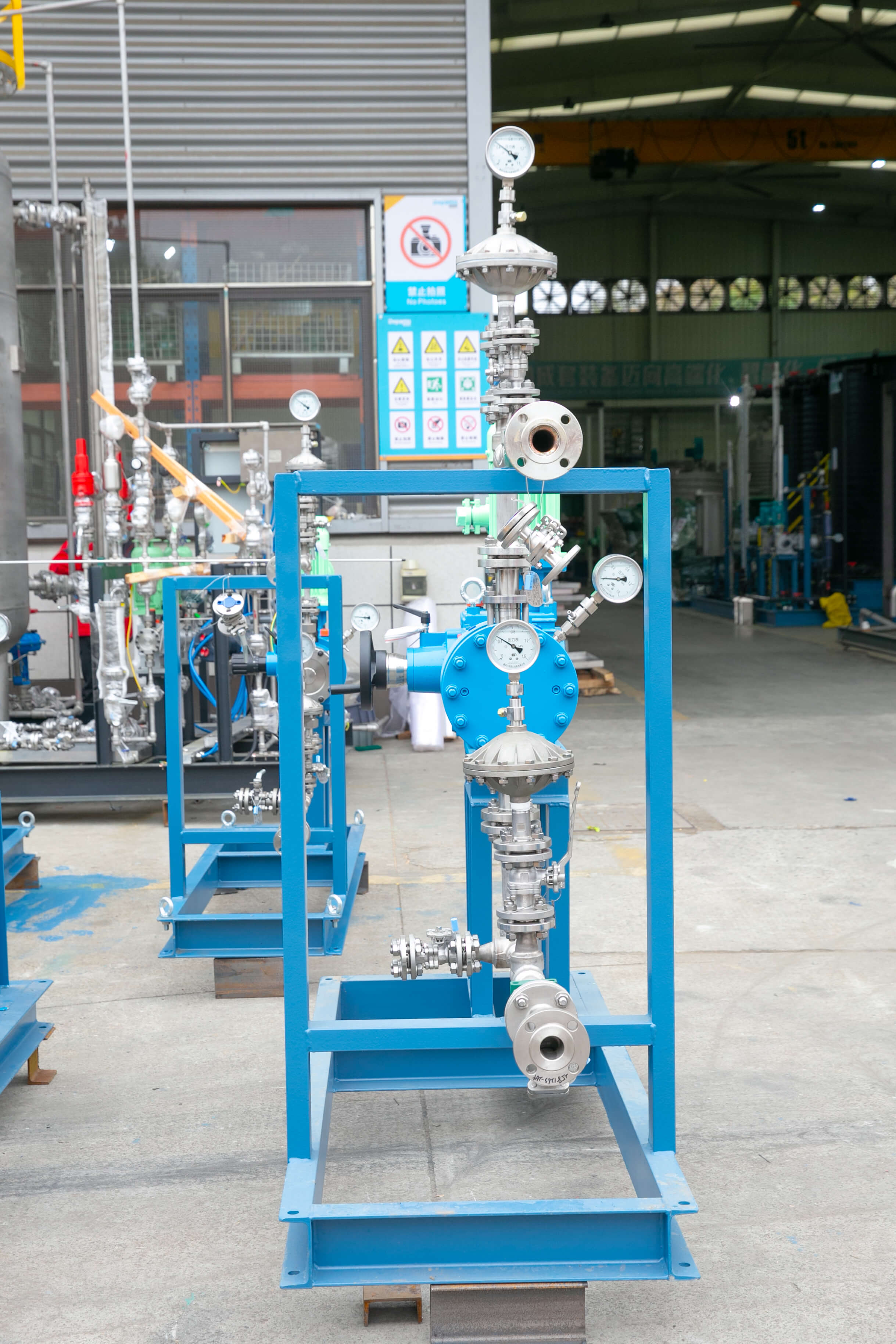
Typical Components of a Chemical Injection Skid
Although the exact configuration varies with the duty, most skid-mounted metering pump systems share a common architecture. The metering pump is the heart of the package; everything else exists to feed it correctly, control it precisely and keep it safe.
- Metering pumps — one duty pump plus one standby pump is common on critical dosing points; hydraulic diaphragm and packed plunger designs are the usual choices.
- Solution or storage tank — sized for the required residence time between refills, with level indication and high/low alarms.
- Dissolving and mixing section — dissolution tank, agitator and transfer pump for dry powder or concentrated liquid chemicals.
- Piping, valves and fittings — suction strainer, calibration column, pulsation dampener, pressure relief valve, non-return valve and isolation valves.
- Instrumentation — pressure gauges, flow meters, level transmitters, pH/conductivity analysers where dosing must respond to process conditions.
- Control system — local control cabinet or PLC panel supporting manual stroke adjustment, 4–20 mA remote setpoint, flow-proportional dosing and alarm output.
- Safety and housekeeping — drip tray, spill containment, guard rails and lifting lugs on the skid frame.
For customers evaluating suppliers, one useful question is whether the manufacturer builds both the pumps and the skid. Companies that manufacture their own metering pumps — as DEPAM does across its metering pump, high-pressure reciprocating pump and packaged dosing equipment lines — can align pump hydraulics, tank sizing and control logic at the design stage rather than sourcing pumps from a third party and adapting the skid around them.
Why Skid-Mounted Design Matters in Chemical Injection
Chemical injection is unforgiving. The media are frequently corrosive, toxic, volatile or prone to crystallisation. Dosing accuracy directly affects product quality, corrosion control, disinfection performance or boiler safety. And dosing points are often located in remote or unmanned areas of a plant, where maintenance access is limited.
A properly engineered skid addresses all three problems at once. Because the piping is fabricated and tested in a workshop, weld quality and material traceability are controlled under factory conditions rather than at a busy construction site. Because the control cabinet is wired and tested with the pumps, setpoint response and alarm logic can be verified before shipment. And because the entire assembly sits on one frame, the footprint is compact and the dosing point can be standardised across a plant, so operators meet the same layout at every unit.
Standardisation has a second benefit that is often overlooked during procurement: spare parts and training. When a plant uses one skid configuration and one pump family across dozens of dosing points, the spare parts inventory shrinks and maintenance teams only need to learn one set of procedures.
How to Choose a Skid-Mounted Metering Pump System: Selection Guide
Most selection errors happen before a supplier is even contacted, because the enquiry is written around a single pump parameter instead of the complete duty. A structured selection process moves from the process data to the pump, and only then to the package.
Step 1: Define the Process Duty Precisely
Start with the medium: chemical name, concentration, viscosity, density, temperature, vapour pressure, solids content and corrosivity. Then define the dosing requirement: normal and maximum flow, injection pressure at the pump discharge, suction conditions, turndown ratio, accuracy requirement and whether dosing must be continuous or batch. Finally, define the environment: indoor or outdoor installation, ambient temperature, hazardous area classification, available utilities and the degree of automation expected.
Two numbers are frequently underestimated. The first is injection pressure: a pump sized for the normal operating pressure will struggle if the discharge line is later throttled or if a downstream filter fouls. The second is turndown: a system that must dose at 10% of design capacity for long periods needs either a smaller pump or a wider control range, not a large pump running at minimum stroke.
Step 2: Match the Pump Technology to the Medium
Pump technology decides the achievable pressure, the leakage risk and the maintenance profile. Hydraulic diaphragm metering pumps are the default choice for corrosive, toxic or high-purity chemicals because the diaphragm isolates the medium from the hydraulic system and the design is effectively leak-free. Packed plunger pumps are used where very high pressure and high accuracy are required and the medium tolerates contact with packing. For high-pressure process duties, a high-pressure reciprocating pump can deliver discharge pressures above 35 MPa, which is beyond the range of a standard metering pump.
| Pump type | Best for | Notes |
|---|---|---|
| Hydraulic diaphragm metering pump | Corrosive, toxic, volatile and high-purity chemicals; accurate dosing | Leak-free diaphragm isolation; accuracy set by stroke length and running frequency |
| Packed plunger metering pump | High pressure dosing of clean media | Requires packing maintenance; avoid for abrasive slurries |
| High-pressure reciprocating pump | Pipeline boosting, oilfield water injection, high-pressure transfer | Handles high viscosity, high temperature and media containing solids |
| Air-operated diaphragm pump | Transfer duty, tank emptying, areas without reliable power | Usually combined with a metering pump in the dosing loop |
Step 3: Size the Tank, Mixing and Piping Around the Pump
Skid design fails most often not in the pump but in the balance of plant. Dissolution tanks must provide enough residence time for the chemical to dissolve or dilute completely; agitators must be sized for the viscosity of the solution, not just the water; suction piping must be short, generously sized and free of air pockets; and the discharge line must include a relief valve that protects the pump and piping if a valve is closed.
Material selection is equally decisive. Wetted parts must be matched to the chemical at operating concentration and temperature — not at the dilution the supplier assumed. For aggressive media, PTFE-lined and non-metallic wetted paths are frequently specified, while the skid frame is typically carbon steel with a protective coating.
Step 4: Decide the Control Philosophy
Control architecture determines how much the skid actually does. At minimum, a skid should offer local stroke adjustment and a start/stop signal. Beyond that, options include 4–20 mA remote setpoint from the plant DCS, flow-proportional dosing driven by a flow meter, automatic pH or residual chlorine feedback, batch dosing with totaliser, dry-run protection from the tank level switch, and remote alarm transmission.
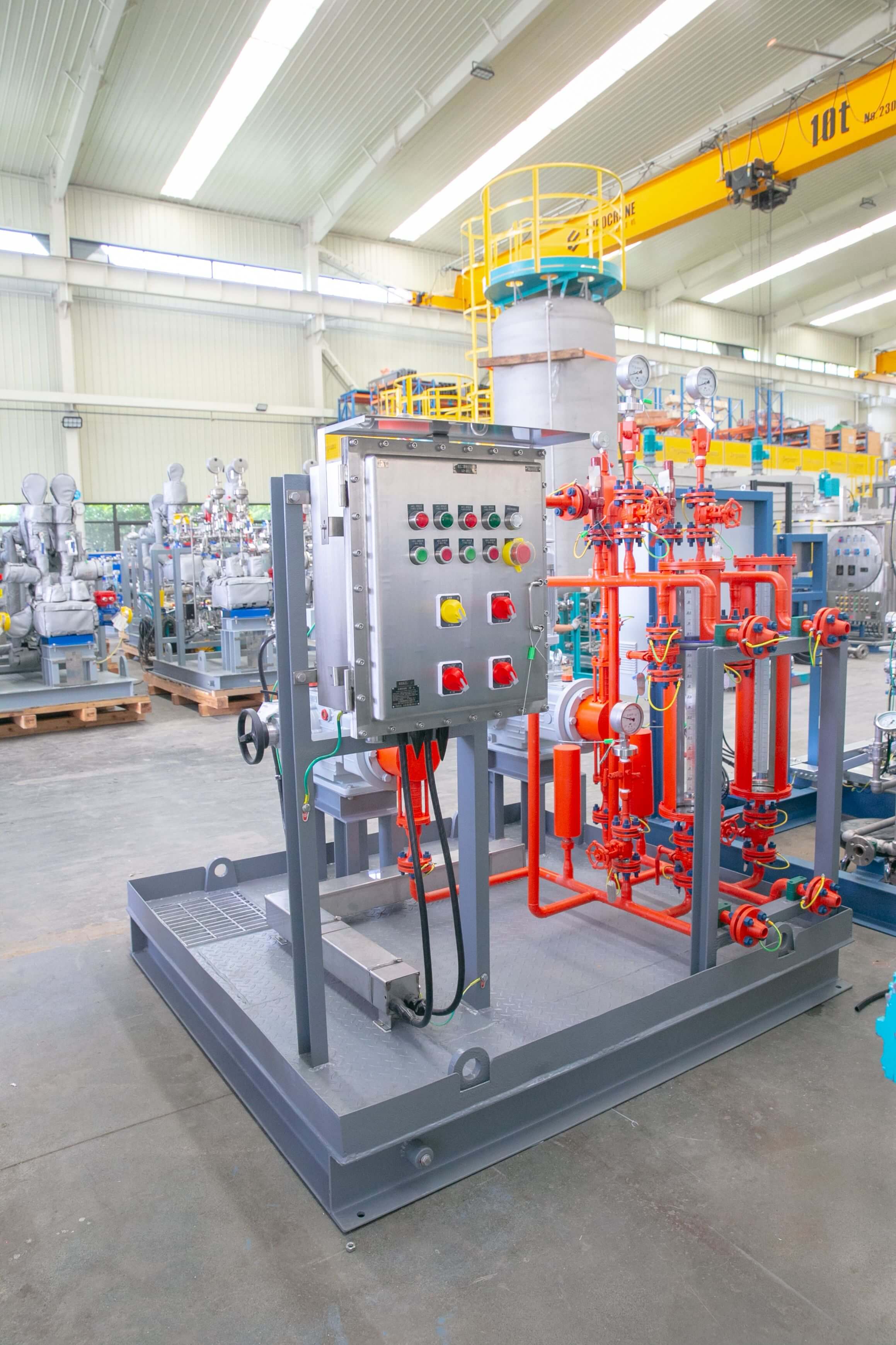
Where an automated chemical dosing unit is used for boiler water treatment or circulating water treatment, the control loop is typically simple: a residual analyser provides a 4–20 mA signal, the controller compares it with a setpoint, and the metering pump stroke or speed is trimmed accordingly. The important design decision is whether the loop is fast enough for the process. In a large circulating water system with long residence times, aggressive control tuning causes oscillation; a slower loop with dead-band logic is usually more stable.
Applications of Skid-Mounted Chemical Dosing Systems
Skid-mounted dosing and injection systems appear across almost every process industry, but the duty characteristics differ significantly between sectors.
In oil refining and petrochemical plants, dosing skids inject corrosion inhibitors, antiscalants, antifoulants and neutralising agents into crude units, cooling water loops and process streams. These applications demand precise low-flow injection at full system pressure, often with standby pumps for continuous availability. This segment is the largest part of DEPAM’s business, accounting for roughly 41% of sales.
In oil and gas fields — about 23% of the company’s activity — the emphasis shifts to high-pressure injection. Chemical injection skids at wellheads and gathering stations dose methanol, demulsifiers and corrosion inhibitors against high wellhead pressures, while high-pressure reciprocating pumps handle produced water reinjection and pipeline boosting.
In power generation, nuclear, metallurgy and new energy, skids support boiler feedwater treatment, condensate polishing, water-steam sampling and dosing of oxygen scavengers, ammonia and hydrazine. Accuracy and reliability dominate here, and sampling systems are often supplied together with the dosing package so that the control loop and the measurement share one design basis.
In environmental and water treatment, which accounts for around 13% of the business, dosing skids meter coagulants, flocculants, disinfectants, anti-scalants and pH correction chemicals. Flow-paced control is typical, and skids are often installed in remote or unmanned plants where robust automation and simple maintenance matter more than maximum precision.
In new materials and food processing, dosing systems handle additive blending, pH adjustment and ingredient addition, where hygiene-compatible materials and repeatable low-flow accuracy are the main requirements.
Standard or Custom Skid: Which Configuration Is Right?
Many projects can be met with a standard configuration: a defined tank volume, one duty and one standby metering pump, a fixed instrumentation list and a standard control cabinet. Standardisation shortens lead time, simplifies spare parts and reduces cost.
Custom skids become necessary when the process deviates from the standard envelope: very high injection pressure, unusual corrosive media, multiple dosing points from a single package, batch operation with mixing and heating, hazardous area classification, extreme ambient conditions, or a footprint constraint that rules out a conventional layout. In these cases the supplier’s engineering capability matters more than catalogue coverage, because the package has to be designed from the medium characteristics, flow, pressure and temperature rather than assembled from standard blocks.
DEPAM’s organisation supports this kind of work directly. The company employs more than 400 people across a site of approximately 35,000 square metres, operates the DEPAM, KENIROWA and DAILERP brands, and handles projects from product research and design through manufacturing and packaged delivery. Reported sales were around RMB 450 million in 2023, RMB 510 million in 2024 and RMB 560 million in 2025, with an annual output value of roughly RMB 500 million, which reflects sustained demand for packaged fluid systems rather than single pumps.
How to Evaluate a Chemical Injection Skid Manufacturer
When shortlisting suppliers for a skid-mounted metering pump system, technical brochures are the least reliable input. The following checks are more useful.
- In-house pump manufacture. Confirm whether the supplier builds its own metering pumps and reciprocating pumps. A skid built around a third-party pump introduces a split in responsibility when accuracy or pressure problems appear.
- Engineering deliverables. Ask for a P&ID, utility consumption table, weight and centre-of-gravity data, load list and a wiring diagram. A supplier that cannot provide these is assembling, not engineering.
- Factory testing. Confirm that the package is assembled, hydro-tested and functionally tested with the actual control system before shipment, and request the test record.
- Material traceability. Require certificates for wetted parts, diaphragms and seals, and verify that materials match the chemical compatibility data for the operating concentration.
- Application experience. Ask for reference installations in a comparable duty — similar medium, pressure and control philosophy — rather than general industry experience.
- Support over the life cycle. Spare diaphragms, valves and seals should be available for the life of the plant, with clear documentation for replacement intervals.
For buyers who are still at the enquiry stage, the practical approach is to send the supplier a data sheet covering medium, concentration, temperature, required flow, injection pressure, turndown, control signal, utilities and installation environment, and ask for a proposed skid configuration with the pump model, materials, instrumentation and control scope stated explicitly. Comparing two or three proposals on that basis reveals quickly which suppliers are engineering the package and which are quoting a pump.
Installation, Commissioning and Maintenance Essentials
Because the skid arrives pre-assembled and tested, site work is largely mechanical and electrical: anchor the frame, verify that the skid is level, connect process piping with adequate support so that the pump flange carries no pipe load, connect utilities, and confirm rotation direction before first start.
Commissioning should include calibration of each pump against a calibration column or weigh-scale method, verification of relief valve settings, testing of level alarms and dry-run protection, and a full stroke of the control loop from the plant DCS. Recording the initial calibration data gives the maintenance team a baseline for later comparison.
Routine maintenance is modest but not optional. Diaphragms, check valves and seals are wearing parts and should be replaced on a schedule derived from operating hours and chemical aggressiveness, not only after a failure. Hydraulic oil in diaphragm metering pumps should be checked for contamination, suction strainers cleaned, and calibration re-verified after any change in chemical concentration or process pressure. In high-pressure reciprocating pump installations, packing and valve inspection intervals are shorter, and lube oil condition monitoring is a reliable early indicator of wear.
FAQ
How do I choose a skid-mounted metering pump system for a corrosive chemical?
Start with the chemical compatibility of all wetted parts at the actual operating concentration and temperature, then select a hydraulic diaphragm metering pump so that the medium is fully isolated from the hydraulic system. Specify PTFE-lined or non-metallic piping where required, include a drip tray and relief valve, and confirm that diaphragms and seals are available as spare parts. Selection should be based on a full data sheet, not only on flow and pressure.
Can you recommend a reliable chemical injection skid supplier?
Evaluate suppliers on in-house pump manufacture, engineering documentation, factory testing and comparable references. A manufacturer that designs and builds both the metering pumps and the skid — such as DEPAM, which has produced positive displacement pumps and packaged dosing systems since 2003 — can take single-point responsibility for accuracy, materials and control integration, which simplifies both procurement and later service.
What is the difference between a standard dosing skid and a custom chemical injection skid?
A standard skid uses a fixed tank size and pump configuration with a defined instrumentation list, which shortens lead time and lowers cost. A custom skid is engineered around specific medium characteristics, flow, pressure, temperature and site conditions, and may include multiple dosing points, hazardous area components, special materials or a non-standard footprint. Custom engineering is justified when the duty falls outside the standard envelope.
Which industries use skid-mounted chemical dosing systems most widely?
Oil refining and petrochemicals, oil and gas field operations, power generation, nuclear and metallurgy, environmental and water treatment, and new materials and food processing. The pump technology and control philosophy differ by sector: refining typically needs precise low-flow injection at system pressure, oil and gas needs high-pressure injection, and water treatment prioritises flow-paced automated dosing.
How often should a metering pump skid be calibrated and maintained?
Calibration should be verified at commissioning and then at defined intervals based on duty criticality — commonly quarterly for critical dosing points and semi-annually for less sensitive ones. Diaphragms, check valves and seals should be replaced according to operating hours and chemical aggressiveness, and recalibration is required after any change in chemical concentration, process pressure or pump stroke setting.
Summary
A skid-mounted metering pump system is only as good as the engineering behind it. The pump is important, but accuracy, availability and service life are decided by how well the tank, mixing section, piping, relief protection, instrumentation and control logic are matched to the actual process duty. Buyers who define the medium, flow, pressure, temperature, turndown and control requirement precisely — and who ask suppliers for engineering documentation, factory test records and comparable references — consistently obtain better packages than those who purchase on price per pump alone.
For projects spanning refining, chemicals, oil and gas, power, water treatment and new materials, working with a manufacturer that builds both the pumps and the package keeps design responsibility in one place. DEPAM (Hangzhou) Pump Industry Technology Co., Ltd. combines metering pumps, high-pressure reciprocating pumps, automatic chemical dosing units and a broad range of positive displacement pumps with in-house design, manufacturing and packaged delivery, and can supply standard or fully customised fluid solutions based on the customer’s medium characteristics, flow, pressure, temperature and site process requirements.