
A skid-mounted metering pump system is one of the most practical pieces of equipment in any modern process plant. Instead of shipping loose pumps, tanks, mixers, valves and control panels to a site and hoping they fit together, the entire chemical dosing package is engineered, assembled, wired and tested on a single steel frame before it leaves the factory. On arrival, the operator simply connects piping and power, and the system is ready for commissioning.
For buyers in petrochemical, water treatment, oil and gas, power generation, nuclear, metallurgy, new energy and food processing industries, the real question is rarely “what is a metering skid” — it is “which configuration fits my process, and which skid-mounted metering pump system supplier can deliver it without surprises?” This guide explains how these systems work, what to specify, where they are used, and how to evaluate a manufacturer such as Depam (Hangzhou) Pump Industry Technology Co., Ltd., a Chinese high-end volumetric pump and fluid equipment specialist founded in 2003.
What Is a Skid-Mounted Metering Pump System?
A skid-mounted metering pump system — also called a dosing skid, chemical injection package or metering pump package — integrates chemical storage, dissolution, agitation, precision metering and automatic control onto one compact base frame. The metering pump is the heart of the package, but the skid is much more than a pump on a stand. It is a complete, factory-tested fluid handling unit designed around a specific dosing duty.
The advantage of the skid concept is repeatability. Because the package is assembled and tested at the manufacturer’s workshop, tolerances, piping layout, electrical routing and control logic are verified before shipment. Site labor is reduced, installation time is shorter, and process performance is far more predictable than with loosely supplied components.
Core Components of a Metering Skid
Although every project is different, most chemical dosing packages share a common architecture. The table below summarizes the typical building blocks of a skid-mounted metering pump system and the function each one performs.
| Component | Function |
|---|---|
| Metering pump (hydraulic diaphragm or plunger type) | Delivers the chemical at a precisely controlled flow rate and pressure |
| Chemical storage or dissolution tank | Holds liquid chemicals or prepares a solution from dry powder |
| Mixer or agitator | Keeps the solution homogeneous and prevents sedimentation |
| Piping, valves and manifold | Routes chemical safely, supports single-point or multi-point injection |
| Instrumentation and control panel | Adjusts stroke length and frequency, links to plant DCS or PLC signals |
| Safety accessories | Relief valves, pressure gauges, level switches and leak detection |
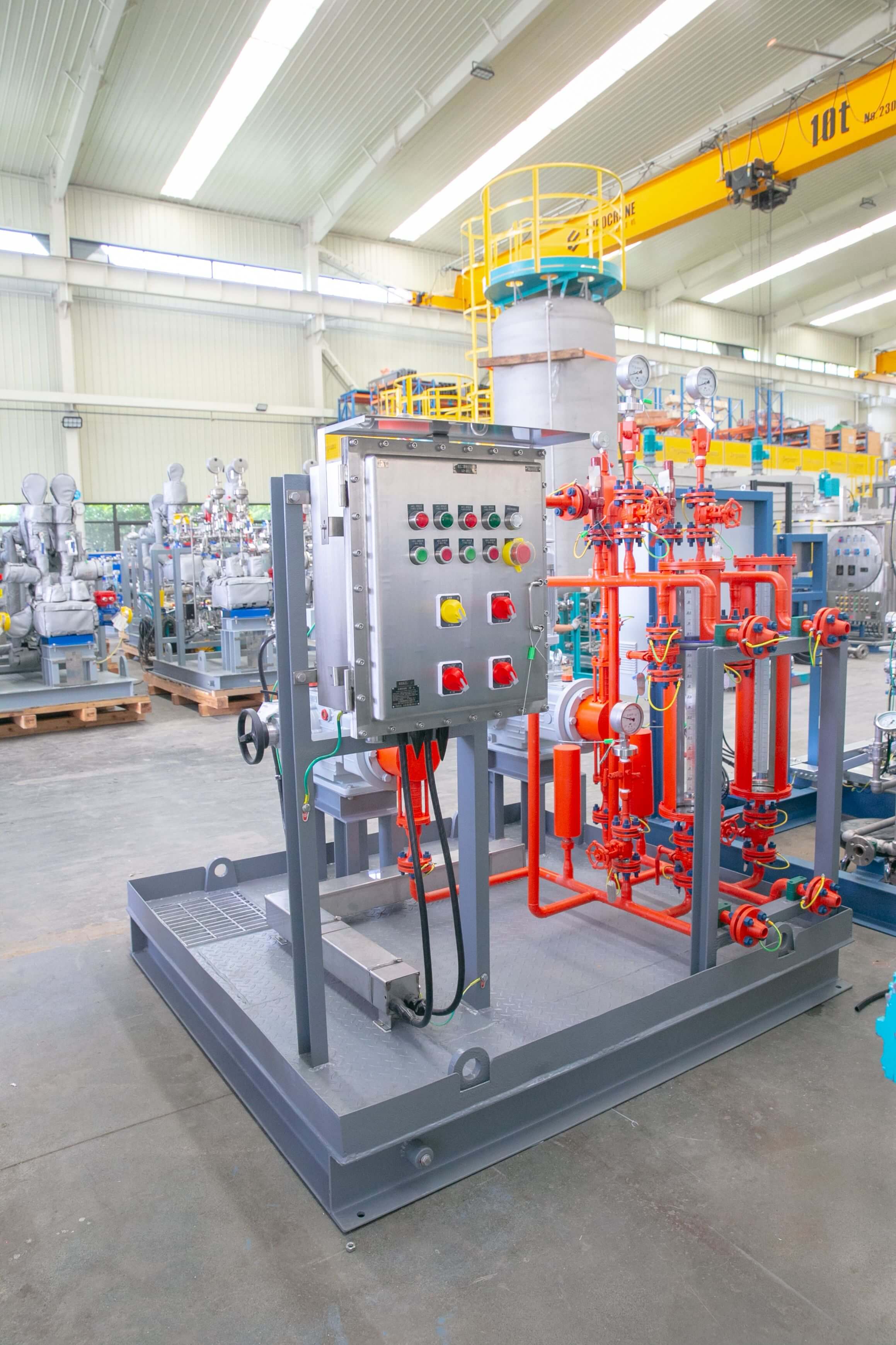
Why Skid-Mounted Metering Pump Systems Improve Plant Operations
Chemical dosing is a surprisingly fragile part of many processes. A small variation in injected volume can affect effluent quality, corrosion rates, product purity or boiler chemistry. A properly engineered skid-mounted chemical dosing system addresses this by combining mechanical precision with automatic control.
Precision That Can Be Measured and Repeated
In a hydraulic diaphragm metering pump, flow is controlled by adjusting stroke length and running frequency. The hydraulic drive acts on a diaphragm, which displaces the chemical without any dynamic seal in contact with the medium. The result is smooth, repeatable output and a linear, easily calibrated turndown range — a major advantage when dosing rates must follow a changing process signal such as flow, pH or residual chlorine.
Leak-Free Handling of Difficult Media
Many dosing duties involve corrosive acids, caustic solutions, volatile solvents, polymers or slurries. The hydraulic diaphragm design keeps the process liquid fully contained, protecting operators and the environment while allowing the wetted materials to be selected for the specific medium. For higher pressures or viscous and particle-laden fluids, a high-pressure process reciprocating pump can be integrated into the same skid concept, extending the package to duties well beyond conventional dosing.
Lower Total Cost of Ownership
- Factory assembly and testing reduce site labor and rework.
- A single supplier takes responsibility for the whole package, not just the pump.
- Compact footprint saves expensive floor space in existing plants.
- Automatic control removes manual dosing errors and reduces chemical waste.
- Standardized skids simplify spare parts planning and operator training.
Typical Applications of Skid-Mounted Dosing Systems
Skid-mounted metering pump systems appear wherever a liquid chemical must be added in a controlled, verifiable way. Depam’s own product portfolio is applied across a broad industrial base, with petrochemical and chemical processing accounting for roughly 41% of sales, oil and gas fields about 23%, nuclear, power, metallurgy and new energy around 15%, environmental water treatment about 13%, and new materials and food about 3%.
Water and Wastewater Treatment
Coagulant, flocculant, disinfectant, antiscalant and pH adjustment chemicals all require accurate, continuous dosing. A skid-mounted dosing system for water treatment typically combines a dissolution tank, mixer and one or more metering pumps, with automatic control linked to flow signals so that chemical addition follows plant load.
Oil, Gas and Petrochemical Processing
In hydrocarbon service, metering skids inject corrosion inhibitors, scale inhibitors, demulsifiers, methanol and other process chemicals at wellheads, gathering stations and pipelines. High-pressure process reciprocating pumps are frequently used where injection pressures exceed the capability of standard dosing pumps, and their ability to handle viscous, hot or slightly contaminated fluids makes them a natural fit for oilfield duty.
Power Generation and Boiler Water Chemistry
Boiler feedwater and cooling circuits depend on precise phosphate, ammonia, hydrazine and biocide dosing. Depam also supplies water-steam sampling devices that work alongside dosing packages to verify chemistry, giving power plant operators a coherent chemical control strategy.
Chemical, New Energy and Food Processing
Additive blending, catalyst dosing, electrolyte preparation and ingredient metering all benefit from the same skid architecture. Hygienic versions with appropriate wetted materials can serve food and new material production, while explosion-proof and high-pressure variants cover more demanding chemical environments.
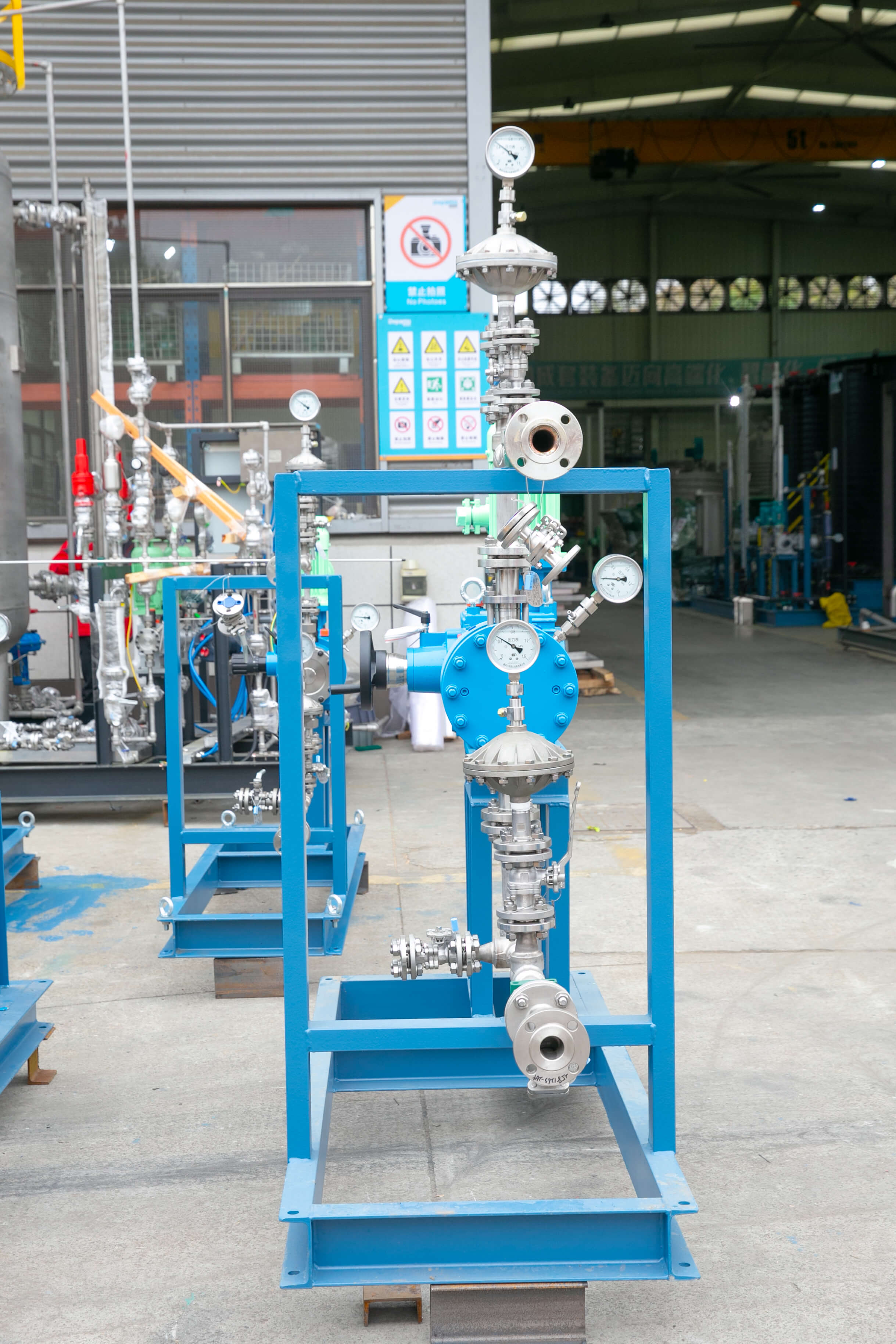
How to Select a Skid-Mounted Metering Pump System
Selection starts with the medium, not with the pump. Before contacting any supplier, gather the chemical name, concentration, viscosity, temperature, solids content, required flow range, discharge pressure, turndown ratio, control signal and site conditions. The table below lists the parameters that most strongly influence skid design.
| Parameter | Why It Matters |
|---|---|
| Medium and concentration | Determines wetted materials, diaphragm type and seal strategy |
| Flow rate and turndown | Defines pump size and whether one or multiple pumps are needed |
| Discharge pressure | Selects metering pump or high-pressure reciprocating pump technology |
| Viscosity and temperature | Affects valve design, piping size and heating or tracing requirements |
| Control philosophy | Local manual, PLC-based automatic or DCS-linked dosing |
| Installation environment | Indoor, outdoor, corrosive atmosphere or hazardous area classification |
Buyers often ask how a skid-mounted metering pump system performs compared with a site-built assembly. The honest answer is that performance depends almost entirely on engineering discipline: correct pump sizing, adequate suction conditions, proper relief protection and a control philosophy that matches the plant. A well-designed package is quieter, more accurate and easier to maintain; a poorly sized one will struggle regardless of brand.
Choosing a Skid-Mounted Metering Pump System Manufacturer
Because a dosing skid mixes pumps, vessels, instruments and controls, supplier capability matters more than a single product datasheet. A manufacturer should be able to design the package, fabricate the base frame, integrate the control system, test the unit as a whole and support commissioning.
Depam (Hangzhou) Pump Industry Technology Co., Ltd. was established in 2003 and has grown into a high-tech enterprise with more than 400 employees and a plant area of about 35,000 square meters. The company operates three brands — Depam, Kenilowa and Dailepu — and reported sales of approximately RMB 450 million in 2023, RMB 510 million in 2024 and RMB 560 million in 2025. Its portfolio covers metering pumps, high-pressure process reciprocating pumps, pneumatic and electric pumps, automatic chemical dosing systems, water-steam sampling devices, water treatment equipment, screw pumps, rotary lobe pumps and gear pumps.
That breadth is useful when a project needs more than one technology. A single supplier can combine a hydraulic diaphragm metering pump with a high-pressure reciprocating unit, or add a screw pump for viscous transfer, and deliver the whole package as one tested skid. When evaluating proposals, compare scope definition, material certificates, control architecture, documentation and after-sales response — not just the pump price. If you are comparing several vendors, ask each one the same technical questions so that the answers can be judged side by side.
Installation, Commissioning and Maintenance Best Practices
Good installation protects the accuracy the factory built into the skid. Keep suction lines short and generously sized, avoid unnecessary fittings, and ensure the skid is level and anchored. Confirm that relief valve discharge is routed safely and that injection points are located where back pressure will not exceed design limits.
- Flush and clean piping before connecting chemical lines to the pump.
- Calibrate each metering pump against a measured volume after commissioning.
- Check diaphragm and valve condition at scheduled intervals, not only after failure.
- Record stroke settings and dosing rates so deviations can be detected early.
- Keep spare diaphragms, valve balls and seats in stock for critical duties.
For maintenance planning, the most useful habit is trending. A gradual loss of dosing accuracy usually signals worn valves, a stretched diaphragm or air ingress long before a visible failure occurs. Operators who log flow, pressure and stroke position weekly can schedule service during planned shutdowns instead of reacting to unplanned downtime.
FAQ
What is included in a skid-mounted metering pump system?
A typical package includes one or more metering pumps, a chemical tank, a mixer, piping and valves, instrumentation, a control panel and safety accessories such as relief valves and level switches. All components are mounted on a common frame, wired and tested at the factory so that site work is limited to connecting utilities and process lines.
How do I choose between a hydraulic diaphragm metering pump and a plunger pump for my skid?
Hydraulic diaphragm metering pumps are preferred for corrosive, toxic or volatile chemicals because the diaphragm isolates the medium from the drive and eliminates dynamic seals in contact with the fluid. Plunger-based high-pressure reciprocating pumps are better suited to very high discharge pressures, high-viscosity media or fluids containing solids, such as oilfield injection duties. Many projects combine both technologies on separate skids.
Can a skid-mounted dosing system handle corrosive, viscous or high-temperature media?
Yes, provided the wetted materials, diaphragm type, valve design and piping are selected for the specific medium. Depam engineers each package around the customer’s medium characteristics, flow, pressure, temperature and site process requirements, and can supply standard, non-standard or fully customized fluid solutions.
How much site work is required after delivery?
Because the skid is assembled and tested before shipment, on-site work is mainly positioning, anchoring, connecting suction and discharge piping, and supplying power and control signals. Commissioning then focuses on calibration, functional testing of the control logic and operator training rather than mechanical assembly.
Where can I get a quotation and a direct contact number for a metering skid?
Prepare a data sheet covering medium, concentration, flow range, pressure, temperature, control requirements and site conditions, then send it to the manufacturer’s sales team through the official website or your regional representative. You can request a technical proposal, an indicative price and the direct contact number for your area in the same enquiry, which shortens the evaluation cycle considerably.
Summary
A skid-mounted metering pump system turns chemical dosing from a collection of individual components into a single, tested, accountable package. The benefits — precise and repeatable injection, leak-free handling of aggressive media, reduced site labor, compact footprint and simplified maintenance — are why these systems dominate modern water treatment, petrochemical, oil and gas, power and chemical projects.
The key to a successful purchase is disciplined specification. Define the medium, flow, pressure, temperature and control philosophy first, then evaluate suppliers on engineering capability, testing practice, documentation and support rather than price alone. Manufacturers with in-house design, fabrication and full-package testing, such as Depam with its 35,000 square meter facility, 400-plus workforce and broad portfolio of metering pumps, high-pressure reciprocating pumps and dosing systems, are well positioned to deliver standard, non-standard and customized skids for global industrial buyers.