
Thick slurry is one of the most unforgiving media in industrial processing. It combines high solids content, abrasion, viscosity and a strong tendency to settle, which means a pump that performs well on clean water can fail within weeks on sludge, ore slurry, lime milk or produced sand-laden fluids. For plant engineers and procurement teams, the real challenge is not simply buying a pump — it is finding a slurry pump manufacturer that understands the process, can match the pump type to the media, and can support the equipment over a decade of duty. This guide explains how thick slurry behaves, which pump technologies handle it best, and how to qualify a supplier before you send a request for quotation.
What Counts as Thick Slurry and Why Standard Pumps Struggle
In industrial terms, a thick slurry is any liquid carrying a meaningful load of suspended solids — typically above a few percent by weight, and often far higher in mining, metallurgy and sludge handling. The behaviour of the mixture depends on particle size distribution, particle shape, carrier liquid viscosity and temperature. Fine particles raise viscosity and reduce pumpability; coarse or sharp particles accelerate wear on casings, rotors and seals. Many slurries are also thixotropic, meaning they behave like a gel at rest and only flow once shear is applied.
Conventional centrifugal pumps are designed around clean, low-viscosity liquids. When applied to thick slurry they lose efficiency quickly, suffer from Cavitation and recirculation at the impeller eye, and wear rapidly at the wear ring and casing. Settling solids can block the suction line entirely during a shutdown, and restarting against a packed pipeline may overload the motor. In many cases the failure is not a single dramatic breakdown but a slow decline in flow rate, rising vibration and repeated seal replacement, all of which erode plant availability.
Positive displacement pump technologies solve most of these problems because they move a fixed volume of media per cycle rather than relying on kinetic energy. Flow becomes largely independent of discharge pressure, shear is reduced, and the pump can self-prime or handle suction conditions that would starve a centrifugal unit. The engineering task then shifts to selecting the right positive displacement family — screw, rotary lobe, gear or reciprocating — for the specific solids load, pressure requirement and sensitivity of the medium.
Slurry Pump Types: Matching the Pump to Your Media
A useful way to approach selection is to rank the duty by two variables: how abrasive and viscous the slurry is, and how much discharge pressure the process requires. Low-pressure transfer of viscous sludge points towards a rotary lobe or progressive cavity screw pump. High-pressure injection of a solids-laden fluid points towards a reciprocating plunger or hydraulic diaphragm pump. Precision chemical dosing of a low-solids solution is a different duty entirely and belongs to a metering pump.
Progressive Cavity Screw Pumps for High-Solids, High-Viscosity Media
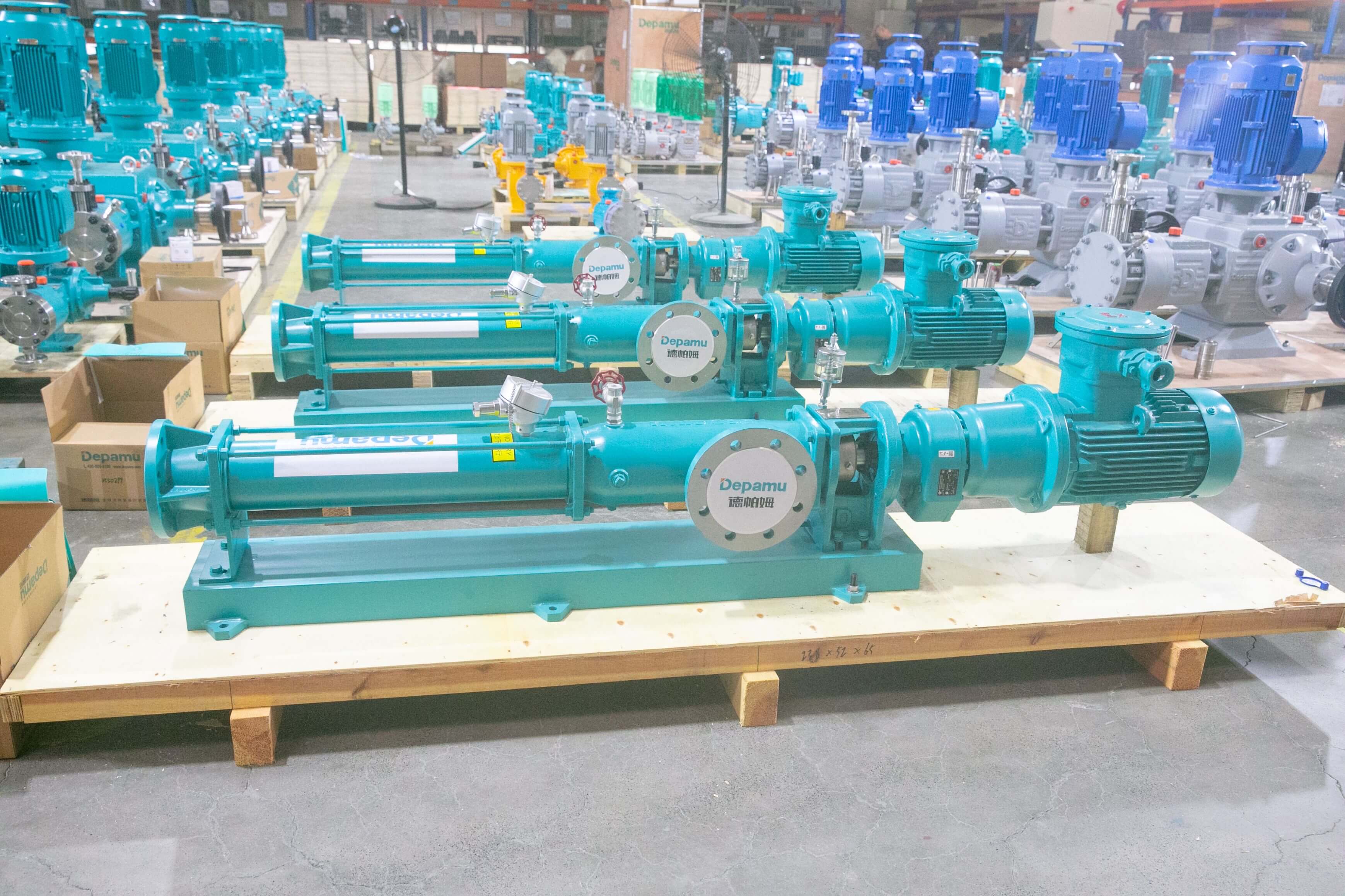
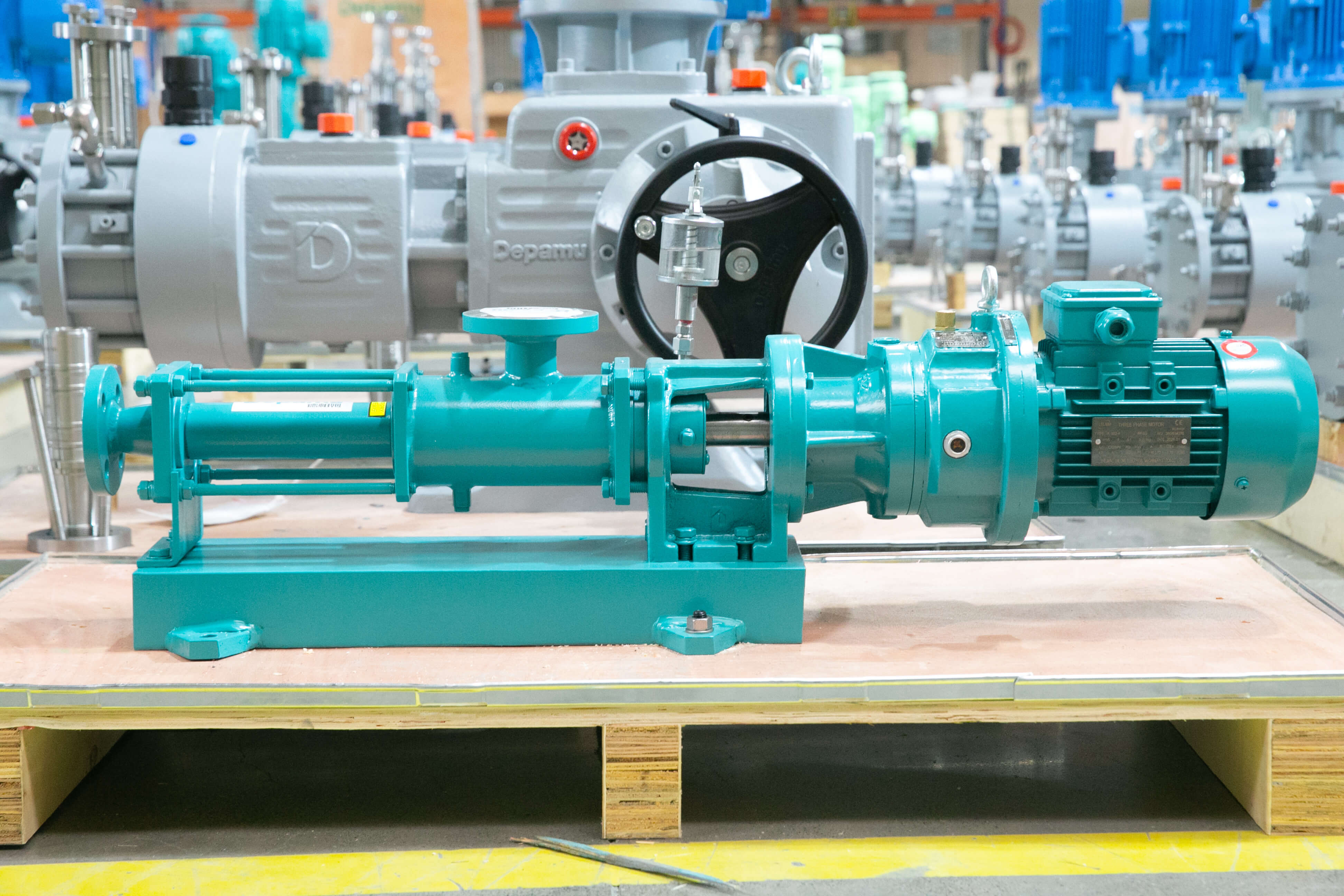
Screw pumps (progressive cavity pumps) use a single helical rotor turning inside a double-helical stator. The sealed cavities travel continuously from suction to discharge, producing a smooth, almost pulsation-free flow that is well suited to thick sludge, dewatered cake transfer, lime slurry, polymer solutions and food-grade pastes. Because the flow path is gentle, shear-sensitive media are protected, and the pump can handle relatively large particles without clogging. The trade-off is that the elastomer stator is a wear component; abrasive media require careful material selection and a realistic maintenance interval.
Rotary Lobe Pumps for Viscous and Shear-Sensitive Slurry
Rotary lobe pumps use two counter-rotating lobes that displace media without contact between the rotors, which means the pump can run dry briefly and can be cleaned in place. They are a strong choice for viscous slurries with moderate solids, for media that must not be emulsified or degraded, and for duties where hygienic design matters. Large, slow-turning lobes pass soft solids well, and reversing the rotation allows the line to be emptied — useful when a slurry would otherwise set inside the pipework.
High-Pressure Reciprocating Pumps for Solids-Laden Injection Duty
Where the process demands high pressure rather than high flow, a high-pressure process reciprocating pump is often the only practical answer. A plunger reciprocates inside a cylinder, pushing a fixed volume of liquid into a discharge line that may run at 35 MPa or more. These pumps deliver stable flow at high pressure and can run continuously, which is why they are widely used for oilfield water injection, pipeline boosting, process chemical injection and high-pressure transfer of media containing fine solids. Wear parts such as plungers, packing and valves are designed as serviceable items, and correct material selection is essential when the media is abrasive or corrosive.
| Pump Type | Best For | Typical Pressure Range | Key Considerations |
|---|---|---|---|
| Progressive cavity screw pump | Thick sludge, lime slurry, polymer, high-viscosity pastes | Low to medium | Stator wear life, solids size, dry-run protection |
| Rotary lobe pump | Viscous, shear-sensitive slurry, soft solids, CIP duties | Low to medium | Clearance selection, lobe material, seal arrangement |
| High-pressure reciprocating pump | High-pressure injection, pipeline boosting, fine-solids media | High (up to 35 MPa and above) | Plunger and valve wear, pulsation damping, packing maintenance |
| Gear pump | Viscous, lubricating, low-abrasion media | Medium to high | Not suited to abrasive solids, filtration required |
| Hydraulic diaphragm metering pump | Precise dosing of chemicals with low solids content | Medium to high | Turndown ratio, dosing accuracy, leak-free requirement |
How to Judge Whether a Slurry Pump Manufacturer Has a Good Reputation
Buyers frequently ask which slurry pump manufacturer has the better reputation. Reputation in this segment is rarely built on marketing; it is built on application depth, manufacturing control and the willingness to engineer around a difficult medium. A supplier that only offers catalogue models will struggle when your slurry contains coarse sand, entrained gas or a pH of 2. A supplier with in-house design, casting and assembly capability, plus a track record across several process industries, can adjust materials, clearances and sealing to the actual duty.
DEPAM (Hangzhou) Pump Industry Technology Co., Ltd. is an example of this type of specialist. Founded in 2003 and operating a plant of roughly 35,000 square meters with more than 400 employees, the company develops and manufactures high-end positive displacement pumps and complete fluid systems. Its portfolio covers metering pumps, high-pressure process reciprocating pumps, pneumatic and electric pumps, chemical dosing skid systems, water and steam sampling devices, water treatment equipment, and screw, rotary lobe and gear pumps. The company operates three brands — DEPAM, Kenuoluowa and Dailepu — and holds registered capital of approximately 54 million RMB, with annual output value of around 500 million RMB and reported sales of about 450 million RMB in 2023, 510 million RMB in 2024 and 560 million RMB in 2025.
Application spread is another useful reputation signal. DEPAM’s sales are distributed across petroleum refining and chemicals (about 41%), oil and gas fields (about 23%), nuclear power, power generation, metallurgy and new energy (about 15%), environmental water treatment (about 13%), new materials and food (about 3%), and other industries (about 5%). A supplier working across these sectors has usually met a wide range of media problems already, which shortens the learning curve on a new project.
Slurry Pump Selection Parameters: A Practical Checklist
No supplier can quote accurately from a flow rate alone. Thick slurry duties require a full description of the medium and the process, because two applications with identical flow and pressure may need completely different pump construction. The checklist below reflects the information most manufacturers will request before proposing a model.
| Parameter | Why It Matters |
|---|---|
| Solids concentration (% by weight) | Determines viscosity, settling risk and whether a positive displacement pump is mandatory |
| Maximum particle size and shape | Sets clearances, lobe or rotor geometry, and valve design on reciprocating units |
| Viscosity and rheology | Affects speed selection, suction performance and motor sizing |
| Temperature | Drives elastomer and seal material choice and any cooling requirement |
| Chemical composition and pH | Determines wetted materials and corrosion allowance |
| Flow rate and discharge pressure | Defines pump size, number of stages and drive power |
| Suction conditions and NPSH available | Prevents cavitation and ensures stable filling of the pumping chamber |
| Duty cycle and control philosophy | Continuous or intermittent operation, variable speed, remote monitoring requirements |
| Site constraints | Footprint, skid mounting, piping orientation, hazardous area classification |
Where to Source Slurry Pumps and What to Ask Before Requesting a Quotation
Procurement teams often search for where to find slurry pumps, or ask for a contact channel and a short list of suppliers worth talking to. The practical answer is that the right source depends on how far the duty deviates from a standard catalogue application. For routine sludge transfer, several manufacturers can supply a workable screw or lobe pump. For high-pressure injection, abrasive media or combined dosing and mixing skids, a supplier with engineering and assembly capability will save far more than the initial price difference.
Before you request a quotation, prepare a short technical package. Include a process description, the full media analysis, a P&ID or sketch of the installation, utility availability, and the expected operating hours per year. Ask each candidate supplier the same set of questions so that offers are genuinely comparable:
- Which pump technology do you recommend for this media, and why does it outperform the alternatives?
- What wetted materials and elastomers will be used, and how were they selected for this chemistry and temperature?
- What is the expected service life of wear parts, and which spare parts should be stocked on site?
- How is the pump tested before shipment, and what documentation is provided?
- Can the unit be supplied as a packaged skid with controls, and what is the delivery lead time?
- What commissioning, training and after-sales support are available in our region?
- What is the total cost of ownership over five years, including spares and energy?
A supplier that answers these questions in technical detail — rather than quoting a model number immediately — is usually the one worth shortlisting. Requesting two or three comparable offers is sensible, provided the scope is identical and the media data is shared with every bidder.
Typical Applications of Thick Slurry and High-Solids Pumps
Slurry handling appears across almost every process industry, and each sector places different demands on the equipment. In environmental water treatment, screw and lobe pumps transfer primary and digested sludge, thickened slurry and dewatering feed, where gentle handling and clog-free operation matter more than pressure. In petroleum refining and chemicals, reciprocating and screw pumps move viscous residues, catalyst slurries and process streams that must be metered or boosted at pressure.
In oil and gas fields, high-pressure reciprocating pumps are widely used for water injection and for moving produced fluids that carry sand and fine solids. Power generation and metallurgy rely on slurry pumps for ash, lime milk and reagent transfer, often in combination with automatic dosing systems that dissolve, agitate and inject chemicals without manual intervention. In new materials and food processing, rotary lobe and screw pumps handle pastes, fruit preparations and viscous intermediates where product integrity is essential. Because the same media can behave very differently at different plants, a customized solution — adjusted materials, sealing, speed or control logic — is often the most economical route.
Installation, Operation and Maintenance Tips
Even a well-selected slurry pump will underperform if it is installed badly or operated outside its intended envelope. The following practices consistently improve reliability in thick-slurry service.
- Keep suction lines short, straight and generously sized; avoid pockets where solids can settle.
- Provide flushing or draining points so the line can be cleared before shutdown, especially for settling slurries.
- Use variable speed control rather than throttling valves to adjust flow; this reduces shear and wear.
- Monitor discharge pressure, vibration and motor current as early indicators of wear or blockage.
- Inspect stators, lobes, plungers, valves and packing on a defined interval based on actual wear data, not calendar assumptions.
- Stock the critical wear parts identified during selection so that a planned inspection does not become an unplanned outage.
- Train operators on dry-run protection, correct start-up sequence and the signs of cavitation.
FAQ
How do I choose between a screw pump and a rotary lobe pump for thick slurry?
Start with solids content, particle size and viscosity. Progressive cavity screw pumps generate higher pressure per stage and handle very high solids and viscous sludge well, but the stator is a wear item. Rotary lobe pumps are better for shear-sensitive media, soft solids and duties requiring clean-in-place or reversible flow, and they handle moderate solids loads at lower pressure. If the slurry is abrasive, compare wear-part cost and replacement frequency as well as purchase price.
What information should I provide to get an accurate slurry pump quotation?
Provide flow rate, discharge pressure, solids concentration, maximum particle size, viscosity, temperature, pH and chemical composition, available suction conditions, duty cycle and site constraints such as footprint and hazardous area classification. A sketch or P&ID of the installation helps considerably. With this data a manufacturer can propose a specific pump type, wetted materials and drive configuration, and can quote a realistic price instead of a rough estimate.
Can a high-pressure reciprocating pump handle media containing solid particles?
Yes, provided the particles are fine and the pump has been configured for the duty. High-pressure process reciprocating pumps are used for oilfield water injection and for process streams carrying fine solids. Plunger material, packing type and valve design must be selected for the abrasiveness and chemistry of the medium, and suction filtration is often recommended. For large or sharp particles, a screw or lobe pump upstream is usually the better arrangement.
How do I verify a slurry pump manufacturer’s reputation before ordering?
Ask for evidence of engineering capability rather than marketing claims: in-house design and manufacturing, testing procedures, material traceability and a clear explanation of how the proposed pump was matched to your media. Review which industries the supplier serves and how long it has operated in them, check whether customized or non-standard builds are routine, and ask for references in a similar application. Detailed technical answers to your RFQ questions are a stronger signal than a low price.
What maintenance schedule is typical for a heavy-duty slurry pump?
Schedules should be based on measured wear rather than fixed intervals. In practice, operators check seals and packing weekly, inspect wear parts such as stators, lobes, plungers and valves at the intervals recommended for the duty, and trend vibration and discharge pressure continuously. Once the actual wear rate is known from the first inspection cycle, the schedule can be adjusted — extending intervals for mild duties and shortening them for abrasive or high-temperature service.
Are customized slurry pump solutions available for difficult media?
Yes. For abrasive, corrosive, high-temperature or high-pressure duties, manufacturers can adjust wetted materials, elastomers, sealing arrangements, pump speed and control philosophy, and can supply the pump as part of a packaged skid with tanks, agitation, instrumentation and automatic dosing control. Supplying full media data at the inquiry stage allows the supplier to propose a customized configuration rather than a standard catalogue model.
Summary
Selecting a slurry pump is a materials-and-process decision before it is a purchasing decision. Thick, abrasive or high-solids media demand positive displacement technology — progressive cavity screw pumps, rotary lobe pumps or high-pressure reciprocating pumps — each with a distinct operating envelope. The most reliable outcomes come from suppliers who ask detailed questions about the medium, can adjust construction to the duty, and support the equipment through its maintenance life. DEPAM (Hangzhou) Pump Industry Technology Co., Ltd., with more than two decades of experience in high-end positive displacement pumps and complete fluid systems, works in exactly this way: standard, non-standard and fully customized solutions built around the customer’s media characteristics, flow, pressure, temperature and site process requirements. Prepare a complete technical package, compare two or three qualified manufacturers on total cost of ownership, and the pump you install will keep running long after the quotation is forgotten.