
Moving dense, abrasive or high-viscosity media is one of the most demanding duties in any process plant. A thick slurry pump is the piece of equipment that keeps that duty under control — it must handle solids, resist wear, hold a stable flow and keep running shift after shift without leaking or clogging. Choosing the wrong machine usually shows up quickly as seal failures, blocked lines, cavitation, or an energy bill that climbs month after month.
This guide explains what a thick slurry pump actually does, which pump technologies fit which media, how to read the key selection parameters, and what to check before you request a quotation. It is written for process engineers, plant maintenance teams and procurement specialists who need a practical decision framework rather than a catalogue of numbers. The examples draw on the product portfolio of Depamu (Hangzhou) Pump Industry Technology Co., Ltd., a manufacturer of high-end volumetric pumps and fluid equipment that has been serving oil refining, chemical, oil and gas field, nuclear power, power generation, metallurgy, new energy, environmental water treatment, new materials and food industries since 2003.
What Is a Thick Slurry Pump and Where Is It Used?
A thick slurry pump is a pump designed to convey a mixture of liquid and suspended solids at relatively high solids concentration or high viscosity. Unlike a clean-water pump, it must tolerate abrasion, keep particles in suspension, and avoid settling inside the casing or the piping. In practice the term covers several pump technologies — progressive cavity (screw) pumps, rotary lobe pumps, gear pumps, high-pressure reciprocating pumps and heavy-duty metering pumps — because the “right” machine depends entirely on the medium.
Dense slurries appear across almost every process industry. In oil refining and petrochemical plants, slurry pumps move catalyst fines, oily sludge and heavy residues. In oil and gas fields they transfer drilling mud, produced sand and polymer-laden fluids. In environmental water treatment they handle lime slurry, sludge and chemical slurries from dosing systems. In new materials and metallurgy they move mineral suspensions, ceramic slips and grinding media. Because the medium often changes with the process stage, plants frequently need more than one pump type on the same site.
The economic case for getting the selection right is straightforward. A correctly sized thick slurry pump runs near its best efficiency point, wears evenly, and can operate continuously for long periods with planned maintenance only. An undersized or oversized unit either chokes on solids, runs dry at the suction side, or wastes energy throttling a flow it was never designed to deliver.
Which Pump Type Handles Which Slurry?
There is no universal thick slurry pump. Each volumetric pump family has a “comfort zone” defined by viscosity, solids content, particle size, pressure and shear sensitivity. Understanding these zones is the fastest way to narrow the choice before detailed engineering begins.
Progressive cavity (screw) pumps
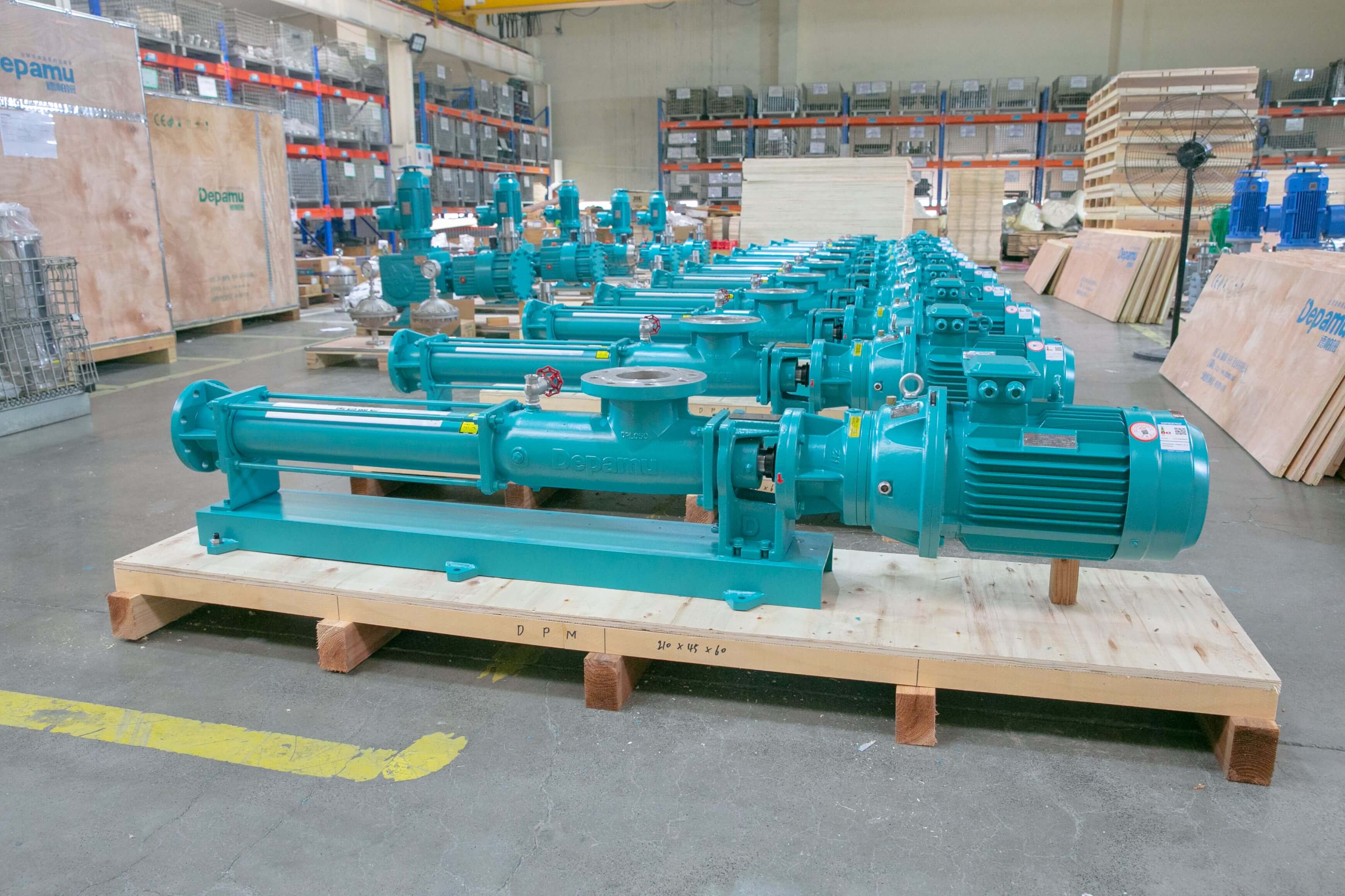
Progressive cavity pumps are the workhorse for thick, high-viscosity and solids-laden media. A single helical rotor turns inside a helical elastomer stator, creating sealed cavities that move axially along the pump. The flow is smooth and almost pulsation-free, the suction lift is good, and the design tolerates fibrous material, sand and sludge far better than a centrifugal unit. They are widely used for sludge transfer, lime slurry dosing and viscous chemical handling. The trade-offs are limited dry-run tolerance and the need to match the elastomer to the chemical and temperature of the medium.
Rotary lobe and gear pumps
Rotary lobe pumps use two counter-rotating lobes that do not touch each other, which makes them suitable for moderately viscous, mildly abrasive media and for gentle handling where shear must be limited. Gear pumps are compact, handle high differential pressures and are well suited to viscous liquids with limited solids. Both families are frequently selected for chemical transfer duties where a thick slurry pump must fit into a tight skid footprint.
High-pressure reciprocating pumps
When the duty combines dense media with high discharge pressure — for example long-distance pipeline boosting or high-pressure injection — a reciprocating plunger pump becomes the natural choice. These machines push liquid with a piston or plunger and can reach very high pressures while maintaining stable flow, which is why they are common in oil and gas field water injection and in process transfer duties where downstream resistance is significant.
Metering pumps
For chemical dosing duties, precision matters as much as solids handling. A hydraulic diaphragm metering pump adjusts stroke length and running frequency to deliver a precise, repeatable dose with a completely leak-free diaphragm barrier, which is essential when the medium is corrosive, volatile or expensive. Dosing a lime slurry or a polymer solution accurately is often the difference between a compliant effluent and a failed discharge permit.
| Pump type | Typical slurry duty | Strengths | Watch points |
|---|---|---|---|
| Progressive cavity (screw) pump | Sludge, lime slurry, viscous residue, fibrous media | High viscosity tolerance, smooth flow, good suction | Elastomer compatibility, no long dry running |
| Rotary lobe pump | Moderate solids, shear-sensitive chemical slurry | Gentle handling, easy cleaning, compact | Clearance selection for particle size |
| Gear pump | Viscous liquid with low solids content | High pressure, compact, steady flow | Not ideal for large abrasive particles |
| High-pressure reciprocating pump | Pipeline boosting, high-pressure injection, oilfield water | Very high pressure, stable flow, continuous duty | Pulsation damping, wear part inspection |
| Hydraulic diaphragm metering pump | Chemical dosing of slurry and aggressive media | High accuracy, leak-free, corrosion resistant | Valve seating with solids-bearing fluid |
Key Parameters to Define Before You Buy
Most selection errors are not caused by the pump — they are caused by incomplete duty data. Before contacting a thick slurry pump manufacturer, gather the following information. The more complete the data set, the more accurate the quotation and the lower the risk of an expensive re-design later.
- Flow rate: minimum, normal and maximum required capacity, including any future expansion margin.
- Discharge pressure: system head, pipe length, elevation change and any downstream equipment resistance.
- Solids content: percentage by weight and by volume, plus particle size range and hardness.
- Viscosity and temperature: at both start-up and normal operating conditions.
- Chemical composition: pH, corrosiveness and compatibility with wetted materials and elastomers.
- Operating pattern: continuous or intermittent, duty cycle, and whether dry running can occur.
- Site conditions: available footprint, power supply, control system protocol and environmental requirements.
With these values in hand, a supplier can recommend the correct pump family, wetted materials, seal arrangement and drive configuration. Where the medium is aggressive or the pressure is high, the design may move from a standard catalogue model to a non-standard or fully customized configuration. Depamu’s engineering team works from exactly this kind of data — medium characteristics, flow, pressure, temperature and on-site process requirements — to deliver standard products, non-standard products and customized fluid solutions.
Application Scenarios for Thick Slurry Pumps
Understanding where dense slurry pumps are deployed helps buyers benchmark their own duty. In oil refining and petrochemical production, thick slurry pumps transfer heavy residue, catalyst slurry and oily sludge between process units, where stable flow and leak-free operation are essential for both safety and product quality. Oil refining and chemical production together represent roughly 41% of Depamu’s sales business, which reflects how central these duties are to the company’s design experience.
In oil and gas fields, slurry handling overlaps with water injection, produced fluid transfer and pipeline boosting. Reciprocating pumps capable of pressures above 35 MPa are used to push fluid into high-resistance lines and long-distance pipelines, while progressive cavity pumps handle the thicker, sand-laden streams. Oil and gas field applications account for approximately 23% of the company’s business.
Environmental water treatment is another major arena, at about 13% of sales. Lime slurry dosing, sludge transfer and chemical preparation all depend on accurate, reliable pumping. Fully automated chemical dosing systems integrate storage, dissolving, mixing, metering and automatic control into a single skid — the pump is the core, supported by dissolving tanks, agitators and a control system, with factory assembly and testing completed so that on-site work is limited to piping and power connections.
Nuclear power, power generation, metallurgy and new energy together account for around 15% of business, where slurry duties often involve high temperature, high pressure or strict containment requirements. New materials and food applications, about 3%, demand gentle handling and hygienic design. In all of these sectors, the same principle holds: the pump must match the medium, not the other way around.
How to Evaluate a Thick Slurry Pump Supplier
Once the technical scope is clear, supplier evaluation becomes the deciding factor. A thick slurry pump is a long-life asset, so the manufacturer’s engineering depth, production capacity and ability to support the equipment over its service life matter as much as the price on the quotation.
Engineering and customization capability
Look for a supplier that can move beyond catalogue selection. Questions worth asking include: can they review your medium data and recommend materials of construction? Can they supply non-standard configurations when the duty falls outside standard ranges? Do they have experience with the combination of high pressure, high viscosity and abrasive solids that defines your process?
Manufacturing scale and quality control
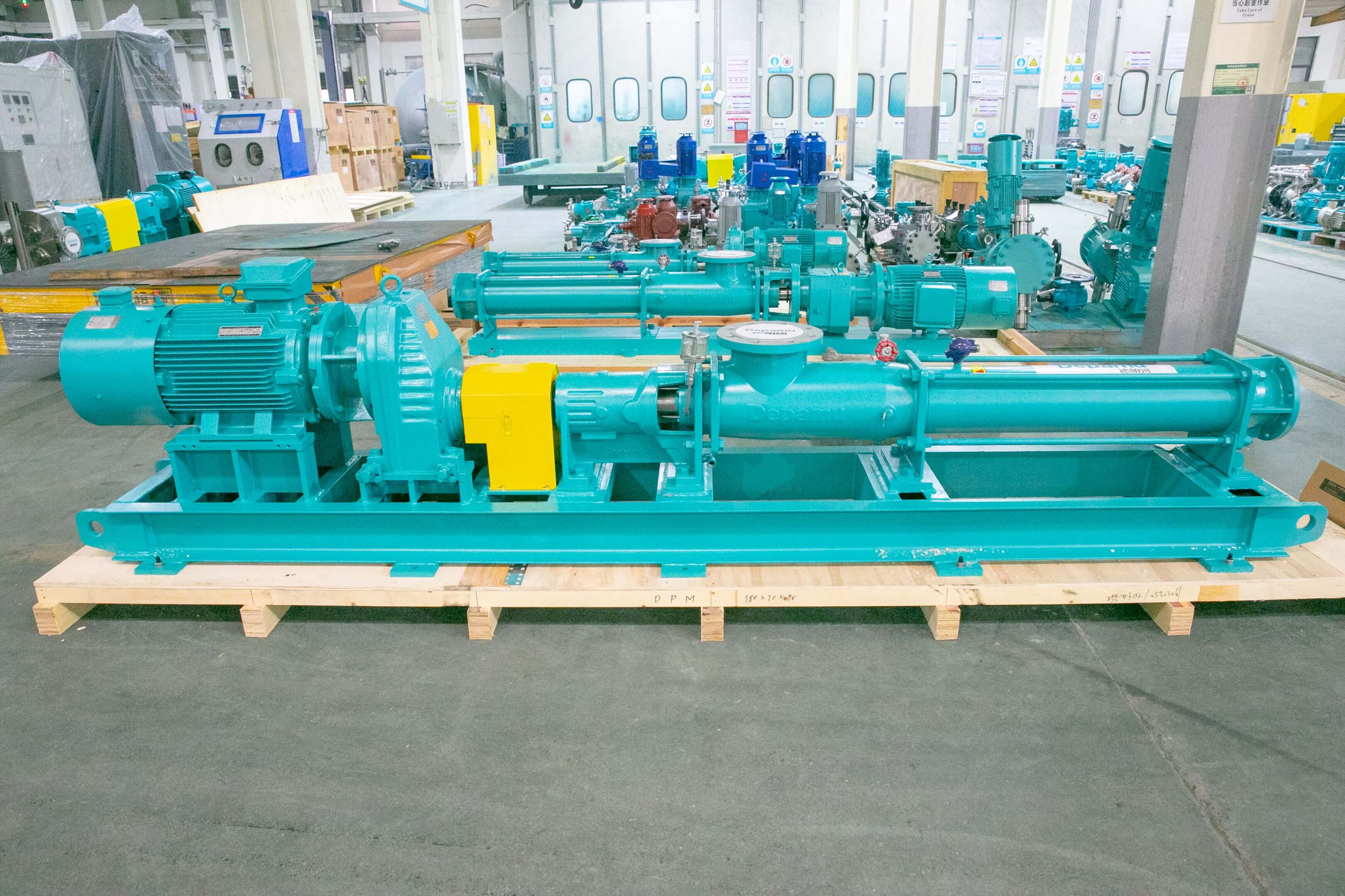
Production capacity is a practical indicator of delivery reliability. Depamu operates a plant of approximately 35,000 square meters with more than 400 employees and an annual output value of around RMB 500 million, holding registered capital of RMB 54 million. The company has grown steadily — sales were about RMB 450 million in 2023, RMB 510 million in 2024 and RMB 560 million in 2025 — which reflects consistent demand across its core industries rather than a single-project spike.
Complete system delivery
Many slurry duties are not just a pump but a small process system: storage, dissolution, mixing, dosing, control and interconnection. A supplier able to deliver a complete packaged solution reduces interface risk, shortens commissioning and gives a single point of responsibility. Factory assembly and testing before shipment is a strong signal of this capability.
Service and spare parts
Ask about recommended spare parts, wear-part availability, documentation quality and response time for technical support. For abrasive slurries, the wear parts — stator, rotor, lobes, valves, diaphragms — define the total cost of ownership far more than the purchase price does.
Maintenance Practices That Extend Pump Life
Even a well-selected thick slurry pump will fail early if it is operated outside its design envelope. A few disciplined habits make a measurable difference to availability and operating cost.
- Never run dry: progressive cavity and many volumetric pumps rely on the medium for lubrication and cooling. Install dry-run protection where the risk exists.
- Flush before shutdown: flushing the casing and piping after handling a settling slurry prevents hardened deposits that damage the rotor or lobes at the next start.
- Monitor pressure and flow trends: a gradual drift usually indicates wear or partial blockage long before a failure occurs.
- Inspect wear parts on a schedule: base inspection intervals on actual medium abrasiveness rather than on generic recommendations.
- Check valves and seals: dosing pump accuracy depends heavily on valve seating; a worn seat shows up as inconsistent dose rather than an obvious leak.
- Keep a spare set of critical parts: for continuous processes, holding one stator, rotor or diaphragm set can turn a multi-day outage into a few hours of planned work.
FAQ
What is a thick slurry pump used for?
A thick slurry pump is used to transfer mixtures of liquid and suspended solids at high concentration or high viscosity. Typical duties include sludge and lime slurry transfer in water treatment, heavy residue and catalyst slurry movement in oil refining, sand-laden produced fluid in oil and gas fields, and viscous chemical transfer in new materials and metallurgy plants. The pump must resist abrasion, keep solids suspended and avoid settling inside the casing.
How do I choose the right thick slurry pump for my process?
Start with the medium, not the pump. Define flow rate, discharge pressure, solids content by weight and volume, particle size and hardness, viscosity and temperature, chemical composition, and whether operation is continuous or intermittent. Then match the medium to the pump family: progressive cavity pumps for high-viscosity and solids-laden media, rotary lobe or gear pumps for moderate viscosity and limited solids, reciprocating plunger pumps for high pressure, and hydraulic diaphragm metering pumps for accurate chemical dosing. Providing complete duty data to the manufacturer is the single most effective way to avoid a mis-selection.
Can a thick slurry pump handle both high pressure and high viscosity?
It depends on the pump family. High-viscosity capability and very high discharge pressure are usually best served by different designs, which is why multiple pump types often coexist on the same site. High-pressure reciprocating pumps can reach pressures above 35 MPa with stable flow and are well suited to pipeline boosting and high-pressure injection, while progressive cavity pumps excel at thick, abrasive and fibrous media at lower pressures. For combined duties, engineering teams evaluate both the medium and the system head before recommending a configuration.
What information do I need to provide to get an accurate quotation?
Provide medium composition and pH, solids percentage and particle size, viscosity and temperature at start-up and normal operation, required flow range, discharge pressure and system head, operating pattern, available footprint and power supply, and any control or automation requirements. Photographs of the installation and a sketch of the piping layout are also helpful. With this data a manufacturer can quote a standard model, a non-standard configuration or a fully customized fluid solution with the correct materials and drive arrangement.
How often should slurry pump wear parts be replaced?
There is no universal interval, because wear rate depends on abrasiveness, particle hardness, solids concentration, operating pressure and running hours. The practical approach is to establish a baseline inspection interval based on the actual medium, then adjust it using observed wear. Monitoring discharge pressure, flow stability and power consumption helps detect wear between inspections, and keeping one set of critical spare parts on site is recommended for continuous processes.
Summary
Selecting a thick slurry pump is a data-driven exercise: define the medium precisely, match it to the right volumetric pump family, confirm materials and drive configuration, and then evaluate the supplier on engineering depth, manufacturing scale and lifecycle support rather than on purchase price alone. Dense slurries are unforgiving — they expose every weakness in sizing, materials and maintenance practice — but a correctly specified pump rewards that discipline with stable flow, low downtime and predictable operating cost.
Depamu (Hangzhou) Pump Industry Technology Co., Ltd. has focused on high-end volumetric pumps and fluid equipment since 2003, producing metering pumps, high-pressure process reciprocating pumps, pneumatic and electric pumps, chemical dosing systems, water and steam sampling systems, water treatment equipment, screw pumps, rotary lobe pumps and gear pumps. Its portfolio covers high-pressure transfer, precision metering, chemical dosing, process boosting and complex medium handling across oil refining, chemical, oil and gas field, nuclear power, power generation, metallurgy, new energy, environmental water treatment, new materials and food industries. Buyers with a defined duty can request a technical review and quotation based on their medium characteristics, flow, pressure, temperature and site requirements.