
Selecting the right pump for a high viscosity, high pressure or particle-laden duty is one of the most consequential decisions in any process plant. A twin screw pump is often the answer when centrifugal pumps lose efficiency, when metering pumps cannot deliver the required flow, and when the fluid itself is the biggest engineering challenge. Because the pump sits directly in the process flow, an undersized or poorly specified unit can cause downtime, product damage and unpredictable maintenance costs across an entire production line.
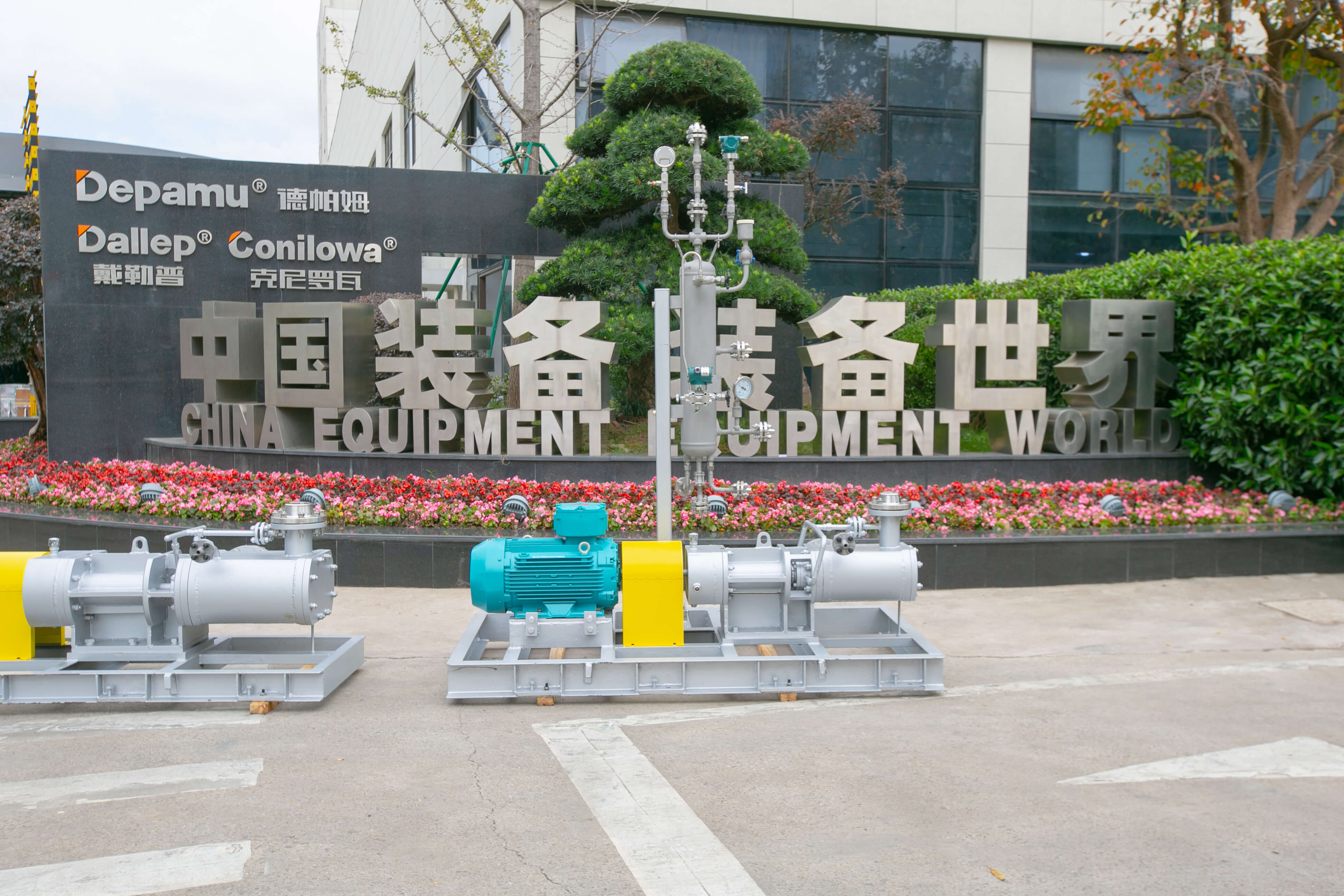
This guide explains how a twin screw pump works, which media it handles well, how to size one correctly, what influences the twin screw pump price, and how to evaluate a twin screw pump manufacturer before placing an order. It is written for procurement engineers, process designers and maintenance managers working in oil refining, chemical processing, oil and gas fields, power generation, water treatment, new materials and food production — the same industries where Depamu (Hangzhou) Pump Industry Technology Co., Ltd. has been building positive displacement and fluid handling equipment since 2003.
What Is a Twin Screw Pump and How Does It Work?
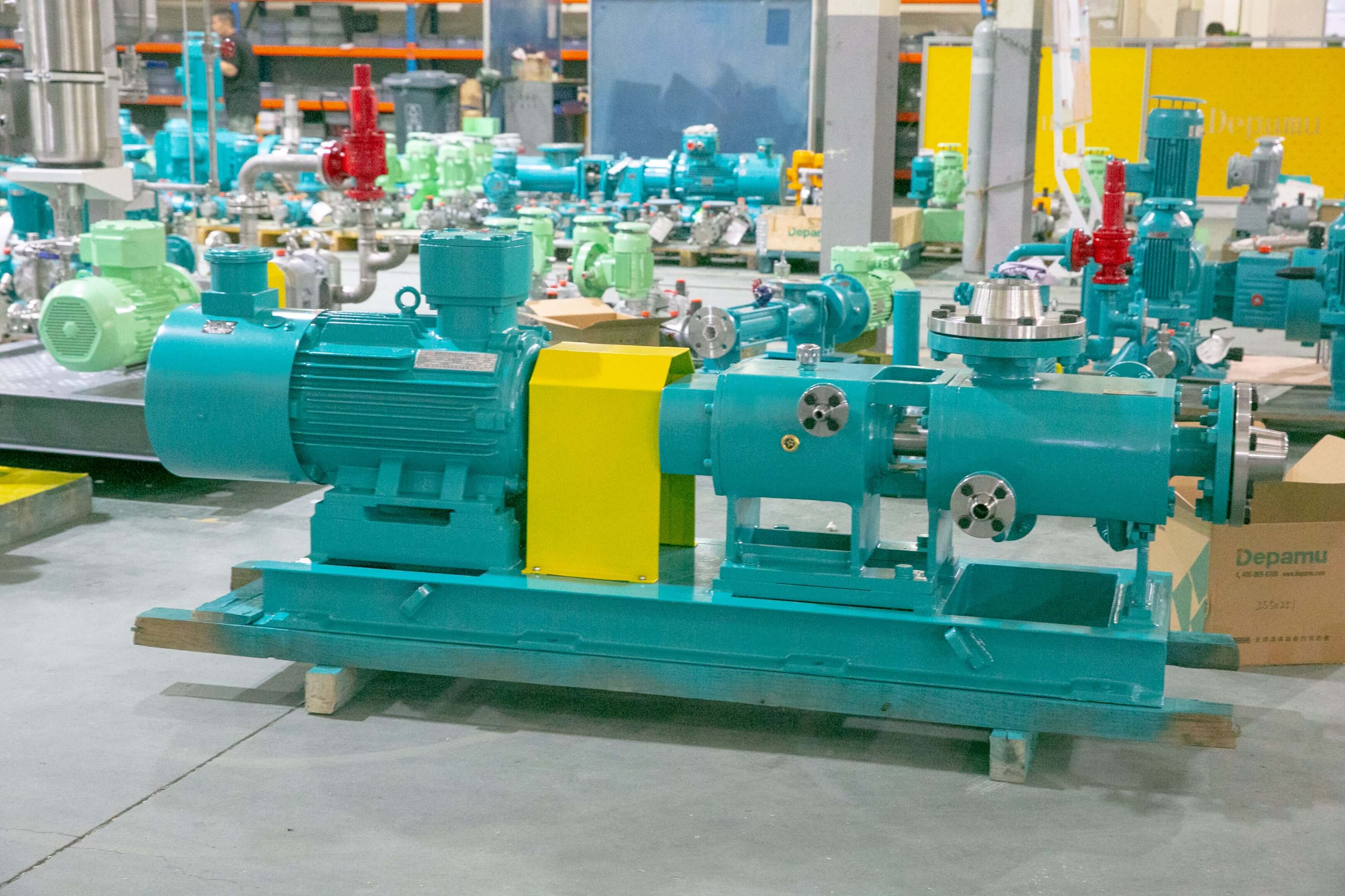
A twin screw pump is a rotary positive displacement pump built around two intermeshing screws — typically a right-hand and a left-hand rotor — that rotate inside a close-tolerance casing. The screws do not touch each other or the casing; instead, timing gears keep them synchronized, and the rotating motion creates sealed cavities that travel axially from the suction side to the discharge side. Liquid is trapped in these cavities and pushed forward with very little turbulence, shear or pulsation.
The Twin Screw Pump Working Principle in Practice
Because the screws never contact one another, the pumped medium is the only lubricant between the rotors. This is why a twin screw pump is well suited to clean or lightly contaminated lubricating fluids, and why the choice of screw profile, clearance and material matters so much when the fluid is abrasive or dry-running conditions are possible. Flow is proportional to rotational speed, so capacity can be adjusted by changing speed rather than by throttling, which keeps energy use predictable.
The result is a pump that delivers a steady, almost pulse-free flow, maintains efficiency across a wide viscosity range, and handles viscosity levels that would cause a centrifugal pump to stall or a gear pump to wear quickly. Compared with a single screw pump, the twin screw design offers higher flow capacity in a compact footprint and better tolerance to entrained gas.
Why Twin Screw Pumps Excel with High Viscosity and Complex Media
Viscosity changes everything in pump selection. As viscosity rises, friction losses increase, centrifugal pump efficiency collapses, and the pump may simply stop delivering flow. A twin screw pump is a positive displacement machine, so each rotation moves a defined volume regardless of viscosity, and it can handle fluids from water-like liquids up to heavy oils and viscous process streams within its design envelope.
The low internal velocity and gentle conveying action also matter for shear-sensitive products. Emulsions, polymer solutions, food-grade liquids and certain chemical intermediates can be damaged by high-shear impellers. In a twin screw pump, the product moves through large, gently swept cavities, which helps preserve structure, droplet size and consistency.
Finally, the self-priming capability of the design simplifies system layout. Because the pump can evacuate air from the suction line and create its own prime, it can often be installed above tank level, reducing pit construction, suction piping complexity and civil works cost. In revamp projects where space is limited, that flexibility frequently shortens the installation schedule.
Industrial Applications: Where Twin Screw Pumps Deliver the Most Value
Across the industries served by modern pump manufacturers, twin screw pumps appear most often where continuous, low-pulsation transfer of difficult liquids is required. Typical duties include crude and refined oil transfer, heavy fuel oil forwarding, chemical intermediate transfer, polymer and resin handling, tank farm circulation, loading and unloading, and sludge or slurry transfer where solid content is moderate and controlled.
In oil refining and petrochemical plants, screw pumps are frequently specified for feedstock transfer, residue handling and viscous product dispatch. In oil and gas fields, they support crude gathering, produced water handling and chemical transfer duties. In chemical processing, they move resins, adhesives, surfactants and viscous intermediates that must not be sheared. In environmental water treatment, they handle sludge, flocculant solutions and chemical dosing lines where steady flow reduces chemical waste.
The table below summarizes how medium characteristics influence twin screw pump selection in common industrial duties.
| Industry / Duty | Typical Medium | Key Selection Focus |
|---|---|---|
| Oil refining and petrochemical transfer | Crude oil, heavy fuel oil, residue, viscous products | Viscosity range, discharge pressure, sealing arrangement, heating jacket |
| Oil and gas field gathering | Crude, produced water, chemical additives | Self-priming ability, corrosion allowance, variable flow control |
| Chemical processing | Resins, adhesives, surfactants, polymer solutions | Low shear operation, material compatibility, flushing plan |
| Water and wastewater treatment | Sludge, flocculant, chemical dosing streams | Solid content, flow stability, corrosion-resistant wetted parts |
| Food and new materials | Viscous food bases, emulsions, specialty slurries | Hygienic design, gentle handling, cleanability |
Twin Screw Pump Selection Guide: Six Parameters That Decide Performance
Correct sizing begins with the process data sheet, not the pump catalog. Before requesting a quotation from any twin screw pump supplier, confirm the medium, the operating envelope and the process environment. Six parameters drive most of the technical outcome.
- Flow rate: Define normal, minimum and maximum capacity, and confirm whether flow must be adjustable during operation.
- Pressure: Specify suction pressure, differential pressure and maximum discharge pressure, including possible upset conditions.
- Viscosity and temperature: Provide the viscosity range at operating temperature, not only at ambient conditions, plus heat-up and cool-down states.
- Solid content and abrasiveness: Clarify particle size, concentration and hardness, since these determine clearance and material choices.
- Material compatibility: Match wetted parts and seals to the chemical composition of the medium, and confirm any cleaning or flushing requirements.
- Drive and control: Decide between fixed-speed and variable-frequency operation, and confirm the electrical area classification for the site.
Where the duty falls outside standard ranges, a capable manufacturer will propose a non-standard configuration — different screw geometry, alternative materials, jacket heating, special mechanical seals or a packaged skid. This is where engineering depth becomes more valuable than catalog breadth.
Twin Screw Pump vs Other Pump Types: A Practical Comparison
Choosing a twin screw pump is usually a comparison decision rather than an absolute one. Centrifugal pumps remain the most economical option for low viscosity, high flow and clean fluids. Gear pumps are compact and efficient for clean lubricating liquids but degrade quickly with abrasive particles. Progressive cavity pumps handle solids well but are limited in pressure and speed. Twin screw pumps occupy the space where viscosity, pressure stability and gentle handling all matter at once.
| Criterion | Twin Screw Pump | Centrifugal Pump | Gear Pump |
|---|---|---|---|
| High viscosity handling | Excellent across a wide range | Poor once viscosity rises | Good for clean viscous liquids |
| Flow stability | Nearly pulse-free | Stable at design point only | Stable, some pulsation |
| Shear impact on product | Low, gentle conveying | High at impeller tip | Moderate to high |
| Self-priming | Yes, without auxiliary equipment | Normally requires priming | Yes |
| Tolerance to solids | Moderate, when specified correctly | Low to moderate | Low |
Choosing a Twin Screw Pump Manufacturer: What Actually Matters
Price is easy to compare; engineering support is not. A manufacturer worth shortlisting should be able to demonstrate three capabilities: in-house design and manufacturing, application engineering based on real process data, and packaged delivery that includes controls, baseplates and auxiliary equipment. Without these, buyers end up integrating components from several vendors and absorbing the interface risk themselves.
Depamu (Hangzhou) Pump Industry Technology Co., Ltd. was founded in 2003 and has grown into a high-tech enterprise with more than 400 employees, a plant area of approximately 35,000 square meters, registered capital of RMB 54 million and annual output value of around RMB 500 million. The company operates the Depamu, Kenilowa and Dailepu brands, and its portfolio covers metering pumps, high-pressure process reciprocating pumps, pneumatic and electric pumps, automatic chemical dosing packages, water and steam sampling systems, water treatment equipment, screw pumps, rotary lobe pumps and gear pumps. Sales reached roughly RMB 450 million in 2023, RMB 510 million in 2024 and RMB 560 million in 2025.
Its business mix reflects deep process experience: petroleum refining and chemicals account for about 41% of sales, oil and gas fields about 23%, nuclear power, power generation, metallurgy and new energy about 15%, environmental water treatment about 13%, new materials and food about 3%, and other industries about 5%. For a buyer sourcing screw pumps, that distribution is a useful signal — it means the application engineering team is accustomed to high-pressure, corrosive, viscous and safety-critical duties rather than only standard water transfer.
Installation, Operation and Maintenance Best Practices
Most premature twin screw pump failures trace back to installation and operating practice rather than the pump itself. Suction piping should be short, generously sized and free of air traps, with a straight run into the pump inlet. The pump must be aligned with the driver after the baseplate is grouted, and piping should be supported independently so that nozzle loads are not transferred to the casing.
During operation, avoid running the pump dry for extended periods unless the design and seal arrangement explicitly permit it. Maintain the specified differential pressure, monitor suction strainer condition, and verify that relief protection is set correctly. For high viscosity duties, confirm that pre-heating or jacketing is functioning before start-up, because cold fluid can overload the drive and damage clearances.
A practical maintenance program includes periodic checks of screw and casing clearance, timing gear lubrication condition, mechanical seal or packing condition, coupling alignment, vibration trend and shaft seal leakage rate. Recording flow, pressure and power consumption over time makes it possible to detect wear before it becomes a failure, and predictive replacement of consumable parts is far cheaper than emergency shutdowns.
Frequently Asked Questions About Twin Screw Pumps
What is a twin screw pump used for?
A twin screw pump is used for continuous transfer of liquids that are viscous, shear-sensitive or require a steady, low-pulsation flow. Typical duties include crude oil and heavy fuel oil transfer, chemical intermediate and resin handling, sludge and slurry transfer in water treatment, and viscous product movement in food and new material production.
How does a twin screw pump differ from a centrifugal pump?
A centrifugal pump converts impeller velocity into pressure and works best with low viscosity fluids at a fixed duty point. A twin screw pump is a positive displacement machine that moves a defined volume per rotation, so it maintains flow across a wide viscosity range, self-primes, and handles viscous or mildly contaminated media that would cause a centrifugal pump to lose efficiency or clog.
Can a twin screw pump handle abrasive particles or solid content?
It can handle moderate solid content when the pump is specified for it — with appropriate clearances, hardened materials and seal protection. Heavy abrasive loading is better addressed through application engineering, since excessive particles accelerate wear on the screws and casing. Buyers should always share particle size, concentration and hardness data before ordering.
What determines twin screw pump price?
Price depends mainly on flow and pressure rating, screw and casing materials, seal type, heating jacket requirements, drive configuration including variable-frequency control, instrumentation, and whether the unit is supplied as a bare pump or a complete skid. Non-standard materials and safety-critical documentation also influence cost, so quotations should be compared on identical specifications.
Where can I buy a twin screw pump with customized specifications?
Buy from a manufacturer that designs and builds in-house and can offer both standard and non-standard configurations. Confirm that the supplier can review your medium data, propose materials and clearances, provide factory testing, and support installation and spare parts over the life of the equipment.
What maintenance does a twin screw pump require?
Routine maintenance includes monitoring vibration, flow, pressure and power consumption, checking seal leakage, verifying timing gear lubrication, inspecting suction strainers, and confirming coupling alignment. Periodic inspection of screw and casing clearances allows planned replacement of wear parts instead of unexpected downtime.
Summary
A twin screw pump is the right choice when a process needs steady, low-pulsation transfer of viscous, shear-sensitive or moderately contaminated liquids, especially where self-priming and wide viscosity tolerance simplify the system design. Getting the result you expect depends far less on the catalog page than on the quality of the selection process: accurate medium data, correct pressure and viscosity ranges, appropriate materials and seals, and a drive strategy that matches how the line actually operates.
Equally important is the partner behind the pump. A manufacturer with in-house design, manufacturing and packaged delivery capability can convert a difficult duty into a reliable, serviceable installation — and can support it with spare parts and engineering advice years after commissioning. Depamu (Hangzhou) Pump Industry Technology Co., Ltd., with more than two decades of experience in positive displacement and fluid handling equipment across refining, chemicals, oil and gas, power, water treatment and new materials, builds screw pumps and complete fluid solutions around exactly that principle: specify to the process, then deliver a system that performs.