
Choosing a two-screw pump supplier is rarely just a purchasing decision. For oil and gas operators, chemical plants, power stations and water treatment facilities, the pump sits directly on the production line, and every hour of downtime has a measurable cost. A well-matched two-screw pump delivers smooth, low-shear, pulsation-free transfer of viscous or sensitive media for years. A poorly matched one delivers vibration, seal failures and constant spare-part orders. This guide explains how the technology works, what to specify, how to compare pump types and how to evaluate a two-screw pump manufacturer before you commit to an order.
What Is a Two-Screw Pump and How Does It Work?
A two-screw pump, often called a twin-screw pump, is a positive displacement rotary pump built around two intermeshing screw rotors inside a close-tolerance casing. As the rotors turn, they form sealed cavities that travel axially from the suction side to the discharge side, moving fluid forward with very little internal turbulence. Because the geometry is axial rather than radial, the medium is transported gently, without the high shear and pulsation typical of reciprocating equipment or high-speed centrifugal pumps.
This design gives the two-screw pump several practical advantages in industrial service. It is self-priming, it maintains flow reasonably independent of discharge pressure, it handles viscosities from light oils to heavy, sticky products, and it can run at relatively low speed to reduce wear when abrasive particles are present. It also handles gas-liquid mixtures better than many competing rotary designs, which is why twin-screw technology appears frequently in crude oil transport, fuel oil forwarding and multiphase duties.
Where two-screw pumps fit best
Two-screw pumps are strongest in medium-to-high pressure transfer duties with viscous, lubricating, shear-sensitive or slightly contaminated fluids. Typical examples include crude oil and heavy fuel oil transfer, bitumen and asphalt handling, polymer and resin dosing, chemical process feed, sludge and oily wastewater transfer, and fuel forwarding in power plants. They are not the automatic first choice for very low-viscosity water duties at high flow, where centrifugal pumps usually offer lower capital cost, nor for ultra-precise micro-dosing, where a metering pump is the correct tool.
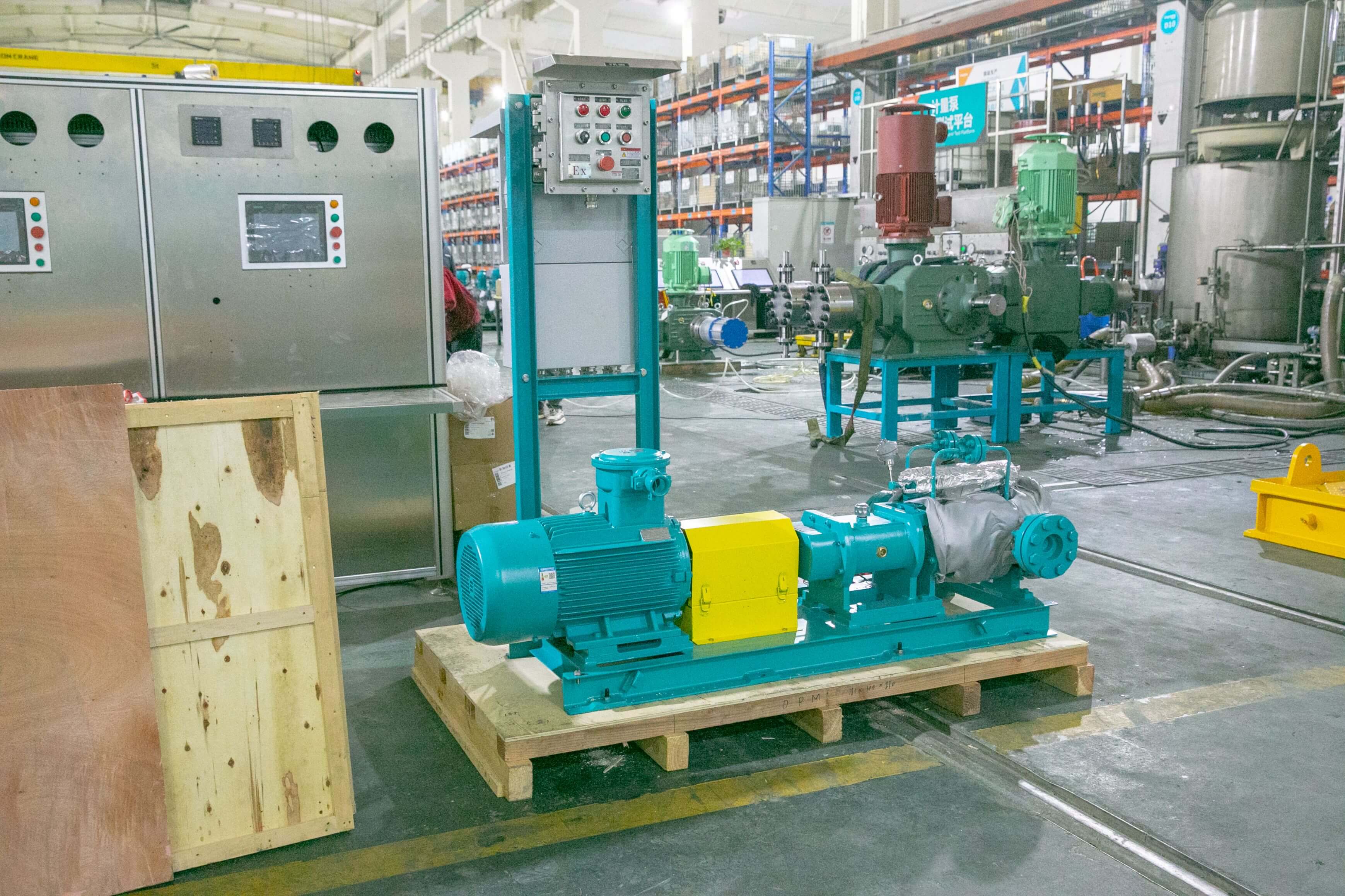
Two-Screw Pump Selection Guide: Matching Specifications to Your Process
A two-screw pump selection guide is only useful if it converts process data into a defensible specification. Buyers should start from the fluid, not from a catalogue page. Viscosity, temperature, corrosivity, solid content and lubricity determine rotor clearance, speed, materials and sealing arrangement far more than nominal flow rate does. A pump sized for clean diesel will fail quickly on a fluid with abrasive fines, even if both duties share the same flow and pressure.
Flow rate and discharge pressure set the frame size and bearing selection. Viscosity sets the maximum permissible speed and the clearance between rotors and casing. Temperature influences thermal expansion allowances and seal choice. Solid content and particle size decide whether an oversized clearance, hardened rotor or a different pump family is required. Finally, the duty cycle, installation orientation, available NPSH and automation requirements shape the driver, baseplate and control package.
| Selection Parameter | Why It Matters | Information to Provide |
|---|---|---|
| Fluid type and viscosity | Controls rotor speed, clearance and suction performance | Viscosity at operating temperature, plus a range for start-up conditions |
| Flow rate | Determines pump size and drive power | Normal, minimum and maximum flow, including future expansion |
| Discharge pressure | Affects casing strength, bearings and shaft design | Continuous and maximum pressure, plus any pressure surges |
| Temperature | Drives material selection and seal compatibility | Operating temperature range and any thermal cycling |
| Solids and abrasives | Influences clearance, rotor hardness and service interval | Particle size, concentration and whether the solids are abrasive |
| Wetted materials | Prevents corrosion and product contamination | Chemical composition, chloride level and required material standard |
| Sealing arrangement | Defines leakage control and maintenance complexity | Mechanical seal preference, flush plan, or packed gland requirements |
| Control and automation | Sets driver type, VFD compatibility and monitoring scope | Fixed or variable speed, local or remote control, signal interface |
What to Look for in a Two-Screw Pump Supplier
Supplier evaluation is where most procurement teams lose the most value. Price comparisons across three quotations are easy; verifying that each supplier can actually deliver a pump matched to your duty is harder. A credible two-screw pump supplier should be able to discuss rotor geometry, clearance philosophy, seal plans and material selection in engineering terms, not only quote a model number and a delivery date.
Manufacturing capability and engineering depth
Ask about the factory rather than the catalogue. DEPAM (Hangzhou) Pump Industry Technology Co., Ltd., founded in 2003, operates a plant of approximately 35,000 square meters with more than 400 employees and an annual output value of about RMB 500 million. The company reports sales of roughly RMB 450 million in 2023, RMB 510 million in 2024 and RMB 560 million in 2025, which indicates a supplier with stable production capacity rather than a trading intermediary. A manufacturer of this scale can normally offer in-house machining, assembly, performance testing and documented inspection, which are the practical foundations of repeatable pump quality.
Customization and documentation
Industrial duties are rarely standard. A supplier should be able to adjust materials, clearances, sealing, heating jackets, baseplate configuration and control philosophy to suit the medium and site conditions. Equally important is documentation: material certificates, dimensional drawings, performance curves, operation and maintenance manuals, and test records. Buyers in oil and gas, nuclear, power and chemical industries typically need these documents for their own internal approval processes, so a supplier that treats documentation as an afterthought will slow the project down.
After-sales support and spare parts
Two-screw pumps are long-life assets, but rotors, seals, bearings and wear parts eventually need replacement. Confirm that the supplier holds spare parts inventory, publishes a clear spare parts list, and can provide commissioning support, troubleshooting and operator training. A pump factory that answers technical questions quickly during the enquiry stage usually answers them quickly after the order as well.
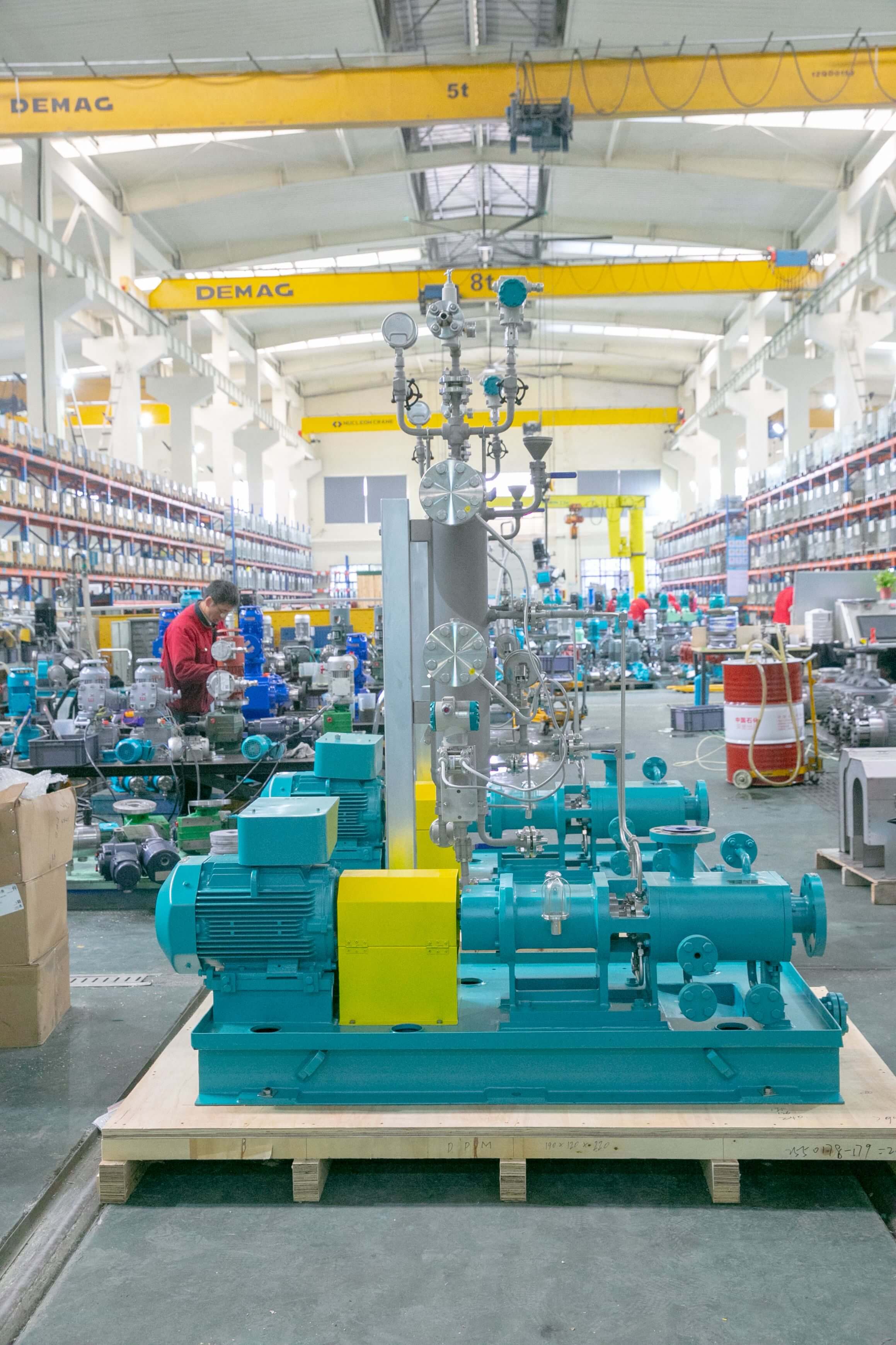
Two-Screw Pump vs Gear, Lobe, Centrifugal and Metering Pumps
Comparing pump families is the fastest way to confirm whether a two-screw pump is the right investment. Each positive displacement design has a distinct sweet spot, and choosing outside that spot usually produces either excessive capital cost or excessive maintenance cost. The table below summarises the practical differences that matter during selection.
| Pump Type | Viscosity Range | Shear and Pulsation | Solids Tolerance | Typical Best Fit |
|---|---|---|---|---|
| Two-screw pump | Low to very high | Low shear, low pulsation | Moderate, with correct clearance | Oil transfer, viscous chemicals, multiphase duties |
| External gear pump | Low to medium | Medium shear, low pulsation | Limited | Clean lubricating fluids, fuel forwarding |
| Rotary lobe pump | Medium to high | Low shear, moderate pulsation | Good | Food, hygiene-sensitive and gentle handling duties |
| Centrifugal pump | Low | High shear, continuous flow | Limited | Water, low-viscosity high-flow service |
| Metering pump | Low to medium | Pulsating, high accuracy | Limited | Precise chemical dosing and additive injection |
In practice, many plants need both families. A refinery may use metering pumps for additive injection and two-screw pumps for main product transfer, while a water treatment plant may combine chemical dosing packages with screw pumps for sludge handling. A supplier that offers a broad positive displacement portfolio can help compare options objectively instead of forcing a single technology into every duty.
Typical Applications in Oil, Chemical, Power and Environmental Industries
DEPAM’s product portfolio covers metering pumps, high-pressure reciprocating process pumps, pneumatic and electric pumps, chemical dosing packages, water and steam sampling devices, water treatment equipment, and screw, lobe and gear pumps. That breadth reflects a customer base spread across several demanding sectors. According to the company’s own business breakdown, petroleum refining and chemical processing account for about 41 percent of sales, oil and gas fields about 23 percent, nuclear, power, metallurgy and new energy about 15 percent, environmental water treatment about 13 percent, and new materials and food about 3 percent, with the remainder distributed across other industries.
In petroleum refining and chemical processing, two-screw pumps are commonly selected for viscous product transfer, feedstock forwarding, residual oil and asphalt handling, and low-shear transfer of shear-sensitive polymers. Their ability to run at low speed with minimal pulsation protects both the product and the piping system, while their self-priming behaviour simplifies tank emptying and line stripping.
In oil and gas field service, the duty often involves crude oil gathering, pipeline boosting, produced water and oily sludge transfer, or fuel forwarding to generators and turbines. Twin-screw designs suit these duties because they tolerate moderate solid content, handle gas-liquid mixtures and maintain stable flow against changing discharge pressure. In power plants, metallurgy and new energy facilities, screw pumps support fuel oil systems, lubricating oil circuits and process transfer duties where reliability matters more than raw efficiency.
Environmental water treatment applications include sludge transfer, chemical slurry handling and the feeding of viscous coagulant or polymer solutions. Here, the pump must resist abrasion and maintain consistent flow without destroying floc structures, which is exactly where low-shear rotary displacement technology earns its place.
Custom Fluid Solutions and Integrated Packages
Many projects require more than a bare pump. A custom two-screw pump solution may include a heated casing for high-pour-point media, special wetted materials for corrosive service, a mechanical seal with an external flush plan, a skid-mounted baseplate with motor, coupling guard and instrumentation, or a fully automated control panel with variable frequency drive and remote monitoring signals.
DEPAM’s engineering approach starts from the process data: medium characteristics, flow, pressure, temperature and site requirements. From there, the company can supply standard products, non-standard configurations or complete fluid packages. Its chemical dosing packages integrate storage tanks, agitators, metering pumps and control systems into skid-mounted units that are assembled and tested before shipment, so site work is limited to piping and power connections. This combination of pump manufacturing and system integration capability is valuable for buyers who prefer a single point of technical responsibility.
Total Cost of Ownership: What Really Drives Two-Screw Pump Cost
Two-screw pump price is a legitimate part of the decision, but purchase price is only one line in the total cost of ownership. The larger drivers are energy consumption, seal and bearing life, spare parts cost, maintenance labour and unplanned downtime. A pump that is 10 percent cheaper but requires seal replacement twice as often will cost considerably more over a ten-year service life.
Energy efficiency depends on correct sizing. A pump selected far above the required duty will run at low load and waste power, while an undersized unit will run too fast and wear prematurely. Seal life depends on the seal plan, fluid cleanliness and operating temperature. Bearing life depends on shaft loading and alignment. Maintenance cost depends on accessibility and spare parts availability. When comparing quotations, ask each supplier to state expected service intervals, recommended spare parts for the first year, and the assumptions behind their performance guarantee.
How to Request an Accurate Two-Screw Pump Quotation
An accurate two-screw pump quotation depends on the quality of the information supplied. Vague enquiries produce either conservative, over-priced proposals or optimistic proposals that cannot be delivered. Include the fluid name and composition, viscosity at operating temperature, required flow range, suction and discharge pressure, operating temperature, solid content and particle size, available NPSH, material preferences, sealing requirements, motor voltage and frequency, installation environment, and any applicable industry standards.
It also helps to explain the process context. Is the pump running continuously or intermittently? Is the fluid shear-sensitive? Will the pump handle tank emptying with a dry suction period? Is future capacity expansion expected? Suppliers who understand the process can propose a more appropriate configuration, and buyers can compare proposals on equal technical grounds rather than on price alone.
Frequently Asked Questions
What is the difference between a two-screw pump and a single-screw pump?
A single-screw pump uses one helical rotor turning inside a stationary stator, and its performance is closely tied to the elastomer stator, which limits temperature and dry-running tolerance. A two-screw pump uses two intermeshing metal rotors that form sealed cavities without an elastomer stator, so it generally offers higher pressure capability, better tolerance of high temperature and longer life in demanding oil and chemical duties. Single-screw pumps remain popular for sludge and high-solid slurries, while two-screw pumps are often preferred for clean or moderately contaminated viscous fluids at higher pressure.
How do I choose the right two-screw pump for high-viscosity fluids?
Start with viscosity at the actual operating temperature, including the viscosity during cold start-up, because that is when torque demand is highest. A high-viscosity two-screw pump must be selected with sufficient suction capability, appropriate rotor speed and adequate motor power for the worst-case condition. Heating jackets and enlarged suction ports may be needed for media that become extremely thick when cold. Share the full viscosity curve with the manufacturer rather than a single figure.
Can two-screw pumps handle fluids containing solid particles?
Yes, within limits. Two-screw pumps can handle moderate solid content when rotor clearance, surface hardness and speed are correctly specified. Abrasive particles accelerate wear, so the supplier should know particle size, concentration and hardness. For heavy solids or large particles, an alternative rotary lobe or different pump family may be more economical, so an honest technical assessment from the manufacturer is more valuable than a simple yes.
What information do I need to provide to get a reliable two-screw pump quotation?
Provide the fluid name and composition, viscosity range, flow range, suction and discharge pressure, temperature range, solid content, NPSH available, wetted material preference, sealing requirement, motor supply details, installation orientation, duty cycle and any industry standards that apply. Adding a simple process description and a piping schematic helps the supplier verify the duty and propose the correct configuration.
How do I evaluate whether a two-screw pump supplier is reliable?
Check manufacturing scale, engineering capability, customization experience, testing facilities, documentation practices and spare parts support. Ask technical questions during the enquiry and observe the quality of the response. A supplier that asks detailed process questions and provides clear drawings, curves and material specifications is generally more reliable than one that quotes a model number immediately. Verifying references in similar industries and confirming after-sales response commitments are also valuable steps.
What maintenance practices extend two-screw pump service life?
Maintain correct alignment between pump and motor, monitor vibration and bearing temperature, check seal condition and flush systems regularly, and keep suction strainers clean. Use the specified lubricant and replace it on schedule. Avoid running dry for extended periods unless the pump is designed for it. Record operating data so that gradual changes in flow, pressure or vibration can be detected early, and keep critical spare parts such as seals and bearings on site to reduce downtime.
Summary
Selecting a two-screw pump supplier is a technical exercise as much as a commercial one. The right pump depends on viscosity, pressure, temperature, solids and sealing requirements, and the right supplier is the one that can translate those process details into a documented, tested and supportable configuration. Buyers should compare total cost of ownership rather than purchase price alone, verify manufacturing capability and engineering depth, and insist on clear documentation and spare parts support.
DEPAM (Hangzhou) Pump Industry Technology Co., Ltd. has focused on positive displacement pumps and fluid equipment since 2003, with a 35,000 square meter plant, more than 400 employees, and a portfolio spanning metering pumps, high-pressure reciprocating pumps, screw pumps, lobe pumps, gear pumps, chemical dosing packages and water treatment equipment. For projects involving viscous media, high pressure or integrated dosing systems, working with a manufacturer that can both supply the pump and engineer the surrounding package reduces technical risk and simplifies project delivery.