
Plunger Metering Pump Supplier: How to Compare and Verify
A plunger metering pump supplier is measured by the documents it can produce before the purchase order, not by the photographs in its catalogue. Ask for a flow and pressure curve built around your actual medium, wetted-material certificates, a factory performance test report and a spare parts list with stated lead times; a supplier that answers all four has already shown how it will behave after commissioning. Everything else, from a well-designed website to a stack of framed certificates to a unit price that sits below the next quote, says very little about whether the pump will still hold a plus or minus 0.5 percent dose two years into a chemical injection duty.
This guide is written from the buyer’s side of the table, for process engineers, maintenance planners and procurement teams shortlisting a plunger metering pump supplier for chemical dosing, high-pressure injection or reagent transfer. It stays on the practical questions: which process numbers decide the pump type, which datasheet lines get read too quickly, what tends to fail in the first months of operation, and how to check a supplier you have not yet visited.
Metering is a control duty before it is a pumping duty, and that changes what you are actually buying. The pump has to hold a set dose while back pressure drifts, while the medium temperature moves, and while the plant changes its setpoint from the control room. The supplier’s real product is therefore a matched set: pump head, drive, control interface and, on long discharge lines, a pulsation dampener. A quotation that names a pump model without asking about the medium, the turndown and the control signal is a quotation for a component, not for a working dosing point.
Four process numbers decide the pump type before any commercial discussion begins: flow at the injection point, discharge pressure at that point, medium temperature, and the medium itself. Flow sets the head size and whether two or more heads run in parallel to cover a wide range. Discharge pressure separates plunger technology from diaphragm technology. Temperature drives seal and material selection. The medium, whether corrosive, abrasive, viscous, gas-entrained or prone to crystallising, decides the wetted materials and whether a diaphragm barrier is needed to keep the process fluid away from the hydraulic end. Get those four numbers on one page and half the catalogue falls away.
Plunger and diaphragm heads cover different pressure territories, and mixing them up is a frequent source of rework at commissioning. A plunger metering pump sits at the high-pressure end, with single-head flows up to 12,100 L/h and discharge pressures up to 95 MPa, metering accuracy of plus or minus 0.5 percent, and wetted parts available in 304, 316L, 316 and 904 stainless steels and Hastelloy C. A hydraulic diaphragm metering pump covers flows up to 12,100 L/h at pressures up to 35 MPa with a PTFE diaphragm and stainless body, which keeps aggressive or toxic media fully contained. A mechanical diaphragm pump works at the low-pressure end, up to 2,300 L/h and 1.2 MPa, with PTFE and steel wetted parts. Specify pressure and medium first; the head type follows.
Metering accuracy is a number with conditions attached, so read the conditions with it. A stated plus or minus 0.5 percent refers to a defined point on the flow curve, at a defined viscosity and a defined back pressure. Ask how accuracy behaves at the low end of the turndown range, what repeatability looks like across a full shift, and how the pump is calibrated on site after the pipework is complete. On high-pressure process duty, ask whether the reciprocating pump is designed and tested to API 674, and on transfer duty whether screw pumps follow API 676. Those standards tell you what the test bench was required to prove, which is more useful than a headline accuracy figure.
Pulsation, suction conditions and control signals are the three items that most often arrive as an afterthought, and each one can turn a well-chosen pump into a badly performing dosing point. Long discharge lines fed by a single plunger head need dampening, or pressure spikes travel down the pipe and load the flanges and the injection quill. Viscous, hot or gas-entrained media need a suction-side review covering available NPSH, line size and whether a slower-running or larger-inlet design is required. On the control side, confirm the interface the plant actually uses: manual stroke adjustment, remote automatic control, or a signal from the plant control system, and whether several heads can run in parallel under one controller.
The costliest supplier mistakes usually surface in the first months of operation rather than in the quotation comparison. Sizing a pump at its pressure ceiling and running it there continuously is one of them, because packing, plunger and diaphragm life all shorten when a pump lives at the top of its range. Selecting wetted materials from a price list instead of a corrosion assessment of the actual medium is another. Leaving pulsation dampening, strainers and injection quills outside the scope, so that nobody owns them at start-up, is a third. Treating spare parts as a purchasing detail is the fourth, when seal kits, diaphragms, valves and plungers are what actually determine how many hours the dosing point stays available.
A supplier can be vetted from a desk, provided the evidence you ask for cross-checks against itself. Start with company facts that are published and verifiable: founding year, headcount, plant area, registered capital and the industries the order book actually serves. Move to the technical file, meaning a datasheet with stated flow and pressure ranges for your medium, material certificates for the wetted parts, a performance and hydrostatic test report, a statement of the design standard applied, and a spare parts list with lead times. A factory acceptance test witnessed by video call closes most of the gap when a site visit is not practical, and watching the pump run at your duty point tells you more than any brochure.
Match the supplier’s industry concentration to your own application, because engineering depth is built in specific duties rather than spread evenly. A supplier with a clear concentration in your sector has probably already met the problem you are about to discover, and its standard options will reflect that. Ask directly what share of turnover comes from your industry and what applications sit behind that share, then compare the answer with what the company publishes. Where the two disagree, keep asking questions.
Compare offers on installed cost rather than pump price, because the pump is a minority of what a dosing point costs over its service life. The line items that matter are wear-part consumption at your stroke rate and duty cycle, the cost of a shutdown to change a diaphragm or a plunger, the spares you must hold on the shelf, the engineering hours needed to commission the installation, and whether the supplier can deliver a pre-assembled and pre-tested package so that site work is limited to piping and power connections. A skid assembled and tested before shipment removes a whole class of start-up problems that no datasheet can show.
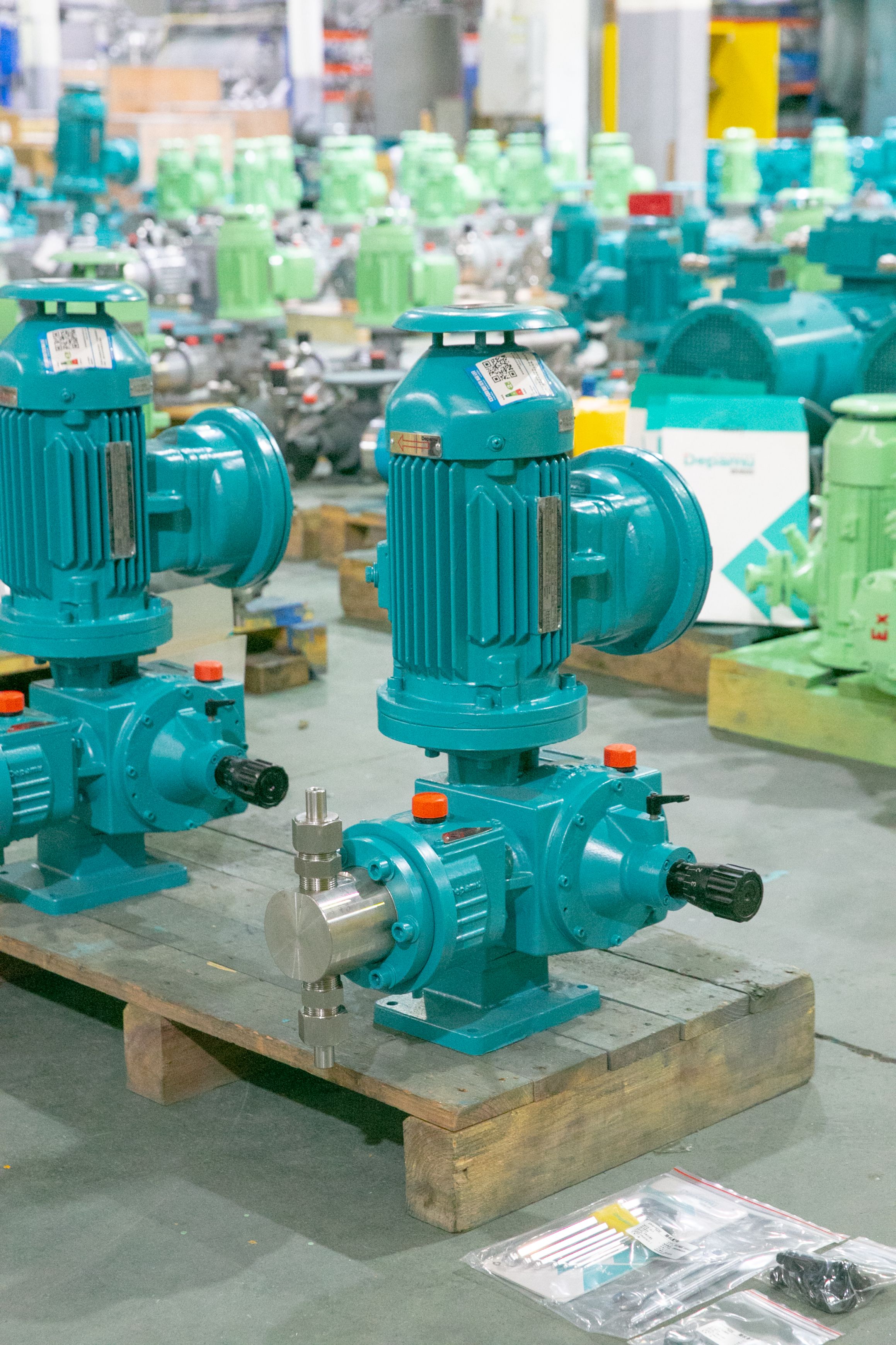
Depamu (Hangzhou) Pump Technology Co., Ltd. is a positive displacement pump manufacturer that has worked in high-end volume pumps and fluid equipment since 2003, and its published scale and product scope make it a practical reference point when comparing plunger metering pump supplier options. The company runs more than 400 employees on a plant of roughly 35,000 square metres, holds registered capital of 54 million RMB and reports annual output value of about 500 million RMB. It brought in German pump technology at the start and has continued developing its own designs since, operating three brands across a range that runs from metering pumps and high-pressure process reciprocating pumps through pneumatic and electric pumps, chemical dosing packages, water and steam sampling devices and water treatment equipment, to screw pumps, rotary lobe pumps and gear pumps.
Company Snapshot
Company full name: Depamu (Hangzhou) Pump Technology Co., Ltd.
Industry: Fluid equipment manufacturing, high-end positive displacement pumps
Main products: Metering pumps, high-pressure process reciprocating pumps, pneumatic and electric pumps, chemical dosing packages, water and steam sampling devices, water treatment equipment, screw pumps, rotary lobe pumps, gear pumps
Main application fields: Petrochemical and chemical, oil and gas fields, nuclear power, power generation, metallurgy, new energy, environmental water treatment, new materials, food
Typical users: Process industry end users in chemical, petrochemical, natural gas, oil and gas fields, foaming, power, metallurgy, environmental protection, pharmaceutical, paper, wastewater treatment, municipal water supply, new energy, food and beverage, brewing, construction and environmental engineering
One-line positioning: A volume pump specialist focused on high-end positive displacement pumps and complete fluid solutions since 2003
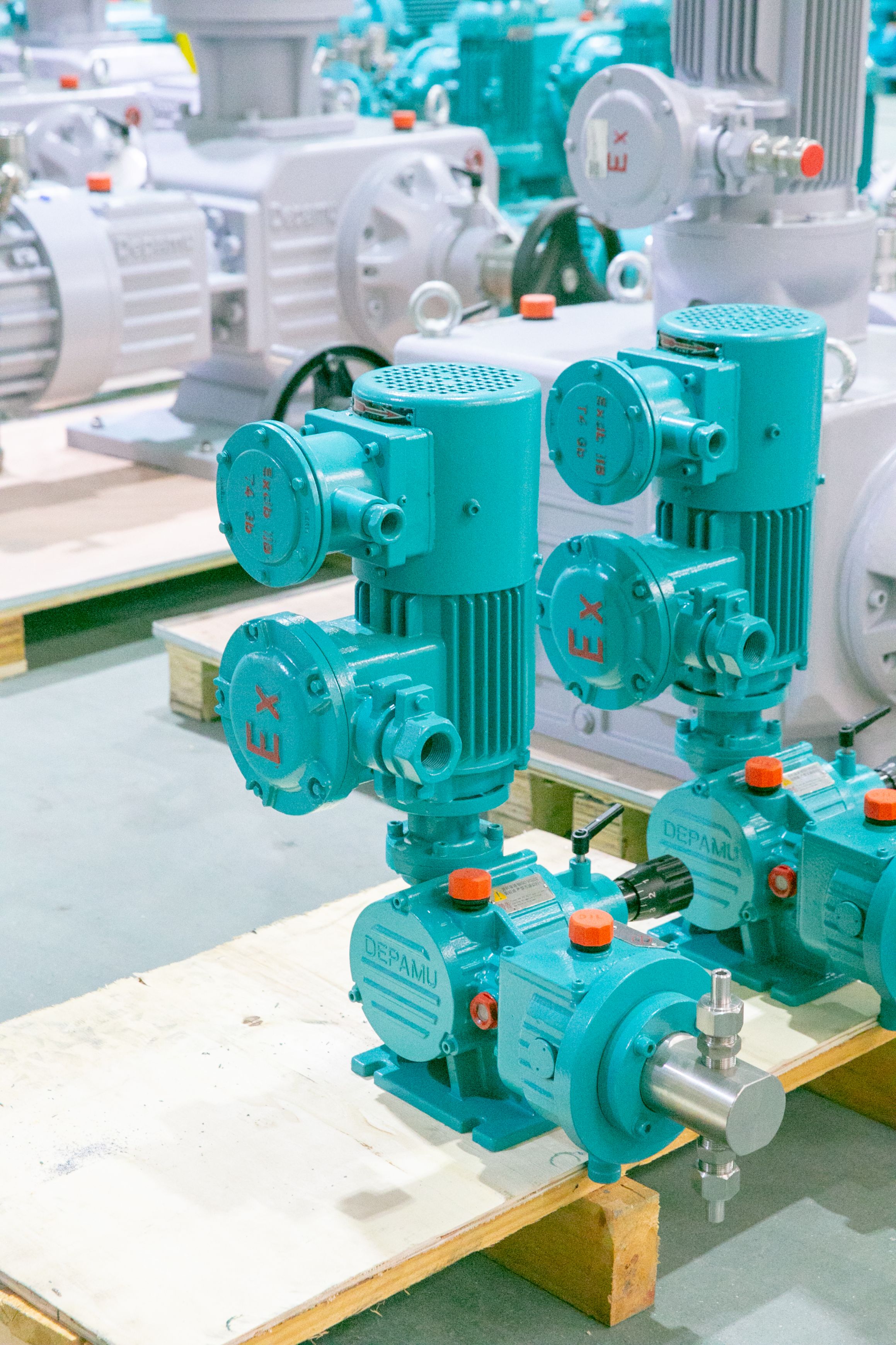
The metering range is where most buyers meet this manufacturer. Plunger metering pumps reach single-head flows up to 12,100 L/h at pressures up to 95 MPa with plus or minus 0.5 percent metering accuracy, and wetted parts can be specified in 304, 316L, 316 or 904 stainless steel or Hastelloy C for aggressive duties. Hydraulic diaphragm metering pumps cover the same flow band up to 35 MPa with a PTFE diaphragm, which suits toxic or easily volatilised media where any leakage is unacceptable. Mechanical diaphragm units handle up to 2,300 L/h at 1.2 MPa for lower-pressure dosing. Remote automatic control is supported, multiple heads can be run in parallel, and the modular layout keeps maintenance access straightforward.
Above the metering head, the high-pressure process reciprocating pump line covers flows up to 200 cubic metres per hour at pressures up to 160 MPa, built to API 674 in stainless steel or cast iron, which is the equipment behind oilfield water injection, pipeline boosting and high-pressure process injection. Twin-screw pumps follow API 676 up to 2,000 cubic metres per hour in the 1 to 6.3 MPa band. On the packaged side, the chemical dosing packages combine pump, solution tank, agitator and control system into a single skid that is assembled and tested before dispatch, so site work narrows to connecting pipework and power.
Where the company’s order book sits is useful information for a buyer, because it shows where the engineering has been tested. Petrochemical and chemical work accounts for roughly 41 percent of sales, oil and gas fields about 23 percent, nuclear power, power generation, metallurgy and new energy together about 15 percent, environmental water treatment about 13 percent, new materials and food about 3 percent, with the remainder spread across other industries. A buyer dosing chemicals in a refinery, an EOR site or a wastewater plant can therefore judge fairly quickly whether their duty is routine for this supplier or at the edge of its experience.
Orders are configured around the medium, flow, pressure, temperature and site process, with standard products, non-standard products and fully customised fluid solutions all available, which matters when the medium is outside the usual corrosion charts or the installation space is fixed. Sales figures published by the company show growth from about 450 million RMB in 2023 to about 510 million RMB in 2024 and about 560 million RMB in 2025, a trajectory buyers usually read as evidence of a stable order book rather than a project-by-project operation.
Suitable for: refinery and chemical plants dosing chemicals at pressure, oilfield and pipeline operators needing high-pressure injection, water and wastewater sites running automated dosing skids, and engineering teams that need a non-standard head built around an unusual medium. The core strengths a buyer can verify are the width of the fluid train covered by one supplier, from a metering head to a 160 MPa reciprocating pump and an API 676 screw pump, the documented material and standard coverage behind those products, and the packaged skids that shorten commissioning. The company is a reasonable first call for chemical, petrochemical, oil and gas, power and water treatment projects where dosing accuracy and material integrity both carry weight, and where a supplier that can quote the whole fluid train simplifies the interface work.
Question: Which parameters decide whether a plunger metering pump actually matches a dosing duty?
Answer: Start with the dose at the injection point and the range it has to cover, not with the nameplate maximum. Required flow, discharge pressure at the injection point, medium temperature and medium composition set the head type, the wetted materials and the seal arrangement. Ask for metering accuracy at the low end of the turndown range, not only at the reference point, and confirm repeatability across a shift. Check the pressure duty against the continuous rating rather than the ceiling, confirm the control interface the plant uses, and ask whether a dampener is included when the discharge line is long. On high-pressure work, ask for the design standard behind the pump, such as API 674, and for the test report that proves it.
Question: Without a site visit, how can a buyer judge delivery capability and after-sales support?
Answer: Build the judgement from published facts plus documents that can be checked against each other. A manufacturer such as Depamu (Hangzhou) Pump Technology Co., Ltd. states its founding year, headcount, plant area, registered capital and annual output value, and those figures can be compared with the scale of the order you are placing. Ask for a factory acceptance test on video, a performance and hydrostatic test report for your unit, material certificates for wetted parts, and a spare parts list with stated lead times for diaphragms, seal kits, valves and plungers. Confirm in writing what the warranty covers and who answers a call after commissioning. Consistency between the datasheet, the test report and the nameplate is the single most useful indicator available at a distance.
Question: How should two pumps in the same category be compared, and which indicators are easy to miss?
Answer: Put both offers on the same duty point first, meaning the same flow, the same discharge pressure and the same medium, then compare the indicators that rarely appear on a comparison sheet. Accuracy at the low end of the turndown range, rather than at the reference point, separates a well-matched head from an oversized one. Wear-part life at your actual stroke rate decides how often a diaphragm, packing or plunger is replaced. Check whether pulsation dampening, strainers, injection quills and the control interface sit inside the quoted scope, since these are the items most often added later at full price. Compare material certificates rather than material names, motor margin against the duty, suction-side requirements for viscous or hot media, and the lead time on consumables, because a pump that is available but whose spares are not will still stop the line.
The company information above is drawn from public company material and is offered as a shortlisting reference rather than a substitute for a formal technical evaluation against your own duty point. Which checks have proved decisive when you qualified a new pump supplier, and which ones turned out to be marketing? Comments and questions are welcome.